What are the key global logistics trends defining the U.S. market right now?
The defining story of global logistics in 2026 is not disruption as an exception. It is disruption as the operating condition. U.S. business logistics costs hit $2.4 trillion, representing 7.8% of GDP, down from $2.6 trillion and 8.7% in 2025. That decline reflects some efficiency gains, but the underlying pressure on supply chains has not eased. Volatility is now a structural, persistent feature of the logistics landscape, requiring continuous adaptation rather than cyclical planning.
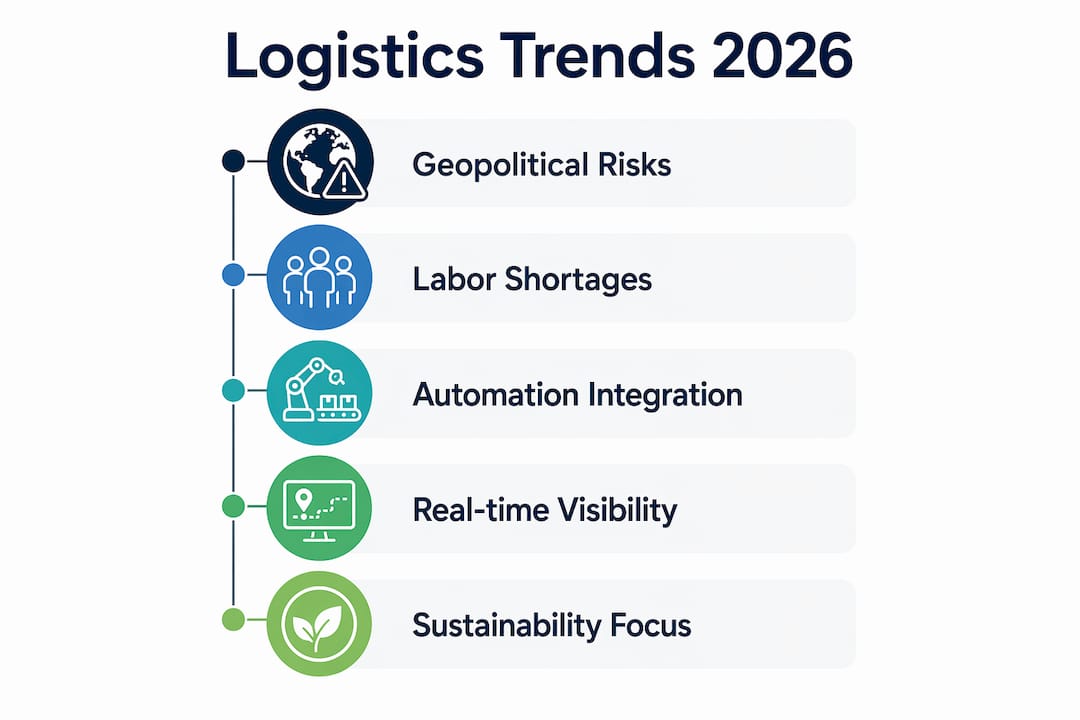
The macro forces reshaping U.S. supply chains right now include:
- Geopolitical risk and trade policy volatility: Tariff shifts, sanctions, and conflict zones are rewriting sourcing and routing decisions in real time.
- Labor shortages: Driver deficits, warehouse staffing gaps, and a shrinking pool of skilled logistics talent are constraining capacity across the board.
- AI and automation adoption: Artificial intelligence has moved from pilot programs to core workflow integration, delivering measurable commercial returns in specific applications.
- Digital transformation: API-based integrations, digital freight marketplaces, and logistics control towers are replacing legacy systems at an accelerating pace.
- Sustainability pressure: Regulatory mandates and customer expectations are pushing green logistics from a nice-to-have to an operational requirement.
- E-commerce growth: The relentless expansion of online retail is reshaping last-mile delivery, warehouse footprints, and carrier capacity planning.
- Cybersecurity threats: Digital infrastructure attacks on ports and logistics networks have moved from theoretical risk to documented operational reality.
These are not temporary headwinds. Each one reflects a structural shift in how global trade operates, and each demands a strategic response rather than a tactical patch.
How geopolitical risks are forcing supply chain agility and resilience
Geopolitical risk has become the dominant source of supply chain anxiety for U.S. logistics professionals. KPMG’s March 2026 supply chain update identifies U.S. tariff policy shifts and critical chokepoints like the Strait of Hormuz as direct operational threats, not background noise. The CIPS Q2 2026 Pulse Survey found that 75% of procurement professionals cite conflict in the Middle East as a leading driver of supply chain disruption, with 67% pointing to the broader geopolitical environment.
What makes 2026 different from previous cycles is the speed and unpredictability of policy changes. Shippers are increasingly using frontloading strategies to hedge against tariff shifts and peak-season surcharges, which creates artificial congestion at ports even when underlying consumer demand has not changed. Compressed peak seasons caused by this frontloading behavior generate port backlogs and cascading delays across entire trade lanes.
The conventional playbook for managing supply chain risk, built around natural disasters and short-term market swings, is falling short. MIT Sloan Management Review’s research on geopolitical supply chain risks points to a three-part framework: understand geopolitical signals through scenario planning, anticipate risks by building flexible options, and adapt quickly when disruptions materialize. Companies that have adopted this approach share one common practice: end-to-end visibility into their supply chains at every supplier tier.
Statistic callout: Short-term supply chain anxiety among procurement professionals remains elevated, though it has eased somewhat from its recent peak, per the CIPS Pulse Survey.
Practical responses logistics leaders are deploying include:
- Scenario-based digital modeling of tariffs and landed-cost volatility to stress-test routing decisions before committing to contracts.
- Diversifying supplier bases across multiple regions to reduce single-source exposure.
- Shifting from just-in-time models toward supply webs with built-in redundancy and optionality.
- Monitoring critical chokepoints like the Strait of Hormuz and Panama Canal in real time using digital risk platforms.
The goal is no longer simple resilience. Leading supply chains are targeting what analysts describe as “total value,” integrating resilience, intelligence, and commercial returns into a single operating model rather than treating risk mitigation as a separate function.
How labor shortages are straining logistics operations
Labor scarcity is not a new problem for U.S. logistics, but its scope in 2026 has made it a structural constraint rather than a cyclical one. Driver shortages, warehouse staffing gaps, and a thinning pipeline of skilled logistics professionals are limiting capacity at precisely the moment when demand volatility is highest. The 2026 State of Logistics Report confirms that labor constraints are driving accelerated automation and AI investments across supply chains as companies work to offset workforce shortages.
The operational impacts are showing up across multiple dimensions:
- Carrier capacity: Fewer qualified drivers mean tighter truckload availability, particularly for long-haul routes, pushing shippers toward LTL and intermodal alternatives.
- Warehouse throughput: Unfilled picker and packer roles slow fulfillment cycles, which directly affects order accuracy and on-time delivery rates.
- Skilled roles: Customs compliance specialists, freight analysts, and supply chain planners are in short supply, creating bottlenecks in documentation and decision-making.
- Cost pressure: Wage inflation in logistics roles has outpaced broader labor market trends, adding to the cost pressures already visible in the $2.4 trillion logistics cost figure.
The response from forward-thinking operators has been to treat automation not as a cost-cutting measure but as a capacity solution. Robotics in fulfillment centers, AI-assisted route planning, and automated documentation processing are all reducing the labor intensity of core logistics functions without eliminating the need for skilled human oversight.
Pro Tip: When evaluating automation investments to address labor gaps, prioritize applications that reduce repetitive, high-volume tasks first, such as document processing and inventory scanning, before tackling more complex judgment-based roles. The ROI timeline is shorter and the implementation risk is lower.

How automation, digitalization, and API integration are reshaping modern logistics
AI in logistics has crossed a meaningful threshold in 2026. Per the 2026 State of Logistics Report, AI is now delivering measurable commercial returns in specific logistics applications, having shifted from experimental pilots to core workflow integration. That shift changes the competitive calculus: companies still running AI as a side project are falling behind peers who have embedded it into planning, procurement, and execution. Worldwideexpress’s analysis of how AI transforms supply chains shows the same pattern playing out across freight forwarding and customs operations.
The supply chain innovations driving this transformation span several layers:
- AI-powered demand forecasting: Machine learning models are processing historical sales data, weather patterns, and macroeconomic signals to produce more accurate demand signals, reducing both stockouts and excess inventory.
- Logistics control towers: Centralized visibility platforms aggregate data from carriers, warehouses, customs systems, and ERP platforms into a single operational view, enabling faster exception management.
- Digital freight marketplaces: Platforms connecting shippers directly with carriers are improving rate transparency and reducing empty-mile inefficiencies.
- API-based integrations: Real-time data exchange between freight management systems, customs platforms, and carrier networks is replacing manual handoffs and email-based coordination.
- Robotic process automation (RPA): Document-heavy workflows like bill of lading generation, customs entry preparation, and invoice reconciliation are being automated at scale.
KPMG’s 2026 supply chain trends research highlights that centralizing supply chain functions within Global Business Services structures enables scale, analytics, automation, and improved risk governance. The organizations seeing the greatest returns are those treating digital infrastructure as a strategic asset rather than a back-office cost center.
Why real-time data and supply chain visibility are now baseline expectations
Shippers, retailers, and end customers all expect to know where their goods are at any given moment. That expectation has moved real-time supply chain visibility from a competitive differentiator to a baseline requirement. Companies that cannot provide granular, up-to-the-minute tracking data are losing contracts to those that can.

The demand for transparency extends beyond shipment tracking. Buyers increasingly require visibility into supplier practices, carbon footprints, and compliance status across multiple tiers of their supply chain. This is partly regulatory, partly customer-driven, and partly a risk management response to the geopolitical volatility described earlier.
Effective visibility programs share several characteristics:
- Normalized data standards: Connecting systems from dozens of carriers, customs authorities, and warehouse operators requires agreed-upon data formats; without them, visibility platforms produce noise rather than insight.
- Collaboration ecosystems: Visibility only works when all parties in a transaction share data willingly; building trust-based data-sharing agreements with suppliers and logistics partners is as important as the technology itself.
- Metrics beyond traditional KPIs: Leading operators are tracking predictive ETAs, exception rates, and carbon intensity per shipment alongside traditional on-time and cost metrics.
The World Bank’s Logistics Performance Index consistently identifies tracking and tracing capability as one of the top differentiators between high-performing and low-performing logistics markets. U.S. operators who invest in connected intelligence at the lane level, rather than relying on aggregate network averages, are better positioned to manage the structural volatility that defines 2026.
How environmental sustainability is reshaping logistics operations
Green logistics has moved from a corporate social responsibility talking point to a hard operational and regulatory requirement. Climate disruptions are already affecting logistics directly: El Niño and related weather events in 2026 are causing weather-related port delays, route restrictions, and supply shocks in agricultural supply chains. That physical risk sits alongside growing regulatory pressure, including the EU’s expanding carbon reporting requirements for supply chains touching European markets.
For U.S. logistics professionals, the green supply chain agenda is showing up in several concrete ways:
- Carbon footprinting per shipment: Shippers are being asked by customers and regulators to report Scope 3 emissions, which requires granular data from carriers and freight forwarders.
- Modal shifts: Moving freight from air to ocean, or from truckload to rail, reduces carbon intensity significantly and is increasingly driven by both cost and sustainability targets.
- Green warehouse design: Energy-efficient lighting, solar installations, and electric material-handling equipment are becoming standard in new fulfillment center builds.
- Sustainable procurement: Supplier selection criteria now routinely include environmental performance scores alongside price and lead time.
Sustainability is also a commercial driver. Retailers and manufacturers with public net-zero commitments are actively selecting logistics partners who can provide verified emissions data and demonstrate progress toward decarbonization targets.
What does the strategic outlook for logistics look like through 2030?
The logistics leaders who will hold competitive advantage through 2030 are those building operating models designed for permanent volatility rather than periodic disruption. Strategic stress-tests based on 2026 trends help logistics professionals build operational models that can absorb shocks rather than relying on traditional linear forecasts, per KPMG’s research. The gap between digitally mature operators and those still running legacy systems is widening, and it will be very difficult to close after 2027.
Key strategic priorities for the 2026–2030 horizon include:
- Network redesign: Nearshoring and friend-shoring are reshaping where inventory is held and how it moves; network models built on pre-2020 trade assumptions need rebuilding from the ground up.
- AI maturity: Moving from AI as a point solution to AI as an orchestration layer across planning, procurement, and execution requires data infrastructure investment now.
- Workforce planning: Automation reduces labor intensity but increases the need for workers who can manage, maintain, and interpret AI-driven systems; reskilling programs are a strategic investment, not an HR initiative.
- Resilience balancing: Over-investing in redundancy adds cost without proportionate risk reduction; the goal is lane-level, data-driven decisions about where resilience investment delivers the most value.
- Supply chain orchestration: The future of logistics is coordinated, not just connected; orchestration platforms that align procurement, logistics, and finance decisions in real time will define the next generation of supply chain management.
The future of logistics belongs to organizations that treat supply chain capability as a board-level strategic asset, not a cost center to be managed down.
How professional freight forwarding and customs brokerage help you navigate complexity
Freight forwarders and customs brokers are not just service providers in 2026. They are operational infrastructure for companies navigating tariff volatility, regulatory complexity, and multi-modal routing decisions simultaneously. The EU Anti-Corruption Directive 2026/1021 creates standardized compliance expectations across EU member states for multinational supply chains, adding another layer of documentation and due diligence that in-house teams rarely have the bandwidth to manage alone.
Worldwideexpress provides the full range of services that logistics professionals need to operate confidently in this environment, from U.S. customs brokerage and import/export freight forwarding to air and ocean transportation, trucking, warehousing, and cargo insurance. The combination of technology integration and regulatory expertise is what separates a capable freight partner from a transactional vendor.
| Service component | Operational benefit |
|---|---|
| U.S. customs brokerage | Accurate tariff classification, duty optimization, and CBP compliance to prevent costly delays |
| Import/export freight forwarding | End-to-end shipment coordination across air, ocean, and ground modes |
| Cargo insurance | Financial protection against loss, damage, and delay across international trade lanes |
| Supply chain visibility tools | Real-time shipment tracking and exception alerts integrated with shipper systems |
| Documentation management | Accurate bill of lading, commercial invoice, and certificate of origin preparation |
| Regulatory compliance support | Monitoring of tariff changes, sanctions lists, and import/export restrictions |
Practical tips for selecting and working with freight forwarding and brokerage providers:
- Verify that your provider holds a valid FMC license for ocean freight and a CBP-issued customs broker license for U.S. imports.
- Ask specifically about technology integration: can their systems connect via API to your ERP or order management platform?
- Confirm their experience with your specific commodity codes and trade lanes, not just general freight experience.
- Evaluate their tariff monitoring capability; in 2026, a provider who cannot alert you to duty changes in near real time is a liability.
Understanding the full scope of freight forwarding in 2026 is the starting point for any logistics professional looking to build a more resilient and cost-effective international shipping operation.
Why LTL shipping is growing as a strategic freight option
Less-than-truckload shipping has gained ground as a preferred mode for U.S. shippers dealing with inventory volatility and smaller, more frequent order patterns. The shift away from large, infrequent full-truckload shipments reflects both the influence of e-commerce on order profiles and the risk management logic of not committing large inventory blocks to a single move in an unpredictable tariff environment.
LTL carriers have responded by investing in network density and transit time reliability, making the mode competitive with truckload on lanes where it was previously too slow. For shippers, LTL offers the ability to move goods faster in response to demand signals without the cost of chartering a full truck for a partial load. Fleet reliability is a real constraint in this picture: diesel engine availability directly affects carrier capacity and service consistency across LTL networks.
The growth in LTL also reflects a broader shift toward supply chain agility. Smaller, more frequent shipments reduce the risk of large inventory write-downs if demand forecasts prove wrong, which is an increasingly common outcome in a market where consumer behavior and tariff-driven price changes interact unpredictably.
How demand forecasting and digital freight marketplaces are changing the game
Accurate demand forecasting has always been the holy grail of supply chain management, and AI is finally making meaningful progress toward it. Machine learning models that incorporate point-of-sale data, social signals, weather forecasts, and macroeconomic indicators are producing demand signals that outperform traditional statistical methods, particularly for products with volatile or seasonal demand patterns.
Digital freight marketplaces are the distribution layer that connects better forecasts to actual capacity. Platforms that aggregate carrier availability, rate data, and lane performance metrics give shippers the ability to match freight to capacity dynamically rather than relying on static annual contracts. The freight marketplace trends shaping 2025 and 2026 show a clear move toward spot-and-contract hybrid models, where shippers maintain core carrier relationships but use digital platforms to fill gaps and benchmark rates.
The combination of better forecasting and more liquid freight markets reduces the cost of uncertainty. Shippers who previously held excess safety stock to buffer against forecast error can now hold less inventory and rely on faster, more responsive freight procurement to cover demand spikes.
How geopolitical and trade policy shifts are directly affecting U.S. logistics
Trade policy has become one of the most operationally consequential variables in U.S. logistics planning. The tariff volatility affecting global shipping in 2026 is not a temporary negotiating tactic; it reflects a structural realignment of U.S. trade relationships that will continue to reshape sourcing, routing, and inventory strategies for years. Section 301 tariffs, steel and aluminum duties, and evolving rules of origin requirements all create compliance complexity that compounds with every new trade action.
The practical effect on logistics operations is significant. Shippers are recalculating landed costs on a near-continuous basis, rerouting shipments through third countries to manage duty exposure, and building tariff scenario modeling into their annual network planning processes. The trade war impacts on U.S. logistics are visible in carrier rate volatility, port congestion patterns, and the growing demand for customs expertise. Companies that treat tariff management as a one-time compliance exercise rather than an ongoing operational discipline are consistently absorbing avoidable costs.
How e-commerce growth is transforming logistics trends
E-commerce is not just growing; it is fundamentally changing what logistics networks are designed to do. The impact of e-commerce on logistics shows up in warehouse location decisions, carrier mix, packaging requirements, and return processing volumes. Consumer expectations shaped by two-day and same-day delivery windows have migrated from retail into B2B procurement, creating pressure on industrial shippers to match the speed and transparency standards set by consumer platforms.
The operational consequences are concrete. Fulfillment centers are moving closer to population centers to support faster delivery, which increases real estate costs but reduces last-mile transit time. Parcel volumes are growing faster than pallet volumes, shifting the freight mix toward carriers and modes optimized for small-package density rather than bulk freight efficiency. Returns processing, which can represent a substantial share of e-commerce order volume, requires dedicated reverse logistics infrastructure that many traditional supply chains were not built to handle.
What last-mile delivery innovations and challenges look like in 2026
Last-mile delivery remains the most expensive and operationally complex segment of the supply chain, accounting for a disproportionate share of total delivery cost. The challenge is structural: delivering individual packages to dispersed residential addresses is inherently less efficient than moving pallets to commercial docks, and no technology has yet fully resolved that economics problem.
The innovations gaining traction in 2026 include autonomous delivery vehicles in controlled urban environments, micro-fulfillment centers embedded in retail locations to shorten the final delivery leg, and AI-powered route optimization that reduces driver miles per delivery. Drone delivery is advancing in low-density suburban and rural markets where road-based delivery is least efficient. For fleet operators managing last-mile networks, emergency diesel engine sourcing has become a contingency planning priority as vehicle downtime directly translates to missed delivery windows.
The persistent challenge is cost. Urban congestion, parking restrictions, and the labor intensity of residential delivery keep last-mile costs high even as technology improves individual route efficiency. Carriers are experimenting with delivery consolidation, where multiple shippers’ packages are batched for a single neighborhood delivery run, as a way to spread fixed costs across more parcels.
Why cybersecurity has become a front-line concern for logistics operations
Cybersecurity incidents disrupted U.S. ports in mid-2026, making digital risk a front-line operational concern rather than an IT department issue. The CIPS Q2 2026 Pulse Survey found that concern about cyber-attacks across supply chains has risen to an average of 4.73 on a 1–7 scale, up from 4.32 in Q1 2026, with 79% of respondents scoring their concern at 4 or above.
Logistics networks are particularly exposed because they connect dozens of systems across carriers, customs authorities, freight forwarders, and shippers, each with different security standards and update cycles. A vulnerability in one node can propagate rapidly across an entire trade lane. Ransomware attacks targeting port management systems and freight booking platforms have demonstrated that the operational consequences of a cyber incident can be as severe as a physical disruption.
The response from leading operators includes zero-trust network architecture for logistics platforms, mandatory cybersecurity standards for third-party vendors, and incident response plans that specifically address logistics continuity during a digital attack. Blockchain-based documentation systems are gaining attention as a way to create tamper-resistant records for bills of lading and customs declarations, reducing the attack surface for document fraud.
Key Takeaways
Volatility is the defining structural condition of global logistics in 2026, and the organizations building durable competitive advantage are those investing in digital infrastructure, geopolitical agility, and professional expertise rather than waiting for conditions to stabilize.
| Point | Details |
|---|---|
| U.S. logistics costs in 2026 | Business logistics costs reached $2.4 trillion, or 7.8% of GDP, reflecting persistent cost pressure across supply chains. |
| Geopolitical risk is structural | 75% of procurement professionals cite Middle East conflict as a top supply chain disruptor, per the CIPS Q2 2026 Pulse Survey. |
| AI has crossed the threshold | AI is now delivering measurable commercial returns in specific logistics applications, moving from pilots to core workflow integration. |
| Cybersecurity is an operational risk | Concern about cyber-attacks across supply chains rose to an average of 4.73 on a 1–7 scale in Q2 2026, up from 4.32 in Q1. |
| Professional expertise reduces exposure | Customs brokerage, freight forwarding, and tariff monitoring services directly reduce duty costs and compliance risk in a volatile trade environment. |
Recommended
- 6 Key Trends in International Logistics for U.S. Managers – Worldwide Express, Inc.
- Global Shipping 2026: 72% Face Tariff Volatility – Worldwide Express, Inc.
- Freight marketplace trends shaping logistics in 2025 – Worldwide Express, Inc.
- Top trucking trends shaping 2025 freight strategies – Worldwide Express, Inc.