Ocean freight, also called international shipping by sea, is the movement of goods across international borders using ocean-going vessels. It is the backbone of global trade, handling the vast majority of the world’s cargo volume at a fraction of the cost of air transport. For US businesses moving large quantities of goods, sea freight offers lower transport cost per unit and far stronger capacity than any other mode.
The basic workflow is straightforward: cargo is packed into standardized containers, loaded onto vessels at the origin port, transported across ocean lanes, and unloaded at the destination port for customs clearance and final delivery. The dominant vessel types are container ships, bulk carriers, and tankers, each suited to different cargo profiles. Standard shipment documents required at every stage include:
- Bill of Lading — the primary contract between shipper and carrier
- Commercial Invoice — declares the value and nature of goods
- Packing List — details contents, weights, and dimensions
- Certificate of Origin — confirms where goods were manufactured
Providers like UPS Supply Chain Solutions, DHL Global Forwarding, and the freight marketplace SeaRates are among the most recognized names in ocean freight services, each offering distinct tools for booking, tracking, and managing international cargo.
How ocean freight forwarding services actually work
Freight forwarding is the operational engine behind most international sea shipments. A freight forwarder acts as the intermediary between the shipper and every party in the logistics chain, including ocean carriers, customs brokers, trucking companies, and warehouses. Without that coordination, a single missed document or miscommunicated cut-off time can delay a shipment by weeks.
The core services a freight forwarder provides include:
- Space booking on vessels and negotiating competitive rates with carriers
- Documentation management covering Bills of Lading, customs declarations, and certificates
- Cargo consolidation for Less-Than-Container Load shipments
- Customs brokerage coordination to meet import and export compliance requirements
- Warehousing and last-mile trucking arrangements at origin and destination
UPS Supply Chain Solutions offers end-to-end ocean freight management with carrier network access across major global trade lanes. DHL Global Forwarding brings deep expertise in customs compliance and temperature-controlled ocean shipments. SeaRates operates as a digital freight marketplace, giving shippers instant rate comparisons and booking tools across multiple carriers. Worldwideexpress combines freight forwarding with licensed customs brokerage, giving US importers and exporters a single point of contact from origin to cleared delivery.
The real value of professional forwarding is risk mitigation. Compliance failures, misdeclared cargo, and documentation errors are among the most common causes of port delays and financial penalties. An experienced forwarder catches those problems before they reach the port.

FCL vs. LCL: which container shipping option fits your shipment?
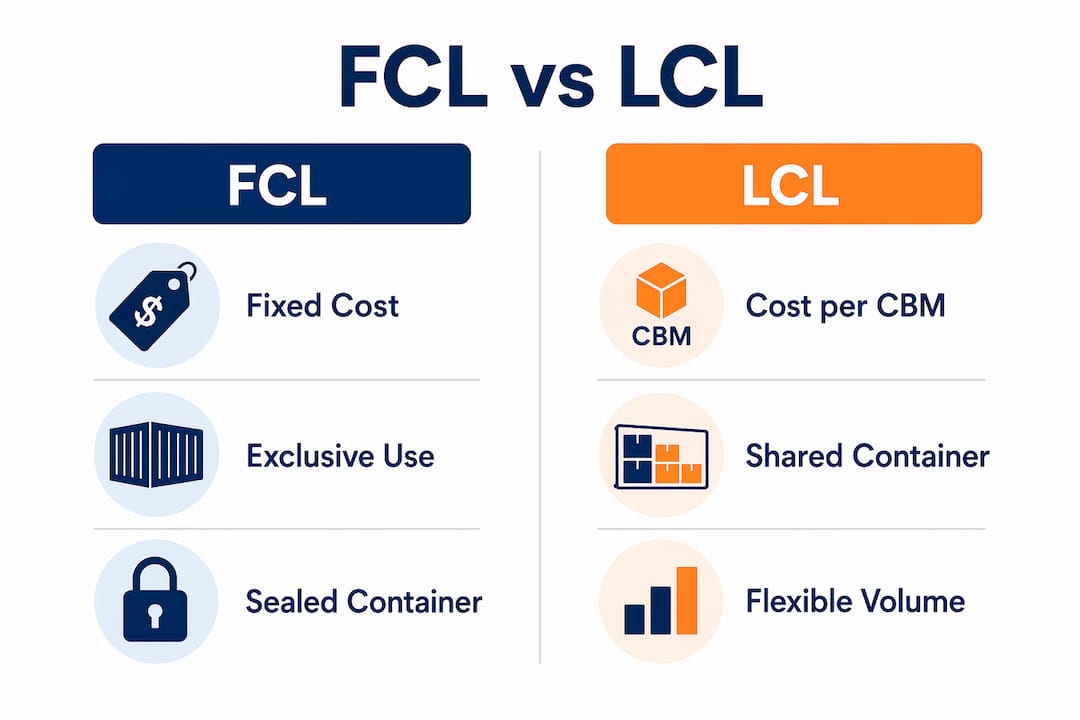
The choice between Full Container Load (FCL) and Less-Than-Container Load (LCL) shipping shapes your cost, transit time, and cargo risk on every ocean shipment. Getting it wrong on a large order is an expensive lesson.
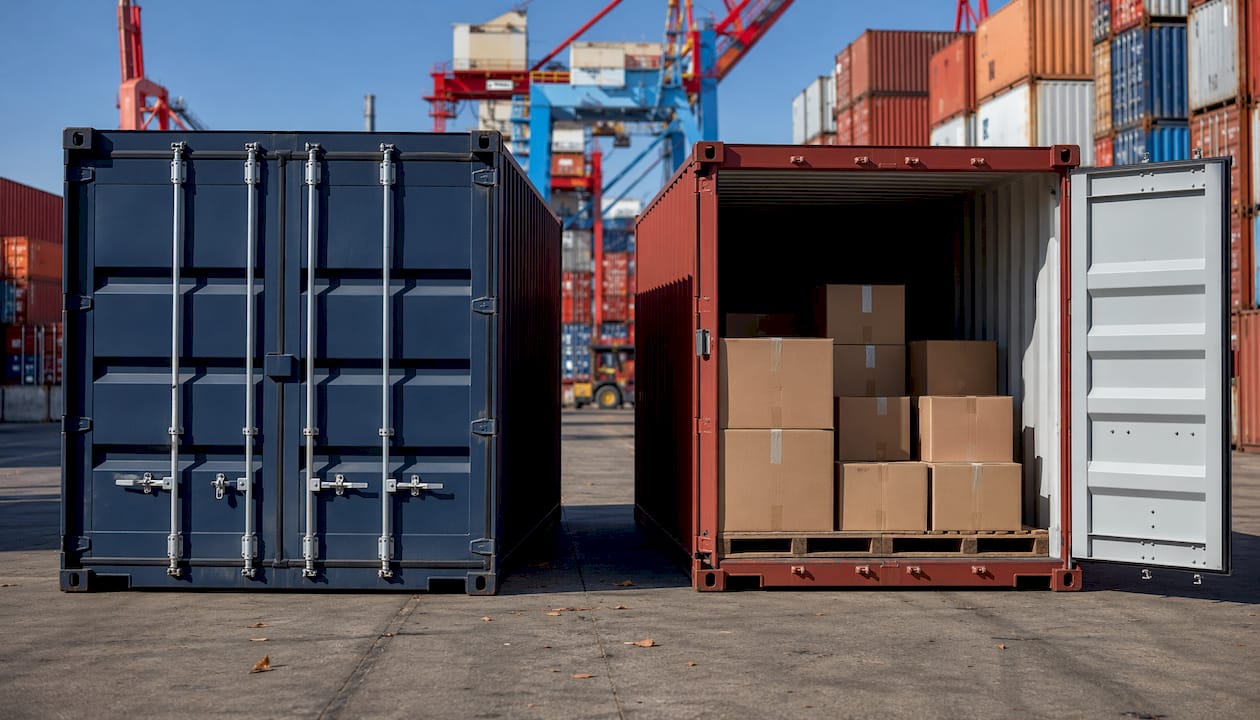
FCL shipments use a sealed container exclusively for one shipper’s cargo. The container is loaded at origin and not opened until it reaches the destination. LCL consolidates cargo from multiple shippers into a single container, with each shipper paying only for the space their goods occupy, measured in cubic meters (CBM).
| Feature | FCL | LCL |
|---|---|---|
| Cost structure | Fixed per container | Per CBM |
| Best volume threshold | Above a moderate volume | Below a moderate volume |
| Transit time | Faster, direct routing | Typically several days longer |
| Cargo handling | Minimal, sealed origin to destination | Multiple handling points |
| Damage risk | Lower | Higher due to consolidation |
| Security | High, single shipper | Moderate, shared space |
LCL makes economic sense below a certain moderate volume. Above that threshold, the per-CBM rate for LCL often exceeds the cost of booking an entire container, making FCL the more cost-effective path. For fragile or high-value goods, FCL is worth considering even at lower volumes, because eliminating multiple handling events at consolidation warehouses meaningfully reduces damage risk.
Pro Tip: Run the numbers both ways at the 12–14 CBM boundary. The FCL premium often disappears faster than shippers expect, especially when you factor in the extra transit days and handling costs that come with LCL consolidation.
What tariffs and fees actually cost you on sea freight shipments
Sea freight costs extend well beyond the ocean rate quoted by a carrier. Port fees, drayage, terminal handling charges, and fuel surcharges can add hundreds of dollars per container on top of the base freight rate, and they vary by destination, shipment type, and vessel. Businesses that budget only the ocean rate routinely face invoice surprises at the destination port.
The major cost categories to plan for include:
- Customs duties — assessed on the declared value of goods, varying by HS tariff code and country of origin
- Terminal handling charges (THC) — fees charged by the port or terminal for loading and unloading containers
- Drayage — trucking cost from the port to the final warehouse or delivery point
- Fuel surcharges (BAF) — Bunker Adjustment Factor fees that fluctuate with global fuel prices
- Port congestion surcharges — applied during periods of high port traffic, common at major US West Coast gateways
- Documentation fees — carrier-imposed charges for processing Bills of Lading and other paperwork
Accurate tariff calculation requires complete and correct documentation from the start. The HS code assigned to your goods determines the duty rate, and an incorrect classification can trigger reclassification, back duties, and penalties. Working with a licensed customs broker before shipment, not after arrival, is the most reliable way to anticipate the full landed cost.
How customs clearance works for ocean freight at US ports
Customs clearance is the process by which US Customs and Border Protection (CBP) reviews, assesses, and releases imported cargo. For ocean freight, clearance typically begins before the vessel arrives, using advance electronic filing through the Automated Broker Interface (ABI) system. Accurate documentation is the single most important factor in clearing cargo without delay.
Key steps and considerations in the clearance process:
- Advance filing — the Importer Security Filing (ISF), also called “10+2,” must be submitted at least 24 hours before cargo is loaded at the foreign port
- Entry filing — a formal customs entry is filed by a licensed broker, declaring the goods, their value, and applicable duties
- Examination risk — CBP uses risk-based targeting to select shipments for physical or document examination; flagged shipments can add days to clearance
- Duty payment — assessed duties and fees must be paid before cargo is released
- Electronic Data Interchange (EDI) — most major forwarders and brokers transmit data electronically, reducing manual processing time
Common pitfalls that cause clearance delays include mismatched values between the Commercial Invoice and the entry filing, missing or incorrect Certificates of Origin, and ISF filings submitted late. Worldwideexpress provides licensed US customs brokerage services that manage the full entry process, from ISF submission through duty payment and cargo release.
Value-added services that protect and improve ocean shipments
Beyond basic transport, ocean freight shipping supports a range of services that reduce risk, improve visibility, and keep shipments compliant with evolving regulations.
Cargo insurance is the most critical of these. Standard carrier liability under the Carriage of Goods by Sea Act (COGSA) is limited to $500 per package, a figure that covers almost nothing for most commercial shipments. All-risk marine cargo insurance covers physical loss or damage from loading through final delivery, and it is the standard protection for any shipment of meaningful value.
Other value-added services worth knowing:
- Packaging and labeling compliance — sea transport subjects cargo to humidity, vibration, and stacking pressure; proper blocking, bracing, and moisture-resistant packaging reduce damage claims
- Refrigerated containers (reefers) — maintain precise temperature ranges for perishables, pharmaceuticals, and temperature-sensitive chemicals
- Hazardous cargo handling — IMDG Code-compliant documentation and stowage for dangerous goods
- Supply chain visibility tools — real-time container tracking via carrier APIs and platforms like SeaRates give shippers milestone updates from origin to delivery
- Environmental compliance — the International Maritime Organization’s (IMO) sulfur cap regulations and carbon intensity reporting requirements affect vessel selection and routing decisions for sustainability-focused shippers
Balancing cost, lead time, and supply chain risk in sea freight
Choosing ocean freight is not simply a transport decision. It is a supply chain design choice that affects inventory financing, demand risk, and capital allocation across the entire business.
Sea freight’s primary advantage is cost efficiency at scale. For bulky, lower-value goods with predictable demand, ocean transport keeps per-unit freight cost tightly controlled, which is why it remains the default mode for global sourcing programs. The trade-off is lead time. Longer transit ties up working capital in goods that are not yet available to sell, and that financing cost is real even when it does not appear on the freight invoice.
Pro Tip: When planning replenishment cycles for ocean freight, build a safety buffer of at least 10 days beyond the carrier’s advertised transit time. Port congestion, vessel schedule changes, and customs examination can each add a week or more to the actual port-to-door timeline.
Supply chain risk compounds when demand is volatile. A shipment that takes 30 or more days to arrive cannot respond to a sudden demand shift the way an air shipment can. Businesses with seasonal peaks, short product life cycles, or high stockout costs should weigh those risks explicitly when comparing ocean and air options. The air vs. sea freight decision is best made at the SKU level, not the company level, because the right answer often differs by product category within the same business.
The most effective approach is to treat sea freight as the baseline mode for stable, high-volume flows, while reserving air for urgent replenishment, new product launches, and high-value goods where the freight cost represents a small percentage of goods value.
Key Takeaways
Ocean freight is the most cost-efficient mode for large-volume international cargo, but its longer transit times create inventory financing costs and supply chain risks that must be factored into every shipment decision.
| Point | Details |
|---|---|
| FCL vs. LCL threshold | LCL is cost-effective below a moderate volume threshold; above that, FCL typically wins on both cost and handling risk. |
| Hidden port costs | Terminal handling, drayage, and fuel surcharges add significantly to the base ocean rate on every shipment. |
| Customs filing timing | The ISF “10+2” filing must be submitted at least 24 hours before foreign loading to avoid CBP penalties. |
| Cargo insurance gap | Standard carrier liability under COGSA is capped at $500 per package; all-risk marine insurance is the practical standard. |
| Lead time buffer | Build at least 10 days beyond the advertised transit time into replenishment planning for ocean shipments. |
Worldwideexpress offers licensed US customs brokerage, ocean freight forwarding, and cargo insurance services for businesses managing international sea freight. Whether you are booking your first container or optimizing an established import program, the team at Worldwideexpress can help you navigate rates, compliance, and documentation from origin to cleared delivery.
Get a competitive freight quote or speak with a logistics specialist at Worldwideexpress logistics services to put your next ocean shipment on the right track.
Recommended
- Complete Guide to International Shipping Basics – Worldwide Express, Inc.
- Importing from Europe: Step-by-Step U.S. Business Guide – Worldwide Express, Inc.
- Step-by-step guide to exporting goods: compliance to shipment – Worldwide Express, Inc.
- Air Freight vs Sea Freight: Complete Guide for 2025 – Worldwide Express, Inc.