What does “import customs clearance completed” actually mean?
When your shipment status reads “import customs clearance completed,” U.S. Customs and Border Protection (CBP) has officially released your cargo. Duties are paid, all required documents have been accepted, and no outstanding inspections remain. Per CBP’s own release status definitions, this status confirms that CBP examination is finished and the cargo is authorized to move.
One critical distinction: clearance is not delivery. The customs release gives you legal authorization to move goods beyond the port. Arranging the actual domestic transport is entirely your responsibility from that point forward.
Here is what the “clearance completed” status confirms:
- CBP has accepted your entry documents and entry summary
- All applicable import duties and fees have been paid or bonded
- No active holds, inspections, or missing-information flags remain on the shipment
- A delivery order has been issued, authorizing movement to the final destination
- The importer of record is now responsible for domestic logistics coordination
The industry term for this stage is “cargo release.” You may see it labeled differently across freight management platforms, but the underlying CBP action is the same: the agency has cleared your goods for legal entry into U.S. commerce.
How does the U.S. import customs clearance process work, step by step?
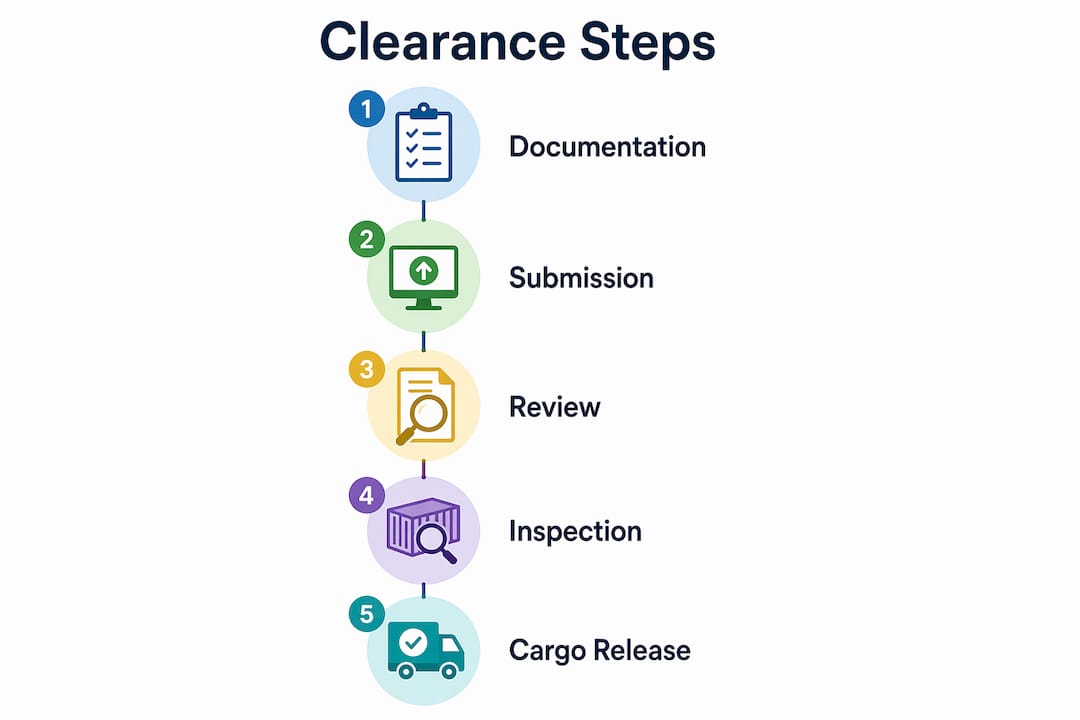
The customs clearance process follows a defined sequence, and understanding each phase helps you anticipate where delays typically occur.
-
Arrival notification. The carrier notifies CBP and the importer of record when the vessel or aircraft arrives at a U.S. port of entry. This triggers the 15-calendar-day window to file entry documents.
-
Document submission via ACE. All entry documents must be submitted electronically through CBP’s Automated Commercial Environment (ACE) portal within 15 days of arrival. Required documents include the bill of lading, commercial invoice, packing list, import bond, and CBP Form 7501.
-
Cargo release filing. The importer of record, or their licensed customs broker, files a Cargo Release through ACE. CBP’s automated selectivity system reviews the filing and assigns a risk channel: green (release), yellow (document review), or red (physical examination).
-
Duty and fee calculation. CBP calculates applicable duties based on the Harmonized Tariff Schedule (HTS) classification, country of origin, and declared value. Antidumping and countervailing duties (AD/CVD) may apply to certain goods under separate orders.
-
Payment of estimated duties. The importer pays estimated duties within 10 working days of cargo release. This is an estimated figure; CBP may adjust it during the liquidation process later.
-
CBP examination (if triggered). If the shipment is flagged for physical or document review, CBP officers inspect the cargo. All holds must be resolved before the release status updates.
-
Cargo release and delivery order issuance. Once CBP clears all holds and confirms payment, the release status updates in ACE. The importer receives a delivery order authorizing movement of goods.
-
Entry Summary filing (CBP Form 7501). The Entry Summary must be filed within 10 working days of cargo release, finalizing duty and fee accounting for the shipment.
Pro Tip: File your Entry Summary before cargo release whenever possible. Pre-filing through ACE reduces post-clearance administrative pressure and gives CBP more time to process without triggering the 10-day countdown.
| Step | Action | Deadline |
|---|---|---|
| Cargo Release filing | Submit entry documents via ACE | Within 15 calendar days of arrival |
| Duty payment | Pay estimated duties to CBP | Within 10 working days of release |
| Entry Summary (Form 7501) | File and finalize duty accounting | Within 10 working days of release |
| Domestic transport | Arrange drayage or trucking | Immediately after release to avoid demurrage |
What challenges can delay your customs clearance?
Most clearance delays trace back to documentation problems, not the goods themselves. Catching these issues before arrival is far easier than resolving them while your cargo sits at the port accruing storage fees.
- Incorrect or missing documents. A mismatched bill of lading number, an unsigned commercial invoice, or a missing packing list can trigger a CBP hold immediately. Every document submitted through ACE must match exactly across all fields.
- Wrong HTS classification. Misclassifying goods under the Harmonized System leads to incorrect duty calculations, which CBP flags during review. Reclassification after the fact can trigger penalties and delay release.
- Cargo holds and inspections. CBP may place a manifest hold, a PGA (Partner Government Agency) hold from agencies like the FDA or USDA, or a physical examination hold. Each type requires a separate resolution process, and failure to clear holds can result in shipment seizure or extended storage fees.
- Late Entry Summary filing. Missing the 10-working-day deadline for CBP Form 7501 triggers liquidated damages equal to double the duty amount on the customs bond. That penalty is not negotiable.
- Importer Security Filing (ISF) errors. Ocean shipments require an ISF 10+2 filing at least 24 hours before loading at the foreign port. Late or inaccurate ISF filings carry their own penalty exposure and can delay cargo release.
- Demurrage and detention fees. Once CBP releases cargo, the port clock starts. Delayed pickup means daily demurrage charges from the terminal, separate from any customs fees.
Pro Tip: Engage a licensed customs broker before your shipment departs the origin country. Brokers with customs compliance expertise catch classification errors and document gaps while there is still time to correct them without port-side penalties.
What should you do after customs clearance is completed?
Clearance completion is the starting gun for domestic logistics, not the finish line. Importers who treat the delivery order as automatic often find their goods sitting at the terminal while fees accumulate by the day.

Arrange domestic transport immediately. Local port drayage typically takes a few days; cross-country trucking runs several days longer; rail intermodal can take about a week depending on the route. Booking your carrier before clearance is confirmed puts you ahead of the demurrage clock. Worldwideexpress offers trucking and drayage coordination as part of its end-to-end import services, which helps close the gap between port release and warehouse delivery.
File or confirm your Entry Summary. If CBP Form 7501 was not pre-filed, you must file it within 10 working days of cargo release. Late filing triggers liquidated damages equal to double the duty amount on your bond, per CBP’s Entry Summary requirements. The Entry Summary 7501 compliance guide from Worldwideexpress walks through the filing requirements in detail.
Maintain your records for CBP’s audit window. CBP holds a 5-year audit window during which it can review any import transaction. Digitized, organized records of commercial invoices, packing lists, HTS classifications, and duty payment confirmations are your primary defense against audit adjustments and compliance penalties.
Post-clearance checklist for importers:
- Confirm delivery order receipt and verify cargo location at the terminal
- Book port drayage or inland carrier immediately
- Verify Entry Summary (Form 7501) filing status and deadline
- Confirm all duties and fees are paid and documented
- Save all CBP release notifications, entry documents, and payment receipts
- Update your internal shipment tracking system with the release date
- Notify your warehouse or receiving facility of the expected delivery window
Pro Tip: Use a digital freight tracking platform alongside your customs broker to monitor both the CBP release status and the carrier pickup in real time. Gaps between those two data streams are where costly surprises tend to appear.
How can Worldwideexpress help you manage the full import process?
Worldwideexpress handles the full arc of U.S. import logistics, from customs brokerage services and ACE filings to domestic freight coordination and supply chain visibility. For importers managing multiple shipments or complex commodity classifications, having a single point of contact across clearance and delivery reduces the coordination gaps that generate fees and delays. Explore the freight forwarding services comparison to see how Worldwideexpress structures its import solutions.

Key Takeaways
When import customs clearance is completed, CBP has released your cargo for legal entry, but the importer’s responsibility for domestic transport, Entry Summary filing, and recordkeeping begins immediately at that moment.
| Point | Details |
|---|---|
| Clearance does not mean delivery | CBP release authorizes movement; the importer must separately arrange all domestic transport. |
| Entry Summary deadline is firm | CBP Form 7501 must be filed within 10 working days of release if not already done; late filing triggers liquidated damages equal to double the duty amount. |
| Demurrage starts at release | Port terminals charge daily fees once CBP clears cargo; booking transport before clearance avoids these costs. |
| Records must cover 5 years | CBP can audit any import transaction within a 5-year window; digitized invoices and HTS records are the importer’s primary defense. |
| Broker engagement prevents most delays | Most clearance delays stem from documentation errors that a licensed customs broker can catch before the shipment arrives. |
Recommended
- Customs Clearance Is in Progress – What It Means for U.S. Importers – Worldwide Express, Inc.
- Customs clearance for businesses: compliance and smooth trade – Worldwide Express, Inc.
- Unlock faster trade with customs pre-clearance benefits – Worldwide Express, Inc.
- Customs Attorney: Ensuring Smooth U.S. Import Clearance – Worldwide Express, Inc.