What happens when the customs clearance process is initiated
When the customs clearance process is initiated, U.S. Customs and Border Protection (CBP) officially starts reviewing your shipment’s entry documents to determine admissibility, assess applicable duties, and decide whether to release, hold, or inspect the goods. This is not a passive administrative step. CBP requires submission of CBP Form 3461 and supporting documents within 15 calendar days of arrival, and the clock starts the moment your cargo lands at a U.S. port of entry.
Several triggers set this process in motion:
- Arrival of the carrier at a U.S. port of entry
- Submission of entry documents by the importer or licensed customs broker
- Receipt of the Importer Security Filing (ISF) pre-arrival notification
- Activation of the Automated Commercial Environment (ACE) system record
Once initiated, three outcomes are possible: the shipment clears and is released, CBP places it on hold for examination, or a Partner Government Agency (PGA) such as the FDA or USDA flags it for additional review. Most shipments with accurate documentation clear without incident.
Pro Tip: Contact the CBP import specialist at your port of entry before your first shipment arrives. Per CBP’s importer guidance, these specialists provide commodity-specific classification advice and can flag requirements you might otherwise miss.
Table of Contents
- Detailed steps in the U.S. customs clearance process
- What documentation does customs clearance require?
- How a licensed customs broker helps you clear customs faster
- Common causes of customs clearance delays and how to avoid them
- What to expect after customs clearance is initiated: timeline and milestones
- Customs duties, taxes, and fees: what you will pay at clearance
- Rights and responsibilities of importers during the customs clearance process
- Worldwideexpress handles your clearance from first filing to final release
- Key Takeaways
Detailed steps in the U.S. customs clearance process
The formal entry process follows a defined sequence. Skipping or rushing any step creates downstream problems that can delay your cargo by days or weeks.
-
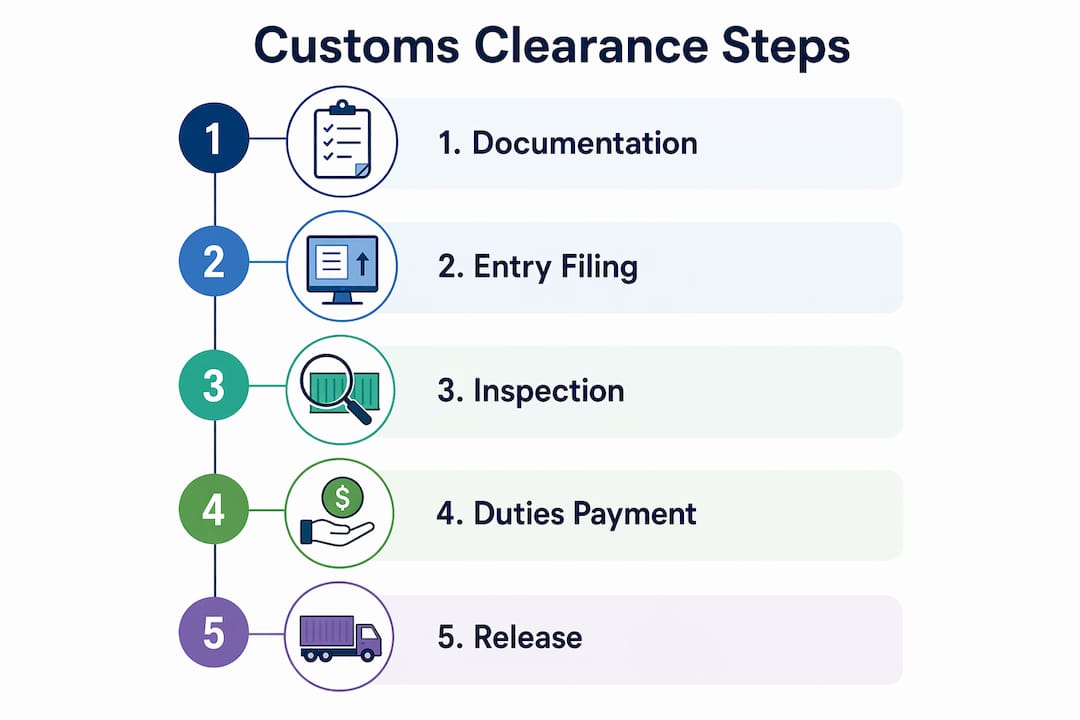
File the Importer Security Filing (ISF). For ocean shipments, the ISF must be submitted at least 24 hours before cargo is loaded at the foreign port. This pre-arrival data gives CBP its first risk assessment window.
-
Receive the carrier’s arrival notice. The carrier notifies the importer or broker when the vessel or aircraft arrives. This notice officially triggers the 15-calendar-day filing deadline.
-
Submit CBP Form 3461 and supporting documents via ACE. The entry package includes the commercial invoice, packing list, bill of lading or air waybill, and any agency-specific permits. Most brokers file electronically through ACE.
-
CBP conducts risk-based screening. CBP’s automated system reviews the entry data for inconsistencies, valuation flags, or high-risk indicators. Only 3% of shipments undergo a physical examination, but missing or mismatched documents trigger holds far more frequently.
-
Goods are released or placed on hold. If CBP approves the entry, a release permit is issued. If not, a detention notice follows within 5 working days of the decision to detain.
-
Pay estimated duties, taxes, and fees. For standard entries, payment accompanies the entry summary filing.
-
File the Entry Summary (CBP Form 7501) within 10 working days. This deadline is firm: missing it triggers a demand for liquidated damages against the importer of record’s bond.
Pro Tip: Ask your broker about the “special permit for immediate delivery” option using CBP Form 3461. When approved, it releases your cargo before the full entry summary is filed, giving you up to 10 working days to complete the paperwork without holding your goods.
What documentation does customs clearance require?
Accurate, consistent paperwork is the single most controllable factor in how fast your shipment clears. Consistent and complete documentation across all shipment records is the most effective strategy for reducing delays and inspections.
The core documents required at entry are:
- Commercial invoice: Must include seller and buyer details, country of origin, full description of goods, quantity, unit price, and total value. CBP uses this for HTS classification and duty calculation.
- Packing list: Details carton contents, weights, and dimensions. Discrepancies between the packing list and commercial invoice are a common trigger for holds.
- Bill of lading or air waybill: Serves as the transport contract and proof of ownership. Required for the carrier to release cargo.
- CBP Form 3461: The entry or release document filed within 15 calendar days of arrival.
- CBP Form 7501 (Entry Summary): Filed within 10 working days of entry, with estimated duties attached.
- Customs bond: All shipments over $2,500 require either a single-entry or continuous bond. Continuous bonds cost approximately $250–$500 per year and cover multiple entries.
- Importer of Record number: Either your IRS business registration number or Social Security number.
| Document | Purpose | Deadline |
|---|---|---|
| CBP Form 3461 | Entry and release request | Within 15 calendar days of arrival |
| Commercial invoice | Valuation and classification | Submitted with Form 3461 |
| Packing list | Cargo verification | Submitted with Form 3461 |
| CBP Form 7501 | Entry summary with duties | Within 10 working days of entry |
| Customs bond | Covers duties and penalties | At time of entry |
Agency-specific documents add another layer. Products like food, electronics with radio transmitters, and children’s products require certifications from FDA, USDA, FCC, CPSC, or EPA before CBP will release them.
How a licensed customs broker helps you clear customs faster
CBP does not require importers to use a broker, but the agency strongly recommends that first-time importers consult one. Licensed customs brokers are credentialed by CBP and carry legal authority to file entries on your behalf.
What a broker actually does for you:
- Classifies your goods under the correct HTS code to determine the accurate duty rate
- Files entry documents electronically via ACE, reducing processing time
- Manages customs bond requirements and coordinates with surety companies
- Communicates directly with CBP and Partner Government Agencies on holds or queries
- Advises on valuation methods to avoid CBP flags for undervaluation
Most importers do not file entry summaries directly. Brokers handle this electronically, which speeds up the process and reduces the chance of clerical errors that trigger examinations, improving clearance efficiency. The legal responsibility for accuracy, however, stays with you as the importer of record. A broker facilitates compliance; it does not transfer liability.
Broker fees vary by shipment complexity and are not CBP charges. For businesses comparing self-filing versus using a customs broker, the cost-benefit calculation usually favors a broker once shipment frequency or cargo value rises above a basic threshold.

Common causes of customs clearance delays and how to avoid them
CBP’s risk-based screening targets shipments with data problems. The good news: most delays are preventable.
The most frequent causes of holds and extended clearance times include:
- Inconsistent data across documents. A unit price on the commercial invoice that does not match the packing list weight, or a country of origin that differs between documents, flags the shipment immediately.
- Incorrect HTS classification. Misclassifying goods leads to wrong duty rates and potential penalties. CBP can reclassify and demand back duties.
- Missing or insufficient customs bond. Shipments over $2,500 without a valid bond cannot be released.
- Missing agency permits. Food shipments without FDA prior notice, or electronics without FCC certification, face prolonged PGA holds that CBP cannot override.
- Late ISF filing. Filing the ISF after the 24-hour pre-loading deadline for ocean freight triggers CBP penalties and can delay cargo release.
Pro Tip: Run a document consistency check before every shipment: confirm that the product description, quantity, value, and country of origin match exactly across the commercial invoice, packing list, and entry summary. This single habit eliminates the most common trigger for customs clearance delays.
What to expect after customs clearance is initiated: timeline and milestones
Realistic timing expectations help you plan inventory and avoid costly storage fees.

| Scenario | Typical Timeline |
|---|---|
| Clean ocean shipment, no holds | 1–3 business days after arrival |
| Clean air shipment, no holds | Same day to 24 hours |
| Random or targeted physical inspection | 3–10 additional business days |
| PGA hold (FDA, USDA, etc.) | Varies; can extend to several weeks |
| Entry summary filing deadline | Within 10 working days of entry |
| General order threshold (no entry filed) | 15 calendar days after arrival |
| Liquidation period | Several weeks after entry |
For standard ocean shipments with correct documentation and no holds, customs clearance typically takes 1–3 business days after arrival. Inspections or paperwork issues can extend clearance to several weeks. Once CBP decides to detain a shipment, it has 30 days from the date of presentation to release, seize, or deny entry. If no decision is made within 30 days, the merchandise is deemed excluded, and the importer may protest to the Court of International Trade.
Failure to file entry documents within 15 calendar days sends goods to “general order” at a bonded warehouse, where they can sit for up to six months before being auctioned. That outcome is entirely avoidable with timely filing.
Customs duties, taxes, and fees: what you will pay at clearance
Duties are calculated based on the HTS classification, the customs value of the goods, and the country of origin. The three main charges at clearance are:
Customs duties are ad valorem (a percentage of the declared value), specific (a fixed amount per unit), or compound (a combination of both). The applicable rate depends on the HTS code and any active trade agreements or Section 301 tariffs.
Merchandise Processing Fee (MPF) applies to most formal entries. It is assessed as a percentage of the cargo value, subject to minimum and maximum thresholds set by CBP.
Harbor Maintenance Fee (HMF) applies to ocean shipments arriving at U.S. ports and is calculated as a percentage of the cargo value.
One notable exception: under Section 321, shipments valued at $800 or less have historically entered duty-free with simplified paperwork. That exemption has been narrowing since 2025, with low-value shipments now commonly requiring formal customs processing. Importers relying on the de minimis threshold should verify current CBP rules before shipping.
Rights and responsibilities of importers during the customs clearance process
Importers hold more authority in the clearance process than many realize, and more accountability than some expect.
Your rights as an importer include the ability to request a binding ruling from CBP on the correct HTS classification and duty rate for your merchandise before you ship. You can also protest CBP decisions, including classification determinations and duty assessments, through formal protest procedures. If CBP detains your goods, you are entitled to a detention notice within 5 working days of the detention decision.
Your responsibilities are equally defined. Even when a licensed customs broker handles filing, you as the importer of record remain ultimately responsible for the accuracy of all entry documentation and for paying all applicable duties, taxes, and fees. CBP can demand redelivery of released merchandise if it later determines the goods failed to meet admission requirements. Repeated late filings, incomplete summaries, or delinquent duty payments can trigger CBP’s “live entry” requirement, which removes the standard 10-working-day float for duty payment and requires full summary data upfront.
Importers who engage a U.S. customs brokerage service do not transfer this legal responsibility. The broker acts as your agent; CBP holds you accountable for the outcome.
Worldwideexpress handles your clearance from first filing to final release
Customs clearance is manageable when you have the right team behind it. Worldwideexpress offers end-to-end logistics services that cover U.S. customs brokerage, import and export freight forwarding, air and ocean transportation, and supply chain management, all under one roof. For businesses that ship regularly, that consolidation eliminates the coordination gaps where delays most often occur.
Where Worldwideexpress stands apart is in combining licensed brokerage expertise with freight operations. Your broker and your freight team work from the same shipment data, which means HTS classifications, bond management, and PGA coordination happen in parallel with cargo movement rather than after it. For importers who have experienced the frustration of a shipment sitting at port while paperwork catches up, that integration makes a concrete difference. Get a freight quote or connect with a Worldwideexpress customs specialist at worldwideexpress.com/logistics-services to get your next shipment moving without the guesswork.
Key Takeaways
Accurate, timely documentation is the single most effective way to move a shipment through U.S. customs clearance without delays or penalties.
| Point | Details |
|---|---|
| Filing deadlines are firm | CBP Form 3461 must be filed within 15 calendar days; Form 7501 within 10 working days of entry. |
| Most shipments clear quickly | Standard ocean shipments with correct documentation typically clear in 1–3 business days. |
| Bonds are mandatory above $2,500 | All shipments over $2,500 require a customs bond; continuous bonds cost approximately $250–$500 per year and cover multiple entries. |
| Importer liability never transfers | Even with a licensed broker, the importer of record remains legally responsible for all filings and duties. |
| Worldwideexpress covers the full process | Worldwideexpress provides licensed customs brokerage alongside freight operations, reducing coordination gaps that cause delays. |
Recommended
- Customs Clearance Is in Progress – What It Means for U.S. Importers – Worldwide Express, Inc.
- Power of Attorney for Customs Clearance: Streamline US Imports – Worldwide Express, Inc.
- Complete Guide to the Customs Inspection Process – Worldwide Express, Inc.
- Customs Attorney: Ensuring Smooth U.S. Import Clearance – Worldwide Express, Inc.