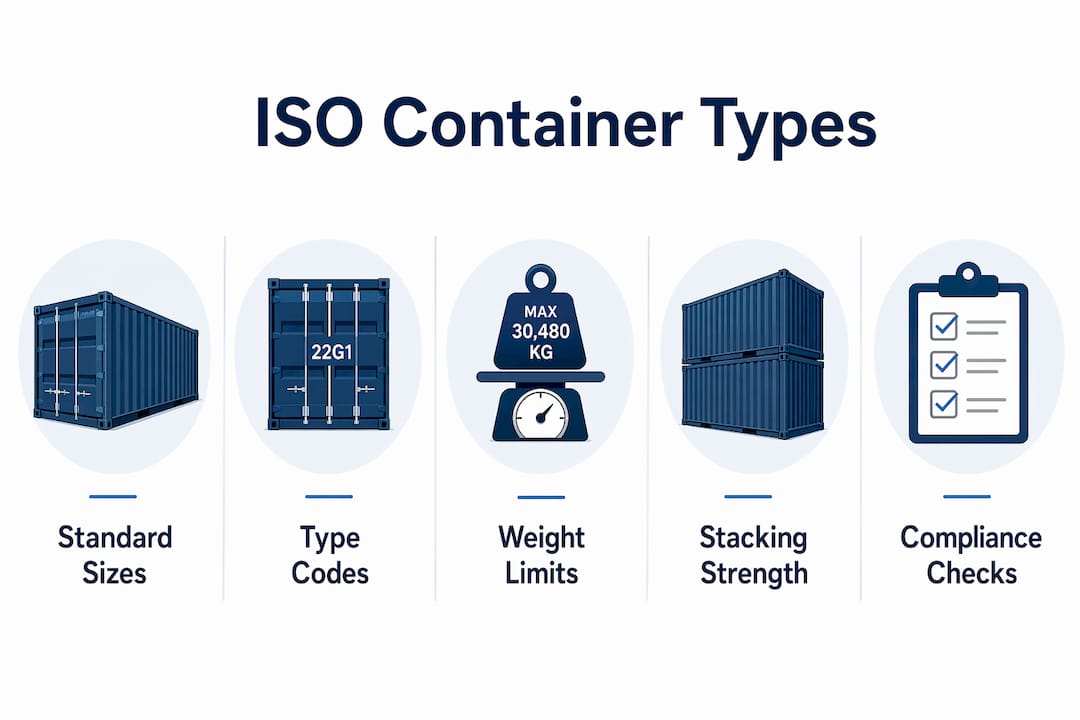
ISO container types are the standardized freight unit classifications defined under ISO 668 (sizes and dimensions) and ISO 6346 (coding, identification, and marking) that tell you exactly what a box is, how big it is, and how it can be handled across any intermodal system worldwide. For most shipments, you will be working with one of these:
- 20’ General Purpose (GP): The workhorse. Dry cargo, standard stacking, universal terminal compatibility.
- 40’ General Purpose (GP): Double the floor space, same width and height as the 20’.
- 40’ High Cube (HC): One foot taller than standard — the go-to for light, voluminous cargo.
- 45’ High Cube: Primarily used in European and some U.S. domestic corridors.
- Refrigerated (Reefer): Temperature-controlled, with an integrated cooling unit and power connection.
- Open Top: No rigid roof — tarpaulin cover, used for over-height cargo.
- Flat Rack: Collapsible or fixed ends, no walls or roof, for out-of-gauge loads.
- Tank: ISO-framed cylindrical tank for liquids, gases, and bulk chemicals.
The container’s size and type code, maximum gross weight, tare weight, and payload are all printed on the data plate (also called the combined data plate), which is typically mounted near the door end. The CSC plate (Convention for Safe Containers) sits alongside it and confirms the unit has passed safety inspection. Both plates are your first stop before accepting any unit.
Table of Contents
- What is an ISO container and which standards govern it?
- How do you read an ISO container identification number?
- What are the standard ISO container sizes and dimensions?
- What are the main ISO container types and how do you use them?
- How do you verify that a container is ISO-compliant before accepting it?
- How do you choose the right ISO container for a shipment?
- Key Takeaways
- Why the check digit deserves more respect than it gets
- Authoritative references for final verification
What is an ISO container and which standards govern it?
An ISO container, formally a Series 1 freight container, is a reusable transport unit built to meet specific dimensional, structural, and marking standards so it can move seamlessly between ships, rail cars, and trucks without reloading cargo. The governing framework rests on three interlocking standards:
- ISO 668: Establishes the classification of Series 1 containers by external dimensions and specifies ratings, minimum internal dimensions, and door openings for each type.
- ISO 6346: Defines the coding, identification, and marking system — owner code, equipment category, size/type code, and check digit.
- ISO 1161: Specifies the corner fittings (castings) that allow containers to be lifted, stacked, and locked to vessel cell guides, rail cars, and chassis.
Beyond the ISO standards, the CSC (Convention for Safe Containers), administered through the IMO, requires that every container used in international transport carry a valid CSC plate confirming it has been inspected and approved for stacking and road/rail use. Per ICHCA technical guidance, containers lacking correct ISO markings may not be safe for standardized stack-loading or automated crane handling. That is not a theoretical concern: a single non-compliant unit in a stack can trigger a terminal hold, a crane rejection, or worse.
The intermodal value of ISO standardization is hard to overstate. Because every ISO-compliant unit shares the same corner-fitting geometry defined in ISO 1161, a 20’ GP loaded in Chicago can transfer to a vessel in Los Angeles, a rail flatcar in Rotterdam, and a truck chassis in Shanghai without a single dimension check at each handoff.

How do you read an ISO container identification number?
The full ISO 6346 identification number has four components, always displayed in the same sequence on the front, sides, top, and door end of the container.
- Owner code (3 letters): Identifies the owner or principal operator. Must be a BIC-registered prefix — only registered codes are valid for international transport and customs documentation.
- Equipment category identifier (1 letter): “U” for freight containers, “J” for detachable freight container-related equipment, “Z” for trailers and chassis.
- Serial number (6 digits): The owner’s unique reference number for that specific unit.
- Check digit (1 digit): A mathematically derived value calculated from the preceding letters and digits. It validates that the ID has been recorded and transmitted accurately.
A complete number looks like this: MSCU 123456 7 — where “MSC” is the owner code, “U” is the equipment category, “123456” is the serial number, and “7” is the check digit.
The check digit is not decorative. The ISO 6346 check digit is derived by a specific mathematical weighting of all preceding characters. An incorrect check digit will frequently block automated EDI processing and terminal acceptance — and it is one of the fastest problems to catch before a container ever reaches the gate. Validate it early; it saves handling time downstream.
The size and type code
Immediately below or adjacent to the identification number, you will find a two- or four-character size and type code. The BIC size/type code guidance breaks it down:
- First character: Length (e.g., “2” = 20 ft, “4” = 40 ft, “L” = 45 ft).
- Second character: Height and width (e.g., “2” = 8’6" standard height, “5” = 9’6" high cube).
- Third and fourth characters: Type group and specific features (e.g., “G1” = general purpose with one non-operating ventilation opening, “R1” = reefer with integral refrigeration).
Practical examples:
| Code | Meaning |
|---|---|
| 22G1 | 20 ft, 8’6" standard height, general purpose with ventilation |
| 42G1 | 40 ft, 8’6" standard height, general purpose with ventilation |
| 45G0 | 40 ft, 9’6" high cube, general purpose, no ventilation openings |
| 22R1 | 20 ft, 8’6", reefer with integral refrigeration |
| 42R1 | 40 ft, 8’6", reefer with integral refrigeration |
The fourth character can also indicate reduced stacking strength or special structural variants. Assuming two same-length containers have identical stack ratings because they share the same first two code characters is a common and costly mistake — one that can result in structural damage and insurance claims.
The BIC owner-code registry is publicly searchable. Carriers and lessors must use registered prefixes; an unregistered or incorrectly formatted owner code causes customs and EDI problems that ripple through the entire documentation chain.
What are the standard ISO container sizes and dimensions?
The table below lists nominal external dimensions, typical internal dimensions, cubic capacity, and weight descriptions for the most common international sizes. These are reference values; actual figures vary by manufacturer and must be confirmed on the container’s data plate.
| Size | Ext. L × W × H | Int. L × W × H (nominal) | Volume | Tare (approx.) | Max Gross | Payload (approx.) |
|---|---|---|---|---|---|---|
| 45 ft HC | — | — | ~86.0 m³ / ~3,040 ft³ | ~4,800 kg | — | ~25,680 kg |
A critical note on North American domestic sizes: The 48 ft and 53 ft containers widely used in U.S. domestic trucking and rail are not ISO international sizes. They exceed ISO 668 dimensional limits and are not interchangeable with international ocean containers. If you are booking intermodal moves that cross international borders, confirm the unit is an ISO Series 1 size, not a domestic North American unit.
Hapag-Lloyd’s technical specifications note that floor thickness, ventilation ducts, and fittings can reduce usable internal dimensions below the nominal figures. Always verify the container’s data plate rather than relying on a generic table — including this one.
What are the main ISO container types and how do you use them?
General Purpose containers dominate the global fleet by a wide margin. Industry estimates put GP containers at roughly 90% of the global container fleet in service, which means most decisions you make will involve a 20’ or 40’ GP. The other types exist for cargo that a steel box with a solid roof simply cannot accommodate.
- General Purpose (Dry): Solid steel walls, roof, and floor with swing doors at one end. Codes 22G1, 42G1. Used for virtually any dry, non-temperature-sensitive cargo. No special fittings beyond standard lashing rings.
- High Cube: Identical footprint to a standard GP but 9’6" tall instead of 8’6". Codes 45G0, L5G0. The extra cubic volume matters for light, bulky goods — furniture, automotive parts, apparel. Note that some rail corridors and road routes have height restrictions that exclude high-cube units.
- Refrigerated (Reefer): Integral refrigeration unit, insulated walls, and a T-bar aluminum floor for airflow. Codes 22R1, 42R1. Requires a power connection (reefer plug) at the terminal and on the vessel. Pre-trip inspection is mandatory before loading perishables.
- Open Top: No rigid roof — a removable tarpaulin covers the cargo. Codes 22U1, 42U1. Used for over-height machinery, coils, and bulk materials loaded by crane. Tarpaulin condition is a pre-acceptance check item.
- Flat Rack: Fixed or collapsible end walls, no side walls or roof. Codes 22P1, 42P1. Handles out-of-gauge cargo — heavy machinery, vehicles, pipes. Lashing points are the critical fitting; verify their rated capacity against cargo weight.
- Open Side: Full-length side doors in addition to end doors. Allows forklift loading along the full length of the container. Less common but valuable for palletized cargo with awkward dimensions.
- Tank: ISO-framed cylindrical tank mounted within a standard 20 ft frame. Codes 22T1–22T9 depending on pressure rating and fittings. Used for liquids, gases, and hazardous chemicals. Valves, pressure ratings, and cleaning certificates are all pre-acceptance requirements.
- Ventilated: Similar to GP but with passive ventilation openings to prevent moisture buildup. Code 22V0 or 22V2. Used for coffee, cocoa, and other agricultural products that off-gas during transit.
- Dry Bulk: A GP-style container fitted with top-loading hatches and bottom discharge fittings. Used for grain, sugar, and similar free-flowing bulk commodities.
- Half-Height: Roughly half the standard internal height, built for dense, heavy cargo like stone, ore, or scrap metal where the weight limit is reached long before the volume is filled.
- Platform (Flat): No superstructure at all — just the base frame with corner fittings. Used for very large, irregular loads that cannot be accommodated even on a flat rack.
Quick-selection comparison
| Container type | Best for | Key handling notes |
|---|---|---|
| 20’ / 40’ GP | Dry general cargo, palletized goods | Standard stacking; verify lashing ring capacity |
| 40’ / 45’ HC | Light, high-volume cargo | Check rail/road height clearances before booking |
| Reefer | Perishables, pharma, temperature-sensitive goods | Requires power; pre-trip inspection mandatory |
| Open Top | Over-height machinery, coils, bulk by crane | Tarpaulin condition check; height surcharge may apply |
| Flat Rack | Out-of-gauge, heavy lift, vehicles | Verify lashing point ratings; special stowage plan needed |
| Tank | Liquids, gases, hazardous chemicals | Pressure rating, valve condition, cleaning certificate required |
| Ventilated | Coffee, cocoa, agricultural products | Verify vent openings are unobstructed |
Specialized container variants like open-side and platform units retain ISO corner fittings but add features that affect lifting, lashing, and loading procedures. Per CIMC technical documentation, these features are reflected in the size/type code and must be matched to the terminal’s handling gear before the unit arrives.
How do you verify that a container is ISO-compliant before accepting it?
A pre-acceptance check takes less than ten minutes and can prevent days of delay. Work through these steps in order:
- Confirm the owner code. Look up the three-letter prefix in the BIC owner-code registry. An unregistered prefix is a red flag — it will cause EDI rejection at the terminal and may trigger a customs hold.
- Validate the full identification number and check digit. Use a check-digit calculator (available through BIC) to confirm the seventh character is correct. A mismatched check digit is one of the most common causes of terminal system rejection.
- Locate and read the CSC plate. Confirm the safety approval number and the next examination date. If the CSC plate is missing, expired, or illegible, do not accept the unit for international stacking.
- Read the data plate. Record tare weight, maximum gross weight, and payload. Confirm the size/type code on the data plate matches the booking documentation. Discrepancies between the data plate and the shipping instruction are a documentation error waiting to happen.
- Inspect corner castings. Check all eight corner fittings for cracks, deformation, or weld repairs that could affect stacking integrity or crane lift safety.
- Check door seals and locking rods. Damaged seals allow moisture ingress; bent locking rods may prevent the doors from sealing under load.
- Look for unauthorized modifications. Cut-outs, added fittings, or structural repairs that are not reflected on the data plate can reduce stacking strength below the rated figure.
- Verify the size/type code against cargo requirements. A unit marked with a reduced-strength code variant must not be stacked to the same height as a standard unit of the same length.
Pro Tip: Automation systems at major terminals validate the check digit and owner-code prefix before the container reaches the gate. If either fails, the unit gets flagged before it can be positioned. Catching these errors at origin — by running the number through the BIC lookup tool before dispatch — eliminates the most common cause of gate-hold delays.
Correct container identification also feeds directly into U.S. customs brokerage documentation. An incorrect owner code or mismatched size/type code on the shipping instruction versus the actual unit can trigger a CBP examination, adding cost and time to the clearance process.
How do you choose the right ISO container for a shipment?
The decision usually comes down to four variables: cargo dimensions, cargo weight, special handling requirements, and transport mode constraints. Work through this checklist before booking:
- Measure cargo dimensions first. If any piece exceeds 2.35 m in width or 2.39 m in height (standard GP internal clearances), you need an open top, flat rack, or platform unit.
- Check the weight-to-volume ratio. Dense cargo (machinery, metals) fills weight capacity before volume. Light cargo (textiles, foam) fills volume first. For light, high-volume loads, a 40’ HC adds roughly 8.7 m³ over a standard 40’ GP at comparable cost.
- Identify special handling requirements. Temperature-sensitive cargo needs a reefer. Liquids need a tank. Agricultural products prone to moisture need a ventilated unit. Never substitute a GP for a reefer on temperature-sensitive pharmaceuticals, regardless of transit time.
- Confirm transport mode compatibility. Not every port or rail corridor accepts high-cube units. Some ro-ro services have height restrictions. Verify with the carrier before booking a non-standard type.
- Check port and terminal gear. Flat racks and open-top units require spreader bars or special lifting gear. Confirm the origin and destination terminals have the equipment before the cargo arrives.
- Request documentation before acceptance. For any unit, require a photo of the data plate and CSC plate. Refuse units with missing CSC plates, non-standard modifications not reflected on the data plate, unknown or unregistered owner codes, or data-plate figures that do not match the booking.
The 40’ GP vs. 40’ HC decision is the most common choice logistics teams face. If cargo is light and voluminous — apparel, furniture, automotive trim — the high cube’s extra foot of internal height (roughly 2.70 m vs. 2.39 m) often allows an additional layer of pallets, reducing the number of containers needed. The deciding factor is whether the destination port and inland transport route can handle a 9’6" unit. If they can, the HC almost always wins on cost per cubic meter for low-density cargo. For a deeper look at ocean freight forwarding steps and container selection in context, that resource walks through the full booking-to-delivery sequence.
Key Takeaways
ISO container compliance starts with reading the data plate and CSC plate correctly — every other verification step depends on those two physical documents being present, legible, and accurate.
| Point | Details |
|---|---|
| Governing standards | ISO 668 defines sizes; ISO 6346 governs coding and marking; ISO 1161 covers corner fittings. |
| Check digit matters | An incorrect check digit blocks EDI and terminal acceptance — validate it before dispatch. |
| Data plate over generic tables | Nominal dimensions are reference only; floor fittings and ducts reduce usable internal volume. |
| GP containers dominate | Roughly 90% of the global fleet is General Purpose — master GP specs before specializing. |
| Domestic sizes are not ISO | U.S. 48 ft and 53 ft units are not ISO Series 1 and cannot substitute for international containers. |
Why the check digit deserves more respect than it gets
Most logistics professionals know to look for the CSC plate and the data plate. Fewer treat the check digit with the same urgency — and that gap is where a surprising number of terminal delays originate.
The ISO 6346 check digit is a mathematical derivative of every character in the owner code, equipment identifier, and serial number. It is not a formatting convention; it is a validation mechanism built into the standard precisely because container IDs are transcribed, keyed, and transmitted thousands of times across a shipment’s life. A single transposition error in the serial number produces a wrong check digit, and modern terminal operating systems catch it instantly.
The practical heuristic worth adopting: treat the check digit as the first thing you verify, not the last. Run the full container number through the BIC lookup tool the moment you receive a booking confirmation. If the check digit fails, resolve it with the carrier or lessor before the unit moves. Waiting until the container arrives at the gate turns a two-minute fix into a multi-hour hold.
The same logic applies to the owner-code prefix. A prefix that is not in the BIC registry is not just a marking problem — it is a customs documentation problem. U.S. Customs and Border Protection systems, like terminal EDI platforms, rely on registered owner codes to match container records. An unregistered prefix on the shipping instruction can trigger a CBP examination that no amount of paperwork fixes quickly. The BIC registry is free to search and takes seconds. There is no good reason to skip it.
One cautionary note worth keeping in mind: accepting a container with a reduced-strength size/type code variant and stacking it as though it were a standard unit has caused structural failures and cargo damage claims. The fourth character of the size/type code is not administrative detail — it is a structural specification.
Authoritative references for final verification
When a table or a checklist is not enough, go to the primary sources. Each one serves a specific verification purpose:
- ISO 6346: The definitive standard for container coding, identification, and marking. Consult it when you need to decode an unfamiliar size/type code, verify check-digit calculation methodology, or confirm marking requirements.
- ISO 668: The classification and dimensions standard for Series 1 freight containers. Use it to confirm nominal external dimensions and ratings for any standard size.
- BIC owner-code registry: The international register of container owner codes, maintained by the Bureau International des Containers. Search it to validate any three-letter owner prefix before accepting a unit or submitting customs documentation.
- BIC size/type code guidance: BIC’s illustrated reference for decoding the full size and type code, including reduced-strength and special-variant indicators.
- BIC container markings guide: Explains the physical placement and content of all mandatory and optional markings, including the combined data plate and CSC plate.
- ICHCA technical guidance on size and type codes: The International Cargo Handling Co-ordination Association’s illustrated guide. Use it when training terminal staff or resolving disputes about marking interpretation.
- IMO/CSC Convention guidance: The IMO administers the Convention for Safe Containers. Consult IMO documentation when a CSC plate is disputed, expired, or when a container has undergone structural modification that may require re-certification.
For U.S.-based logistics teams managing import and export documentation, Worldwideexpress provides logistics services that integrate container identification, customs brokerage, and freight forwarding into a single managed workflow — reducing the risk of EDI errors and compliance gaps that start with a misread container code.
Recommended
- Understanding the Various Types of Shipping Containers – Worldwide Express, Inc.
- Container shipping basics: Reliable solutions for global trade – Worldwide Express, Inc.
- Cargo Freight Container Types, Costs, and Best Practices – Worldwide Express, Inc.
- Essential Logistics Terms Every Professional Must Know – Worldwide Express, Inc.