TL;DR:
- Implementing ESG in logistics requires establishing a data baseline, adopting a recognized reporting framework, and launching operational pilots to demonstrate savings.
- Regulatory requirements vary internationally, with U.S. SEC rules excluding Scope 3 disclosures domestically, but European laws mandating broader reporting.
ESG logistics means applying environmental, social, and governance standards to freight, warehousing, and trade operations. Start today with three actions: baseline your fuel and route data using telematics or EDI feeds, run a one-quarter pilot on route optimization, and commit to a recognized reporting framework such as the Global Reporting Initiative (GRI) or SASB/ISSB. Research covering 2007–2022 stock performance found that logistics firms with strong ESG strategies showed lower stock volatility, a signal that sustainability work reduces investor-perceived risk. Worldwideexpress supports this work through customs brokerage, freight forwarding, and supply chain visibility tools built for international operators.
- Baseline now: Pull fuel consumption, empty miles, and on-time delivery rates from your TMS or EDI system.
- Pilot fast: A single quarter of route optimization data gives you enough to set a credible target.
- Report publicly: GRI or SASB/ISSB disclosures signal commitment to customers, lenders, and regulators.
Table of Contents
- What does ESG in logistics actually cover?
- Why ESG matters for U.S. logistics businesses right now
- How do you measure and report ESG performance?
- What are the biggest data problems and how do you fix them?
- Step-by-step roadmap from pilot to scaled ESG program
- How do you finance ESG investments in the U.S.?
- What U.S. regulatory requirements should logistics teams watch?
- How Worldwideexpress supports ESG implementation
- Key Takeaways
- The part most logistics teams get wrong in 2026
- Worldwideexpress helps you move from ESG goals to verified results
- Authoritative sources and further reading
What does ESG in logistics actually cover?
ESG in logistics is not one thing. The material issues differ sharply depending on whether you are a freight forwarder, a carrier, or a customs broker, and operational teams need to map each pillar to their own responsibilities.
Environmental topics center on greenhouse gas (GHG) emissions across Scope 1 (owned fleet), Scope 2 (purchased energy), and Scope 3 (supplier and customer miles). Fuel efficiency, empty miles, modal shift from air to ocean, sustainable packaging, and terminal energy use all fall here. For a carrier, Scope 1 is the priority. For a freight forwarder, Scope 3 dominates because most emissions sit in the carriers you contract.
Social issues include worker safety and training, driver and contractor labor practices, community impacts near terminals, and cargo health and safety. Lost-time injury rate (LTIR) is the standard KPI. According to Egon Zehnder’s industry analysis, contractor networks and worker safety represent two of the most significant ESG risks in transport and logistics.
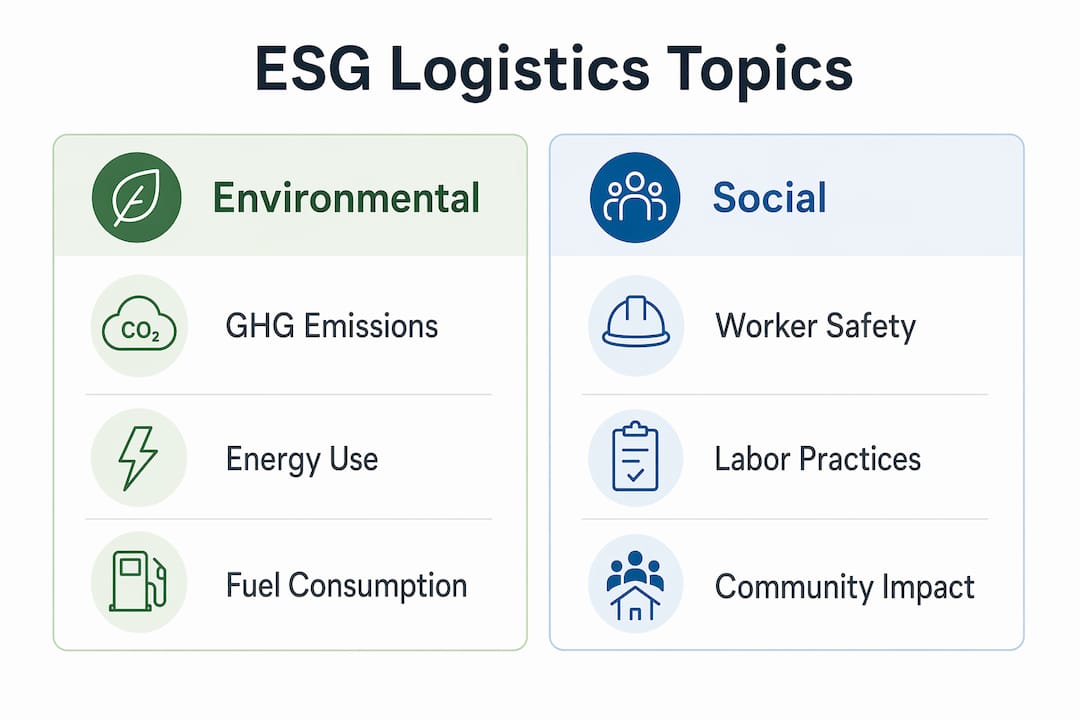
Governance covers anti-corruption policies, supplier due diligence, data governance for verifiable reporting, and third-party assurance. ISO 14001 certification and verified GHG inventories are the most recognized trust-builders for external stakeholders.
Pro Tip: A customs broker’s most material governance issue is often anti-corruption and documentation integrity, not emissions. Map your materiality to your role before picking metrics.
- Freight forwarders: prioritize Scope 3 and supplier compliance rates.
- Carriers: prioritize Scope 1/2 emissions, fuel intensity, and LTIR.
- Customs brokers: prioritize governance, data accuracy, and anti-corruption controls.
Why ESG matters for U.S. logistics businesses right now
The financial case is direct. Logistics firms with strong ESG strategies showed lower stock volatility across the 2007–2022 period, meaning ESG work correlates with reduced investor-perceived risk. That is not a soft benefit; it affects cost of capital.
Key finding: Transportation leaders increasingly treat sustainability as a cost-management strategy tied to resilience and network decisions, per Morningstar/Breakthrough research.
Operationally, route optimization cuts fuel spend. Safety programs lower insurance premiums and incident costs. Reliable supplier data reduces disruption risk. These are measurable savings, not aspirational goals.
On the market side, large beneficial cargo owners (BCOs) and enterprise shippers now screen logistics partners on ESG performance. Access to green financing through sustainability-linked loans depends on verified KPIs. Carriers and forwarders without credible disclosures are increasingly excluded from RFPs.
- Fuel savings from route optimization reduce direct operating costs.
- Improved safety records lower insurance and workers’ compensation costs.
- Verified ESG data unlocks sustainability-linked lending at better rates.
- Credible reporting keeps you competitive in enterprise procurement.
How do you measure and report ESG performance?
Adopt a recognized framework first; then collect metrics. The GRI Standards cover broad sustainability disclosure and are the most widely used globally. SASB/ISSB targets investor-focused metrics and aligns with SEC disclosure expectations. The GHG Protocol is the baseline for emissions accounting across all three scopes.
Core metrics to track immediately:
| Metric | Scope/Category | Reporting Framework |
|---|---|---|
| Scope 1 GHG emissions | Owned fleet fuel combustion | GHG Protocol / GRI |
| Scope 2 GHG emissions | Purchased electricity (warehouses) | GHG Protocol / GRI |
| Fuel consumption (gallons) | Fleet operations | GRI, SASB |
| Empty miles percentage | Route efficiency | SASB (Road Transport) |
| On-time delivery rate | Service quality | SASB |
| Lost-time injury rate (LTIR) | Worker safety | GRI 403 |
| Supplier compliance rate | Governance/procurement | GRI |
On Scope 3: the SEC’s final climate rules excluded Scope 3 reporting requirements for U.S. public companies, but the EU’s Corporate Sustainability Reporting Directive (CSRD) still requires broader disclosures for companies operating in Europe. If you move freight across the Atlantic, Scope 3 is not optional.
For cadence: track operational KPIs quarterly, publish an annual public report, and bring in third-party limited assurance once your Scope 1/2 data is stable.
What are the biggest data problems and how do you fix them?
The primary barrier is fragmented, unverifiable data. Most U.S. logistics operations run on siloed TMS, WMS, and EDI systems that do not share a common emissions taxonomy. Third-party carriers rarely report fuel data in a standardized format.

Fix it stepwise. Deploy telematics on your owned fleet first; cargo tracking technology gives you real-time fuel and mileage data that is audit-ready. For contracted carriers, add a minimal ESG data field to your onboarding process: fuel consumption per lane, vehicle type, and any existing certifications. That single addition gives you the raw material for Scope 3 estimates.
Cloud platforms that centralize trade and emissions data, alongside EDI integration, are the next layer. Digitalization and sensors including IoT and onboard monitoring are now standard recommendations for verifiable ESG reporting in shipping and logistics.
Pro Tip: When third-party carrier data is unavailable, use EPA’s MOVES model or GLEC Framework emission factors as interim proxies. Document the methodology clearly so auditors can follow your logic.
Third-party data vendors work well for ocean and air segments where AIS and flight data are publicly available. For road freight, supplier-side attestations backed by ISO 14001 certification carry more weight with auditors than self-reported estimates.
Step-by-step roadmap from pilot to scaled ESG program
A realistic timeline runs 6–24 months. The goal in the first phase is a credible baseline, not perfection.
- Months 1–3: Baseline assessment. Map your Scope 1 and 2 emissions using existing fuel invoices and utility bills. Identify your top five lanes by freight volume and calculate approximate Scope 3 emissions using published emission factors.
- Months 3–6: Select framework and run a focused pilot. Choose GRI or SASB/ISSB based on your primary audience (operational stakeholders vs. investors). Launch one pilot: route optimization on your highest-volume domestic lane, or a warehouse energy-efficiency audit. Measure fuel savings or kWh reduction against a documented baseline.
- Months 6–12: Measure, refine, and expand supplier engagement. Analyze pilot results. Set a public target (e.g., a percentage reduction in fuel intensity per ton-mile). Add ESG data requirements to carrier and supplier contracts for new agreements.
- Months 12–18: Integrate into procurement and finance. Embed ESG KPIs into carrier selection scorecards and capital budgeting. Pursue sustainability-linked financing using verified KPI data.
- Months 18–24: Scale and seek assurance. Publish your first annual ESG report. Engage a third-party auditor for limited assurance on Scope 1/2 data.
Pilot checklist for a route-optimization project:
- Data sources: TMS lane data, fuel invoices, driver logs.
- Success metric: fuel consumption per ton-mile, before and after.
- Technology: telematics platform or delivery tracking tools.
- Stakeholder owners: operations manager, fleet supervisor, finance lead.
- Budget lines: software license, telematics hardware, staff time for data review.
Other proven pilot formats include EV last-mile delivery, warehouse LED and HVAC retrofits, and carrier onboarding for emissions data collection.
How do you finance ESG investments in the U.S.?
Combine sustainability-linked loans, tax incentives, and operational savings to fund the program. Upfront costs are real, but long-term financial benefits and green finance access consistently offset them for logistics operators who build verified KPI records.
Sustainability-linked loans offer lower interest rates when borrowers hit verified ESG KPIs, making the cost of capital directly responsive to operational performance.
- Sustainability-linked loans: Rate reductions tied to verified KPIs such as fuel intensity or LTIR. Lenders require limited assurance on the metrics.
- Federal and state EV incentives: The Inflation Reduction Act’s commercial clean vehicle credit (Section 45W) covers qualified electric trucks and vans used in freight operations.
- Accelerated depreciation: Green assets including EV charging infrastructure may qualify for bonus depreciation under current IRS rules.
- Green bonds: Available for larger fleet or terminal investments; require a documented green framework and third-party review.
- Operational savings as self-financing: Fuel savings from route optimization and lower maintenance costs on electric vehicles over time reduce the net investment required.
Align your KPIs with lender requirements before signing any sustainability-linked facility. Secure limited assurance on those KPIs at least one reporting cycle before you need the financing.
What U.S. regulatory requirements should logistics teams watch?
U.S. domestic rules are evolving, and international obligations are already binding for many operators. The SEC’s final climate rules, adopted March 6, 2024, require material Scope 1 and 2 GHG disclosures for public companies on a phased timeline, with large accelerated filers beginning emissions disclosures in 2027. Scope 3 was excluded from the final rules.
For U.S. logistics companies trading with Europe, the EU’s CSRD requires broader Scope 1, 2, and 3 disclosures. California’s SB 253 and SB 261 extend similar requirements to large companies doing business in the state, regardless of where they are incorporated.
- SEC rules: Monitor phased timelines; large accelerated filers face the earliest deadlines.
- California climate laws: SB 253 (emissions reporting) and SB 261 (climate risk reporting) apply to companies with California revenues above defined thresholds.
- EPA transport initiatives: The EPA’s Clean Trucks Plan sets tighter NOx and particulate standards for heavy-duty vehicles; compliance affects fleet purchasing decisions now.
- EU CSRD cross-border exposure: If you move freight to or from Europe, map your U.S. reporting to CSRD requirements and retain supplier attestations for foreign-market compliance.
Document your data collection practices, retain carrier and supplier attestations, and build your reporting architecture to accommodate both U.S. and EU requirements from the start.
How Worldwideexpress supports ESG implementation
Worldwideexpress brings practical infrastructure to ESG programs for international shippers and brokers. The services that directly support data collection and compliance include:
- U.S. customs brokerage: Documentation, classification, and compliance support that feeds directly into governance and traceability records. Customs brokerage services create the paper trail that auditors need.
- International freight forwarding: Air, ocean, and multimodal coordination with tracking integration for Scope 3 data capture.
- EDI and shipment tracking: Real-time visibility tools that produce the lane-level data needed for emissions baselines.
- Cargo insurance: Cargo coverage that protects shipments and supports the risk-management disclosures required under SEC and CSRD frameworks.
- Supply chain visibility: End-to-end tracking that supports supplier compliance monitoring and ESG audit trails.
Worldwideexpress’s combination of customs expertise, global freight forwarding, and tracking integration makes it a practical starting point for logistics teams building their first ESG data infrastructure.
Contact Worldwideexpress to discuss an ESG pilot assessment aligned with your freight and customs operations.
Key Takeaways
Strong ESG logistics programs start with a verified data baseline, a recognized reporting framework, and a focused operational pilot that demonstrates measurable savings before scaling.
| Point | Details |
|---|---|
| Start with a data baseline | Pull Scope 1/2 emissions from fuel invoices and EDI feeds before setting any targets. |
| Choose GRI or SASB/ISSB | Pick the framework that matches your primary audience: GRI for broad stakeholders, SASB/ISSB for investors. |
| Run a focused pilot first | A single route-optimization or warehouse energy pilot delivers the ROI evidence needed to scale. |
| Watch cross-border rules | SEC rules exclude Scope 3, but EU CSRD and California laws require broader disclosures for global operators. |
| Worldwideexpress as a starting point | Customs brokerage, freight forwarding, and tracking integration from Worldwideexpress support ESG data collection from day one. |
The part most logistics teams get wrong in 2026
The conventional wisdom says ESG is a reporting exercise. Get the data, publish the report, satisfy the stakeholder. That framing is why so many programs stall after the first annual disclosure.
The teams making real progress treat ESG as a budgeting discipline, not a communications one. Route optimization is not an ESG initiative; it is a cost-reduction initiative that happens to produce emissions data. Warehouse energy audits pay back in utility savings. Carrier onboarding standards reduce supply chain disruption. When you frame these as operational improvements with a sustainability output, finance approves them faster and operations teams actually execute them.
The other underrated lever is procurement. Embedding minimal ESG data requirements into carrier contracts at renewal is the fastest way to scale supplier compliance without a dedicated ESG team. One data field per carrier, collected at onboarding, compounds into a credible Scope 3 dataset within two to three contract cycles.
For 2026 specifically, the cross-border regulatory gap is the most pressing issue for U.S. freight operators. The SEC’s Scope 3 exclusion gives domestic-only companies breathing room, but any operator moving freight through Europe is already subject to CSRD timelines. Build the architecture once, for both markets, and you avoid a costly rebuild in 18 months.
Worldwideexpress helps you move from ESG goals to verified results
Cutting emissions targets and filing reports are two different problems. Worldwideexpress solves the operational one: the customs documentation, freight coordination, and tracking integration that generate the verifiable data your ESG program depends on. For companies starting a pilot or scaling an existing program, that infrastructure is the difference between a credible disclosure and a spreadsheet of estimates.
Worldwideexpress offers freight forwarding services across air, ocean, and multimodal lanes, U.S. customs brokerage for import and export compliance, and supply chain visibility tools that feed directly into ESG reporting workflows. The full logistics services portfolio covers everything from cargo insurance to warehousing. Request a consultation to map your current operations to an ESG baseline and identify the fastest pilot opportunity for your freight profile.
Authoritative sources and further reading
The frameworks and regulatory sources below are the canonical references for ESG logistics reporting and compliance. Which one to consult first depends on your goal.
- Global Reporting Initiative (GRI): Start here for broad sustainability reporting. GRI 305 (Emissions) and GRI 403 (Occupational Health and Safety) are the most relevant standards for logistics operations.
- SASB/ISSB Standards: Use for investor-focused disclosures. The SASB Road Transportation and Marine Transportation standards are sector-specific.
- GHG Protocol: The baseline methodology for Scope 1, 2, and 3 emissions accounting. Required by most frameworks and lenders.
- ISO 14001: The international standard for environmental management systems; third-party certification builds auditor trust.
- SEC Climate Disclosure Rules (Cooley summary): The authoritative summary of the March 2024 final rules, including phased timelines and Scope 3 exclusion.
- EU CSRD guidance: Consult for cross-border obligations if you operate in or ship to European markets.
- Center for Sustainability & Excellence (CSE) ESG Reporting Guide: Practical framework and materiality guidance specific to shipping and logistics companies.
Recommended
- EDI Tracking for Logistics Pros: A 2026 Guide – Worldwide Express, Inc.
- Express Shipping for E-Commerce: A 2026 Business Guide – Worldwide Express, Inc.
- Global Logistics Trends Shaping U.S. Supply Chains in 2026 – Worldwide Express, Inc.
- E-Commerce Customs Clearance: Your 2026 Compliance Guide – Worldwide Express, Inc.