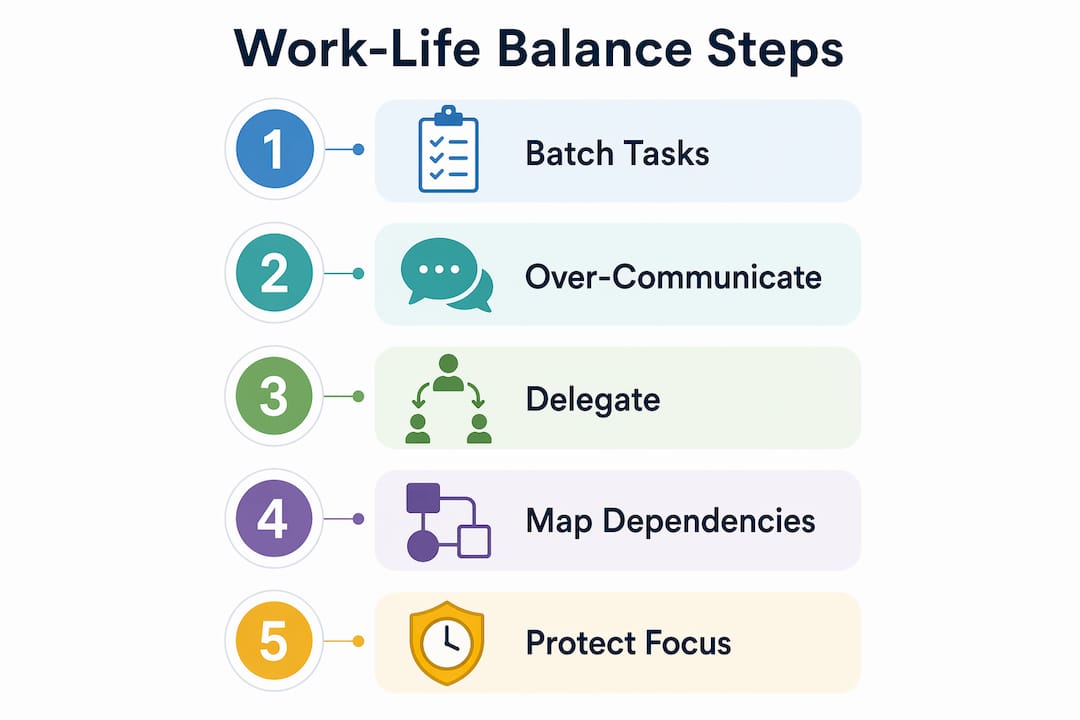
Logistics leaders who systemize operations, protect focused work hours, and over-communicate with clients and carriers consistently outperform those who rely on reactive hustle. The core elements that make this work:
- SOPs for customs entries, exceptions, and handoffs
- Batching supplier check-ins and status updates into fixed windows
- Time buffers built into SLAs on critical lanes
- Deliberate delegation of low-value tasks to trained staff or partners
- Client-facing templates for status updates and exception reports
- Targeted automation for tracking alerts and routine communications
OSHA’s workplace safety standards and CBP compliance requirements both create real operational pressure on logistics teams. Ignoring the human cost of that pressure, as research on supply chain burnout confirms, leads to errors, turnover, and service failures. The good news: structured habits protect both people and shipments.
Table of Contents
- What are the six actions you can start today?
- How do batching and focused hours stop the constant-checking habit?
- How does over-communication close the “gap of control”?
- How do SOPs and delegation create sustainable scale?
- How do you map third-party dependencies and build contingency plans?
- What team norms protect focus and respect global time zones?
- How do you recognize burnout early and act before it escalates?
- What does a 30/60/90-day implementation plan look like?
- Key Takeaways
- Why the “gap of control” insight changes everything
- Worldwideexpress reduces your team’s exception load directly
- Useful sources
What are the six actions you can start today?
Six concrete moves will stop reactive behavior before it compounds:
- Set one supplier-check window. Review supplier updates once daily, not continuously. A fixed 8:00 AM window works for most US-based teams.
- Schedule a 30-minute status digest. Pull all shipment updates into one daily review rather than checking tracking portals throughout the day.
- Assign one exception owner. Every active lane needs a named person responsible for escalations. Ambiguity creates double-handling and stress.
- Enable one automated tracking report. Configure your TMS or carrier portal to send a daily exception alert automatically.
- Protect a 90-minute deep-work block. Block 9:00–10:30 AM (or your team’s sharpest window) for high-cognitive tasks: customs prep, SLA reviews, contract negotiations.
- Add an SLA buffer on critical lanes. Build one extra transit day into customer-facing commitments on your highest-risk routes.
Pro Tip: Keep a shared SOP folder with status-update templates and exception-report scripts. New staff can follow them from day one, and experienced staff stop reinventing the same email every week.
How do batching and focused hours stop the constant-checking habit?
Consistency beats intensity for long-term sustainability in logistics. Continuous checking fragments attention, inflates response anxiety, and produces worse decisions than batched, focused work.

A sample weekly schedule for a manager handling international suppliers:
| Time Block | Activity | Notes |
|---|---|---|
| Mon–Fri 8:00–8:30 AM | Supplier digest + exception triage | Batch all overnight updates |
| Mon–Fri 9:00–10:30 AM | Deep-focus block (no notifications) | Customs prep, SLA reviews |
| — | Client status updates | Use templates; batch replies |
| Mon–Fri 9:00 PM | Supplier messages to Asia | Reaches China at 9:00 AM their time |
| Sat 8:00–10:00 AM | High-cognitive planning | Weekly review, SOP updates |
Sending supplier messages at 9:00 PM Eastern reaches Asian suppliers at their morning start, cutting response latency by a full business day.
Batching rules that protect the schedule:
- Supplier windows: contact suppliers once per day, in one batch message
- Exception triage: review exceptions at 8:00 AM and 3:00 PM only
- Report batching: generate all tracking reports at end of day, not on demand
- Email rules: set auto-responders outside the two daily reply windows
Pro Tip: Match task type to energy level. Reserve the 9:00–10:30 AM block for high-cognitive work. Avoid deep-focus work after 9:00 PM; that window is for mechanical tasks like data entry and message queuing, not strategic decisions.
How does over-communication close the “gap of control”?
The single biggest stressor in freight forwarding is the gap of control: the dependence on carriers, customs authorities, and overseas agents whose actions you cannot directly control. Clients feel that gap as silence, and silence creates anxiety calls that eat your team’s time.
Over-communication is the fix. Sending a proactive update before a client discovers a problem eliminates most urgent escalations.
A practical status-update template includes: shipment reference, current status, next milestone, estimated date, and any known risk. An exception report adds: what happened, impact on timeline, action taken, and revised ETA. Send status updates twice weekly on active shipments; send exception reports within two hours of identifying a problem.
- Frequency: status updates twice weekly; exception reports within 2 hours
- Format: one-paragraph email or shared portal note, not a phone call
- Owner: assign one person per account to send updates consistently
- Escalation rule: if a milestone is missed by more than 24 hours, auto-trigger an exception report
Pro Tip: Set automated escalation rules in your TMS so that a missed scan or customs hold triggers a draft exception report automatically. Staff review and send; they don’t write from scratch.
How do SOPs and delegation create sustainable scale?
Documented SOPs plus deliberate delegation equal sustainable scale. Without documentation, every task lives in someone’s head, and that person cannot take a day off without the operation degrading.
Document these first:
- Customs entry checklist (required documents, CBP filing sequence, common error flags)
- Exception-handling script (who to call, what to say, how to log it)
- Supplier onboarding contact script
- Client status-update template (see Section 4)
- Handoff protocol between shifts or team members
For delegation and outsourcing, time-tracking reveals which tasks consume hours without requiring judgment. Those are the first to delegate. Tasks to outsource first: manual shipment tracking, data entry into the TMS, routine status-update emails, and document filing.
When selecting a VA or 3PL partner, verify:
- Familiarity with your TMS or willingness to learn it within two weeks
- Availability during your critical overlap windows (especially evening hours for Asia lanes)
- Clear escalation path: what they handle independently vs. what they flag immediately
- A written handoff SOP before they go live on any active lane
Template libraries for supplier communication can save multiple hours per month and reduce the cognitive load of writing the same message repeatedly.
How do you map third-party dependencies and build contingency plans?
Map your dependencies first, then set SLAs and buffers around the most fragile links. A simple dependency map covers: origin agent, origin carrier, customs broker, destination carrier, and final-mile partner for each active lane.
Contingency actions for each fragile link:
- Identify an alternate carrier for every critical lane before you need one
- Hold a “hold-for-pickup” policy at destination for high-value cargo
- Assign a named escalation owner for each third party
- Apply cargo insurance to shipments above your risk threshold
- Set contractual SLAs with carriers and brokers; use operational buffers (one extra transit day) for customer-facing commitments
Pro Tip: Use your supply chain risk management framework to review dependency maps quarterly. Lanes that were low-risk six months ago may have new fragility points after carrier consolidations or port congestion events.
What team norms protect focus and respect global time zones?
Clear norms reduce unnecessary messaging and protect rest. Without written policies, the default is always-on, and always-on leads to shift-work sleep disruption and accumulated fatigue.
Policy snippets for remote logistics teams:
- Async updates: all non-urgent updates go into a shared channel or portal note, not a direct message
- Time-zone norm: schedule meetings within the overlap window of all attendees; never require attendance outside local business hours for routine calls
- Protected focus hours: no internal pings between 9:00 and 11:00 AM in each team member’s local time
- No-notify day: one afternoon per week (Friday PM works well) with no non-urgent messages
- Shift scheduling: rotate night shifts on a predictable cycle; avoid back-to-back night and day shifts within 48 hours
Pro Tip: Use a shared calendar with time-zone visibility and send one daily digest message instead of multiple pings. A single 8:00 AM team update replaces six individual check-ins and cuts notification fatigue immediately.
How do you recognize burnout early and act before it escalates?
Early detection plus quick structural fixes keeps people in the game. High-pressure logistics roles cause emotional strain through unpredictability and responsibility; the warning signs appear in behavior and output before they appear in conversations.
Warning signs to watch:
- Missed internal deadlines that were previously never an issue
- Declining quality in customs entries or client communications
- Spike in reactive, after-hours messages from a team member
- Increased error rates on routine tasks
- Withdrawal from team channels or shortened responses
Immediate intervention steps:
- Redistribute one active lane to another team member for two weeks
- Mandate one full rest day with no system access
- Automate the affected person’s most repetitive daily task temporarily
- Schedule a 20-minute coaching conversation focused on workload, not performance
- Review shift schedules for back-to-back high-pressure assignments
OSHA’s workplace safety guidelines include mental health as a component of worker safety. Practical frontline measures, including short breaks, hydration, and movement during long shifts, reduce physical strain and support mental recovery. These are not perks; they are operational inputs.
What does a 30/60/90-day implementation plan look like?
Measurable, staged change reduces relapse into old patterns. A phased plan gives teams a realistic timeline and clear ownership.
| Phase | Objective | Owner | KPI |
|---|---|---|---|
| 30 days | Document top 5 SOPs; set daily batching windows | Operations lead | SOPs completed; exception email volume |
| 60 days | Delegate 3 repetitive tasks; activate automated tracking alerts | Team lead + VA/partner | % tasks delegated; avg. response time |
| 90 days | Full 30/60/90 retrospective; adjust SLA buffers; review burnout indicators | Leadership | SLA compliance rate; reported stress indicators |
KPIs to track:
- Exception email volume per week (target: down from baseline)
- Average client response time (target: under 2 hours during business hours)
- Percentage of tasks delegated vs. handled by the manager directly
- SLA compliance rate on critical lanes
- Team-reported burnout indicators (monthly pulse survey, 3 questions)
Hold a weekly 15-minute review of exception volume and response time. At 90 days, run a retrospective: what reduced stress, what created new friction, and which SOPs need revision.
Key Takeaways
Logistics leaders who combine SOPs, batching, over-communication, and deliberate delegation protect both their teams and their service levels simultaneously.
| Point | Details |
|---|---|
| Batch and protect focus time | Schedule supplier check-ins and status updates in fixed daily windows; protect a 90-minute deep-work block. |
| Over-communicate proactively | Send status updates twice weekly and exception reports within 2 hours to close the gap of control. |
| Document SOPs first | Customs entries, exception scripts, and handoff protocols are the highest-leverage items to document first. |
| Stage change over 90 days | Use a 30/60/90 plan with named owners and KPIs to avoid relapse into reactive habits. |
| Worldwideexpress as a capability gap | Worldwideexpress customs brokerage, tracking, and cargo insurance services can directly reduce in-house exception load. |
Why the “gap of control” insight changes everything
The conventional wisdom on work life balance tips tends to focus on personal habits: meditate, exercise, log off at 6 PM. That advice is not wrong, but it misses the structural driver of stress in logistics. The real problem is not that logistics professionals work too hard. It is that they carry responsibility for outcomes they cannot directly control.
Every time a vessel reroutes, a customs hold appears, or a carrier goes silent, the manager absorbs the anxiety of the unknown. Clients call. Escalations pile up. The reactive loop begins. No amount of personal wellness practice fixes a structural communication gap.
What actually works is building systems that shrink the unknown: proactive client updates that arrive before the client panics, SOPs that give every team member a clear path through an exception, and buffers that absorb the inevitable variance in international transit. These are operational decisions, not lifestyle choices. The personal habits matter too, but they only hold when the operational environment stops generating constant emergencies.
The forwarders who sustain long careers in this industry are not the ones who work the hardest. They are the ones who built the most predictable systems around the least predictable supply chains.
Worldwideexpress reduces your team’s exception load directly
The right freight-forwarding partner does not just move cargo. It removes the categories of work that consume your team’s time and attention: customs exceptions, compliance questions, tracking gaps, and cargo claims.
Worldwideexpress offers U.S. customs brokerage, import and export freight forwarding, digital shipment tracking, and cargo insurance under one roof. That means fewer handoffs, fewer escalation calls, and fewer hours spent chasing status updates across multiple vendors. For teams already stretched thin, consolidating those functions with a single experienced partner is one of the fastest ways to reduce manager workload without adding headcount. Get a freight quote or review Worldwideexpress’s full logistics services to see where outsourcing can free up your team’s most valuable hours.
Useful sources
- The Human Cost of Supply Chain Crises: The Burnout Nobody Talks About — backs the burnout and workload claims throughout
- Is freight forwarding a stressful job? — primary source for the gap-of-control concept and over-communication insight
- The ultimate side-hustle playbook: import/export while working full time — supports batching and consistency-over-intensity claims
- After-Hours Importing — source for energy-matching and the no-deep-work-after-9-PM rule
- Time management for import side hustlers — supplier message timing and template library guidance
- Scaling your import business — time-tracking and delegation framework
- Creating a healthy work-life balance as a shift worker — shift scheduling and sleep disruption guidance
- Logistics & lifestyle: Managing stress in a 24/7 industry — frontline physical and mental recovery measures
- How high-pressure logistics work affects mental well-being — stress sources and psychological safety practices
- OSHA — workplace safety and mental health standards referenced in burnout section
- CBP — compliance requirements referenced in opening and SOP sections
Recommended
- Remote Team Management Tips for Logistics Leaders – Worldwide Express, Inc.
- Remote work in logistics: efficient strategies for global teams – Worldwide Express, Inc.
- How to Improve Cash Flow in Logistics Today – Worldwide Express, Inc.
- Improve Worker Safety in Logistics: Proven Protocols for 2026 – Worldwide Express, Inc.