Start with customer revenue and bootstrap as far as it takes you. Then layer in non-dilutive capital — grants, SBIR awards, or strategic partnerships — before touching equity. When you do raise equity, raise the minimum needed to hit your next high-value milestone, not the maximum the market will give you.
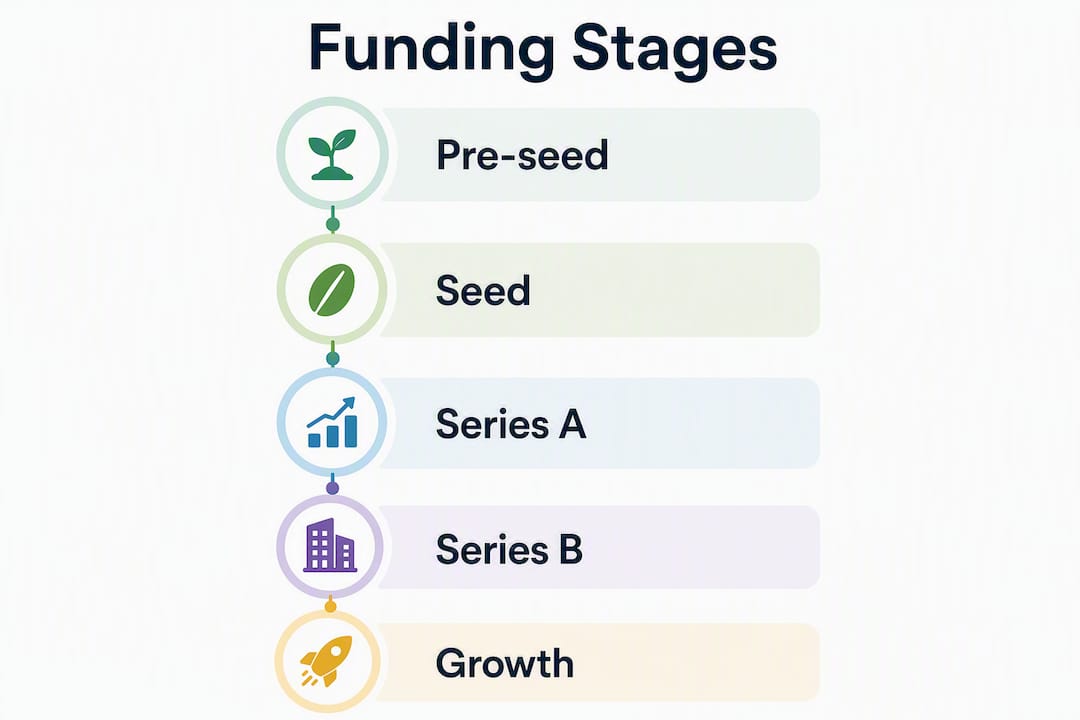
Stage-by-stage path:
- Pre-seed: Personal savings, friends and family, customer pre-sales, and early-stage grants. Preserve ownership entirely.
- Seed: Angel investors, accelerators like Y Combinator, and convertible notes or SAFEs. Validate the model before pricing a round.
- Series A: Institutional venture capital once you can demonstrate a repeatable, unit-economics-positive growth model.
- Series B and beyond: Venture debt, revenue-based financing, and follow-on equity to scale what is already working.
Two quick signal checks: choose non-dilutive capital (grants, customer prepayments, strategic partnerships) when your business can wait and your ownership matters more than speed. Choose equity when you need explosive growth capital and accept that investors will share in the upside. Debt fits best when revenue is predictable and cash flow can service repayment without threatening operations.
Table of Contents
- What are the main funding options for startups?
- Which funding type fits your startup’s stage?
- How do you choose the right funding mix?
- Where can you find each type of funding in the U.S.?
- Key legal and financial terms every founder must understand
- What founders get wrong about startup funding
- How to build a realistic fundraising timeline
- Key Takeaways
- What most funding guides won’t tell you
- Useful sources
What are the main funding options for startups?
Every funding type carries a different cost — measured in ownership, cash flow, time, or control. The catalog below covers every major source U.S. founders should consider, with trade-offs and platform examples for each.

Bootstrapping
You fund the business from personal savings, early revenue, and relentless cost discipline. No dilution, no debt, no outside pressure on your roadmap. The obvious constraint is capital ceiling: most bootstrapped companies grow more slowly and face real limits on capital-intensive opportunities. Best for service businesses, SaaS with low infrastructure costs, and founders who want to retain full control.
- Pros: Zero dilution, full control, forces lean habits
- Cons: Slow growth, personal financial risk, limited scale
- Typical amount: Varies widely; often $10,000–$150,000 from personal resources
- Timeline to capital: Immediate
Friends and family
Early informal capital from people who trust you personally. Terms are flexible, but mixing personal relationships with financial obligation creates real risk if the business struggles. Document every arrangement with a simple promissory note or equity agreement — a handshake deal becomes a source of lasting damage when things go wrong.
- Pros: Fast, flexible terms, low or no interest
- Cons: Relationship risk, informal governance, limited amounts
- Typical amount: $5,000–$150,000
- Timeline: Days to weeks
Angel investors
High-net-worth individuals who invest personal capital, often at pre-seed or seed stage, in exchange for equity or a convertible instrument. Beyond the check, experienced angels bring introductions, domain knowledge, and credibility with later-stage investors. AngelList is the most widely used U.S. platform for connecting founders with angels and syndicates.
- Pros: Patient capital, mentorship, network access
- Cons: Equity dilution, variable involvement, deal terms vary widely
- Typical amount: $25,000–$500,000 per angel; syndicates can reach $1M+
- Timeline: 4–12 weeks
Venture capital
Institutional funds that invest in high-growth startups in exchange for equity, board seats, and governance rights. VC is the right tool for a narrow set of businesses: those targeting large markets, with defensible technology or network effects, and founders willing to accept aggressive growth timelines. Most startups do not qualify and should not pursue VC.
- Pros: Large capital, strategic support, signal to market
- Cons: Significant dilution, board control, pressure for exits
- Typical amount: $1M–$15M+ at Series A; $15M–$50M+ at Series B
- Timeline: 3–9 months
Crowdfunding
Rewards-based: Kickstarter and Indiegogo let founders pre-sell products to the public before manufacturing. No equity changes hands. This is particularly powerful for consumer hardware, creative projects, and physical goods — it validates demand and funds production simultaneously.
Equity crowdfunding (Reg CF): Under Regulation Crowdfunding, U.S. startups can raise up to $5 million per year from non-accredited investors through SEC-registered platforms. This opens the investor pool dramatically but adds regulatory compliance obligations.
- Pros (rewards): No dilution, demand validation, marketing exposure
- Pros (equity CF): Broad investor access, community building
- Cons: Public campaign risk, fulfillment obligations, platform fees, Reg CF compliance
- Typical amount: $10,000–$5M depending on model
- Timeline: 30–90 days for campaign; Reg CF adds SEC filing time
Bank loans and SBA loans
Traditional bank loans require collateral, established credit, and often a revenue history that most early-stage startups cannot show. The U.S. Small Business Administration does not lend directly but guarantees loans made by approved lenders, reducing lender risk and making terms more accessible. SBA 7(a) loans cover general business purposes; SBA 504 loans target fixed assets like equipment and real estate. Use the SBA’s Lender Match tool to find participating lenders.
- Pros: — No dilution, lower rates than unsecured debt, SBA backing improves access
Venture debt
A loan product designed for venture-backed startups, typically offered alongside or after an equity round. Venture debt extends runway without additional dilution, but it comes with warrants (small equity stakes for the lender) and covenants that can restrict operations. Best for companies that have already raised equity and want to stretch between rounds.
- Pros: Extends runway, minimal dilution vs. equity
- Cons: Warrants, covenants, requires existing equity backing
- Typical amount: 20–35% of the last equity round
- Timeline: 4–8 weeks
Revenue-based financing (RBF)
Revenue-based financing repays as a fixed percentage of monthly revenue until the founder has returned a capital multiple, commonly 1.2x–1.5x of the original amount. No equity changes hands. RBF fits recurring-revenue businesses with healthy margins — SaaS, subscription e-commerce, and similar models. For capital-intensive or low-margin businesses, the effective cost can be punishing.
- Pros: No dilution, repayment flexes with revenue
- Cons: Expensive for low-margin businesses, revenue percentage reduces cash flow
- Typical amount: $50,000–$3M
- Timeline: 1–4 weeks
Convertible notes and SAFEs
A convertible note is a short-term debt instrument that converts to equity at a future priced round, typically with a discount rate and a valuation cap. A SAFE (Simple Agreement for Future Equity), pioneered by Y Combinator, is similar but is not debt — it carries no interest and no maturity date. Both instruments let early-stage founders raise capital quickly without negotiating a full valuation.
- Pros: Fast to close, defers valuation negotiation, low legal cost
- Cons: Dilution at conversion, cap and discount terms matter enormously
- Typical amount: $25,000–$2M
- Timeline: 1–3 weeks
Grants and non-dilutive programs
The SBIR (Small Business Innovation Research) and STTR (Small Business Technology Transfer) programs are the primary federal grant mechanisms for U.S. startups, specifically for R&D-focused companies. Phase I awards typically reach moderate amounts; Phase II can reach higher sums depending on the agency. NIH, DOE, NSF, and DoD all participate. State-level innovation grants and economic development programs add further options. Grants are highly competitive and slow, with application-to-funding timelines commonly running 6–12 months.
- Pros: No dilution, no repayment, credibility signal
- Cons: Slow, competitive, restricted to specific purposes (R&D, sector-specific)
- Typical amount: $50,000–$1.75M+ (SBIR/STTR); state grants vary widely
- Timeline: 6–12 months
Accelerators and incubators
Accelerators like Y Combinator offer a fixed-term program (typically 3 months), seed funding, mentorship, and a powerful alumni network in exchange for a small equity stake. Y Combinator’s standard deal has historically provided $500,000 in funding for 7% equity, though terms evolve. Incubators tend to be longer-term, often university-affiliated, and may offer space and resources without taking equity.
- Pros: Capital, mentorship, network, investor introductions at Demo Day
- Cons: Equity cost, competitive admission, geographic or sector focus
- Typical amount: $100,000–$500,000 (top-tier accelerators)
- Timeline: 3–6 months from application to program end
Strategic and corporate partnerships
Large corporations sometimes invest in or partner with startups through pilot contracts, joint development agreements, or corporate venture arms. A paying pilot with a Fortune 500 company is non-dilutive capital that also validates the product. As noted in the research, customer prepayments and strategic partner commitments not only fund operations but materially improve valuation signals when you later raise equity.
- Pros: Non-dilutive, demand validation, distribution access
- Cons: Slow negotiation, IP risk, dependency on one partner
- Typical amount: Varies; pilot contracts from $50,000 to millions
- Timeline: 3–12 months
| Funding Type | Best for / Ideal profile | Typical stage | Typical U.S. amount | Ownership impact | Repayment obligation | Speed to close | Investor involvement | Typical eligibility |
|---|---|---|---|---|---|---|---|---|
| Bootstrapping | Service, SaaS, lean models | Pre-seed | Personal resources | None | None | Immediate | None | Any founder |
| Friends & family | Early-stage, personal network | Pre-seed | $5K–$150K | Minimal | Negotiated | Days–weeks | Low | Personal relationship |
| Angel investors | High-growth, early traction | Pre-seed/Seed | $25K–$1M+ | Moderate dilution | None | 4–12 weeks | Moderate | Pitch + warm intro |
| Venture capital | Large-market, high-growth | Seed/Series A+ | $1M–$50M+ | Significant dilution | None | 3–9 months | High | Strong traction, large TAM |
| Crowdfunding (rewards) | Consumer products, hardware | Pre-seed/Seed | $10K–$5M | None | Fulfillment | 30–90 days | None | Public campaign |
| Crowdfunding (Reg CF) | Community-driven brands | Seed | Up to $5M/year | Dilution | None | 60 days | Low | SEC-registered platform |
| SBA loans | Established small businesses | Seed/Growth | Up to $5.5M | None | Yes (interest + principal) | 30–90 days | None | Credit, collateral, revenue history |
| Venture debt | Post-equity-round startups | Series A/B | 20–35% of last round | Warrants only | Yes | 4–8 weeks | Low | Existing equity backing |
| Revenue-based financing | Recurring-revenue businesses | Seed/Growth | $50K–$3M | None | Revenue % until cap | 1–4 weeks | None | Consistent monthly revenue |
| Convertible note / SAFE | Early-stage, fast close needed | Pre-seed/Seed | $25K–$2M | Dilution at conversion | None (SAFE) / Maturity (note) | 1–3 weeks | Low | Founder credibility |
| Grants (SBIR/STTR) | R&D, tech, science-based | Any | $50K–$1.75M+ | None | None | 6–12 months | None | U.S. small business, R&D focus |
| Accelerators | High-growth, coachable teams | Pre-seed/Seed | $100K–$500K | Small equity stake | None | 3–6 months | High | Competitive application |
| Strategic partnerships | B2B, enterprise, hardware | Any | Varies | None | None | 3–12 months | Moderate | Relevant product/market fit |
Pro Tip: The cheapest capital is capital you never have to raise. Customer prepayments, pilot contracts, and strategic partnerships preserve ownership and validate demand before you ever open a pitch deck.
Which funding type fits your startup’s stage?
Stage determines what investors expect to see and what instruments are even available to you. Showing up to a Series A conversation without a repeatable growth model is not just premature — it signals poor judgment to the investors you most want to impress.
Pre-seed (idea to MVP):
- Bootstrapping, friends and family, customer pre-sales
- Convertible notes or SAFEs for first outside capital
- Accelerator applications (Y Combinator accepts companies at this stage)
- Grants if the business has an R&D component
Seed (MVP to early traction):
- Angel investors and angel syndicates via AngelList
- Seed-stage VC funds
- Rewards-based crowdfunding for consumer products
- SBIR Phase I for science and tech companies
Series A (repeatable growth model):
- Institutional VC funds
- Venture debt alongside the equity round
- Revenue-based financing if ARR is established
- Series A funds the repeatable growth model; investors expect unit economics, not just potential
Series B and growth:
- Follow-on VC, growth equity
- Venture debt to extend runway between rounds
- RBF for capital-efficient scaling
- SBA loans for asset-heavy expansion
| Stage | Typical U.S. round size | Runway target | Key investor metric |
|---|---|---|---|
| Pre-seed | $50K–$500K | 12–18 months | Team, concept, early signal |
| Seed | $500K–$3M | 18 months | MVP, early customers, retention |
| Series A | $3M–$15M | 18 months | Repeatable growth, unit economics |
| Series B | $15M–$50M+ | 24 months | Efficiency, scalability, ARR growth |
Series B investors underwrite the efficiency and scalability of the growth model, not just the upside potential. Founders who conflate Series A and Series B expectations often underprepare on operational metrics.
How do you choose the right funding mix?
A practical funding plan starts by clarifying three things: what the capital is for, how fast you need to grow, and how much control you are willing to give up. Many startups mix instruments across stages, and the right mix shifts as the business matures.
Decision checklist — answer these before approaching any capital source:
- Does the business have predictable, recurring revenue? If yes, debt and RBF are viable. If no, equity or grants are safer bets.
- How capital-intensive is the model? Hardware, manufacturing, and logistics businesses often need more capital earlier and may benefit from equipment financing or SBA loans.
- How time-sensitive is the opportunity? Equity and grants are slow. RBF and venture debt close in weeks.
- How much dilution can you absorb before losing meaningful control or economic upside?
- Do you need more than money — mentorship, network, distribution? Accelerators and strategic partners deliver that; debt does not.
- Is the business R&D-focused? SBIR/STTR grants are purpose-built for this and carry zero dilution.
Questions to ask investors and lenders before signing anything:
- What is the liquidation preference, and is it participating or non-participating?
- Are there anti-dilution provisions? What triggers them?
- What covenants apply to this loan, and what happens if we breach one?
- What is the effective APR, including all fees, not just the stated interest rate?
- What board rights or observer rights come with this investment?
- What are the repayment mechanics — fixed schedule, revenue percentage, or bullet at maturity?
Runway math: Divide your current monthly burn rate into the capital you plan to raise. A $1.5M raise at $100,000 per month burn gives 15 months of runway. Add 20–25% buffer for fundraising time on the next round. Founders who raise exactly to their next milestone often run out of capital mid-fundraise.
Pro Tip: Raise the minimum equity needed to hit your next high-value milestone, then reassess. Raising more than you need accelerates dilution and can signal poor capital discipline to later-stage investors.
For founders in logistics, trade, or import/export, cash-flow management is especially critical when evaluating debt candidacy — receivables cycles and customs delays can create gaps that make fixed-repayment debt dangerous.
Where can you find each type of funding in the U.S.?
Equity and angel capital:
- AngelList: the primary U.S. platform for angel syndicates, rolling funds, and early-stage VC discovery. Create a profile, join relevant communities, and use the platform’s syndicate structure to reach investors at scale.
- Y Combinator: apply at ycombinator.com twice per year (winter and summer batches). Prepare a two-minute video, a clear problem statement, and evidence of early traction. Applications open roughly 3–4 months before each batch.
- Local angel networks: most major U.S. cities have organized angel groups (Tech Coast Angels in Los Angeles, Golden Seeds nationally for women-led companies). Search the Angel Capital Association directory.
SBA and bank loans:
- SBA Lender Match: enter basic business information and receive matched lender introductions within two days. Prepare two years of tax returns, a business plan, financial projections, and collateral documentation.
- Community Development Financial Institutions (CDFIs): mission-driven lenders that serve underserved founders. Find them at the CDFI Fund directory (cdfifund.gov).
Grants:
- SBIR.gov: the official portal for all federal SBIR and STTR solicitations across 11 participating agencies. Filter by agency, topic, and phase. Phase I proposals are typically 15–25 pages.
- Grants.gov: the central repository for all federal grant opportunities. Set up keyword alerts for your sector.
- State programs: most states operate their own innovation grant and loan programs. Search “[your state] small business innovation grant” or contact your state’s economic development office.
Crowdfunding:
- Kickstarter: best for creative projects and consumer hardware. Launch only when the product is camera-ready; campaigns with professional video and a clear reward structure consistently outperform those without.
- Indiegogo: more flexible campaign structures, including InDemand for post-campaign sales. Also hosts equity crowdfunding through its partnership with MicroVentures.
- Wefunder, Republic, StartEngine: leading Reg CF platforms for equity crowdfunding.
Revenue-based financing:
- Clearco, Capchase, and Pipe are among the better-known U.S. RBF providers for SaaS and subscription businesses. Most require 6+ months of revenue history and a minimum monthly revenue threshold.
Accelerators:
- Y Combinator application checklist: clear problem, evidence of founder-market fit, working prototype or early customers, two-minute founder video, and a concise written application. Apply early; late applications receive less attention.
- Techstars, 500 Global, and sector-specific accelerators (Plug and Play, MassChallenge) run multiple cohorts per year.
For founders building equipment-heavy or asset-intensive businesses, equipment financing offers a debt path that ties repayment to the asset itself rather than general cash flow.
Key legal and financial terms every founder must understand
Accepting capital without understanding the terms is one of the most common and costly mistakes early-stage founders make. Term-sheet clauses like liquidation preferences and anti-dilution provisions can materially alter founder outcomes even when the headline valuation looks attractive.
Terms to know before you sign:
- Valuation (pre-money vs. post-money): Pre-money valuation is what the company is worth before the investment. Post-money is pre-money plus the new capital. A $5M pre-money valuation with a $1M raise gives a $6M post-money valuation and roughly 16.7% dilution to the investor.
- Liquidation preference: Investors get paid before founders in an exit. A 1x non-participating preference means investors recover their investment first; a participating preference means they recover their investment AND share in remaining proceeds. Participating preferences can dramatically reduce founder proceeds in modest exits.
- Anti-dilution: Protects investors if a future round prices below their entry. Broad-based weighted-average anti-dilution is standard and relatively founder-friendly; full-ratchet anti-dilution is punishing and should be resisted.
- Vesting: Founders and employees earn equity over time, typically over four years with a one-year cliff. Accelerated vesting on acquisition is a negotiating point worth fighting for.
- Board seats: Institutional investors often require a board seat. Understand the board composition before and after the round — losing board control early limits your options significantly.
- Warrants: Common in venture debt; give the lender the right to purchase equity at a fixed price. Warrants dilute founders but are typically small (1–2% of the round).
- Covenants: Loan conditions that restrict behavior — minimum cash balances, revenue targets, restrictions on additional debt. Breaching a covenant can trigger immediate repayment.
- Interest rate vs. effective APR: The stated rate on a loan is rarely the full cost. Origination fees, prepayment penalties, and factor rates on merchant cash advances can push the effective APR far above the headline number.
Simple dilution example:
You own 100% of a company valued at $4M pre-money. An angel invests $1M, giving a $5M post-money valuation. The angel owns 20% ($1M / $5M). You now own 80%. If a second round raises $3M at a $9M pre-money valuation ($12M post-money), the new investor owns 25%. Your 80% is diluted to 60%. After two rounds, you hold 60% of a company worth $12M — still $7.2M in paper value, but the direction of travel matters.
Numbered checklist for term-sheet review:
- Confirm the liquidation preference type (non-participating preferred is founder-friendly).
- Identify any anti-dilution clause and its trigger conditions.
- Map the post-round cap table including all options and warrants.
- Read every covenant in a debt instrument and model the breach scenario.
- Calculate the effective APR on any loan, including all fees.
- Confirm vesting schedules for all founders and key employees.
- Understand board composition and voting thresholds for major decisions.
Pro Tip: Never sign a term sheet or debt covenant without independent legal and accounting review. The cost of an attorney for a few hours is trivial compared to the cost of a clause you did not understand.
What founders get wrong about startup funding
There is no general federal grant for starting a business. USA.gov is explicit: federal agencies provide targeted grants for specific purposes — rural development, R&D, sector-specific programs — but not for general startup operating costs. Founders who spend months chasing “free federal money” for general operations are chasing something that does not exist.
“The federal government does not provide grants for starting and expanding a business. Grants from the federal government are only available to non-commercial organizations, such as nonprofits and educational institutions. However, small businesses may qualify for targeted programs like SBIR/STTR for R&D, or sector-specific grants from agencies like the USDA or DOE.” — per USA.gov guidance
Red flags and scams to watch for:
- Any service promising guaranteed access to federal startup grants for a fee.
- Merchant cash advances marketed as “business loans” with factor rates that translate to effective APRs well above 50% — and sometimes far higher.
- Investors who ask for upfront fees before wiring capital.
- Revenue-based financing offers with repayment caps above 1.5x or unusually short repayment windows that compress cash flow.
- Term sheets with full-ratchet anti-dilution or participating preferred with no cap.
Pro Tip: Before signing any debt instrument, ask the lender to state the effective APR in writing, including all fees. If they refuse or cannot calculate it, walk away.
How to build a realistic fundraising timeline
Sample 12–18 month fundraising plan:
- Month 15–18: — Close Series A. Negotiate venture debt alongside if runway extension is needed.
Round-sizing formula:
Worked example: $80,000 monthly burn, targeting 20 months of runway. Target raise = ($80,000 × 20) + 25% buffer = $1,600,000 + $400,000 = $2,000,000.
| Stage | Typical U.S. range | Common instrument | Runway target |
|---|---|---|---|
| Pre-seed | Ranges widely | SAFE, convertible note, grants | 12–18 months |
| Seed | Varies widely | Priced equity, SAFE, angel round | 18 months |
| Series A | Typically millions | Priced equity (preferred stock) | 18 months |
| Series B | Typically larger amounts | Priced equity, venture debt | 24 months |
Key Takeaways
Founders who mix equity, debt, and non-dilutive capital strategically — rather than defaulting to venture capital — consistently preserve more ownership and build more durable businesses.
| Point | Details |
|---|---|
| Start non-dilutive | Exhaust customer pre-sales, grants, and partnerships before touching equity. |
| Match instrument to stage | SAFEs and angels fit pre-seed; institutional VC belongs at Series A with a proven growth model. |
| Size rounds with a buffer | Raise monthly burn × target runway, then add 20–25% for fundraising time. |
| Read every term-sheet clause | Liquidation preferences and anti-dilution provisions can override a strong headline valuation. |
| No general federal startup grant | SBIR/STTR funds R&D; USA.gov confirms there is no federal grant for general business operations. |
What most funding guides won’t tell you
The dominant narrative around startup funding is that venture capital is the goal and everything else is a consolation prize. That framing leads founders to optimize for the wrong thing at the wrong time.
The founders who tend to do best are not the ones who raised the most money earliest. They are the ones who raised the right amount at the right moment, from people who understood the business. Raising a large seed round before validating the model does not accelerate success — it accelerates the burn rate and compresses the time available to find product-market fit.
Two patterns show up repeatedly among founders who later regret their early capital decisions. The first is taking equity from investors who did not understand the business model, then spending months managing misaligned expectations instead of building. The second is signing debt covenants without modeling the breach scenario — a minimum cash covenant that seemed comfortable at signing becomes a crisis when a large customer pays late.
For founders in trade, import/export, or logistics-adjacent businesses, this cash-flow sensitivity is acute. Customs delays, freight payment cycles, and inventory financing gaps can all create situations where a fixed-repayment debt instrument becomes dangerous. Understanding freight contract payment terms and receivables cycles before committing to a repayment schedule is not optional — it is the difference between a manageable loan and a liquidity crisis. Founders building physical-goods businesses that cross borders should factor logistics costs and payment timing into every funding model they build.
The practical correction in both cases is the same: slow down before signing, get independent legal and accounting review, and model the downside before the upside.
Useful sources
- U.S. Small Business Administration — Loans: Find SBA-guaranteed loan programs and use Lender Match to connect with approved lenders.
- Fund your business — SBA Business Guide: The SBA’s official overview of self-funding, equity, and debt options for small business owners.
- Start a business — USA.gov: Authoritative federal guidance on business formation and funding, including the clear statement that no general federal startup grant exists.
- Kickstarter: Launch rewards-based crowdfunding campaigns for consumer products and creative projects.
- Indiegogo: Flexible crowdfunding platform with InDemand post-campaign sales and equity crowdfunding options.
- AngelList: Connect with angel investors, syndicates, and early-stage VC funds; build a startup profile and raise from accredited investors.
- Y Combinator: Apply to the world’s most prominent startup accelerator; review the SAFE template and startup resources library.
- SBIR.gov: Official portal for all federal SBIR and STTR solicitations; filter by agency, phase, and topic area.
This article provides general information about startup financing and does not constitute legal, financial, or tax advice. Consult a qualified attorney, CPA, or financial advisor before making funding decisions or signing any capital agreement.
Recommended
- Unlock Small Business Export Benefits for Global Growth – Worldwide Express, Inc.
- Cheap International Shipping: A 2026 Guide for Businesses – Worldwide Express, Inc.
- Broker Shipping: How to Choose the Right Partner in 2026 – Worldwide Express, Inc.
- Top e-commerce shipping strategies for logistics success 2026 – Worldwide Express, Inc.