For U.S.-bound air cargo, the single most important action is submitting accurate ACAS and entry data as early as possible and working with a licensed customs broker or an eligible ACAS filer. That one step prevents the majority of Do-Not-Load orders and post-arrival holds before they ever happen.
Eligible parties who can file ACAS advance cargo data with CBP include the inbound air carrier, authorized brokers or filers, or other eligible third-party filers. If your shipment is at risk right now, the fastest path forward is to contact your broker, verify the ACAS transmission and manifest data, correct any errors, and resubmit before the aircraft departs.
- Contact your assigned broker or Worldwideexpress immediately if a hold or Do-Not-Load notice appears.
- Verify that the air waybill number, shipper/consignee data, and cargo description in the ACAS filing match your commercial documents exactly.
- If data was rejected, correct and resubmit through the approved channel before wheels-up.
Pro Tip: Per CBP’s Enhanced ACAS guidance, filing entry-level data at booking or pickup, not just at departure, gives CBP the longest possible window to clear your shipment without intervention.
Key Takeaways
Submitting accurate ACAS data before consolidation, with a licensed broker filing through ABI/ACE, is the single highest-impact action for fast airport customs clearance.
| Point | Details |
|---|---|
| File ACAS before consolidation | Submit advance cargo data at booking or pickup, not at departure, to maximize CBP’s screening window. |
| Match AWB and entry data exactly | Any discrepancy between the air waybill, ACAS filing, and commercial invoice triggers a CBP hold. |
| Confirm bond and importer of record | Formal entries over $2,500 require a customs bond and a named importer of record before departure. |
| Pre-notify FDA and USDA early | Regulated commodities need agency pre-notifications filed before arrival, not after the plane lands. |
| Worldwideexpress for end-to-end clearance | Worldwideexpress provides ACAS filing support, ABI/ACE entry filing, and 24/7 hold resolution at major U.S. airports. |
Table of Contents
- What customs clearance for air cargo actually means in the U.S.
- How airport customs clearance actually happens, step by step
- Documents and data you need for air cargo entry
- Most common causes of holds and how to prevent them
- How to choose a customs broker for airport clearance
- Pre-departure and arrival checklist for faster clearance
- Why this guidance is reliable
- What early ACAS filing actually looks like in practice
- Worldwideexpress handles airport customs clearance end to end
- Sources
What customs clearance for air cargo actually means in the U.S.
Customs clearance for air cargo is the regulatory process by which U.S. Customs and Border Protection (CBP) reviews, assesses, and authorizes the release of commercial goods arriving by aircraft. It is entirely separate from passenger immigration. The cargo side involves advance security screening, duty assessment, and physical or documentary examination of freight, not travelers.
Several agencies and parties share responsibility for a clean clearance:
- CBP leads the process: it receives advance data, issues screening dispositions, and authorizes release.
- TSA coordinates on security screening for cargo loaded onto passenger aircraft.
- The air carrier transmits the air waybill manifest and is the primary ACAS filer in most cases.
- The customs broker files the formal entry (Form 3461 and Form 7501) through ACE/ABI on behalf of the importer of record.
- The importer of record is legally responsible for duties, accuracy of entry data, and compliance.
- Freight forwarders and Regulated Agents handle physical consolidation and may participate in ACAS filing as eligible third-party filers.
Speed is one of air freight’s core advantages, but it depends entirely on clean data. According to Tariffs Tool’s air freight clearance guide, most clean air entries clear in 2–6 hours after wheels-down. A shipment flagged for a Centralized Examination Station (CES) exam typically adds one to two days; other holds can extend that by several days.
How airport customs clearance actually happens, step by step
The clearance sequence begins long before the aircraft lands, and understanding the full flow helps you catch problems at the cheapest point to fix them.
- Pre-departure: ACAS filing. The carrier, broker, or eligible third-party filer transmits advance security data to CBP. Under 19 CFR §122.48a, the timing rule for most international air cargo is “wheels up” from the last foreign port, meaning data must be filed before the aircraft departs. For nearby foreign areas (Canada, Mexico, Caribbean), the rule is four hours prior to arrival.
- CBP screening disposition. CBP reviews the ACAS data and issues one of three responses: “No Targeting,” “Examine,” or “Do Not Load.” A “No Targeting” response is the green light to proceed.
- Manifest filing. The carrier files the complete air waybill manifest with CBP, typically at or before departure.
- Entry filing. The customs broker files Form 3461 (entry/immediate delivery) via ABI/ACE. For formal entries over $2,500, a customs bond is required.
- Arrival and CBP matching. CBP matches the entry data to the manifest. Discrepancies trigger holds.
- Examination (if selected). Three exam types exist: documentary (paper review), non-intrusive inspection (X-ray or imaging), and physical (full unpack). CES exams add 24–48 hours; physical exams can take longer.
- Release and delivery. CBP issues release, the broker notifies the importer, and the freight is available for pickup from the bonded terminal or cargo facility.
Pro Tip: Share entry-level data with your carrier at booking or pickup, not just at departure. Per CBP’s Enhanced ACAS FAQ, early submission gives CBP the maximum window to process clearance and reduces the chance of a last-minute Do-Not-Load.
Documents and data you need for air cargo entry
Every U.S. air import entry requires a core set of documents. Missing even one can stop a shipment at the terminal.
| Data / Document | Filing Trigger | Filed By | ACAS (A) / Entry (E) |
|---|---|---|---|
| Air Waybill (AWB) | All shipments | Carrier / Broker | A + E |
| Shipper name, address, contact | All shipments | Carrier / Filer | A |
| Consignee name, address, email, phone | All shipments | Carrier / Filer | A (enhanced) |
| Cargo description, weight, piece count | All shipments | Carrier / Filer | A |
| Commercial invoice | Formal entry | Importer / Broker | E |
| Packing list | Formal entry | Importer / Broker | E |
| HTS classification number | Formal entry | Broker | E |
| Declared customs value | Formal entry | Broker | E |
| CBP Form 3461 (entry) | Formal entry | Broker via ABI/ACE | E |
| CBP Form 7501 (entry summary) | Post-release | Broker via ABI/ACE | E |
| Customs bond | Entries over $2,500 | Broker / Surety | E |
| FDA prior notice | Food, dietary supplements | Importer / Broker | E (conditional) |
| USDA permit or phytosanitary cert | Plants, animals, ag products | Importer | E (conditional) |
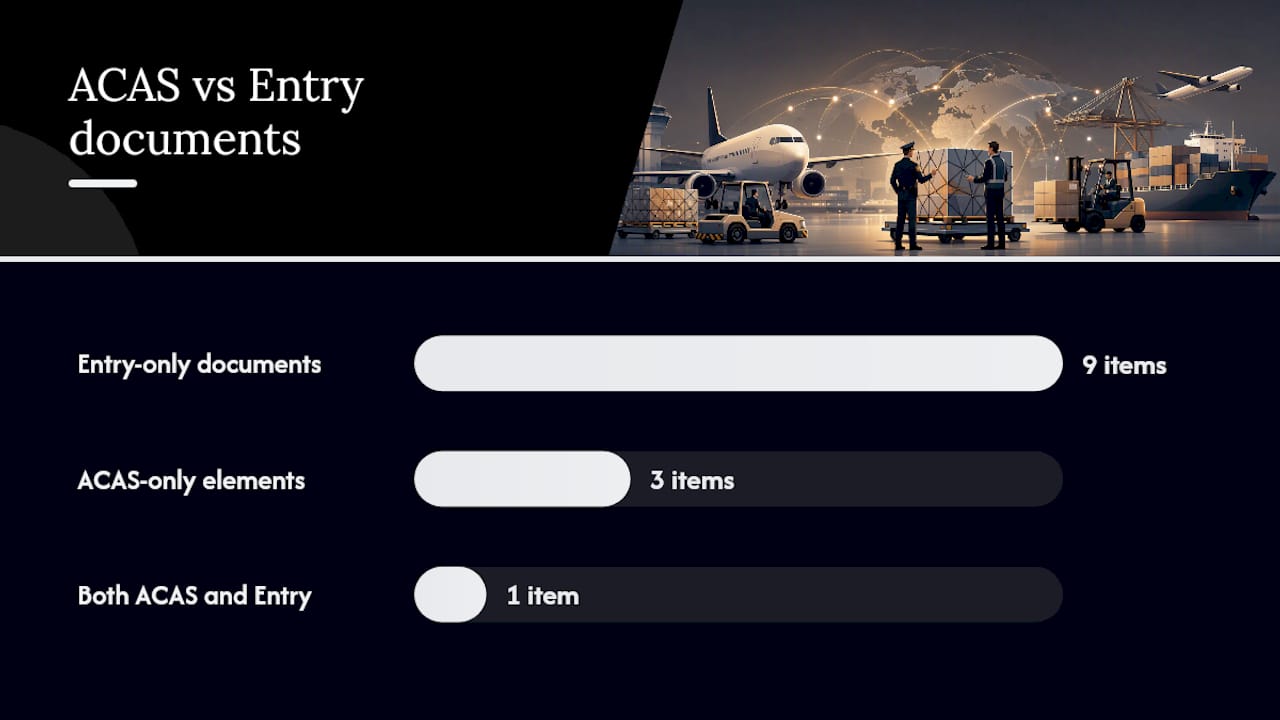
ACAS data elements, per the ACAS FAQs published by CBP, include both standard fields (shipper/consignee name and address, AWB, cargo description, weight) and enhanced elements such as consignee email and phone number, packing location, Verified Known Consignor status, and eCommerce marketplace data. Transmissions use Cargo-IMP or CAMIR-Air message formats through CBP-approved interchange systems, as detailed in the ACAS Implementation Guide.
Pro Tip: Verified consignee contact details, specifically a working email and phone number, are enhanced ACAS elements that speed CBP’s security processing. Confirm them with your shipper before the booking is finalized.
Most common causes of holds and how to prevent them
The majority of air cargo delays are avoidable. Inaccurate advance data and incomplete documentation account for most holds, and both are fixable before the aircraft departs.
- Late or inaccurate ACAS transmission. File before consolidation. Per the ACAS FAQs, the earlier the filing, the sooner CBP communicates a screening disposition, minimizing operational impact.
- AWB and entry data mismatch. The cargo description, weight, and party names in the ACAS filing must match the commercial invoice and entry exactly. Any discrepancy triggers a hold.
- Missing importer of record or bond. Formal entries over $2,500 require a customs bond and a named importer of record. Confirm both are in place before departure.
- Regulatory agency holds. FDA requires prior notice for food and dietary supplements; USDA requires permits or phytosanitary certificates for plants and agricultural products. These must be filed before arrival, not after.
- Rejected ACAS transmission. If CBP rejects a transmission, correct the data and resubmit immediately. Do not wait for the carrier to act; your broker should have a documented error-correction process.
When a Do-Not-Load order arrives, time is the only resource that matters. Contact your broker within minutes, not hours. The broker should pull the ACAS filing, identify the flagged element, correct it, and coordinate resubmission with the carrier before the loading cutoff. If the shipment is already loaded, escalate to your CBP client representative immediately.
Pro Tip: Keep your CBP client representative’s direct contact on file. For urgent Do-Not-Load situations, that relationship is faster than any general helpline. Worldwideexpress can help you establish and maintain that contact as part of ongoing brokerage support.
How to choose a customs broker for airport clearance
Pick a broker with documented ACAS filing experience, ABI/ACE system access, and established relationships at your specific port of entry. A broker who files well at JFK may not have the same handler relationships at LAX or O’Hare.
Selection criteria:
- Active ABI/ACE integration for electronic entry filing
- Demonstrated ACAS filing capability (ask for their filing process in writing)
- Airport cargo handler and bonded terminal relationships at your port of entry
- NCSP (National Cargo Security Program) or RACA status for enhanced screening participation
- Continuous bond options (preferable to single-entry bonds for regular importers)
- Documented SLAs for entry filing turnaround and error correction
- Cargo insurance and liability coverage options
Questions to ask during evaluation:
- What is your average entry filing time after wheels-down for clean shipments?
- How do you handle a rejected ACAS transmission at 2 AM?
- Do you have a continuous bond program, or do you require single-entry bonds?
- Which airports do you have direct handler relationships with?
- How do you coordinate with FDA or USDA for regulated commodities?
Red flags to watch for: no documented ABI access, inability to explain their ACAS filing process, vague escalation procedures for holds, and no experience with perishable or temperature-sensitive cargo if that applies to your shipments. A broker who understands how customs brokers support global trade will answer these questions without hesitation.
Pre-departure and arrival checklist for faster clearance
Use this checklist at booking and again at departure to confirm everything is in place for fast airport customs clearance. Catching a gap here costs minutes; catching it at the terminal costs days.
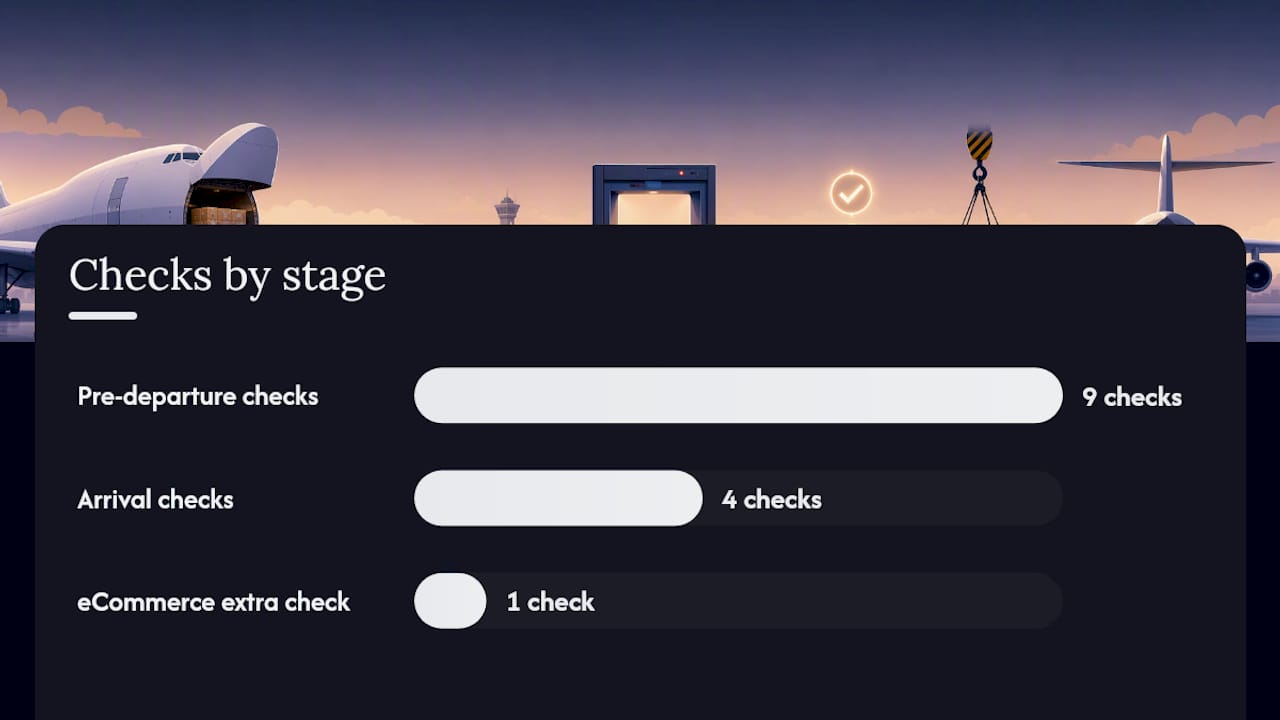
Pre-departure:
- [ ] ACAS data filed: shipper/consignee names, addresses, email, phone, AWB, cargo description, weight, piece count
- [ ] AWB number confirmed and matches all commercial documents
- [ ] HTS classification number verified and declared value confirmed
- [ ] Commercial invoice and packing list complete and consistent with AWB
- [ ] Customs bond confirmed (continuous or single-entry) for shipments over $2,500
- [ ] Importer of record identified and on file with broker
- [ ] FDA prior notice filed for food, supplements, or cosmetics
- [ ] USDA permit or phytosanitary certificate obtained for applicable commodities
- [ ] Broker notified of departure schedule and any special handling requirements
At arrival:
- [ ] Confirm broker has filed Form 3461 via ABI/ACE
- [ ] Track CBP status in ACE for release or exam notification
- [ ] Bonded terminal pickup arranged and driver documentation ready
- [ ] For perishables or pharmaceuticals: cold-chain or temperature-controlled handling confirmed with the cargo facility in advance
For eCommerce shipments, also verify that marketplace data fields required under enhanced ACAS elements are included in the filing. The eCommerce customs clearance guide covers those additional requirements in detail.
Pro Tip: Perishables and pharmaceuticals require pre-coordination with the bonded cargo facility, not just the broker. Confirm temperature-controlled storage availability at the destination airport before the shipment departs.
Why this guidance is reliable
This guide follows CBP’s published ACAS rules and frontline broker practice. Every procedural claim traces to a primary regulatory source or CBP-published guidance.
Primary regulatory and CBP sources used:
- 19 CFR §122.48a: timing rules, mandatory data elements, and eligible filers for advance air cargo information
- ACAS Implementation Guide (CBP): transmission formats (Cargo-IMP / CAMIR-Air) and system integration requirements
- Enhanced ACAS FAQ (CBP, 2026): enhanced data elements, early filing benefits, and Do-Not-Load procedures
- ACAS FAQs (CBP): filing responsibilities, timelines, and forwarder/broker participation benefits
The operational reality is this: brokers who participate in ACAS filing, rather than leaving it entirely to the carrier, gain earlier screening dispositions and the opportunity to segregate or screen cargo under NCSP before a Do-Not-Load order is issued. That proactive posture is what separates fast clearance from costly delays.
Worldwideexpress’s customs compliance resources reflect this same regulatory framework, applied to real airport handling operations across major U.S. hubs.
What early ACAS filing actually looks like in practice
The most common misconception in air freight is that customs clearance starts when the plane lands. It does not. The brokers who consistently deliver fast release are the ones who treat the ACAS filing as a pre-departure coordination task, not an arrival formality.
Consider a typical scenario: a shipper in Frankfurt sends a pallet of medical devices to a U.S. distributor. The broker receives the commercial invoice and packing list at booking, confirms the HTS classification, verifies the consignee’s email and phone for the enhanced ACAS elements, and shares that data with the carrier before consolidation. CBP receives the ACAS transmission hours before wheels-up, issues a “No Targeting” disposition, and the entry is filed before the aircraft crosses the Atlantic. By the time the pallet lands at O’Hare, release is waiting.
That outcome is not luck. It is the direct result of treating ACAS as a coordination task between shipper, broker, and carrier, not a box to check at departure. The practical takeaway: give your broker complete entry-level data at booking, every time.
Worldwideexpress handles airport customs clearance end to end
Faster airport clearance starts with a broker who files ACAS before consolidation, not after landing. Worldwideexpress offers U.S. customs brokerage services that cover the full clearance cycle: ACAS filing coordination, ABI/ACE entry filing, airport cargo handler relationships at major U.S. hubs, continuous bond options, and 24/7 support for urgent holds or Do-Not-Load situations. For perishables, pharmaceuticals, and regulated commodities, Worldwideexpress coordinates FDA and USDA pre-notifications as part of the standard brokerage workflow.
The delays covered in this guide—late ACAS, AWB mismatches, missing bonds, regulatory holds—are all addressable before departure when the right broker is in place. To get a quote or connect with a Worldwideexpress customs specialist, visit Worldwideexpress and request a consultation for your next air shipment.
Sources
The sources below are the primary references for every procedural and regulatory claim in this guide. Save them and share them with your broker or carrier before your next shipment.
- Enhanced Air Cargo Advance Screening Security Filing Frequently Asked Questions (FAQ)
- Air Cargo Advance Screening (ACAS) Implementation Guide | U.S. Customs and Border Protection
- 19 CFR § 122.48a — Advance electronic information for certain bulk and containerized cargo
- ACAS FAQs
- Air Freight Customs Clearance — Duties, Brokers & Tariffs (2026)
- US Customs Clearance Process: Fees, Processing Time, Payments & What Status Messages Mean | GoFreight
- CBP Import Requirements 2026 — U.S. Customs and Border Protection Compliance Guide
For CBP client representative support on urgent holds, contact CBP’s Trade Transformation Office through the ACE portal or ask your broker to escalate through their designated CBP account manager.
Recommended
- Airport Customs Clearance 2026: 40% Faster Processing – Worldwide Express, Inc.
- Power of Attorney for Customs Clearance: Streamline US Imports – Worldwide Express, Inc.
- Streamline airport customs clearance for faster shipping – Worldwide Express, Inc.
- The Initiated Customs Clearance Process: A U.S. Guide – Worldwide Express, Inc.