The fastest way to get a reliable international car-shipping plan is to pick the right transport mode, gather your export documents, and request a quote with your exact VIN, vehicle dimensions, and origin and destination ports. For most running vehicles, that means choosing between Roll-on/Roll-off (RORO) ocean service, a shared container, a sole-use container, or air freight, each carrying a meaningfully different price tag and transit window.
According to indicative 2026 cost data, RORO runs within a broad range for ocean shipping per vehicle, with shared containers, sole-use containers, and air freight each carrying relatively higher price tags. Those are ocean or air freight charges only. Destination duties, VAT, terminal handling, and local delivery can add as much again to the landed cost, so budget accordingly before you commit to a method.
Before you contact any international car shipping company, have these four items ready: your vehicle’s VIN, year/make/model, the origin port or city and ZIP, and the destination port or country. Add running condition and approximate dimensions if the vehicle is modified or oversized. That information is what separates a precise quote from a rough estimate.
Key Takeaways
Shipping a car internationally from the U.S. requires choosing the right transport method, filing EEI through AES at least 72 hours before export, and budgeting for destination duties that can match or exceed the base freight cost.
| Point | Details |
|---|---|
| Choose your method first | RORO ($900–$2,000) suits running vehicles; sole-use containers ($1,800–$3,500) protect classics and exotics. |
| File EEI 72 hours before export | AES/AESDirect filing is mandatory for all used self-propelled vehicles, regardless of value or destination. |
| Budget for destination costs | Duties, VAT, terminal handling, and broker fees at the destination can equal or exceed the base freight charge. |
| Insure to declared value | Carrier liability is limited; marine all-risks insurance covers physical loss during loading, transit, and unloading. |
| Worldwideexpress as your single point of contact | Worldwideexpress handles AES filing, ocean/air freight booking, customs brokerage, and cargo insurance facilitation for vehicle shippers. |
This article is general information, not a substitute for advice from a qualified lawyer. Consult a qualified legal professional about your own circumstances before acting on anything here.
Table of Contents
- How Much Does International Car Shipping Cost?
- Which Shipping Method Is Right for Your Vehicle?
- What Are the Realistic Booking and Transit Times?
- What Documents Do You Need to Export a Car From the U.S.?
- How to Prepare Your Vehicle for Export
- Understanding Insurance and Carrier Liability
- What Happens at the Destination Port?
- How to Choose an International Car Shipping Company
- What Information Do You Need to Get an Accurate Quote?
- What a Freight Forwarder and Customs Broker Do for Vehicle Shippers
- Customs Regulations and Restrictions by Destination Country
- Payment Terms, Deposits, and Cancellation Policies
- What Experienced Shippers Know That First-Timers Often Miss
- Worldwideexpress Handles the Complexity of Shipping Your Vehicle Abroad
- Sources
How Much Does International Car Shipping Cost?
Price is the first question, and the honest answer is that it depends on four variables more than anything else: the shipping method, the lane, the vehicle’s size, and what you include in the service scope.
Price bands by method
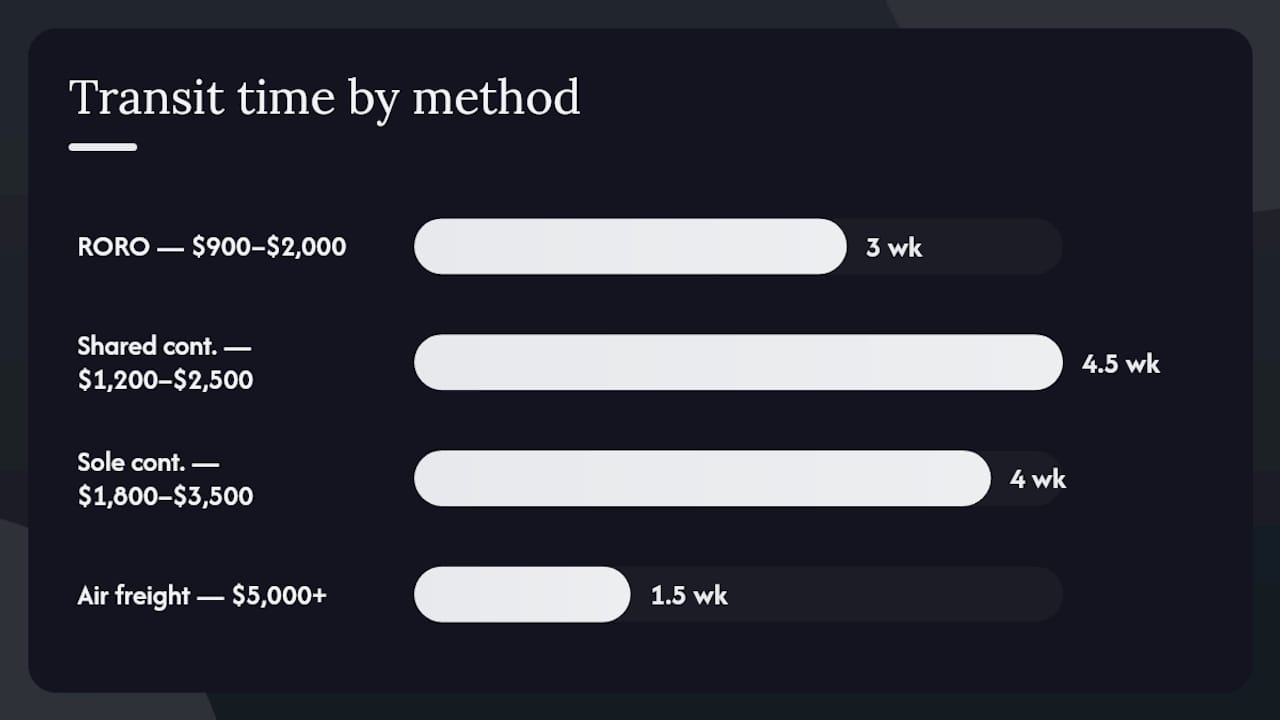
Cost data for 2026 puts the per-vehicle freight ranges at:
- RORO: $900–$2,000
- Shared (consolidated) container: $1,200–$2,500
- Sole-use container: $1,800–$3,500
- Air freight: $5,000 and up
These figures cover ocean or air freight only. Port fees, destination customs duties, VAT or GST, terminal handling charges, and inland trucking are billed separately and, on many lanes, can equal or exceed the base freight charge.
What drives the price up or down
The method is the single biggest lever, but several secondary factors move the number significantly:
- Lane: U.S. to Western Europe and U.S. to Australia are well-served routes with competitive rates. U.S. to Gulf Cooperation Council (GCC) countries or remote Pacific islands carry surcharges for limited sailing frequency.
- Vehicle size and height: Oversized vehicles, lifted trucks, and those with nonstandard ground clearance take up more deck or container space. Pricing follows cubic or deck space, so cross-checking your vehicle’s dimensions before requesting a quote avoids surprises.
- Port fees: Origin terminal handling, documentation fees, and chassis fees vary by U.S. gateway port.
- Seasonality: Summer and year-end sailings tend to book faster and sometimes carry rate premiums.
- Door-to-door vs. port-to-port: Port-to-port is cheaper; door-to-door adds inland trucking at both ends.
Sample lane price context
Forbes’s international car shipping guide notes that freight is typically only part of the landed cost, with duties and destination handling adding a significant secondary layer. As a rough illustration of lane variance:
Typical freight ranges for RORO and container shipping vary by lane, with U.S. to Western Europe being less expensive than U.S. to Gulf or Australia; duty and other charges apply separately. Destination duties, VAT, and local handling are additional and vary by country and vehicle value.
Which Shipping Method Is Right for Your Vehicle?
Four methods cover nearly every overseas car shipping scenario. The right one depends on your vehicle’s value, running condition, timeline, and destination port access.
| Method | Cost Range | Transit Time | Best For | Key Limitation |
|---|---|---|---|---|
| RORO | $900–$2,000 | 2–4 weeks | Running everyday vehicles | No personal items; open-deck exposure |
| Shared container | $1,200–$2,500 | 3–6 weeks | Running vehicles, moderate budget | Slower due to consolidation waits |
| Sole-use container | $1,800–$3,500 | 3–5 weeks | Classics, exotics, non-running cars | Higher cost; not all ports offer it |
| Air freight | $5,000+ | 1–2 weeks | High-value vehicles, urgent timelines | Expensive; limited to certain airports |
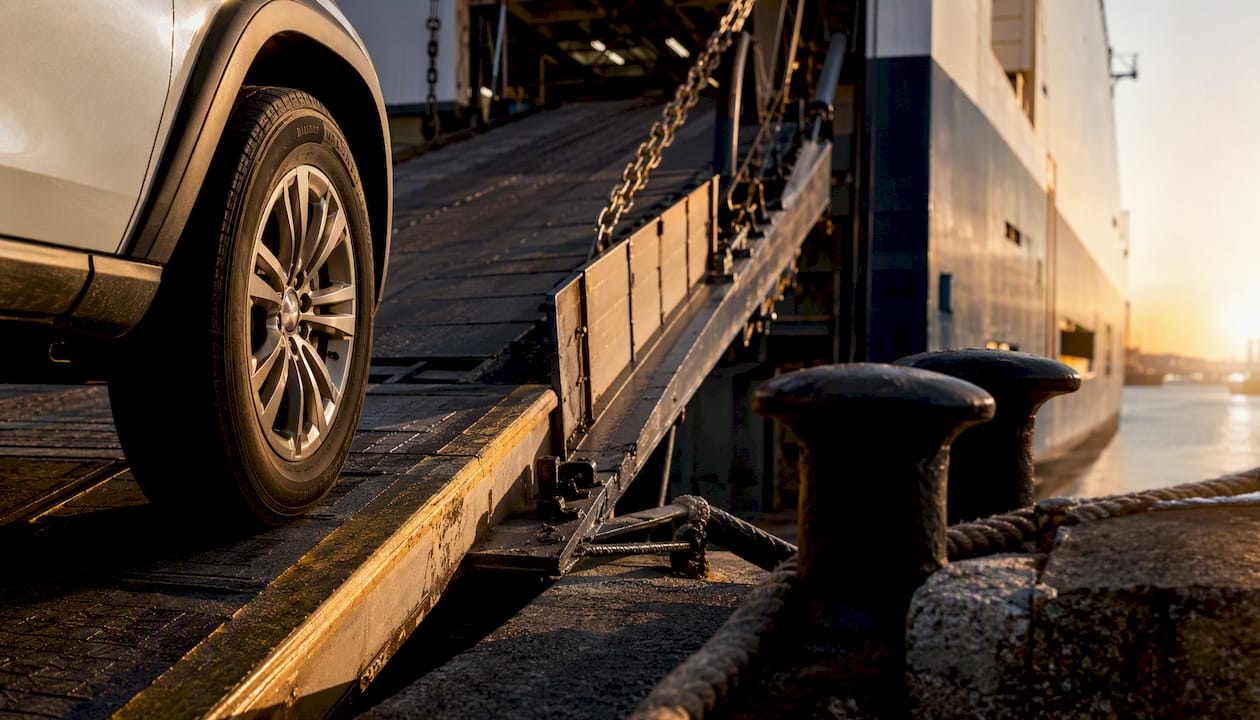
RORO is the cost-default for most running vehicles. Drivers load the car directly onto a specialized vessel, and it rides on open decks to the destination port. On the same route, RORO frequently prices 20–40% below container options, making it the go-to for everyday sedans, SUVs, and pickup trucks heading to well-served ports.
Shared containers offer more physical protection than RORO because the vehicle travels inside a steel box, but the consolidation model means your car waits until the container fills. That wait adds days or weeks to the schedule, making this method a poor fit for rigid relocation timelines.
Sole-use containers give a classic car or exotic full enclosure with no other cargo sharing the space. The vehicle can be crated or braced inside, and personal items are sometimes permitted (subject to destination customs rules). The premium over RORO is real, but for a $100,000+ vehicle, the added protection is usually worth it.
Air freight is reserved for situations where speed or extreme value justifies the cost. Transit runs roughly 1–2 weeks from U.S. gateway airports, but the freight bill alone starts around $5,000 and climbs steeply with vehicle weight.
What Are the Realistic Booking and Transit Times?
Timing surprises are one of the most common frustrations in international vehicle shipping. The booking window, consolidation waits, and port congestion all affect when your car actually arrives.
Booking lead times vary by method. RORO sailings from major U.S. gateway ports (Baltimore, Jacksonville, Houston, Los Angeles) typically have weekly or bi-weekly departures, and booking 2–3 weeks ahead secures a confirmed slot. Shared container services need more lead time, often 3–4 weeks, because the forwarder must wait for enough cargo to fill the container before it moves. Sole-use containers can sometimes load faster if the port has available equipment.
Transit windows by method and lane:
- RORO: 2–4 weeks ocean transit
- Shared or sole-use container: 3–6 weeks ocean transit
- Air freight: 1–2 weeks total
- Short-sea or overland routes (e.g., U.S. to Canada or Mexico): often faster, sometimes days
Seasonality matters. Summer months and the period around Chinese New Year see elevated port congestion on trans-Pacific lanes. Booking 4–6 weeks ahead during peak periods is a reasonable buffer.
Pro Tip: Book door-to-port rather than door-to-door if you have a contact at the destination who can arrange local pickup. It cuts cost and gives you direct control over the final delivery leg. Whatever you choose, ask your forwarder for milestone tracking dates: estimated loading date, vessel departure, estimated arrival, and customs release. Those four dates let you plan around the shipment rather than wait anxiously for updates.
What Documents Do You Need to Export a Car From the U.S.?
U.S. export compliance for vehicles is more specific than most shippers expect, and missing a single filing or document can hold the car at the port.
EEI/AES filing: the 72-hour rule
Per CBP guidance, the U.S. Census Bureau requires Electronic Export Information (EEI) to be filed through the Automated Export System (AES) or AESDirect for all used self-propelled vehicles, regardless of destination, value, or condition. That filing must be completed 72 hours prior to export. Missing this window is one of the most common causes of last-minute holds. Worldwideexpress’s AES filing resource explains how freight forwarders assist exporters with AES submissions and the specific data fields required.
For a deeper look at timing and data requirements, the AES filing requirements guide covers the full compliance checklist.
Document checklist
CBP’s motor vehicle export guidance requires the following documents be presented at the port of export:
- Original vehicle title (or Manufacturer’s Statement of Origin for new vehicles)
- Valid government-issued photo ID for the exporter
- Bill of sale or purchase invoice (if recently purchased)
- Notarized lender statement if the vehicle carries a lien
- Foreign ownership documents with certified translation, if applicable
- Completed EEI/ITN (Internal Transaction Number) from AES
19 CFR § 192.2 requires the exporter to present both the vehicle and the required ownership documentation to Customs at the port of exportation, generally at least 72 hours prior to export. CBP will authenticate and mark the original documents at that time. For vessel and air exports, the 72-hour window applies; for land crossings, the vehicle and documents must be presented at the time of export.
Special cases and exemptions
A few situations change the standard filing obligations. Vehicles moving under a Temporary Importation Bond (TIB) or ATA Carnet are exempt from some duties at the destination but still require EEI filing. If you plan to drive the vehicle abroad and return it to the U.S., CBP recommends obtaining a Certificate of Registration (CBP Form 4455) before departure. That certificate documents U.S. origin and allows the vehicle to re-enter duty-free. The export declaration compliance guide walks through the full declaration workflow for exporters who want a step-by-step reference.
How to Prepare Your Vehicle for Export
Preparation is straightforward, but skipping any step can cause rejection at the port or damage during transit.
Pre-shipment checklist
- Fuel level: Reduce the tank to no more than one-quarter full. Many carriers and terminals require this for safety reasons.
- Battery: Ensure the battery is fully charged and terminals are secure. A dead battery at loading causes delays.
- Personal items: Remove all personal belongings from the vehicle. Customs at the destination may treat undeclared items as separate imports.
- Alarm system: Disable the alarm or leave a spare key with the carrier so the vehicle can be moved without triggering it.
- Spare key: Provide one set of keys to the carrier; keep a second set.
- VIN labeling: Confirm the VIN is visible on the dashboard and matches all paperwork exactly.
- Fluids and leaks: Check for fluid leaks. A leaking vehicle may be refused at the terminal.
Photo documentation
Photograph every panel, the roof, the undercarriage, and the interior before drop-off. Date-stamp the photos using your phone’s camera metadata or a newspaper in the frame. Those images are your primary evidence if a damage claim arises at the destination. For container shipments, photograph the vehicle inside the container before the doors close.
Pro Tip: Request a written condition report (also called a pre-shipment inspection report) from the terminal or carrier at the time of drop-off. Have a representative sign it. A signed report with photos is far stronger evidence in a claim than photos alone.
U.S. regulations require that the vehicle and documentation be presented to Customs at specified times prior to export, typically at least 72 hours for vessel or air exports, to comply with export rules.
Understanding Insurance and Carrier Liability
Carrier liability and marine insurance are not the same thing, and the gap between them matters most when something goes wrong.
Carrier liability is the baseline protection included in the bill of lading. It is typically limited to a low per-vehicle or per-kilogram cap and often excludes cosmetic damage, weather exposure on RORO decks, and mechanical failure. For a standard used vehicle, that coverage may be adequate. For a classic car or high-value exotic, it almost certainly is not.
Marine “all-risks” insurance covers physical loss or damage during loading, transit, and unloading, subject to policy exclusions. When purchasing a policy, check the declared value carefully. Insure the vehicle for its full replacement or agreed value, not just the purchase price, particularly for vehicles that have appreciated.
What insurers need for a claim
- Pre-shipment condition report and dated photos
- Bill of lading with the carrier’s notation of any pre-existing damage
- Survey report from a marine surveyor at the destination (required for most claims above a threshold)
- Repair estimates from a licensed shop
- Proof of ownership and declared value at time of shipment
Claim timelines vary by insurer and the complexity of the damage, but most marine insurers expect a survey within days of delivery and a formal claim submission within 30 days. Delays in reporting can void coverage, so act immediately upon discovering damage at the destination port.
What Happens at the Destination Port?
Clearing a vehicle through a foreign port involves fees and steps that many shippers underestimate until the bill arrives.
Common destination charges
- Import duty: Calculated as a percentage of the vehicle’s customs value (CIF: cost + insurance + freight). Rates vary widely by country and vehicle age.
- VAT or GST: Applied on top of the customs value plus duty in most countries.
- Terminal handling charges (THC): Port fees for unloading and moving the vehicle within the terminal.
- Customs broker fees: The destination broker’s service charge for clearing the vehicle.
- Pre-delivery inspection (PDI) or emissions check: Some countries require a roadworthiness or emissions test before registration.
Who pays and how
Most individual shippers use Delivered Duty Unpaid (DDU) terms, meaning the consignee (you or your agent at the destination) is responsible for paying duties and taxes upon arrival. Delivered Duty Paid (DDP) arrangements, where the shipper pre-pays duties, are less common for personal vehicles but available through some forwarders.
Delivery options at the destination typically include door delivery by a local trucking partner, self-pickup from the port terminal, or bonded storage if you need time before clearing the vehicle. Bonded storage accrues daily fees, so plan the clearance timeline before the vessel arrives.
Before shipping, verify the destination country’s vehicle registration and emissions conformity requirements. Some markets require left-hand-drive conversions, specific emissions certifications (Euro 6, for example), or odometer conversions from miles to kilometers before a vehicle can be registered. Discovering these requirements after the car arrives is expensive. The customs clearance process guide provides a useful overview of what to expect from the broker at the destination end.
How to Choose an International Car Shipping Company
The freight-forwarding and auto-transport market includes licensed professionals and opportunistic brokers with no real accountability. Knowing how to separate them saves money and avoids serious headaches.
Credentials to verify
- Licensed customs broker: Verify the broker holds a valid CBP-issued customs broker license.
- FMC-registered NVOCC: If the company acts as a carrier (issuing its own bill of lading), it should be registered with the Federal Maritime Commission as an NVOCC.
- Freight forwarder credentials: Membership in NCBFAA (National Customs Brokers and Forwarders Association of America) is a positive signal.
- Insurance facilitation: The company should be able to arrange or refer you to marine cargo insurance, not just mention it.
Questions to ask before booking
- What is the earliest available sailing on this lane?
- Do you handle AES/EEI filing, or is that my responsibility?
- What is your process for non-running vehicles?
- Can you provide a sample bill of lading from a recent shipment?
- How do you handle damage claims, and what is your average resolution time?
- What is included in the quoted price, and what is billed separately?
Red flags
- Vague pricing with no itemized breakdown
- No mention of AES/EEI filing assistance
- Inability to name the vessel or sailing date at booking
- Pressure to pay a large deposit before signing a clear contract
- No proof of insurance or refusal to provide a certificate of insurance
A practical decision framework: if your vehicle is worth under $20,000 and is running, RORO with a licensed forwarder handling AES filing is usually the most cost-efficient path. If the vehicle is a classic, non-running, or worth more than $50,000, a sole-use container with declared-value marine insurance and a forwarder who specializes in high-value vehicles is worth the premium.
What Information Do You Need to Get an Accurate Quote?
An inaccurate quote almost always traces back to incomplete information at the request stage. Providing the following upfront gets you a number you can actually rely on.
Quote worksheet
- VIN (17-digit vehicle identification number)
- Year, make, and model
- Running condition (drives on its own power, or non-running)
- Dimensions if the vehicle is modified, lifted, or oversized (height, width, length)
- Origin city and ZIP code (or the nearest major port)
- Destination city and country (or specific destination port)
- Preferred service type (RORO, shared container, sole-use container, or air)
- Desired delivery window (flexible or fixed date)
Documents to attach for a faster quote
- Copy of the vehicle title
- Recent photos of the vehicle (all four sides)
- Purchase invoice if the vehicle was recently bought
After the initial quote, expect the forwarder to confirm a few variables before locking in the final price: destination duties and VAT (which depend on the vehicle’s customs value), port handling fees at the destination terminal, and inland trucking costs if door-to-door service is requested. Those items are not always known at the quote stage, but a good forwarder will flag them clearly rather than bury them in a later invoice.
What a Freight Forwarder and Customs Broker Do for Vehicle Shippers
Shipping a personal vehicle internationally involves at least two regulatory environments (U.S. export and destination import), multiple carriers, and documentation that must be perfectly synchronized. A freight forwarder and licensed customs broker handle that coordination so the vehicle moves without holds.
Core services a forwarder provides
- AES/EEI filing through AESDirect on your behalf
- Bill of lading issuance and management
- Booking with RORO operators or container lines
- Inland trucking coordination at origin and destination
- Cargo insurance facilitation
- Customs clearance at the destination (or coordination with a destination broker)
- Milestone tracking and status updates
When a forwarder reduces risk most
Paperwork errors are the leading cause of avoidable delays. A mismatched VIN between the bill of lading and the title, or a missed EEI filing, can hold a vehicle at the port for days. A forwarder who reviews documents before the car arrives at the terminal catches those errors before they become costly. For high-value vehicles, the forwarder’s single-point accountability, covering one contact for tracking, insurance, and customs, is itself worth the service fee.
Worldwideexpress offers freight-forwarding, customs brokerage, cargo insurance facilitation, and shipment tracking as part of its logistics services portfolio. For individual vehicle shippers, that means AES filing support, ocean freight booking (RORO or container), and customs broker coordination handled through one provider. The ocean freight forwarding guide explains the step-by-step process for ocean shipments, from booking to bill of lading to destination release.
When evaluating whether to use a forwarder or go direct to a carrier, the freight forwarding vs. broker comparison is a useful reference for understanding where each adds value on a personal vehicle shipment.
Customs Regulations and Restrictions by Destination Country
Every destination country sets its own rules on what vehicles it will admit, how they must be modified, and what items cannot travel inside them. Checking these rules before you book is not optional.
Prohibited items inside the vehicle are a near-universal concern. Most countries prohibit personal effects, food, firearms, and hazardous materials inside shipped vehicles. Some destinations extend that prohibition to any cargo inside the passenger compartment. Customs officers at the destination port will inspect the vehicle, and undeclared items can result in fines, confiscation, or shipment refusal.
Emission standards are increasingly strict. The European Union requires compliance with Euro 6 standards for newly registered vehicles. Australia applies the Australian Design Rules (ADR), which include specific emissions and safety specifications. The UAE and Saudi Arabia have their own type-approval requirements. A U.S.-spec vehicle may not meet these standards without modification, and some countries simply prohibit registration of vehicles that do not comply, regardless of age or value.
Vehicle age restrictions apply in several markets. Some countries in Africa, Southeast Asia, and South America prohibit the import of vehicles older than a set number of years (often 5–10 years). Others apply punitive duty rates to older vehicles to discourage imports.
Left-hand-drive vs. right-hand-drive is a practical concern for markets like the United Kingdom, Australia, Japan, and New Zealand, where traffic flows on the left. Importing a left-hand-drive U.S. vehicle into those markets is often legal but may require modifications for headlight beam direction, speedometer units, and sometimes steering conversion, all at the owner’s expense.
Modifications and homologation: Some countries require formal homologation (type approval) for vehicles that were not originally sold in that market. This process can take weeks and add significant cost. Verify homologation requirements with the destination country’s transport authority before shipping.
Payment Terms, Deposits, and Cancellation Policies
Payment structures in international vehicle shipping are not standardized, and the terms a company offers tell you a great deal about how it operates.
Deposits are standard practice. The deposit secures the sailing slot and initiates the documentation process. Be cautious of any provider demanding full payment before the vehicle is loaded or before a bill of lading is issued.
Final payment is usually due before the bill of lading is released or before the vessel departs, depending on the provider’s terms. Some companies bill in two stages: deposit at booking and balance before sailing. Others invoice the full amount after the vehicle is loaded and the bill of lading is confirmed. Clarify this before signing.
Refund and cancellation policies vary significantly. Cancellations made well before the scheduled loading date (typically more than 7–14 days) often result in a partial refund of the deposit, minus administrative or booking fees. Cancellations close to the sailing date may forfeit the deposit entirely, particularly if the carrier has already been booked and the slot cannot be resold. Get the cancellation terms in writing before paying anything.
Payment methods: Wire transfer and credit card are the most common options. Credit card payments offer some consumer protection if a dispute arises, though some providers charge a processing fee for card payments. Avoid providers who accept only cash or cryptocurrency with no paper trail.
Currency: Most U.S.-based forwarders quote and invoice in U.S. dollars. Destination charges (duties, VAT, terminal fees) are typically billed in the local currency by the destination broker.
What Experienced Shippers Know That First-Timers Often Miss
One scenario that comes up repeatedly in international vehicle export involves a U.S. resident shipping a personal vehicle to Europe for an extended stay, planning to drive it there and eventually return it to the U.S. The paperwork for the outbound leg looks straightforward: EEI filed through AES, title presented to CBP, vehicle loaded on a RORO vessel. The problem surfaces on the return.
Without a CBP Certificate of Registration (CBP Form 4455) obtained and verified before the vehicle left the U.S., proving American origin on re-entry becomes complicated. CBP may treat the returning vehicle as a foreign import and assess duties. Obtaining Form 4455 takes minutes at a CBP port of entry before departure and costs nothing. Skipping it can cost thousands on the return.
The other lesson experienced shippers repeat consistently: verify the VIN on the bill of lading before the car sails. A single transposed digit between the bill of lading and the title is one of the most common causes of port holds and clearance delays. Check it against the dashboard VIN plate, the title, and the AES filing. All three must match exactly.
The practical next step: request a lane-specific quote, confirm that AES filing is included in the service, and ask the forwarder to send you a draft bill of lading for VIN verification before the vehicle is loaded.
Worldwideexpress Handles the Complexity of Shipping Your Vehicle Abroad
Shipping a personal vehicle internationally means managing U.S. export compliance, ocean or air freight booking, cargo insurance, and destination customs clearance, often across multiple time zones and regulatory systems. Worldwideexpress brings those pieces together under one roof.
For individual vehicle shippers, Worldwideexpress provides customs brokerage, AES filing support, ocean and air freight forwarding, cargo insurance facilitation, and end-to-end shipment tracking. When you contact Worldwideexpress, the process starts with the quote worksheet covered earlier in this article: VIN, origin, destination, method preference, and vehicle condition. From there, a specialist confirms the sailing options, walks through the documentation requirements, and coordinates the AES filing so the 72-hour window is met without last-minute scrambling.
For readers who want to understand the full scope of ocean freight services before reaching out, the ocean freight forwarding guide covers every step from booking to bill of lading to destination release. To request a quote or speak with a specialist about your specific lane and vehicle, visit Worldwideexpress and start the conversation.
Sources
- Exporting Used Self-Propelled Vehicles | U.S. Customs and Border Protection
- 19 CFR § 192.2 – Requirements for exportation. | Electronic Code of Federal Regulations (e-CFR) | US Law | LII / Legal Information Institute
- International Car Shipping in 2026: Methods, Cost, Documents and Cross-Border Lanes
- International Car Shipping Guide: Cost And Companies 2025 – Forbes
- Www2
Recommended
- International Car Shipping Companies: A 2026 Guide – Worldwide Express, Inc.
- How to Request a UPS Quote International for U.S. Logistics – Worldwide Express, Inc.
- International Shipping for U.S. Importers: Get a Quote – Worldwide Express, Inc.
- International Shipping by Sea: A Complete US Guide – Worldwide Express, Inc.