For freight planning, three footprints cover the vast majority of global shipments: the GMA pallet at 48 × 40 in (1,219 × 1,016 mm), the Euro pallet at 1,200 × 800 mm (47.2 × 31.5 in), and the ISO intercontinental size at 1,200 × 1,000 mm (47.2 × 39.4 in). Knowing which to use first is straightforward once you map the footprint to the market.
- U.S. domestic and North American retail: GMA 48 × 40 in (1,219 × 1,016 mm), the de facto standard for grocery, CPG, and retail distribution
- European retail and FMCG: Euro/EPAL 1,200 × 800 mm, sized to fit European truck bodies and retail racking
- Intercontinental and Asia-Pacific trade: ISO 1,200 × 1,000 mm or 1,219 × 1,016 mm per ISO 6780:2003, plus square variants (1,067 × 1,067 mm, 1,100 × 1,100 mm, 1,140 × 1,140 mm)
Quick conversion reference: 1 inch = 25.4 mm. So 48 in = 1,219.2 mm and 40 in = 1,016 mm. The 1,219 × 1,016 mm figure is the metric expression of the GMA footprint, rounded to the nearest millimeter.
Key Takeaways
The GMA 48 × 40 in and Euro 1,200 × 800 mm footprints cover most global freight lanes, but pallet count optimization through Cost-to-Serve modeling typically delivers larger savings than footprint changes alone.
| Point | Details |
|---|---|
| Primary footprints to know | GMA 48 × 40 in (North America), Euro 1,200 × 800 mm (Europe), ISO 1,200 × 1,000 mm (intercontinental). |
| Check ISO 6780 tolerances | Verify entry clearances against your pallet jacks, forklifts, and AS/RS before accepting a new pallet type. |
| Run a CTS simulation first | Model pallet counts and drop sizes before changing your pallet fleet; consolidation savings often exceed footprint savings. |
| Standardize footprint and entry type | Enforce these globally; negotiate material and grade locally to control procurement cost. |
| ISPM-15 applies to wood exports | Any wood pallet crossing an international border requires heat treatment certification; plastic pallets are exempt. |
Worldwideexpress supports palletized international shipments across air, ocean, and trucking lanes. For help structuring a palletized export or import program, visit the Worldwideexpress logistics services page.
Table of Contents
- What are the standard shipping pallet dimensions?
- What does ISO 6780 specify for pallet tolerances and clearances?
- How do regional names and pooling conventions map to footprint?
- How do construction type and entry type affect handling and capacity?
- How do pallet footprints affect container and trailer utilization?
- How do you choose the right pallet footprint for your network?
- What does the research say about pallet count and cost-to-serve optimization?
- Which sectors use which pallet types, and why?
- Why footprint standardization is harder than it looks
- Sources
What are the standard shipping pallet dimensions?
The table below covers the footprints logistics teams encounter most often. Load ranges are illustrative industry figures used for procurement planning; always confirm rated capacity with your supplier or pooling provider.
A note on nominal plan dimensions: “Plan dimensions” refers to the footprint viewed from above, expressed as stringer length × deckboard length. For a GMA pallet, the 48-inch dimension runs along the stringer; the 40-inch dimension runs along the top deckboards. This orientation matters for racking alignment and automated conveyor systems. Manufacturing tolerances mean actual dimensions can vary slightly from nominal; confirm with your supplier before specifying for tight-tolerance automation.
What does ISO 6780 specify for pallet tolerances and clearances?
ISO 6780:2003 is the governing international standard for flat pallets used in intercontinental materials handling. It specifies approved plan sizes, dimensional tolerances, and the vertical and horizontal clearances that determine whether a pallet will work with your handling equipment.
The approved rectangular plan sizes under ISO 6780 are:
- 1,200 × 800 mm
- 1,200 × 1,000 mm
- 1,219 × 1,016 mm (the metric GMA equivalent)
Approved square sizes include 1,067 × 1,067 mm, 1,100 × 1,100 mm, and 1,140 × 1,140 mm. Beyond the footprint list, the standard’s most operationally critical content covers clearances and flatness. Per ISO 6780:2003 dimensional tolerances:
- Pallet truck vertical entry clearance: minimum defined value for manual pallet jacks to enter without obstruction
- Forklift minimum clearance: specified to prevent tine contact with bottom deckboards
- Automated handling systems: 100 mm vertical clearance recommended for AS/RS and conveyor-integrated equipment
- Flatness tolerance: maximum vertical deck deviation limits are specified to prevent rocking on conveyors and in racking
Pro Tip: Before accepting a new pallet type into your facility, physically measure the entry clearance against your narrowest pallet jack tine and your AS/RS sensor height. A pallet that clears a manual jack by 5 mm may still jam an automated guided vehicle. Pull the ISO 6780 clearance table and compare it to your equipment specs before signing a supply agreement.
How do regional names and pooling conventions map to footprint?
Footprint and region are tightly linked in practice, and misreading that link adds cost fast.
- 48 × 40 in (GMA pallet) → North America: Grocery Manufacturers Association specification, used across U.S. grocery, retail, and CPG. CHEP operates one of the most widely referenced pooling networks for this footprint in North America.
- 1,200 × 800 mm (Euro/EPAL) → Europe: Sized to fit two across a standard European truck body (2,400 mm interior width). The EPAL mark certifies construction quality and repair standards.
- 1,219 × 1,016 mm → ISO intercontinental / metric GMA: The same physical footprint as the GMA pallet, expressed in millimeters. Used in cross-border documentation and ISO-compliant specifications.
- 1,067 × 1,067 mm and 1,100 × 1,100 mm → Asia-Pacific: Common in Australia, Japan, and parts of Southeast Asia; the 1,100 × 1,100 mm size fits two across a Japanese truck body.
Pallet pooling providers like CHEP manage large rental fleets of standardized pallets, reducing the capital cost of owning a pallet fleet and ensuring dimensional consistency across a network. The trade-off is that you are locked into the pooling provider’s footprint and grade specifications. For exporters shipping to both North America and Europe, maintaining two separate pallet pools is often unavoidable. A shipment built on GMA 48 × 40 pallets will not fit cleanly into European retail racking designed for 800 mm-wide Euro pallets, and re-palletizing at the destination port erases any freight savings from the original load optimization.
The World Bank has noted that the multiplicity of pallet standards creates a measurable cost burden for exporters in developing markets, where access to pallet rental and exchange infrastructure is limited. Choosing the wrong footprint for a target market is not just an operational inconvenience; it affects landed cost and market competitiveness.
How do construction type and entry type affect handling and capacity?
Pallet construction determines how a pallet moves through your facility, what equipment can handle it, and how much weight it can safely carry.
Stringer vs. block pallets: A stringer pallet uses three parallel boards (stringers) running the length of the pallet to support the top deck. A block pallet uses nine wooden or plastic blocks at the corners, edges, and center. Block pallets are heavier and more expensive to manufacture, but they offer four-way entry and generally higher racking capacity.

2-way vs. 4-way entry: A 2-way pallet accepts forks only from two sides (the open ends of the stringers). A 4-way pallet accepts forks from all four sides. In a busy warehouse or automated distribution center, 4-way entry cuts handling time and gives conveyor systems more flexibility in orientation. For AS/RS installations, 4-way entry is often a hard requirement.
Common materials and when each fits:
- Hardwood (oak, southern yellow pine): Standard for GMA and Euro pallets; cost-effective, repairable, widely available
- Softwood: Lower cost, lighter, but lower load ratings; common in one-way export applications
- Plastic (HDPE, PP): Consistent dimensions, hygienic, no splinters, ISPM-15 exempt; preferred in pharma, food-grade, and automated lines where dimensional tolerance is tight
- Metal (steel, aluminum): Used in heavy industrial and automotive applications where load weights exceed wood’s practical limits
Illustrative capacity ranges by construction type:
| Construction | Dynamic load (approx.) | Racked load (approx.) | Static load (approx.) |
|---|---|---|---|
| Stringer (wood, 2-way) | 1,100 kg | 900 kg | 8,000 kg |
| Block (wood, 4-way) | 1,500 kg | 1,100 kg | 10,000 kg |
| Plastic (block, 4-way) | 1,250 kg | 1,000 kg | 8,000 kg |
These are illustrative ranges for procurement planning. Confirm rated capacities with your supplier’s test data.
Pro Tip: Any wood pallet crossing an international border must comply with ISPM-15 (the FAO’s International Standards for Phytosanitary Measures No. 15), which requires heat treatment or methyl bromide fumigation and an official mark. Plastic pallets are exempt. If your export volumes are high enough, the ISPM-15 compliance cost and documentation burden can tip the economics toward plastic. Review the export packing requirements before specifying wood pallets for any international lane.
How do pallet footprints affect container and trailer utilization?
Footprint choice has a direct, calculable impact on how many pallets fit per container or trailer, and that number drives freight cost per unit more than almost any other palletization variable.
Standard container and trailer interior dimensions (approximate):
- 20’ dry container: 5,900 mm long × 2,350 mm wide (interior)
- 40’ dry container: 12,030 mm long × 2,350 mm wide (interior)
- 53’ North American trailer: 16,154 mm long × 2,591 mm wide (interior)
Pallets per load, single-layer floor loading:
These figures assume single-layer floor loading with standard orientation and no overhang. Actual counts depend on interior dimensions of the specific container or trailer unit; refer to the ISO container types reference for precise interior measurements by container type.
A few rules of thumb that experienced planners use:
- Never plan for overhang beyond 25 mm on any side. Overhang risks load shift, customs rejection, and damage claims.
- The Euro pallet’s narrower 800 mm width fits three across a 2,400 mm European truck body exactly. The GMA pallet at 1,016 mm does not, which is why re-palletizing for European distribution is so common.
- Double-stacking is possible for light loads, but always verify container door height clearance and stacking load ratings before planning a double-stack configuration.
- Pallet height matters as much as footprint. Empty pallet deck height varies by supplier and construction type. Account for it when calculating total loaded stack height against container or trailer interior clearance.
How do you choose the right pallet footprint for your network?
The decision is sequential. Work through these steps before committing to a pallet specification.
- Map your product-to-pallet fit. Measure your case or unit load footprint and confirm it tiles cleanly onto the pallet without overhang. A product that fits a 1,200 × 800 mm Euro pallet poorly may fit a 1,200 × 1,000 mm ISO pallet cleanly, improving units per pallet and reducing wasted space.
- Check container and trailer compatibility. Use the pallet count table above as a starting point, then verify against the actual interior dimensions of your contracted equipment.
- Confirm racking and automation fit. Pull your racking bay dimensions and AS/RS specifications. Verify that the pallet footprint, entry type, and deck clearance all meet equipment requirements per ISO 6780.
- Assess load stability and packaging. A larger footprint is not always better. A pallet with poor product-to-pallet fit creates unstable loads that shift in transit, increasing damage rates.
- Check regulatory and export treatment requirements. Wood pallets crossing international borders need ISPM-15 compliance. Confirm treatment marks are present on every pallet before loading. See the efficient packing for export guide for documentation checklists.
- Evaluate pooling implications. If you use a pooling provider, you are constrained to their footprint. Factor in pallet return logistics and any geographic gaps in the pooling network.
Decision rules:
- Serving European retail? Specify 1,200 × 800 mm Euro/EPAL. No exceptions without retailer approval.
- Maximizing North American trailer utilization? GMA 48 × 40 in with 4-way block construction gives the best combination of load count and handling speed.
- Shipping intercontinentally to multiple regions? ISO 1,200 × 1,000 mm is the most broadly compatible footprint, though it will not fit European retail racking without modification.
Red flags to avoid:
- Assuming a GMA pallet is compatible with European retail racking (it is not)
- Ignoring empty pallet deck height when calculating loaded stack clearance
- Specifying untreated wood pallets for export lanes without verifying ISPM-15 compliance
- Accepting a new pallet supplier without measuring actual dimensions against nominal spec
What does the research say about pallet count and cost-to-serve optimization?
Footprint is only half the equation. The number of pallets per shipment, and how that number is optimized, often delivers larger cost savings than switching footprint alone.
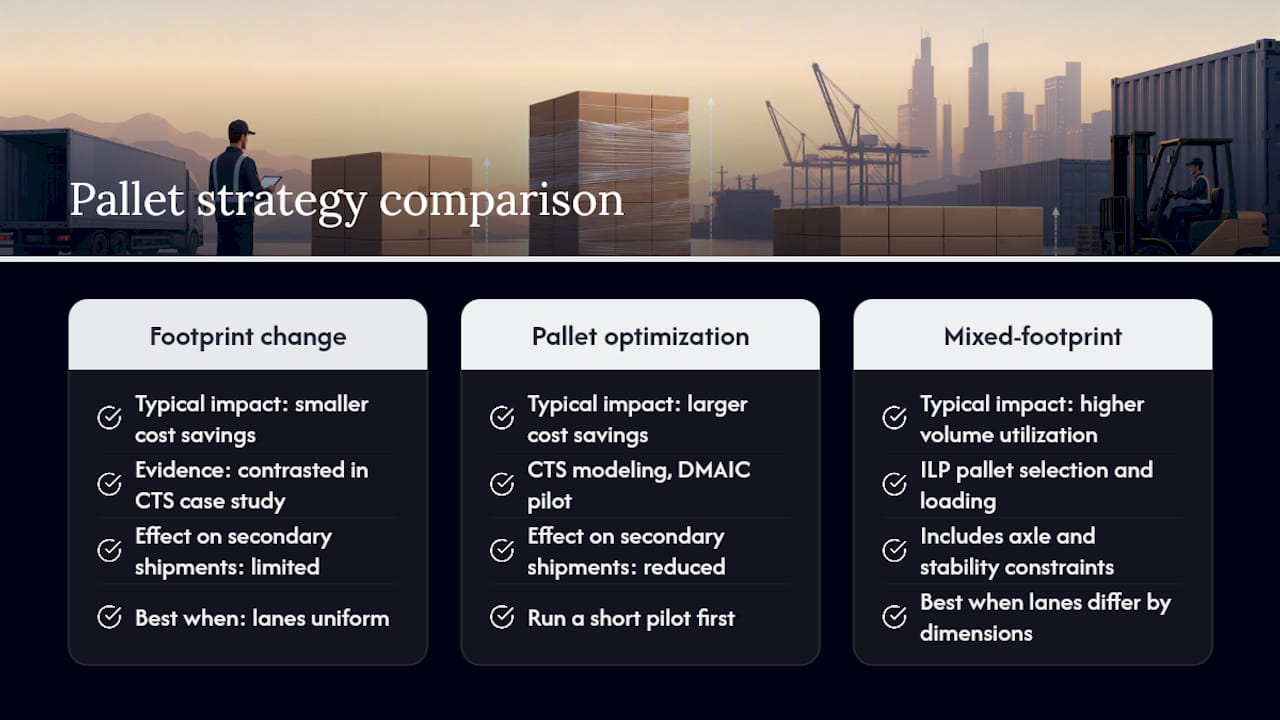
A case study using Cost-to-Serve (CTS) methods and a DMAIC improvement framework found that optimizing pallet drop sizes and shipment frequency produced measurable transport cost savings and reduced secondary shipments in the studied network, per the Sheffield Hallam University repository. The methodology combined CTS modeling with shipment consolidation analysis across a multi-month pilot. The MATEC Conference paper documenting the results confirms that consolidation and drop-size optimization improved secondary transport performance in the case company. The limits of the study are worth noting: results reflect a single network, and savings will vary by lane density, product mix, and existing utilization rates.
Optimizing pallet drop sizes and shipment consolidation, guided by Cost-to-Serve modeling, produced measurable reductions in secondary shipments and transport cost in the studied network. The methodology is transferable: map your current pallet counts per shipment, model the consolidation scenarios, and run a short pilot before committing to a fleet change.
Separately, research using an integer linear programming (ILP) formulation demonstrated that integrating pallet selection with truck loading, including axle balance and stability constraints, can increase loaded volume utilization compared to using a single pallet type across all lanes. The practical implication is that a mixed-footprint strategy, where different pallet sizes are assigned to different lanes or product families, can outperform a single-footprint standard when lanes have significantly different product dimensions or container types.
Pro Tip: Before changing your pallet fleet, run a simple CTS simulation using your current shipment data. Map pallets per drop, shipment frequency, and secondary transport cost. Even a back-of-envelope model will reveal whether your savings opportunity is in footprint, in consolidation, or in drop-size frequency. For a structured approach to optimizing global shipping logistics, start with the lanes with the highest secondary transport cost.
Which sectors use which pallet types, and why?
Sector context shapes pallet choice as much as regional convention does.
- FMCG and retail (North America): The GMA 48 × 40 in pallet dominates because it fits standard U.S. warehouse racking, retail DC conveyors, and pooling networks. Brands shipping to European retail typically re-palletize to 1,200 × 800 mm Euro pallets at a European distribution hub. Pallet pooling through providers like CHEP reduces capital cost but limits footprint flexibility.
- FMCG and retail (Europe): The Euro/EPAL 1,200 × 800 mm pallet is the retail standard. Its block construction and 4-way entry make it compatible with European automated sortation systems. EPAL certification ensures consistent repair standards across the pooled fleet.
- Automotive and industrial: Heavy components often require larger square footprints (1,100 × 1,100 mm or 1,140 × 1,140 mm) or custom steel pallets. Block construction with high racked load ratings is standard. Steel pallets are common in press shops and engine assembly lines where loads exceed 2,000 kg and pallet life is measured in years, not trips.
- Pharmaceuticals: Plastic block pallets are the preferred choice in pharma manufacturing and cold-chain distribution. Consistent dimensions are critical for automated packaging lines where a 5 mm variation in deck height can cause a jam. Plastic pallets are also ISPM-15 exempt, hygienic, and traceable by RFID or barcode. GDP (Good Distribution Practice) guidelines in many markets effectively require documented pallet specifications as part of the supply chain quality system.
Why footprint standardization is harder than it looks
The instinct in most standardization projects is to pick one pallet and enforce it everywhere. That instinct is understandable and almost always wrong.
Footprint and entry type are worth standardizing globally. These two variables determine racking compatibility, forklift clearance, and automation fit, and the cost of getting them wrong shows up immediately in handling errors and equipment jams. Material and grade, on the other hand, are worth negotiating locally. A hardwood GMA pallet sourced in North America is not the same cost proposition in Southeast Asia, where softwood or plastic alternatives may be more economical and equally fit for purpose.
The single-pool ideal, one footprint, one supplier, one pooling provider across all lanes, rarely survives contact with European retail requirements or Asia-Pacific truck body dimensions. A more practical target is a two-pool standard: one footprint for North American domestic lanes, one for European or intercontinental lanes, with clear decision rules for which applies to each lane. That structure reduces re-palletization events without demanding the impossible.
The research on CTS and pallet drop-size optimization reinforces this. Savings come from pallet count and consolidation discipline, not from footprint purity. Standardize where it reduces handling cost; negotiate where it reduces procurement cost.
Sources
These are the primary references used in this guide and the ones worth bookmarking for ongoing pallet specification work.
- ISO 6780:2003 – Flat pallets for intercontinental materials handling — Principal dimensions and tolerances
- Standard Pallet Dimensions & Specifications | CHEP USA
- Pallet Drop‑Size Optimisation (case study) – Sheffield Hallam University repository
- Integrated pallet selection and truck loading optimization (ScienceDirect abstract)
When specifying new pallet purchases, use ISO 6780 as the dimensional reference and require suppliers to provide test data for dynamic, racked, and static load ratings. Cross-reference their nominal dimensions against the tolerances in the standard before signing a supply agreement.
Recommended
- Export packing requirements: a logistics manager’s guide – Worldwide Express, Inc.
- Shipping logistics explained: streamline your international trade – Worldwide Express, Inc.
- How to ship oversized cargo: a guide for businesses – Worldwide Express, Inc.
- Improve Worker Safety in Logistics: Proven Protocols for 2026 – Worldwide Express, Inc.