A customs import declaration is the formal statement, filed with U.S. Customs and Border Protection, that identifies your goods, their value, and the duties owed on them. The entry itself, filed on CBP Form 3461, gets cargo released from the port. The entry summary, filed on Form 7501, is the actual declaration; it fixes the classification, value, and duty calculation CBP relies on to collect revenue. The importer of record files it, either directly or through a licensed customs broker.
Two deadlines govern this process:
- Entry documents are due within 15 calendar days of the cargo’s arrival.
- The entry summary and estimated duties must be filed and paid within 10 working days after release.
Miss either window and you’re looking at liquidated damages against your bond, not just a late fee.
Key Takeaways
The entry summary on Form 7501, not the initial entry, is the legal customs import declaration that fixes value, classification, and duty owed.
| Point | Details |
|---|---|
| Two deadlines apply | File entry documents within 15 calendar days of arrival; file the entry summary and duties within 10 working days after release. |
| The IOR carries legal liability | The importer of record, not the broker or carrier, must exercise reasonable care and certify Form 7501’s accuracy. |
| ISF filing predates arrival | Ocean shipments need the 10+2 Importer Security Filing at least 24 hours before loading, or risk a denied load or exam. |
| Documentation errors cause most delays | Mismatched invoice values, missing assists, and manifest discrepancies trigger holds far more often than port congestion. |
| Worldwideexpress supports full-service filing | Its customs brokerage handles entry filing, bond procurement, ABI/ISF transmission, and document review for importers who need it. |
Table of Contents
- What Documents Go Into a Customs Import Declaration Form
- How Long Do You Have to File an Import Declaration?
- Who Signs and Certifies the Import Declaration?
- What Should Be in Your Import Documentation Checklist?
- How Do You File a Customs Declaration Electronically?
- What Causes Customs Delays and Penalties?
- How Worldwideexpress Helps With Import Declarations
- Where to Find Official CBP Forms and Regulations
- Why the Paperwork Gets Blamed for What Is Really a Timing Problem
- Get Help Filing a Compliant Customs Import Declaration
- Frequently Asked Questions
- Sources
What Documents Go Into a Customs Import Declaration Form
Every formal entry rests on a small stack of paperwork, and missing one piece is the fastest way to stall a shipment at the port. CBP’s own procedural guidance treats these as core documents for commercial entries, filed electronically through the Automated Broker Interface (ABI) whenever possible.
- CBP Form 3461 (Entry/Immediate Delivery): requests release of the cargo before duties are finalized. This is your entry, not your declaration.
- CBP Form 7501 (Entry Summary): the actual declaration of value, tariff classification, and duty owed. This is where accuracy matters most.
- Entry Manifest, Form 7533, or the carrier’s electronic manifest: identifies what’s aboard the vessel or aircraft and ties your entry to a specific shipment.
- Commercial invoice: must show the buyer, seller, itemized unit values, any discounts, and assists (tooling, molds, or materials the buyer supplied free or at reduced cost).
- Packing list: matches physical cartons or pallets to invoice line items.
- Bill of lading or air waybill: proof of transport and often your evidence of the right to make entry.
- Customs bond: mandatory for nearly all formal entries. It guarantees payment of duties, taxes, and penalties if something goes wrong. A continuous bond covers a full year of shipments and is usually cheaper per entry than a single-transaction bond if you import regularly.
How Long Do You Have to File an Import Declaration?
Two clocks start running the moment your cargo touches U.S. soil, and both are unforgiving. CBP requires initial entry documents within 15 calendar days of arrival. Separately, once cargo is released, the entry summary and estimated duties are due within 10 working days.
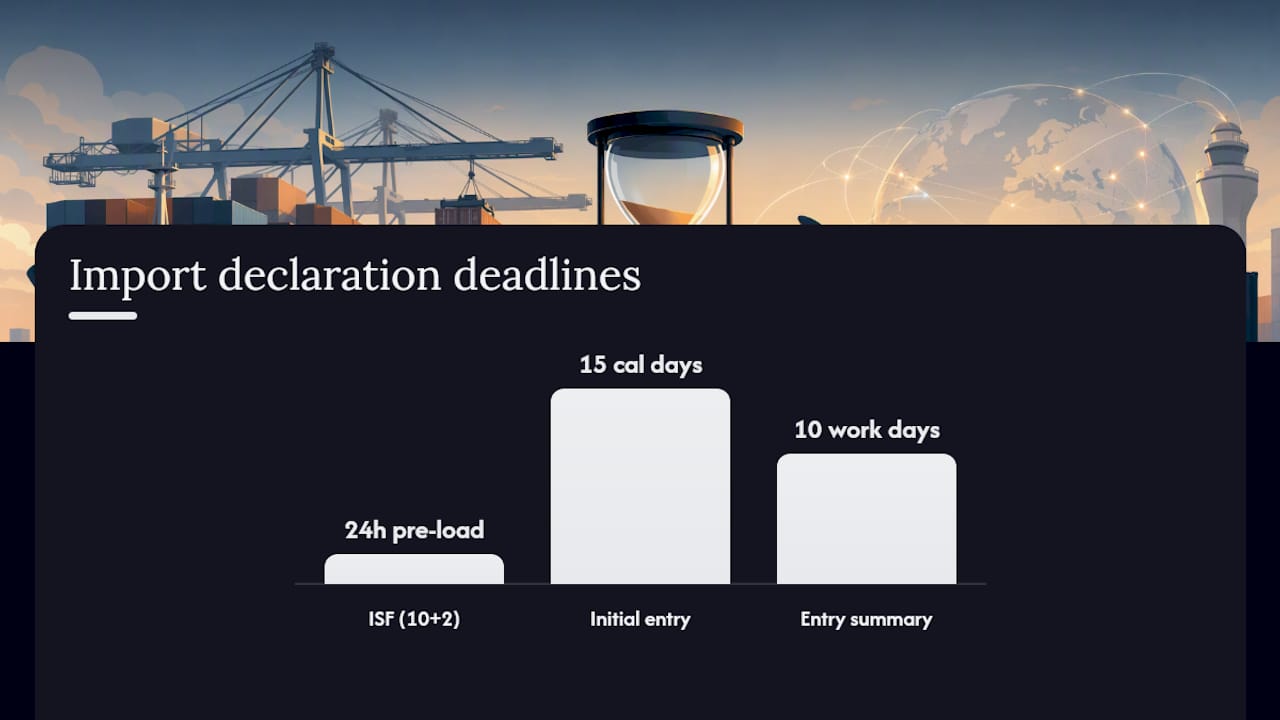
Statistic callout: The gap between those two deadlines, 15 calendar days versus 10 working days measured from a different starting point, trips up more importers than any single documentation error, because teams assume one clock covers both obligations.
Ocean shipments carry a third deadline that predates arrival entirely. The Importer Security Filing, known as “10+2,” requires the importer to transmit ten data elements to CBP at least 24 hours before cargo is loaded at the foreign port. Miss that window and CBP can deny loading outright or flag the container for exam on arrival.
- If CBP selects your shipment for examination, either document review or physical inspection, the release clock pauses until the exam clears.
- Exams add days, sometimes weeks, and the entry summary deadline still counts from the eventual release date.
- Building in buffer time before your goods ship is far cheaper than absorbing storage fees while an exam runs.
Who Signs and Certifies the Import Declaration?
The importer of record carries the legal weight here, not the freight carrier and not the warehouse. Federal regulation requires the importer of record to exercise “reasonable care” in every filing, a standard drawn from 19 CFR Part 141 that governs declarations and who may lawfully make entry.
Form 7501 itself contains binding language: the declarant certifies that the values, classifications, and other declared information are accurate, and must notify CBP promptly if an error surfaces later. An electronic transmission through ABI carries the same legal force as a wet signature under CBP regulations, so filing electronically doesn’t lower the stakes.
- Importers of record must maintain entry records for five years and produce them on request.
- A foreign company acting as importer of record generally needs a U.S.-based resident agent or a genuine U.S. presence, a detail many first-time importers overlook until it blocks their filing rights.
- A licensed customs broker files under a power of attorney from the importer, but the legal responsibility for accuracy stays with the importer of record, not the broker.
Pro Tip: Keep a signed power of attorney on file with your broker before your first shipment ships, not after it arrives. A missing POA is one of the most common, and most avoidable, causes of a held entry.
What Should Be in Your Import Documentation Checklist?
Getting the paperwork right the first time saves more money than any duty-saving strategy. Work through this sequence before your goods ever leave the origin port.
- Build a complete invoice. List the buyer and seller by legal name, itemize unit values for every line, disclose discounts, and declare any assists. If the original invoice isn’t in English, attach a translation.
- Classify every item under the Harmonized Tariff Schedule. The HTS code determines your duty rate, and CBP holds the importer responsible for getting it right, not the exporter. Keep binding rulings, prior entries, or engineering specs as backup if a classification could be questioned.
- Confirm the value method. Transacted price, the price actually paid or payable, is the default valuation method CBP expects; deviations require documented justification.
- Pull certificates of origin if you’re claiming a preferential rate under a trade agreement, and gather any permits required for regulated goods such as food, chemicals, or textiles.
- Cross-check the packing list against the invoice so quantities match exactly before the shipment departs.
How Do You File a Customs Declaration Electronically?
Nearly every formal entry today moves through the Automated Broker Interface, the electronic system that links importers, brokers, and CBP. An ABI transmission carries the same legal weight as a signed paper document under federal regulation, which is why electronic filing has become the default rather than the exception.
- Paper filings still exist for certain low-volume or informal entries, but ABI is mandatory for most commercial formal entries.
- Carrier manifests, filed as Form 7533 or transmitted electronically, arrive separately from your entry and must match it. A mismatch between manifest quantities and entry quantities is a common trigger for a hold.
- Mail entries follow a distinct, simplified process for low-value personal shipments and don’t require the same formal entry documents as commercial freight.
- Regardless of channel, the underlying data, values, classification, and quantities, must reconcile across every document CBP receives.
What Causes Customs Delays and Penalties?
Most disruptions trace back to paperwork, not port congestion. Delays stretching beyond a few days are almost always caused by documentation problems that a pre-shipment check would have caught.
- Invoice values that don’t match the entry summary, or missing assist declarations, invite a CBP request for information (a “CF 28”) that pauses release.
- A missed or late ISF filing can trigger a liquidated damages claim, sometimes before the vessel even reaches U.S. waters.
- Incorrect HTS classification or undervaluation carries civil penalties under 19 U.S.C. 1592, ranging from a fraction of the duty owed for negligence to the full domestic value of the goods for fraud.
- Manifest and entry quantity mismatches are a frequent reason for a physical exam, which adds storage costs at the port while it’s underway.
Reconcile invoices against purchase orders before the goods ship, not after they arrive. If an error slips through anyway, filing a post-entry correction promptly is almost always cheaper than waiting for CBP to find it first.
How Worldwideexpress Helps With Import Declarations
Filing an accurate entry is procedural, but it’s rarely simple once assists, valuation questions, or regulated goods enter the picture. Worldwideexpress handles the full mechanics of a compliant filing: CBP entry and entry summary submission, customs bond procurement, ABI and ISF transmission, document review before filing, and shipment tracking through release.
- Self-filing can work for straightforward, repeat shipments with stable classification and low value.
- Complex goods, first-time imports, or anything with preferential-rate claims usually justify hiring a licensed broker.
Pro Tip: If your HTS classification has ever been questioned, or you’re importing a product category for the first time, get a broker’s eyes on the invoice before it ships, not after CBP flags it.
The reasonable care standard doesn’t grade on effort. It grades on outcome, and a broker’s job is to make that outcome match what you actually intended to declare.
Where to Find Official CBP Forms and Regulations
- CBP Form 7501: the entry summary form itself, with declarant certification language.
- Importing Into the United States guide: CBP’s own commercial importer reference covering entry steps, bonds, and reasonable care.
- 19 CFR Part 141: the regulatory text governing entry declarations and who may make entry.
- DHS import/export forms directory: a consolidated index of CBP forms, including CF 3461 and 7533.
For anything beyond a straightforward, repeat shipment, verify current requirements against these primary sources or consult a licensed customs broker.
Why the Paperwork Gets Blamed for What Is Really a Timing Problem
Most guidance on this topic treats documentation errors and missed deadlines as separate problems. They aren’t. A wrong HTS code discovered on day nine of a ten-day entry summary window is a timing failure wearing a documentation costume. The fix isn’t better forms. It’s moving the classification and valuation work earlier, ideally before the vessel loads, not after it clears the port.
The conventional advice tells importers to “double check your paperwork.” That’s true but useless without a sequence. Reasonable care, as CBP defines it, is a standard of process, not a one-time review. It means the same invoice discipline on every shipment.
If there’s one place first-time importers underinvest, it’s the ISF deadline. Everyone plans around the entry summary deadline. Almost nobody treats the pre-load filing with the same urgency, and that’s exactly where a denied load or an unplanned exam originates. Prioritize the filing that happens before your goods are even on the water. Everything downstream gets easier once that’s handled correctly.
Get Help Filing a Compliant Customs Import Declaration
Worldwideexpress is the practical alternative to piecing together entry filings on your own, especially once your shipments involve preferential rates, assists, or regulated goods where a misstep carries real financial exposure. Rather than managing ABI transmissions, bond selection, and ISF timing across separate vendors, you work with one team that handles customs brokerage end to end, from entry filing through release tracking.
That matters most for businesses juggling multiple import categories or first-time filers who don’t yet have a documented process for reasonable care. Worldwideexpress’s brokerage service covers entry and entry summary filing, bond procurement, and document review before anything gets transmitted to CBP, so errors get caught before they become penalties.
If you’re planning your next shipment, request a freight quote and get a broker’s assessment of your documentation before your cargo leaves the origin port.
Frequently Asked Questions
What is the difference between an entry and an entry summary?
An entry, filed on CBP Form 3461, requests release of cargo from the port. The entry summary, filed on CBP Form 7501, is the formal declaration of value, classification, and duty owed, filed after release.
Who is legally responsible for a customs import declaration?
The importer of record. Even when a licensed broker files on their behalf, the importer of record must exercise reasonable care and remains liable for the accuracy of the declaration.
How long do I have to file the entry summary after my goods are released?
Ten working days after release, with estimated duties paid at the same time. Initial entry documents are due separately, within 15 calendar days of arrival.
Do I need a customs bond for every import?
Nearly all formal entries require one. A continuous bond covering a full year of shipments is typically more cost-effective than a single-transaction bond for anyone importing regularly.
When is hiring a customs broker worth it over self-filing?
Self-filing can work for simple, repeat shipments with stable classification. Complex goods, first-time imports, or anything claiming a preferential tariff rate usually justify a licensed broker’s review.
Sources
- CBP Form 7501 (Entry Summary) PDF
- Importing Into the United States: A Guide for Commercial Importers
Recommended
- Export Declaration: A Compliance Guide for Exporters – Worldwide Express, Inc.
- Understanding Customs Invoice Requirements for Trade – Worldwide Express, Inc.
- How to Avoid Customs Penalties: A Step-by-Step Guide – Worldwide Express, Inc.
- How to Complete a Customs POA Form for U.S. Imports – Worldwide Express, Inc.