An HS tariff code is the standardized number customs authorities use to identify exactly what you’re shipping and calculate what you owe. The Harmonized System behind it is maintained by the World Customs Organization and forms the backbone of every country’s national tariff code. Get the number wrong on your paperwork, and you’re looking at customs delays, penalty fees, or duty bills that don’t match what you actually owe.
TL;DR:
- The first six digits of the HS code are universal, but countries add further digits, which can significantly alter duty rates and eligibility for trade benefits.
- Misclassification due to incorrect codes can cause customs delays, penalties, or audits, especially if codes assigned by suppliers do not match the importing country’s system.
- Accurate classification involves detailed product descriptions, consulting official tools like CROSS and Schedule B, and verifying codes before each shipment to prevent costly mistakes.
- Customs authorities prioritize the HS code on commercial invoices, requiring clear, complete line-item data including the product description, quantity, and origin.
- Regularly updating codes and obtaining binding rulings or working with customs brokers is essential when dealing with high-value, complex, or frequently shipped products.
Table of Contents
- What is the Harmonized System and how does its numbering work?
- How does HS map to national systems like HTS and Schedule B?
- Why do HS and tariff codes actually matter for customs?
- How do you find and verify the correct HS tariff code?
- Common classification mistakes that trip up shippers
- What belongs on your commercial invoice and customs forms?
- When should you get a binding ruling or professional help?
- How do HS codes affect trade agreements and preferential duty rates?
- How often does the HS get revised, and how do you stay current?
- What do real HS code applications look like in practice?
- Worldwide Express’s role in getting classification right
- Sources
What is the Harmonized System and how does its numbering work?
The World Customs Organization built the Harmonized System as a universal language for describing traded goods, and more than 200 countries now use it as the foundation for their own tariff schedules. It sorts merchandise into a large number of commodity groups (https://eur-lex.europa.eu/EN/legal-content/summary/international-convention-on-the-harmonized-commodity-description-and-coding-system.html), each tied to a 6-digit code that means the same thing whether you’re clearing a container in Rotterdam or Long Beach.
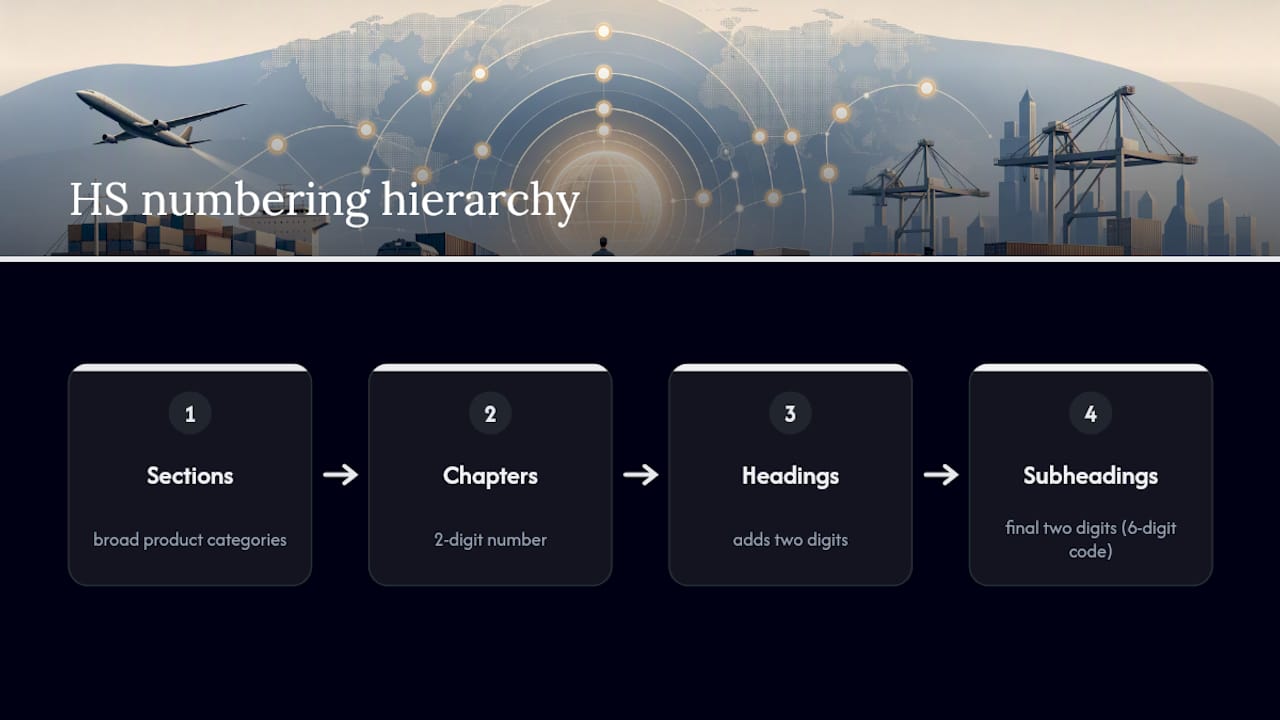
The structure runs top to bottom, like a filing cabinet with increasingly specific drawers. Sections group broad categories (live animals, textiles, machinery). Chapters narrow that down with a 2-digit number. Headings add two more digits to define a product family, and subheadings add a final two digits to pin down the specific item. That 6-digit endpoint is where international harmony stops and national customization begins.
The WCO revises the system periodically to keep pace with new products and shifting trade patterns, and it publishes Explanatory Notes that spell out how to interpret borderline cases. Those notes carry real weight when a classification isn’t obvious from the code description alone.
How does HS map to national systems like HTS and Schedule B?
Every country takes that internationally shared 6-digit HS core and tacks on extra digits for its own tariff and statistical purposes. In the United States, the split runs along a simple line: importers use the Harmonized Tariff Schedule, maintained by the U.S. International Trade Commission, while exporters use Schedule B, maintained by the Census Bureau. Both build on the same HS foundation, but they serve different purposes and carry different digit counts.
U.S. imports get sorted into many HTS categories, while exports fall into a smaller but still large number of Schedule B categories(https://www.trade.gov/harmonized-system-hs-codes). That gap exists because import codes need to support duty assessment down to a granular level, while export codes exist mainly for trade statistics. The legal tariff rate itself gets assigned at the 8-digit HTS level(https://hts.usitc.gov/), with additional statistical digits tacked on beyond that for reporting purposes.
Here’s where shippers get tripped up: two products can share an identical 6-digit HS prefix and still land in completely different duty brackets once you hit digit seven or eight. A supplier’s invoice might list a code that’s accurate for their country’s export system but wrong for your country’s import tariff. Always treat the first six digits as a starting point, not a finish line.
Why do HS and tariff codes actually matter for customs?
The code you declare determines the duty rate customs applies to your shipment, full stop. It also flags whether your goods trigger regulatory review, such as agricultural inspections, safety certifications, or import quotas tied to specific product categories.
Beyond duty math, these codes feed the trade statistics that governments and economists use to track import and export volumes by product category. Customs authorities and researchers rely on that data, which means accuracy matters at a level most shippers don’t think about.
Misclassification carries real consequences. An incorrect code can trigger entry delays while customs sorts out the discrepancy, penalty assessments if the error looks like an attempt to underpay duty, and audits that dig into your past shipments, not just the current one. A pattern of small errors across dozens of shipments adds up to a much bigger compliance headache than a single flagged entry.
How do you find and verify the correct HS tariff code?
Guessing costs money. Here’s the sequence that actually works, in order:
- Write a precise product description. Note the material composition, the intended use, the function, and any model or part numbers. “Plastic toy” tells customs nothing useful; “injection-molded polypropylene action figure, non-motorized, for children over 3” gives them something to classify.
- Identify the 4-digit heading first. Browse by chapter to find the broad category, then narrow to the heading that best fits your product’s primary function.
- Refine to the 6-digit subheading using the General Rules of Interpretation. These rules exist specifically to resolve close calls, like a product that could plausibly fit two different headings. Work through them in order rather than picking whichever heading sounds right.
- Cross-check with official tools. Use hts.usitc.gov for U.S. import classification, the Census Bureau’s Schedule B search for exports, the WCO’s Explanatory Notes for interpretation questions, and CROSS to see how CBP has ruled on similar products before. Parcel shippers can also run a quick check through the USPS HS code lookup tool, though that’s a starting point, not a legal determination.
- Verify against the destination country’s tariff schedule before you ship, since the digits beyond position six belong to the importing country’s system, not yours.
- Escalate when the stakes are high. If you’re shipping high-value goods, entering a regulatory gray zone, or facing genuine ambiguity between two plausible codes, request a binding ruling or bring in a customs broker rather than guessing.
Pro Tip: Run the same product description through both the HTS search and a CROSS ruling search. If CBP has already ruled on something similar, you’ll often find language you can borrow almost word for word to justify your classification.
For exporters specifically, this practical export classification guide walks through verification steps worth reviewing before your first international shipment.
Common classification mistakes that trip up shippers
Keyword searches are the most common trap. Typing “shoes” into a tariff search engine returns dozens of headings, because footwear splits by material, sole type, and intended use. A keyword hit tells you a code exists somewhere in that category; it doesn’t tell you which one applies to your specific product.
Relying blindly on a supplier’s code is nearly as risky. That code might reflect the exporting country’s classification, not yours, or it might simply be wrong. Cross-check any supplier-provided code against your own country’s tariff schedule before you accept it as fact.
When two headings both seem plausible, don’t flip a coin. Pull the WCO Explanatory Notes for both candidates and search CROSS for past rulings on comparable products. Precedent exists for a reason, and customs officers tend to classify consistently with prior rulings.
What belongs on your commercial invoice and customs forms?
The HS code belongs directly on the commercial invoice, typically in its own line item next to the product description, not buried in a general notes field. Customs officers scan for it first, so make it easy to find.
Each line item needs the code paired with a clear description, quantity, country of origin, and unit value together, not scattered across separate documents. Missing any one of those fields is a common reason customs holds a shipment for clarification.
Requirements vary slightly by carrier. USPS international forms have a dedicated HS code field for parcels, while most major carriers and freight forwarders build it into their standard customs declaration templates. A reliable customs invoice template keeps these fields consistent shipment after shipment, which matters most once you’re shipping regularly rather than as a one-off.
When should you get a binding ruling or professional help?
CROSS gives you access to thousands of past CBP rulings, searchable by product keyword or HS code, and it’s the fastest way to see how customs has already treated something similar to what you’re shipping. The WCO’s Explanatory Notes and its Compendium of Classification Opinions serve the same function at the international level, offering authoritative interpretation when the tariff text alone leaves room for doubt.
Request a formal binding ruling when the shipment value is high enough that a misclassification would be expensive, when the product sits in a regulatory gray area, or when you’re setting up a recurring import that you’ll be classifying the same way for years. For anything short of that threshold, a customs broker can usually resolve the question faster than the formal ruling process, which can take months.
How do HS codes affect trade agreements and preferential duty rates?
Free trade agreements don’t waive duties on products in general. They waive duties on specific HS codes that meet specific rules of origin, and the classification you assign determines whether your product even qualifies for consideration. Get the code wrong, and you could either miss out on a preferential rate you were entitled to or claim one you weren’t, which invites an audit.
Rules of origin frequently reference HS codes directly, spelling out how much a product’s classification can change through manufacturing before it loses eligibility for preferential treatment. A shirt assembled from imported fabric might qualify for a lower tariff under one agreement’s rules and get excluded under another’s, depending on where the HS classification shifts during production. This is one of the areas where the six-digit international core and the national extensions genuinely diverge in practical effect, since preferential rate schedules attach to the longer national code, not just the shared HS prefix.
Businesses that ship the same products regularly under a trade agreement benefit from confirming the HS classification once, formally, and keeping that documentation on file. Customs authorities can and do audit preferential duty claims retroactively, sometimes years after the shipment cleared, and a solid classification record is your best defense if that happens. Treat the code as part of your trade agreement compliance file, not just a line on an invoice.
How often does the HS get revised, and how do you stay current?
The World Customs Organization updates the Harmonized System on a recurring cycle, adding new headings for emerging product categories and retiring or restructuring ones that no longer reflect how goods are made or traded. Past revisions have reorganized categories for electronics, chemicals, and other sectors where technology moved faster than the existing code structure could track.
A code that was correct three years ago can become outdated or reassigned after a revision takes effect, which means the classification you filed under before might no longer be the current one. National systems like the HTS and Schedule B update on their own related schedules to absorb these changes, sometimes with a lag between when the WCO publishes a revision and when a country’s tariff schedule reflects it.
The practical fix is simple: don’t treat an HS code as a permanent fact once you’ve looked it up. Check the current HTS or Schedule B listing before each new shipment cycle, especially if you’re importing or exporting the same product line year after year. Businesses with high shipment volumes or complex product lines often build a periodic classification review into their compliance calendar rather than relying on a code someone looked up once and filed away.
What do real HS code applications look like in practice?
A furniture importer bringing in wooden dining chairs needs a different code than one importing the same chairs with upholstered seats, because the material composition shifts the subheading and the applicable duty rate along with it. Get the upholstery detail wrong on the description, and the classification, and the duty bill, follow the wrong product entirely.
An electronics exporter shipping the same component to five different countries will file it once under a single 6-digit HS prefix but may need to verify five separate national extensions, since Schedule B for the outbound shipment and each destination country’s import tariff can diverge past that shared core. A textile manufacturer claiming a preferential rate under a trade agreement has to confirm that the finished garment’s classification actually satisfies that agreement’s rules of origin, not just that the fabric did.
These aren’t edge cases. They’re the ordinary friction points that show up every week for businesses moving physical goods across borders, and they’re exactly why the classification step deserves more attention than a quick guess based on what the last shipment used.
Worldwide Express’s role in getting classification right
Worldwide Express works with importers and exporters every day who need a second set of eyes on a tricky classification before it becomes an expensive mistake. A misfiled code on a high-volume electronics shipment can mean weeks of delay while customs sorts out the discrepancy, and that’s the exact scenario our customs brokerage team steps in to prevent, checking the classification against CROSS precedent and the current tariff schedule before the shipment ever reaches the port.
If you’re staring down an ambiguous product or a recurring shipment where getting the code wrong once means getting it wrong hundreds of times, our logistics services team can walk through the classification with you directly.
— Ian
Sources
- Harmonized System (HS) Codes – International Trade Administration
- Harmonized Tariff Schedule — USITC
- CBP Rulings Online Search System (CROSS)
- What is the Harmonized System? — World Customs Organization (WCO)
Recommended
- HS Code in Shipping: What Importers Must Know – Worldwide Express, Inc.
- Harmonized Tariff Schedule: Impact on U.S. Importers – Worldwide Express, Inc.
- International Shipping for U.S. Importers: Get a Quote – Worldwide Express, Inc.
- Tariff Rate Quotas: Impact on U.S. Imports and Costs – Worldwide Express, Inc.