A dry cargo container is a weatherproof, general-purpose steel box built to move non-liquid, non-refrigerated goods by ship, rail, or truck without ever being opened in transit. Most shippers choose between a 20-footer, a 40-footer, or a 40-foot high-cube, and the decision usually comes down to one question: will your cargo run out of weight capacity first, or run out of space first? Every unit that meets ISO 668 and ISO 1496-1 standards, and carries a valid CSC safety plate, is built to answer that question the same way anywhere in the world.
TL;DR:
- Selecting between a 20-foot or 40-foot container depends on cargo density: high-density freight favors smaller containers to avoid weight limits, while bulky but light cargo fits larger containers better.
- Most dry containers are standardized with a width of 2.44 meters, but length and height vary, impacting cargo volume and capacity, with high-cubes being most common for bulky goods.
- Proper loading requires even weight distribution over the floor’s crossmembers and secure lashings, as improper packing risks damage and delays at customs.
- Compliance with ISO standards and a valid CSC safety plate are mandatory, with terminal inspections checking for damage or corrosion that could cause shipment rejection.
- End-of-life containers are recyclable steel shells, often repurposed for storage or housing, but few remain in service beyond 10 to 15 years due to wear and structural fatigue.
Table of Contents
- What counts as a dry cargo container?
- How big is a dry cargo container? Sizes and dimensions compared
- Weight or volume: how do you pick the right container size?
- What standards and safety checks apply to dry containers?
- How should you load and secure cargo inside the container?
- What condition grades should you know before buying or leasing?
- Author, resources, and your next step
- What happens to dry cargo containers at end of life?
- Dry containers versus refrigerated and tank containers: which fits your cargo?
- What customs and regulatory steps affect dry cargo shipments?
- What steel and flooring go into a dry container’s construction?
- An editorial take: match the box to the cargo, not the other way around
- Sources
What counts as a dry cargo container?
A dry cargo container, sometimes called a dry van or standard box in freight circles, is the workhorse of intermodal shipping. It has solid steel walls, a fixed roof, and doors that seal tight against rain and sea spray, but it has no insulation, no power hookup, and no temperature control. That makes it the default choice for palletized goods, boxed retail products, machinery parts, and bulk packaged commodities that don’t spoil or need climate management.
Several variants exist under that dry container umbrella, and picking the right one saves real money on wasted space or rejected bookings.
- Standard dry van (DV): the baseline general-purpose box, built from high-strength Corten steel and used globally for nearly everything that fits inside a rectangular footprint, according to HZ Containers.
- High-cube (HC): roughly one foot taller than a standard box, which matters when cargo is bulky rather than heavy, or when the unit will later be converted into a workshop or storage unit.
- Open-top: removable tarp roof for loading oversized machinery from above with a crane.
- Flat rack: no walls or roof at all, built for pipes, vehicles, and irregular industrial loads.
- Half-height: shorter and reinforced for dense cargo like coal, ore, or aggregate.
- Pallet-wide: slightly wider interior tuned to European pallet dimensions to cut wasted air space.
- Double-door: end doors on both sides for faster loading and unloading at busy terminals.
Every one of these variants shares the same DNA underneath: ISO corner castings for crane and lashing points, rubber door seals rated wind and water tight (WWT), and a reinforced floor built to spread concentrated loads across steel crossmembers rather than letting them punch through the deck.
How big is a dry cargo container? Sizes and dimensions compared
Exterior width stays locked at roughly 2.44 meters across nearly every size in the fleet, a standardization detail from ISO 668 that keeps chassis, cranes, and rail cars compatible worldwide. What changes is length and height, and that changes how much you can pack inside.
These figures track closely with the volume benchmarks published by MG-Atlantic’s container size guide, and the door dimensions come from standard manufacturing specs cited by HZ Containers. Niche lengths like 10ft, 48ft, and 53ft do circulate, mostly for domestic intermodal moves in North America or short-haul depot storage, but they’re outliers rather than fleet staples.
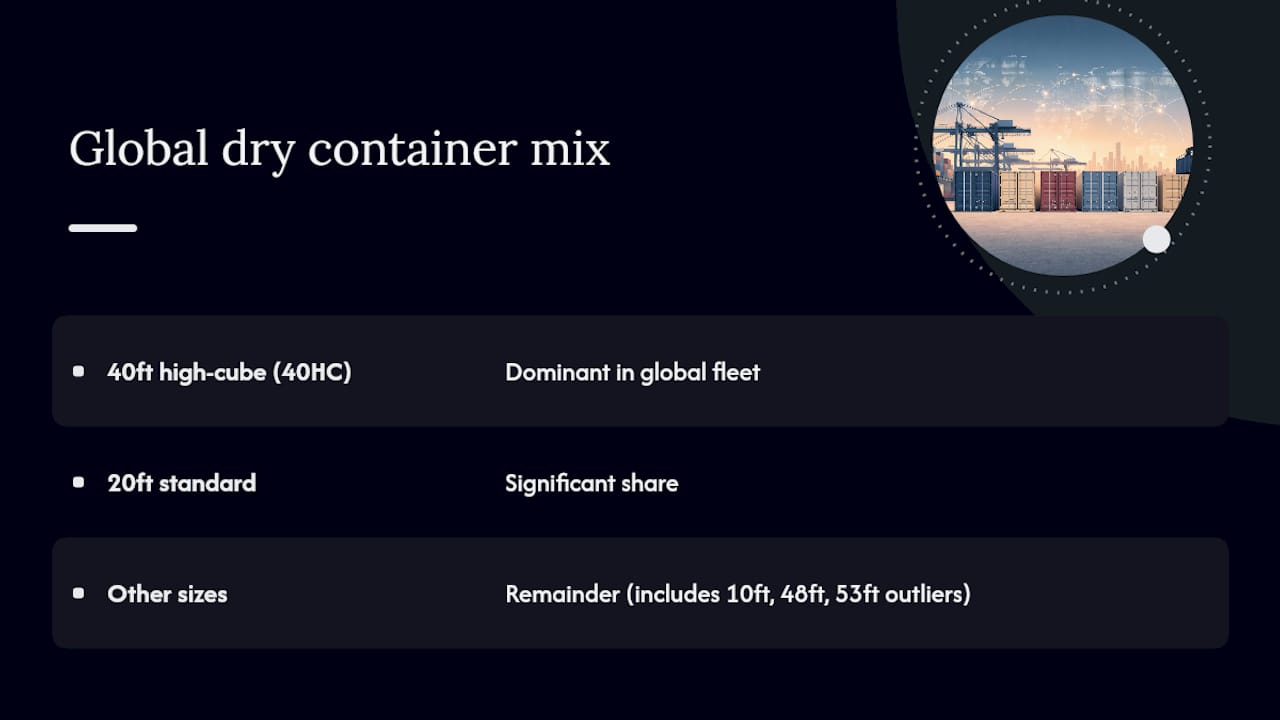
Fleet composition tells its own story: the global dry container fleet is dominated by 40HC units, with 20-foot standard boxes making up a significant share and the remainder split across other sizes, per DCSA’s container type guide. That shift toward high-cube reflects a simple truth about modern freight, most of it is light and bulky rather than dense and heavy.
Weight or volume: how do you pick the right container size?
Every container has three numbers stamped on its CSC plate that matter more than any marketing claim: tare weight (the empty container’s own weight), maximum gross weight or MGW (the legal ceiling for container plus cargo), and payload (MGW minus tare, adjusted further by road-legal axle limits on your specific route), as detailed in this UK guide to types of freight delivery.
The real decision hinges on stowage factor, which is just cargo weight divided by cargo volume. Freight forwarders use a rough threshold of about 750 kg per cubic meter to decide which limit you’ll hit first, a benchmark detailed in MG-Atlantic’s sizing guide.
- Calculate your cargo’s density in kg/m³ before booking anything.
- Above roughly 750 kg/m³, you’ll likely max out weight before filling the box, so a 20-foot standard container is usually the more cost-effective choice.
- Below that threshold, you’ll run out of space first, making a 40HC the better fit despite its larger footprint.
- Always cross-check the route’s road-legal weight limits and the delivery site’s access constraints before finalizing a booking.
Assuming a bigger box is automatically cheaper per unit of cargo is one of the more common and costly mistakes in container selection, since legal payload caps often make the smaller option the smarter one on dense freight.
What standards and safety checks apply to dry containers?
Three ISO specifications govern nearly every dry cargo container in circulation. ISO 1496-1 sets the specification and testing requirements for general-purpose Series 1 containers, covering stackability and structural strength so units interchange safely across trucks, trains, and vessels. ISO 668 standardizes exterior dimensions and classification, which is why a 40-footer from one manufacturer fits the same chassis and crane spreader as one from another. ISO 1161 governs the corner fittings themselves, the castings every crane, lashing rod, and twist-lock depends on.
Layered on top of ISO compliance is the Convention for Safe Containers (CSC) safety plate, a mandatory tag riveted to every unit that records tare, MGW, and manufacture date, and confirms the box has passed structural certification.
Pro Tip: Terminal staff routinely check CSC plate data against your booking weight before loading. A mismatch between declared and stamped figures can trigger a costly re-stuffing or redistribution on the spot, a risk flagged directly by TraceContainer’s safety standards guide.
Common rejection triggers at the gate include:
- Damaged or perished door seals that compromise the wind and water tight rating.
- Corroded or punctured flooring that can’t safely distribute cargo weight.
- Expired or illegible CSC plates.
- Structural dents near corner castings that threaten stacking integrity.
Routine terminal inspections and IICL-style maintenance checks catch most of these issues before they become shipment delays.
How should you load and secure cargo inside the container?
Proper loading is less about brute force and more about physics. Concentrated loads, especially heavy machinery, need to sit over the container’s structural crossmembers so weight transfers toward the corner castings rather than punching a hole through the floor.
- Distribute weight evenly across the floor, keeping heavier items low and centered over the axle points.
- Use dunnage, such as wood blocking or airbags, to fill voids and stop cargo from shifting mid-transit.
- Lash pallets and crates with rated straps anchored to the container’s built-in lashing rings.
- For bulk dry goods, consider a flexitank or liner bag system rather than loose stowage.
- Apply a tamper-evident seal to the door bar immediately after loading and record the seal number on the packing list.
- Match your commercial invoice, packing list, and customs paperwork to the exact cargo loaded, since discrepancies here are a leading cause of terminal holds.
Getting the paperwork right matters as much as the physical pack. For a fuller walkthrough of palletizing standards and export documentation, Worldwideexpress’s guide to efficient packing for export cargo covers the details terminal staff actually check.
What condition grades should you know before buying or leasing?
Dry containers come in a handful of recognized condition tiers, and matching the grade to your use case avoids overpaying. Brand new units carry the highest price but zero wear. One-trip containers have made a single ocean voyage and look nearly new at a discount. Good used units show cosmetic wear but remain structurally sound for years of further service. Wind-and-water-tight (WWT) grade units are the budget tier, no longer certified for ocean transit but perfectly serviceable for storage.
- New or one-trip units suit long-term leasing or resale-sensitive operations.
- Good used containers work well for regular freight moves on a budget.
- WWT-grade boxes are popular for static storage, job-site offices, and conversions.
- High-cube units are the preferred shell for container home and workshop conversions, thanks to the extra headroom.
Buying versus leasing depends on shipment frequency. Frequent shippers often lease through a carrier or Worldwideexpress’s logistics services to avoid tying up capital in idle assets, while businesses with permanent storage needs tend to buy used or WWT-grade units outright.
Author, resources, and your next step
This guide draws on standard freight-forwarding practice for matching cargo to container specs. For deeper technical reference, see Worldwideexpress’s ISO container types breakdown or its export packing guide.
- Measure your cargo’s dimensions and total weight.
- Calculate stowage density and compare it to the 750 kg/m³ threshold.
- Confirm route weight limits and delivery-site access.
- Request a freight quote once your container size is locked in.
What happens to dry cargo containers at end of life?
A steel dry container typically serves 10 to 15 years of active ocean duty before wear on seals, flooring, or structural steel takes it out of certified service. That doesn’t mean it’s scrapped. Most retired units get a second life as WWT-grade storage boxes, construction site offices, or the raw shell for container home conversions, extending their usefulness by another decade or more before any metal actually gets recycled.
When a container does reach true end of life, the steel itself is highly recyclable. Corten steel, the weathering alloy used in most dry container construction, retains scrap value because it melts down cleanly for reuse in structural steel and rebar production. That’s a meaningful environmental upside compared to materials that degrade in landfill.
The bigger environmental story, though, is the imbalance problem. Trade flows aren’t symmetric, so empty containers pile up in some ports while others face shortages, and repositioning empty boxes burns fuel without moving any actual cargo. Some carriers and depots are experimenting with better empty-container matching software to cut that wasted mileage, though the industry-wide fix remains incomplete.
For businesses evaluating supply chain sustainability more broadly, Worldwideexpress’s overview of sustainable supply chain practices covers how container logistics factor into a company’s broader environmental footprint, from empty repositioning to modal choice.
Dry containers versus refrigerated and tank containers: which fits your cargo?
Dry cargo containers win on cost, availability, and flexibility. They’re the cheapest container type to lease or buy, they’re stocked at nearly every depot worldwide, and they handle the widest range of commodities, from boxed electronics to bagged grain to palletized retail goods. Their main limitation is equally simple: no temperature control and no liquid containment, so anything perishable or fluid is off the table.
Refrigerated containers, or reefers, solve the temperature problem but at a real cost. They need a continuous power supply throughout the journey, cost significantly more to lease, and require specialized maintenance on the refrigeration unit itself. They make sense for pharmaceuticals, produce, and frozen goods, but using one for non-perishable cargo is paying for a feature you don’t need.
Tank containers solve a different problem entirely, moving bulk liquids and gases that no dry box or reefer could safely carry. They demand specialized cleaning between loads and stricter regulatory oversight, particularly for hazardous or food-grade liquids, which limits their flexibility for general cargo.
For the vast majority of non-perishable, non-liquid freight, a dry cargo container remains the most economical and logistically simple option. The decision usually isn’t dry versus reefer versus tank in the abstract. It’s whether your cargo actually needs the extras those specialized boxes provide, or whether a standard dry van does the job for less.
What customs and regulatory steps affect dry cargo shipments?
Customs clearance for dry cargo containers hinges on accurate, matching paperwork across every document in the chain: commercial invoice, packing list, bill of lading, and any certificates of origin or product-specific compliance documents. A mismatch between declared cargo weight or contents and what’s physically loaded is one of the fastest ways to trigger a customs hold, separate from the terminal-level checks on CSC plates and container condition.
Harmonized System (HS) codes need to be accurate for every commodity in the container, since customs authorities use them to assess duties, verify import eligibility, and flag restricted goods. Mixed-cargo containers with multiple commodity types require extra care here, since an incorrect code on even one line item can delay clearance for the entire shipment.
Country-specific import regulations vary widely and change often, covering everything from packaging material restrictions (wood pallets typically need ISPM 15 heat-treatment certification) to labeling requirements and prohibited-goods lists. What clears customs smoothly in one country can face additional scrutiny or outright rejection in another, so checking destination-specific requirements before booking matters more than assuming a universal standard applies.
Working with an experienced customs broker cuts down on these risks substantially, since brokers track evolving country-specific rules that individual shippers often miss. Worldwideexpress’s U.S. customs brokerage services handle exactly this kind of documentation and compliance work for importers moving dry cargo through U.S. ports.
What steel and flooring go into a dry container’s construction?
Nearly every dry cargo container built today uses Corten steel, a weathering alloy that forms a stable, tightly adhering rust layer on its surface rather than corroding straight through like ordinary carbon steel. That layer actually protects the metal underneath, which is why Corten-built boxes can spend over a decade in salt air and rough handling without structural failure, according to HZ Containers’ construction overview.

Corner castings, manufactured to the ISO 1161 spec, are typically cast steel welded at all eight corners of the frame. These aren’t decorative. Every crane lift, every stacked container in a nine-high yard stack, and every twist-lock securing the box to a chassis routes force through those eight points.
Flooring inside a standard dry container is almost always marine-grade plywood, sometimes treated bamboo, laid over steel crossmembers spaced to distribute point loads. This matters directly for anyone loading forklifts or heavy pallets, since a floor rated for distributed weight can still fail under a concentrated point load if it isn’t positioned over the crossmembers correctly.
Door seals complete the weatherproofing picture, using EPDM or NBR rubber gaskets that compress tight against the door frame to achieve the wind-and-water-tight rating terminals check before accepting a booking. Seal degradation from UV exposure or repeated flexing is one of the most common reasons a container fails inspection, which is why routine checks matter as much as the initial build quality.
An editorial take: match the box to the cargo, not the other way around
The research on dry containers keeps circling back to one uncomfortable truth: most shippers pick a size based on habit, not math. A 40-footer feels like the default because it’s the most commonly quoted size, but for dense cargo, that instinct actively costs money once you hit the legal weight cap with half the box still empty.
The stowage factor calculation takes five minutes and should happen before every booking, not after a shipment gets flagged for overweight at the gate. Conventional shipping advice treats container selection as a formality, when it’s actually the single decision with the biggest downstream effect on cost per unit shipped.
What gets overrated in most guides is the emphasis on container type variety, open-top, flat rack, and the rest. Those matter for edge cases, but the vast majority of freight moves in a standard dry van or a 40HC, and the real skill is doing the density math correctly rather than knowing every niche variant exists.
Prioritize the weight-versus-volume calculation first. Everything else, condition grade, buying versus leasing, even which terminal you route through, is a secondary decision once that number is locked in.
— Ian
Choosing the right container is only half the job. Getting it booked, cleared, and moving on schedule is where most shipments actually run into trouble, from customs documentation gaps to route capacity constraints. Worldwideexpress handles international freight forwarding, customs brokerage, and ocean transportation for businesses moving dry cargo across borders, and a freight quote request is the fastest way to see what a fully coordinated shipment actually costs for your specific cargo profile.
Sources
- Shipping Container Types: A Guide
- Container Size Guide: 20ft vs 40ft vs 40HC | MG-Atlantic
- DV Shipping Container – Standard Box – HZ CONTAINERS.com