If your cargo is too wide, tall, or heavy for a standard container, a 20-foot or 40-foot flat rack is usually the most practical choice. Flat racks fit tracked machinery, pipe bundles, and prefabricated modules that would never clear a standard door frame. When width creeps past extreme thresholds or weight overwhelms lashing capacity, breakbulk becomes the safer path. Either way, the next move is the same: measure the load, sketch its center of gravity, photograph it, and request out-of-gauge (OOG) approval and a quote before you commit to a sailing date.
TL;DR:
- Flat racks are ideal for cargo that exceeds standard dimensions, such as machinery, pipe bundles, and modular building sections, especially when width or weight surpass container limits.
- The load’s center of gravity sketch, proper bedding, and approved lashing plan are crucial for preventing damage or rejection during approval and handling.
- Additional costs include equipment fees, surcharges for overlength or overwidth cargo, on-deck placement, and inland heavy-haul, which vary based on cargo dimensions and weight.
- Return logistics require planning for depot locations, free-time windows, and potential detention charges, with collapsible racks offering cost savings on empty repositioning.
- Insurance should explicitly cover on-deck exposure and include thorough documentation to support claims in case of weather-related or shifting damages offshore.
Table of Contents
- What Are Flat Rack Shipping Containers?
- What Are the Standard Flat Rack Container Dimensions?
- Flat Rack vs RoRo vs Breakbulk: Which Fits Your Cargo?
- How Do You Secure and Load Cargo on a Flat Rack?
- What Does It Cost to Book a Flat Rack, and What Do Carriers Need?
- How Worldwide Express Supports Flat Rack Projects
- How Do You Handle Flat Rack Return Logistics?
- What Insurance Do You Need for Flat Rack Cargo?
- What Customs Issues Come Up With Flat Rack Cargo?
- A Practical Perspective on Flat Rack Shipping Pitfalls
- Get a Flat Rack Shipping Quote
- Sources
What Are Flat Rack Shipping Containers?
A flat rack is a reinforced steel base with strengthened corner posts and no side walls or roof. That open design is exactly why it works for cargo that a box container can’t swallow: excavators, generators, steel coils, yachts, and modular building sections all ride on flat racks because the load can overhang the sides or top within approved limits.
Two configurations dominate the market:
- Fixed-end flat racks have permanent end walls, offering more structural rigidity for heavier, denser loads.
- Collapsible-end flat racks fold their end walls down flat, allowing multiple empty units to stack for cheaper repositioning and letting cargo overhang the ends when needed.
Terminal operators typically load flat racks with top-lift or side-lift equipment rather than standard forklifts, since the cargo often needs crane placement to control the drop and avoid shock-loading the deck. Shippers moving pipe bundles or wind-turbine components frequently specify collapsible units for the return-trip savings alone. For a broader look at how flat racks compare with standard boxes, container shipping basics covers the full equipment lineup.
What Are the Standard Flat Rack Container Dimensions?
Spec sheets vary by manufacturer, but the working numbers are fairly consistent across the industry. A 20-foot flat rack typically runs close to 5.64 meters of usable inside length, while a 40-foot unit runs near 11.65 meters, with usable deck widths around 2.35 to 2.44 meters on most standard flat rack container designs.
Payload is where things get more variable. Newer 40-foot flat rack designs carry static payload ratings noted up to a high figure reflecting newer designs, according to documented flat rack specifications, though actual allowable weight depends heavily on the carrier and the specific unit. documented flat rack specifications, though actual allowable weight depends heavily on the carrier and the specific unit.
Three numbers matter, and they are not the same thing:
- MGW (maximum gross weight): the absolute ceiling stamped on the CSC plate, covering the container plus cargo.
- Tare weight: the empty container’s own weight, which gets subtracted from MGW.
- Usable payload: what’s actually left for your cargo, and it shrinks fast if your load is short and concentrated rather than spread across the deck.
Pro Tip: Never quote a shipment off a generic spec sheet. Every flat rack carries a CSC plate with its own certified maximum gross weight, and carrier data sheets are the decisive source for allowable stacking and stowage limits. Confirm the actual plate before you commit to a booking.
Flat Rack vs RoRo vs Breakbulk: Which Fits Your Cargo?
The right method depends less on cargo type and more on cargo behavior, specifically whether it rolls, sits flat, or exceeds container-handling limits entirely.
- Flat rack: best for heavy, moderately wide tracked machinery and over-length pieces that can be bedded and lashed securely to the deck.
- RoRo (roll-on/roll-off): best for operational wheeled equipment that can drive or be towed on and off under its own power. It’s often cheaper and faster, but it doesn’t work for tracked machines or anything that can’t roll.
- Breakbulk: reserved for cargo whose width or weight makes container methods impossible. It costs more and sails less frequently, but it’s the only real option once a load exceeds flat rack limits.
Flat racks tend to be the fastest containerized route for OOG cargo because they ride on standard container vessel services rather than waiting for dedicated breakbulk sailings. The tradeoff is exposure: your cargo sits uncovered on deck, and OOG surcharges are close to automatic once it exceeds the container envelope.
How Do You Secure and Load Cargo on a Flat Rack?
Getting cargo approved for flat rack carriage comes down to proving the carrier that weight distribution, bedding, and lashing all meet a defensible safety standard. Here’s the sequence that actually gets loads approved on the first pass:
- Establish center of gravity first. Provide a COG sketch before booking, not after the cargo arrives at the terminal. Carriers use this to decide stowage position and lashing plan.
- Keep blocking clear of corner posts. Avoid placing dunnage or blocking within 12 inches (30 centimeters) of the corner posts, since that zone needs to stay clear for structural load transfer.
- Bed the cargo properly. Timber sleepers or steel spreader plates transfer weight onto the flat rack’s main longitudinal girders rather than concentrating it on the thin deck plating between them. Skipping this step is a common cause of overloading disputes at terminals, since a short, concentrated load can exceed local deck capacity even when it’s well under the unit’s total rated payload.
- Apply lashings with known LC (lashing capacity) values. Direct lashings and cross lashings each have rated breaking strength, and carriers expect a lashing plan that shows enough total capacity for the cargo’s weight and the voyage’s expected forces.
- File VGM and get formal OOG approval. SOLAS’s verified gross mass requirement applies to flat rack cargo just as it does to standard boxes, and carriers won’t load OOG freight without written approval of the stowage plan.
The European Commission’s cargo securing guidance offers a solid baseline for lashing standards, but flat rack width is its own risk category. The National Cargo Bureau’s risk alert on extreme overwidth cargo recommends a detailed evaluation once cargo width approaches or exceeds 12 feet (3.66 meters), since unsupported overwidth loads risk sagging and stowage or access problems that can force the cargo into a different, more expensive handling category entirely.
What Does It Cost to Book a Flat Rack, and What Do Carriers Need?
Flat rack pricing stacks several charges on top of standard freight, and each one depends on how far outside the box your cargo actually sits.
- Flat rack equipment fee: carriers charge more for special equipment than for a standard dry container.
- OOG surcharge: applies once cargo overhangs the rated envelope, and it scales with how far it protrudes.
- On-deck vs under-deck stowage: on-deck placement, common for OOG loads, usually carries its own premium.
- Crane handling and terminal lift fees: flat rack cargo often needs specialized lifting rather than standard forklift handling.
- Inland heavy-haul costs: moving oversized cargo to and from the port frequently requires permits and escort vehicles that a standard container never touches.
Carriers charge more for flat racks partly because empty units are pooled at specific ports rather than universally available, which means repositioning an empty flat rack to your load point can add both lead time and cost if your origin isn’t already a flat rack hub.
Send vendors these five items and quotes come back faster and more accurately: precise length, width, and height; gross weight; a COG sketch; photos from multiple angles; and your desired departure window. Carriers typically also want to know your cargo’s lifting points and any protective measures it needs, details covered in more depth in this guide to shipping oversized cargo.
How Worldwide Express Supports Flat Rack Projects
Worldwideexpress coordinates the full flat rack process: ocean forwarding, OOG approval with the carrier, customs brokerage, inland heavy-haul transport, and cargo insurance, all through one point of contact. That matters because flat rack shipments touch more parties than a standard box move, and errors in any single handoff can strand cargo at a terminal. Carrier relationships built over years of ocean transportation bookings mean documentation and lashing plans reach the right desk the first time.
How Do You Handle Flat Rack Return Logistics?
Flat racks don’t disappear once your cargo reaches its destination. They’re carrier assets, and returning or repositioning them empty is where a surprising amount of hidden cost lives.
Most ocean carriers require the empty flat rack back at a designated depot within a set free-time window, usually a matter of days, before per-diem detention charges start accumulating. Because flat racks aren’t as common at every port as standard dry containers, the nearest depot accepting returns isn’t always the port where your cargo was discharged. That gap forces either an inland trucking leg to the correct depot or a negotiated extension, both of which cost money if nobody planned for them.
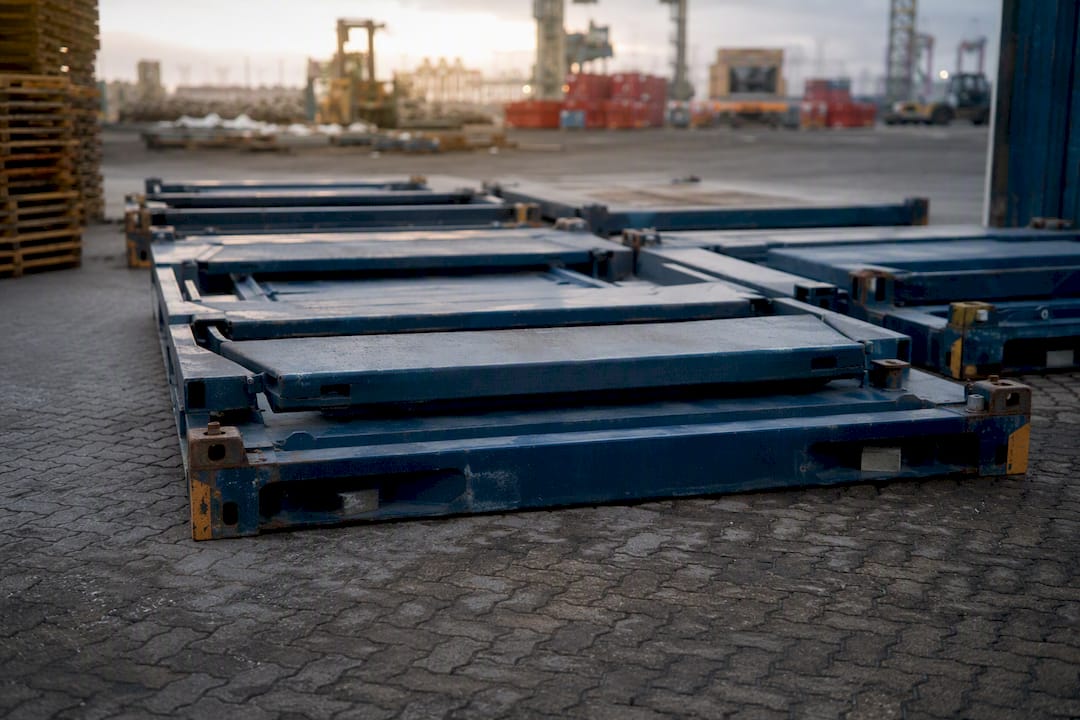
Collapsible-end flat racks have a real advantage here: carriers can nest several empty units together for the return voyage, cutting the per-unit repositioning cost compared with fixed-end racks that each take up a full slot. If your project needs multiple flat racks, specifying collapsible units upfront can meaningfully reduce what you pay on the back end, even though the fixed-end version often has slightly higher payload ratings for the outbound leg.
The practical fix is building return logistics into your original booking conversation rather than treating it as an afterthought. Ask the carrier where the nearest accepting depot sits relative to your cargo’s final delivery point, what the free-time window is, and whether detention charges start counting from discharge or from an agreed release date. A freight forwarder who’s already tracking flat rack pools across regional ports can often route the empty return more efficiently than a shipper handling it independently for the first time.
What Insurance Do You Need for Flat Rack Cargo?
Flat rack cargo carries risk that standard containerized freight simply doesn’t face, because the load sits exposed on deck rather than sealed inside a box. Weather, sea spray, and shifting during rough transit are all live concerns, and standard marine cargo policies don’t automatically account for that exposure the same way.
Any cargo insurance policy for a flat rack shipment should explicitly address on-deck stowage, since some standard policies exclude or limit coverage for cargo carried on deck rather than below it. That distinction alone can leave a shipper underinsured if nobody flags it before binding coverage. Total loss and partial loss both need clear definitions in the policy, particularly for high-value machinery where a damaged component might not total the whole shipment but still represents a significant repair cost.
Weight and lashing documentation also matter for claims, not just for carrier approval. If a claim arises from cargo shifting or lashing failure, insurers will look closely at whether the COG sketch, bedding plan, and lashing calculations matched what NCB and carrier guidance recommend for that cargo profile. Solid documentation upfront strengthens your position if something goes wrong at sea.
Given the exposure and value typical of flat rack cargo, all-risk coverage tends to make more sense than named-perils policies that only pay out for specifically listed causes of loss. Cargo insurance built for oversized and exposed shipments should be arranged before the vessel sails, not after, since some insurers won’t backdate coverage once cargo is already at sea.
What Customs Issues Come Up With Flat Rack Cargo?
Customs clearance for flat rack cargo carries a few wrinkles that standard container shipments rarely face, mostly because the cargo itself is often high-value, mechanically complex, or subject to specific import classifications.
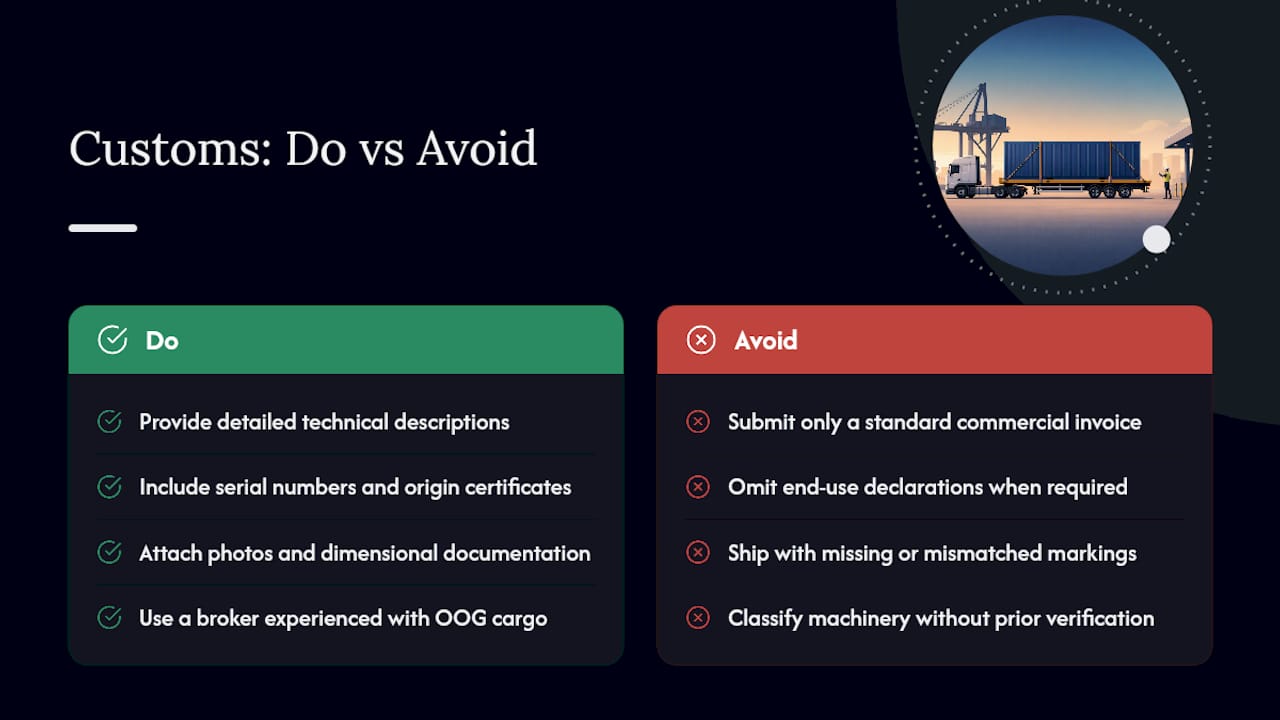
Heavy machinery and industrial equipment frequently require detailed technical descriptions and valuation documentation beyond a standard commercial invoice. Customs authorities in many markets want serial numbers, country-of-manufacture certificates, and sometimes end-use declarations for equipment that could have dual civilian and industrial applications. Getting this documentation wrong doesn’t just delay clearance, it can trigger a physical inspection, which is far more disruptive for an oversized load sitting on a flat rack than for a sealed box container.
Photos and dimensional documentation gathered for the OOG booking process double as useful customs support, since authorities reviewing an unusual shipment often want visual confirmation that matches the declared cargo description. Proper labeling and marking of components, especially on modular or multi-piece shipments, also speeds clearance considerably. The role of labels in logistics becomes especially relevant here, since mismatched or missing markings on individual pieces of a disassembled shipment are a common cause of customs delays.
Tariff classification for specialized machinery can also be genuinely ambiguous, and getting it wrong risks either overpaying duties or facing penalties for misclassification. A customs broker who has handled OOG cargo before knows which classification codes typically apply to specific equipment categories and can flag ambiguous cases before filing rather than after a shipment gets held.
A Practical Perspective on Flat Rack Shipping Pitfalls
Most flat rack problems trace back to the same root cause: information arriving too late. Shippers measure cargo after booking instead of before, or they send a weight figure without a center-of-gravity sketch, and then wonder why the carrier’s approval takes three extra days or comes back rejected outright.
The failure modes repeat predictably. Insufficient lashing capacity gets discovered at the terminal, not during planning. Bedding gets treated as optional rather than structural, and a short, heavy load ends up exceeding local deck capacity even though the flat rack’s total rating looked fine on paper. Stowage position, on-deck versus under-deck, gets assumed rather than confirmed, and that assumption sometimes doesn’t survive contact with an actual OOG approval.
Stage the paperwork before you touch the phone to book. Get photos, dimensions, and a COG sketch finalized first, and the rest of the process moves considerably faster. Readers with a specific project in mind are welcome to request a project review with Worldwideexpress before finalizing dimensions.
— Ian
Get a Flat Rack Shipping Quote
Worldwideexpress handles flat rack cargo end to end: OOG approval coordination with the carrier, customs brokerage, inland heavy-haul transport, and cargo insurance, all under one point of contact instead of five separate vendors chasing each other’s paperwork.
To return an accurate quote, Worldwideexpress needs five things from you: precise length, width, and height of the cargo; the gross weight; a center-of-gravity sketch; photos from multiple angles; and your target departure window. Send those five items and a quote typically comes back with realistic OOG surcharge estimates instead of a placeholder number that changes once the carrier sees the real dimensions. If you’d rather start with a broader look at how the process works before committing to specifics, the guide to ocean freight forwarding steps walks through what happens after booking. Ready to move forward now? Request a freight quote and get your flat rack project scheduled.
Sources
- Mitigating Risks of Extreme Overwidth Cargo on Flatracks — National Cargo Bureau
- Break Bulk, Over-Sized Cargo Shipments On Flat-Rack Containers — More Than Shipping