FTL means full truckload: one dedicated trailer for one shipper. LTL means less-than-truckload: consolidated freight from multiple shippers sharing one trailer. The practical rule is simple. Ship fewer than 6 pallets or need to save on cost, go LTL. Ship more than 12 pallets, or the cargo is fragile, high-value, or time-critical, go FTL. The breakeven zone in between, roughly 8 to 12 pallets, is where the real decision-making happens.
TL;DR:
- The typical breakeven point where full truckload becomes more cost-effective than LTL usually falls between 8 to 12 pallets or 10,000 to 15,000 pounds, but this varies with density and market conditions.
- Carriers price LTL shipments based on weight, freight class, and distance, often adding accessorials that can increase costs by 15% to 40 percent, while FTL uses flat or per-mile rates with fewer surcharges.
- For shipments in the 6 to 12 pallet range, it is advisable to request quotes for LTL, PTL, and FTL simultaneously to identify the most economical option, considering density and handling risks.
- Low-density, high-class freight significantly raises LTL costs, making FTL more affordable at lower pallet counts, sometimes as few as 6 or 7 pallets.
- Optimal shipment mode depends on detailed data including exact weights, dimensions, freight class, route specifics, and insurance, rather than just pallet count alone.
Table of Contents
- What Do FTL and LTL Actually Mean?
- FTL vs LTL Freight: Weighing the Trade-Offs
- When Should You Choose FTL Over LTL?
- How Carriers Price LTL vs FTL Shipments
- Packing and Insurance: What Changes Between Modes
- What Information Do You Need to Get Accurate Quotes?
- Why the Pallet Count Alone Won’t Tell You Enough
- How Worldwideexpress Helps You Choose the Right Mode
- Sources
What Do FTL and LTL Actually Mean?
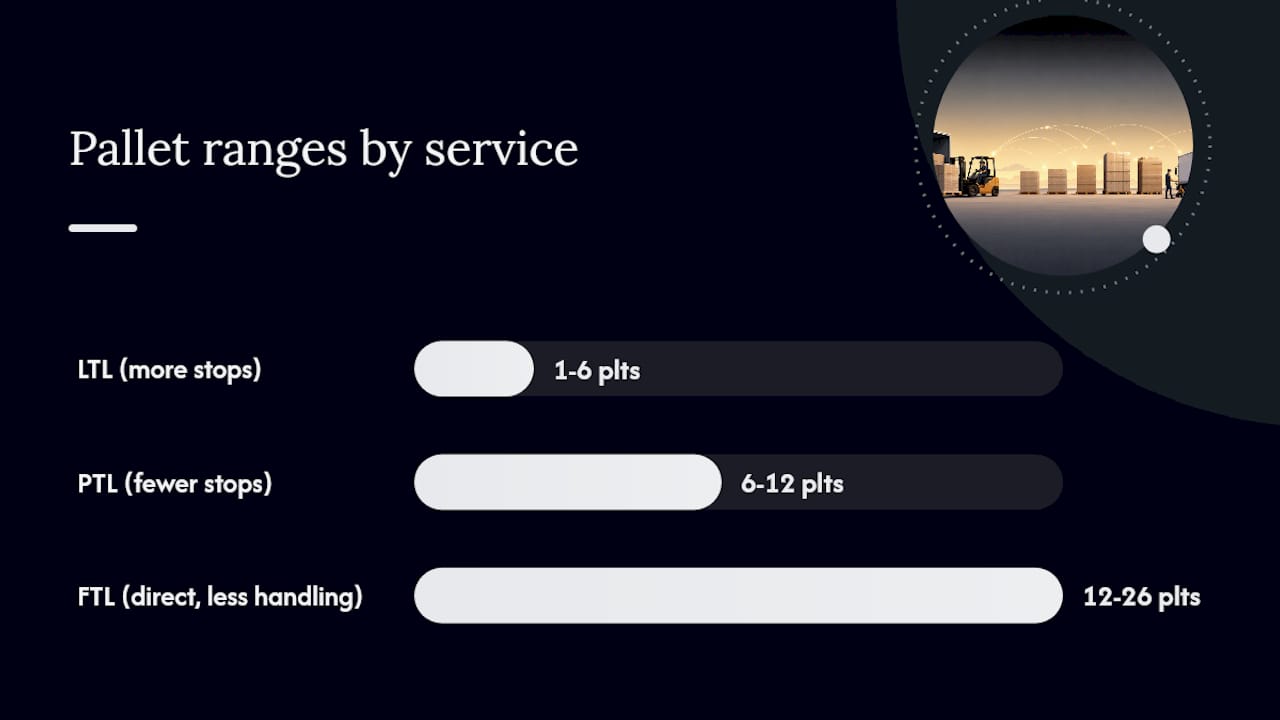
FTL stands for full truckload freight. A single shipper books the entire trailer, whether or not it’s completely full. Most FTL moves ride in 48-foot or 53-foot dry van trailers, which can hold roughly 12 to 26 pallets depending on how they’re stacked and secured. Shippers sometimes book FTL for loads that don’t come close to filling the trailer. That’s a deliberate trade: pay for the whole box, but get direct routing and zero contact with anyone else’s freight.
LTL stands for less-than-truckload freight. Instead of one shipper filling a trailer, a carrier consolidates loads from several businesses onto the same trailer. Typical LTL shipments run 1 to 6 pallets and stay under about 12 linear feet of trailer space. Pricing depends heavily on weight, distance, and something most first-time shippers overlook entirely: NMFC freight class, a density-based classification system the National Motor Freight Traffic Association maintains for the entire industry. A pallet of bricks and a pallet of pillows might weigh the same but get billed completely differently because of how much space they take up relative to their weight.
There’s a middle tier most explainers skip: partial truckload, or PTL. It covers the 6 to 12 pallet range and works like a hybrid: still consolidated with other freight, but with fewer stops and less handling than standard LTL. If your shipment lands in that gray zone, PTL deserves a quote alongside the other two options, a point worth remembering as you read on.
FTL vs LTL Freight: Weighing the Trade-Offs
Each mode trades cost against control, and the right call depends on what matters more for a given shipment.
FTL advantages:
- Direct point-to-point routing with no intermediate stops or terminal transfers
- Lower handling means fewer chances for damage, since freight isn’t loaded and reloaded across multiple docks
- Predictable transit times, which matters for perishables, medical supplies, or anything on a tight production schedule
- Carriers commonly recommend FTL even for smaller loads when speed or fragility outweighs the cost of an underfilled trailer
LTL advantages:
- Lower headline cost for small shipments, since you only pay for the space and weight you use
- No need to coordinate a full trailer’s worth of product before shipping
LTL disadvantages:
- More handling touches as freight moves through regional terminals, which raises damage risk
- Longer transit windows compared to a direct FTL run
- Classification complexity: getting the NMFC class wrong invites reweigh and reclass fees after pickup
PTL splits the difference in the 6 to 12 pallet band, usually with less handling than full LTL and a lower cost than booking an entire trailer.
When Should You Choose FTL Over LTL?
The crossover point where FTL usually becomes cheaper than LTL sits around 8 to 12 pallets, or roughly 10,000 to 15,000 pounds. That’s a directional guide, not a fixed line. Lane distance, current market rates, and one factor shippers underestimate constantly, freight density, all shift where the breakeven actually falls.
Density matters because LTL pricing rewards compact, heavy freight and penalizes bulky, lightweight freight. Low-density, high-class freight pushes LTL costs up, sometimes enough that FTL becomes the cheaper option even at 6 or 7 pallets instead of 10. A pallet of folded cardboard boxes and a pallet of steel brackets might occupy identical trailer space, but the carrier bills them worlds apart.
| Small shipment (1–5 pallets) | Mid-range (6–12 pallets) | Large shipment (12+ pallets) | |
|---|---|---|---|
| Recommended mode | LTL | Quote LTL, PTL, and FTL | FTL |
| Pricing basis | Weight, class, distance (per cwt) | Varies by carrier | Flat rate or per-mile lane rate |
| Handling risk | Higher (multiple terminals) | Moderate | Lower (single trailer, direct route) |
| Transit speed | Slower, multi-stop | Faster than standard LTL | Fastest, direct routing |
Pro Tip: Never settle for a single quote type in the 6 to 12 pallet range. Ask your carrier or broker to price the same shipment as LTL, PTL, and FTL side by side, then compare the all-in totals rather than just the base linehaul rate.
The WarehousingCosts.com breakeven analysis makes a point worth repeating: shippers who treat the LTL versus FTL choice as binary, instead of a continuum with PTL in the middle, routinely overpay or take on avoidable damage risk in that mid-range zone.
How Carriers Price LTL vs FTL Shipments
LTL pricing runs on three variables: weight, NMFC freight class, and distance, typically billed per hundredweight (cwt). Density drives the class assignment, which is why two shipments of identical weight can carry wildly different price tags. FTL pricing works differently. Carriers quote a flat rate per trailer or a per-mile rate for the lane, and that price barely moves whether you load 14 pallets or 22, since you’ve already paid for the whole trailer.
Accessorial charges are where quotes go sideways. Common add-ons include:
- Liftgate service for locations without a loading dock
- Residential or non-commercial delivery fees
- Inside delivery beyond the truck’s tailgate
- Reweigh and reclass fees when the carrier’s scale disagrees with your paperwork
- Detention charges when a driver waits beyond the free loading window
- Fuel surcharges layered on top of the base rate
These aren’t rounding errors. LTL accessorials can add 15% to 40% on top of the base rate, and FTL detention and layover charges can swing an otherwise competitive quote significantly. Understanding freight classification ahead of time helps avoid the reweigh and reclass surprises that inflate LTL invoices after the fact.
Packing and Insurance: What Changes Between Modes
LTL freight gets handled more, so it needs to survive more. Standard LTL best practice calls for stronger palletization, corner blocking, banding, and stretch overwrap tight enough to survive a forklift transfer at three different terminals.
- Use four-way pallets so any forklift angle works at any terminal
- Band and shrink-wrap every layer, not just the top
- Label each side of the pallet, not just the top, since handlers may approach from any angle
- For high-value or fragile goods, weigh FTL’s higher headline cost against the lower handling risk before defaulting to LTL
Declared value on a standard bill of lading often falls short of a shipment’s real worth. Ask about additional cargo insurance whenever the freight’s value exceeds what the carrier’s default liability actually covers.
What Information Do You Need to Get Accurate Quotes?
Comparable quotes require identical inputs. Supply the same data to every carrier or broker so the numbers actually mean something side by side.
- Exact weight and dimensions for every pallet, plus total pallet count
- Origin and destination ZIP codes, including any access restrictions like limited dock hours or residential delivery
- NMFC freight class or density calculation, so nobody guesses at classification after pickup
- Expected transit time and whether the route includes terminal stops
- Which accessorials apply, and which party is responsible for each one
- The carrier’s reweigh and reclass policy, so there are no surprises on the invoice
- Available cargo insurance options beyond standard carrier liability
Request all-in estimates, linehaul plus every accessorial, rather than a bare base rate. Any shipment with an unusually high freight class or low density deserves a second look before you commit to a mode.
Why the Pallet Count Alone Won’t Tell You Enough
Most shippers want a clean number: ship under X pallets, book LTL; ship over Y, book FTL. That number exists, and it’s useful as a starting point. But treating freight density as an afterthought is the single most common reason shippers end up on the wrong side of that breakeven.
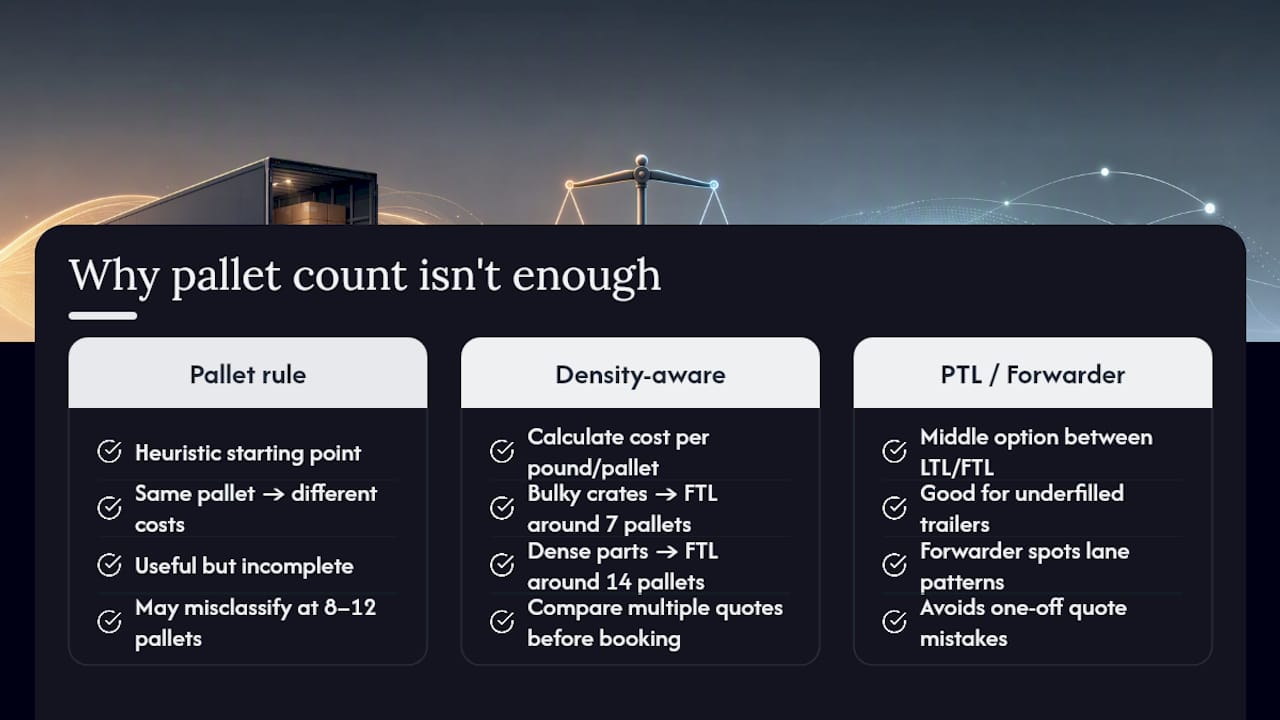
Two businesses shipping the same pallet count can face completely different economics. A furniture maker shipping bulky, low-density crates might hit FTL pricing efficiency at 7 pallets. A company shipping dense machined parts might not reach that point until 14. The pallet rule is a heuristic, not a formula, and the businesses that save real money are the ones who calculate cost per pound or per pallet across multiple quotes before committing to a mode.
The middle option, PTL, gets ignored more than it should. It exists precisely for shippers who feel stuck choosing between an overpriced LTL bill and an underfilled trailer. A freight forwarder who runs lane analysis regularly can spot that mid-range opportunity faster than a shipper comparing quotes once a quarter, because the value in that decision comes from pattern recognition across dozens of lanes, not a single transaction.
— Ian
How Worldwideexpress Helps You Choose the Right Mode
A freight forwarding partner that works across freight forwarding, customs brokerage, trucking, and warehousing can help ensure lane analysis does not happen in isolation from the rest of a shipment’s journey. Choosing between FTL, PTL, and LTL gets easier when someone is also calculating density, consolidating insurance, and pricing accessorials into one all-in quote instead of three separate guesses. If a shipment sits in that 6 to 12 pallet gray zone, a freight forwarding partner can run the comparison and flag where the real savings sit.
Sources
- LTL vs. Full Truckload Shipping: What’s the Difference – NMFTA
- Warehousingcosts
- Choosing FTL or LTL shipping – Amazon Freight Services