Route optimization cuts delivery miles by roughly 10 to 30 percent and lifts driver productivity by 15 to 30 percent, according to industry syntheses of fleet performance data. It does this by algorithmically sequencing stops against real constraints rather than relying on a dispatcher’s mental map. The result: fewer miles driven, more stops per shift, and on-time delivery rates that hold steady even as order volume grows. What follows explains the mechanics, the math, and the measurement framework behind those numbers.
TL;DR:
- Route optimization reduces mileage by 10 to 30 percent and increases driver productivity by the same range, mainly through better sequencing of stops.
- Accurate constraint modeling, including time windows, vehicle capacity, and regional access rules, is essential for the optimizer’s success and real-world applicability.
- Real-time re-optimization can save additional fuel and time by adjusting routes for traffic and supply chain delays during the day.
- Pilot projects should last at least three weeks, focus on a single region, and emphasize data quality and constraint accuracy before scaling up.
- For international freight, integrated visibility into delays such as customs and warehouse handoffs is vital to keep routes viable and reliable.
Table of Contents
- What Is Logistics Route Optimization, and How Does It Differ From Route Planning?
- How Route Optimization Works: Algorithms, Data, and Re-Optimization
- Constraints and Objective Functions You Have to Model Correctly
- What ROI Can You Realistically Expect From Route Optimization?
- Which Type of Route Optimization Software Fits Your Fleet?
- How to Implement Route Optimization Without the Common Pitfalls
- Execution-Aware Operations: Where Routing Meets International Handoffs
- How Do You Measure Whether Route Optimization Is Actually Working?
- How Does Route Optimization Reduce Carbon Footprint?
- What Do Successful Route Optimization Rollouts Actually Look Like?
- The Real Bottleneck Isn’t the Algorithm
- How Worldwideexpress Supports Execution-Aware Logistics
- Sources
What Is Logistics Route Optimization, and How Does It Differ From Route Planning?
Route planning answers a simple question: what order should a driver visit stops in? Route optimization answers a harder one: what is mathematically the best order, given every constraint that governs your fleet, and how does that answer change as the day unfolds?
The distinction matters more than it sounds. A dispatcher building routes manually, or with basic mapping software, is planning. They’re sequencing stops based on geography and gut feel, often the same way they did it last week. Logistics route optimization instead runs an algorithm against your actual data. It weighs distance, time windows, vehicle capacity, driver hours, and traffic simultaneously, then produces a route that a human planner working alone would rarely land on, especially once you’re past 15 or 20 stops per vehicle.
The objectives an optimization engine can pursue include:
- Minimum distance: the shortest total mileage across all routes combined
- Minimum time: the fastest completion given traffic and service durations
- Lowest cost: a blended objective weighing fuel, labor, and vehicle wear
- Service priority: guaranteeing high-value or time-critical stops get served first
- Balanced workload: spreading stops evenly across drivers rather than optimizing one route in isolation
Most platforms let you weight these objectives against each other. A grocery delivery fleet might prioritize time windows above all else, while a bulk freight operation optimizes almost purely for cost per mile. The right objective function depends on what your customers actually value and where your margins get squeezed.
How Route Optimization Works: Algorithms, Data, and Re-Optimization
Underneath every routing engine sits a version of the Vehicle Routing Problem, the mathematical cousin of the classic Traveling Salesperson Problem. Finding the provably optimal route for even a modest number of stops requires computing power that grows explosively with each added address. Past roughly 12 to 15 stops, an exact solution becomes computationally infeasible in any reasonable time frame. That’s why every commercial solver relies on heuristics and metaheuristics, algorithms designed to find a very good route quickly rather than a perfect one slowly.
The practical pipeline behind a working optimizer looks like this:
- Ingest the stops. Orders, delivery addresses, and service requirements load into the system, often from a transportation management system or order management platform.
- Validate and geocode addresses. Bad coordinates are the single most common reason optimizers fail in the field, so this step catches malformed or unverifiable addresses before they break a route.
- Build the distance and time matrix. The system calculates travel time and distance between every stop pair, factoring in road networks and, increasingly, live traffic conditions.
- Apply constraints. Time windows, vehicle capacity, driver certifications, and access restrictions all get layered onto the raw geography.
- Run the solver. The optimization engine searches for the best feasible sequence given every constraint above.
- Re-optimize as conditions change. New orders, cancellations, or a jackknifed trailer three stops ahead trigger a fresh calculation mid-route, according to the documented flow behind modern routing platforms.
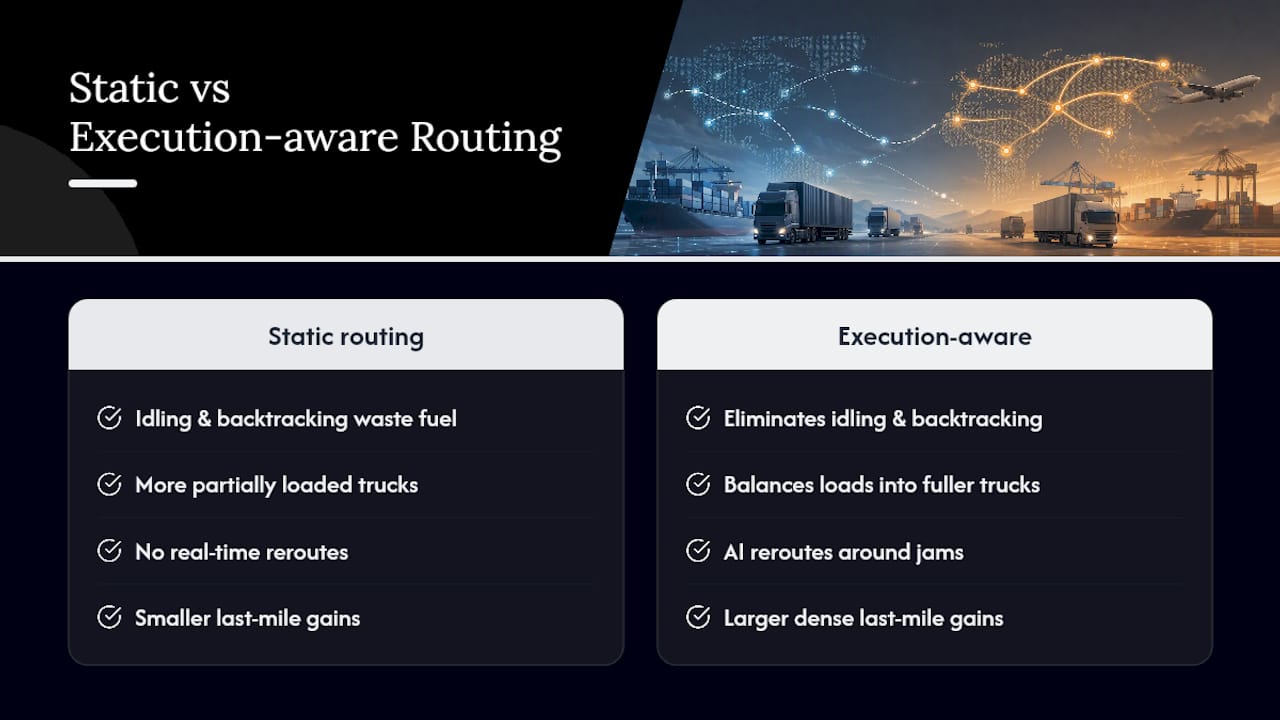
That last step is where the industry has moved fastest. Static, batch-run planning built the morning before dispatch is giving way to execution-aware systems that re-optimize in real time as orders, traffic, and driver status shift throughout the day.
Constraints and Objective Functions You Have to Model Correctly
A routing algorithm is only as good as the constraints you feed it. Skip one, and the optimizer will confidently produce a route that looks great on a map and falls apart the moment a driver tries to execute it.
The constraints that matter most in practice:
- Time windows and service durations: a delivery window means nothing if the system doesn’t also account for how long the driver spends at the dock unloading.
- Vehicle capacity and product compatibility: weight, volume, and whether refrigerated goods can share a trailer with dry freight all need encoding.
- Access rules: low bridges, no-truck zones, and appointment-only docks quietly break more routes than any traffic jam.
- Driver hours and hours-of-service compliance: a route that’s mathematically perfect but pushes a driver past legal limits isn’t usable.
- Shift patterns and break requirements: built-in rest stops change the shape of an efficient route entirely.
Objective functions add another layer of tension. Minimizing distance and minimizing time aren’t the same goal. The shortest route in miles might run through congested surface streets, while a slightly longer highway route finishes faster and burns less fuel idling in traffic. Most operations end up optimizing for a blended cost function rather than any single variable in isolation.
Pro Tip: Model your hours-of-service limits as a hard constraint, not a soft preference, in any optimizer configuration. A route that looks 8 percent more efficient on paper is worthless if it requires a driver to violate federal hours limits to complete it.
What ROI Can You Realistically Expect From Route Optimization?
The numbers here are consistent across independent syntheses of fleet data, and they’re substantial enough to build a business case around.
By the numbers: Fleets that move from manual or basic route planning to true optimization typically see 10 to 30 percent reductions in mileage and fuel consumption, alongside 15 to 30 percent gains in driver productivity. On-time delivery rates improve measurably in the same shift.
Translating those percentages into dollars is straightforward once you know your baseline. If your fleet burns $2 million a year in fuel and you capture even the low end of that range, a 10 percent reduction is $200,000 back on the table annually, before counting the labor efficiency gains from fitting more stops into the same shift.
The KPIs worth building into any business case:
- Miles driven per stop, before and after optimization
- Fuel consumed per stop or per route
- Stops completed per driver per shift
- On-time delivery percentage
- Cost per delivery, fully loaded with labor and fuel
Two variables swing these numbers more than anything else: geographic density and stop count per route. A dense urban last-mile operation with 40 stops per van captures far more optimization value than a rural route with six widely spaced deliveries, simply because there’s more sequencing complexity to solve. Adoption of dedicated routing software has grown accordingly, as more mid-size fleets recognize the payback period runs in months, not years, for operations of meaningful scale.
Which Type of Route Optimization Software Fits Your Fleet?
Not every operation needs the same tool, and buying more capability than your fleet’s complexity requires just adds cost and integration overhead without adding value.
- Entry-level route apps work well for small fleets, typically under 20 to 30 vehicles, with straightforward delivery patterns and few hard constraints. They’re fast to deploy but often lack sophisticated capacity or driver-hour modeling.
- Mid-market transportation management platforms add multi-depot support, better constraint handling, and integration with dispatch and telematics systems.
- Enterprise GIS-based platforms bring the deepest constraint management and the most realistic road-network routing, the kind of capability Esri’s logistics platform provides for complex, high-volume fleets running across multiple regions.
Whatever category you land in, evaluate against the same core checkpoints: can the solver handle your actual stop volume without timing out, does it support every constraint your operation genuinely needs (not just the common ones), can it re-optimize in real time rather than only at batch intervals, and does it integrate cleanly with your existing transportation management or telematics stack. Size your pilot to a single depot or region first. A fleet-wide rollout before you’ve validated the constraint model against real drivers is how expensive mistakes happen.
How to Implement Route Optimization Without the Common Pitfalls
Rolling out a routing engine is less a software installation and more a data and change management project wearing a software costume.
- Audit your address and stop data first. Address quality and geocoding errors are consistently among the largest causes of optimizer failure in early pilots. Fix this before touching an algorithm.
- Codify every real constraint. Sit with dispatchers and drivers to capture the access rules, dock appointment windows, and informal exceptions that never made it into any system of record.
- Design a genuine A/B pilot. Run optimized routes against a manual baseline using the same stops and the same driver pool. That structure gives you the cleanest possible read on actual impact, free of seasonal or driver-skill noise.
- Bring dispatchers and drivers into the rollout early. A route that looks efficient on a screen but ignores a driver’s on-the-ground knowledge of a customer’s actual receiving hours will get overridden in the field, silently erasing your gains.
- Scale only after the pilot data holds up. Expand region by region, watching the same KPIs you tracked in the pilot.
Pro Tip: Run your pilot for at least three full weeks, not three days. Route optimization gains often look inflated in week one simply because drivers are paying closer attention to a new system, then settle into their true baseline once the novelty wears off.
The most common failure mode isn’t a bad algorithm. It’s an under-scoped pilot that skips the data audit, ignores a real-world constraint like a customer’s receiving-dock hours, and then gets judged a failure when the routes it produces are technically optimal but operationally unworkable.
Execution-Aware Operations: Where Routing Meets International Handoffs
A route can be mathematically perfect and still fall apart the moment a shipment is late arriving at the depot that feeds it. That’s the blind spot in a lot of routing conversations: optimization treats the depot as a fixed starting point, when in reality inbound freight, customs clearance, and warehouse handoffs all shift that starting point around constantly.
This is where integrated visibility earns its keep. A dispatch team re-optimizing routes in real time needs live exception feeds, not just live traffic data, because a delayed inbound container changes what’s actually available to load onto outbound routes that morning. Executives increasingly treat routing as an execution layer that has to talk to supply and inventory planning, not a standalone dispatch tool working from yesterday’s assumptions.
Operational controls worth building into any routing program:
- Capture exception data (delays, damage, customs holds) at the source, not after the fact
- Gate route commitments against confirmed inventory availability, not projected availability
- Build a documented exception playbook so dispatchers aren’t improvising when an inbound handoff slips
- Tie cargo tracking and ETA visibility directly into the re-optimization trigger, so a delay upstream automatically flags downstream routes for review
For fleets that combine domestic delivery with international freight, the timing gap between customs clearance and the next available delivery window is often the single biggest unmodeled variable in the entire routing plan. Solving it usually means better freight coordination and logistics optimization further up the chain, not just a better local algorithm.
How Do You Measure Whether Route Optimization Is Actually Working?
Track a small, consistent set of KPIs rather than drowning your team in dashboards.
- Miles per stop, week over week
- Fuel consumed per stop
- Stops completed per driver per shift
- On-time delivery percentage
- Exception rate (missed windows, failed deliveries)
A pilot that compares optimized routes against a manual baseline, using the same stops and the same driver pool, produces the cleanest read on real impact, free of the noise that comes from comparing different weeks, seasons, or drivers.
Report weekly during a pilot, monthly once you scale. Before expanding beyond the pilot region, confirm the gains hold across at least a few weeks of data, not one unusually good week, and get sign off from dispatch leadership before touching driver headcount or vehicle allocation based on the results.
How Does Route Optimization Reduce Carbon Footprint?
Fewer miles driven means less fuel burned, and that arithmetic scales fast across a fleet. A delivery operation capturing even the low end of typical mileage reductions, around 10 percent, is cutting a proportional share of its fleet’s direct emissions without buying a single new vehicle.
The mechanism is straightforward: idling in traffic, backtracking across a poorly sequenced route, and running near-empty trucks on low-density stops all waste fuel that optimized sequencing eliminates. Balancing loads across fewer, fuller vehicles instead of more, partially loaded ones compounds the effect, since you’re moving the same freight volume with fewer engine hours total.
Real-time re-optimization adds a second layer of savings that static planning can’t touch. When AI-driven traffic prediction reroutes a truck around a developing jam before it hits standstill traffic, that truck isn’t idling and burning fuel for the twenty minutes it would have spent stuck in place. Multiply that across a fleet running hundreds of routes daily, and the emissions difference between static and execution-aware routing becomes a meaningful part of a company’s broader sustainability reporting.
Last-mile delivery carries an outsized share of this impact, since urban delivery routes tend to involve more stop-and-go driving per mile than long-haul freight. Fleets serving dense metro areas typically see the largest proportional emissions gains from optimization, simply because there’s more inefficiency in the baseline to remove. For companies reporting against sustainability targets, route optimization is one of the few levers that reduces both cost and emissions with the same investment, rather than forcing a trade-off between the two.
What Do Successful Route Optimization Rollouts Actually Look Like?
The pattern across successful implementations tends to repeat regardless of industry: a scoped pilot, a clean data foundation, and a willingness to fix constraint gaps before blaming the algorithm.
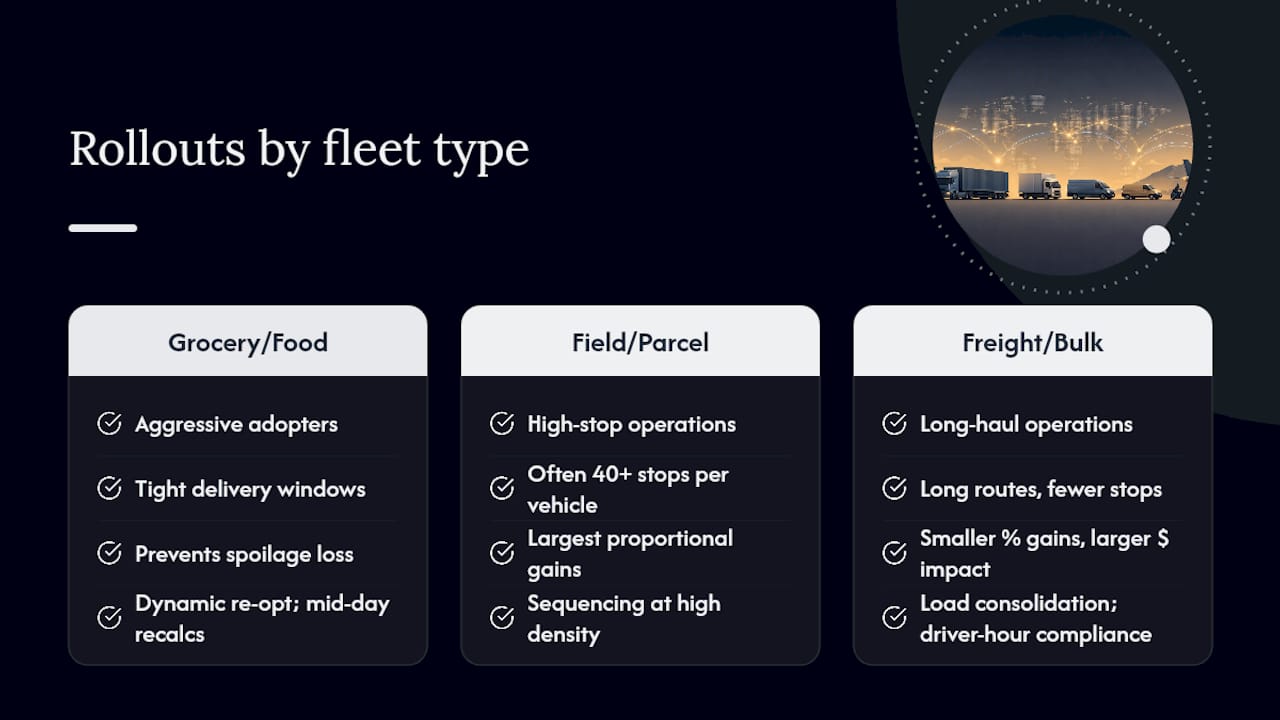
Regional grocery and food distribution operations, where delivery windows are tight and product spoilage adds real financial stakes to a missed stop, have been among the most aggressive adopters of dynamic re-optimization. The tight windows leave little room for a route to drift once traffic or an order change hits, so these fleets lean heavily on mid-day recalculation rather than a single morning plan.
Field service and parcel operations running high stop counts per vehicle, often 40 or more, see the largest proportional gains simply because manual sequencing at that density is nearly impossible to do well by hand. A dispatcher planning 15 stops can often beat an unsophisticated algorithm; a dispatcher planning 50 stops across variable time windows almost never can.
Freight and bulk distribution operations tend to see smaller mileage percentage gains but larger absolute dollar impact, because a single percentage point of fuel savings on a long-haul route is worth more in raw dollars than the same percentage on a short urban hop. These fleets often optimize more for load consolidation and driver-hour compliance than for pure route sequencing.
The common thread across every successful case: none of them treated the rollout as a one-time software purchase. Each one built a measurement habit, kept adjusting constraints as real-world exceptions surfaced, and expanded scope only after the data validated the pilot.
The Real Bottleneck Isn’t the Algorithm
Most of the routing conversation focuses on solver sophistication, and most of that focus is misplaced. Modern optimization engines are good enough for the overwhelming majority of logistics operations. The gap between a promising pilot and a program that actually holds up at scale is almost always data quality, constraint completeness, and whether dispatchers trust the output enough to stop manually overriding it.
Run a scoped pilot in one region against a genuine manual baseline. Track five KPIs, not fifteen. Fix your address data before you touch a solver setting. Then scale only once the numbers hold for several consecutive weeks, not one good one. The strategic upside here is real, measurable cost reduction, added delivery capacity without new vehicles, and service reliability that survives a bad traffic day, but none of it shows up automatically just because you bought software. If you’re building this program and need it to connect cleanly with cross-border freight timing, that’s worth a direct conversation with your operations or logistics partners before you lock in a pilot design.
— Ian
How Worldwideexpress Supports Execution-Aware Logistics
Optimized routes only hold up when everything feeding them, inbound freight, customs clearance, warehouse handoffs, arrives on schedule too. That’s the gap most routing software can’t close on its own, and it’s where Worldwideexpress operates differently: as the partner handling the international side of your supply chain so your domestic routing plan isn’t built on guesswork about when inventory actually lands.
A logistics partner coordinating international freight forwarding, customs brokerage, and air and ocean transportation with global tracking visibility can help dispatch teams see delays before they cascade into missed delivery windows. For operations juggling cross-border handoffs alongside domestic route optimization, that visibility is often the missing piece between a route plan that works on paper and one that survives contact with a real supply chain. If your team is scoping a pilot and needs the international freight side locked down first, start with a freight forwarding consultation to see where the timing gaps actually are.
Sources
- What is route optimization — Blue Yonder
- What Is Route Optimization? A 2026 Guide for Delivery & Fleet — RouteMate
- What Is Route Optimization? A Complete Guide For Logistics — Locus
- Route planning and optimization — Esri
- Why transport costs are rising in 2026 and how route optimization reduces them