A T1 is the external Union transit declaration that lets non‑Union goods move across the EU (and connected countries) without paying import duty or VAT until they clear customs at their final destination. You need one whenever non‑Union goods cross EU territory under customs supervision rather than being imported outright. Filing runs through NCTS Phase 5, requires a financial guarantee and a Movement Reference Number (MRN), and ends only when the goods are presented at the customs office of destination or an authorized consignee’s premises.
TL;DR:
- Most T1 movements must have active guarantee references correctly mapped to the MRN before departure to prevent delays at the border.
- The transit time for T1 is generally capped at 14 days, with exceptions possible only if documented delays occur during transit.
- Accurate and complete data, including transport identity and office details, are crucial for smooth T1 processing and to avoid rejections.
- T1 can be used across the Common Transit Convention territory, including routes through the UK, Norway, Switzerland, and other partner countries, not just within the EU.
- Outsourcing T1 handling to a specialized logistics provider reduces operational errors, lowers border delays, and ensures compliance for recurring or complex shipments.
Table of Contents
- What Does T1 Customs Cover, and How Does It Differ From T2?
- How Does the T1 Transit Procedure Work in NCTS Phase 5?
- Who Is Responsible for a T1, and What Guarantees Apply?
- What Documents and Data Do You Need Before Filing a T1?
- How Long Does a T1 Last, and What Trips Up Most Filers?
- Where Is T1 Accepted, and What Routing Rules Apply?
- A Forwarder’s Checklist for Running T1s Without Costly Delays
- Why Getting T1 Handling Right Is a Business Decision, Not Just a Compliance Task
- How Worldwideexpress Handles T1 Transit for Trading Businesses
- Sources
- FAQ
What Does T1 Customs Cover, and How Does It Differ From T2?
T1 applies to non‑Union goods, meaning cargo that has not yet cleared import formalities anywhere in the EU. Think of a container arriving at Rotterdam from Shanghai and trucked to a warehouse in Munich for clearance there instead of at the port. Placing that shipment under a T1 transit declaration suspends import duties, VAT, and commercial policy measures until they reach their destination office. The legal backbone is the Common Transit Convention (CTC) layered on top of the Union Customs Code, and the transit manual spells out exactly how the two interact.
T2, by contrast, covers Union goods moving through a non‑EU CTC country without losing their duty‑paid status. Practical rule of thumb:
- Use T1 for non‑Union goods entering, transiting, or moving between customs offices before formal import.
- Use T2 for EU‑origin goods passing through Switzerland or Norway en route to another EU member state.
- Mixed loads with both statuses typically require separate declarations for each portion.
How Does the T1 Transit Procedure Work in NCTS Phase 5?
Since December 2024, every T1 runs through NCTS Phase 5, which means paper declarations are no longer an option and every step generates a trackable electronic message. Here’s how a movement actually flows from filing to closure:
- Submit the IE015. The declarant files the pre-departure declaration with commodity codes, weight, package counts, consignor and consignee details, and the guarantee reference and LRN. This generates the MRN that tracks the movement start to finish.
- Watch for an IE016 rejection. If customs finds a discrepancy, an automated rejection message comes back before the goods ever move. Fixing this before departure is far cheaper than fixing it mid-transit.
- Receive release for transit (IE029). Once accepted, the goods are released and the Transit Accompanying Document, printed with the MRN and a barcode, travels with the truck or container.
- Move under guarantee. The declared route, transport identity, and estimated transit time (capped at 14 days under current NCTS rules) govern the movement.
- Present goods at destination (IE044). The office of destination or an authorized consignee confirms arrival electronically, which discharges the T1 once the data matches.
- Resolve any IE055 discrepancy. A mismatch between declared and arrived goods triggers this message and can hold up discharge until it’s cleared manually.
Who Is Responsible for a T1, and What Guarantees Apply?
The holder of the procedure carries legal responsibility for the goods from departure until formal discharge is confirmed, not just until the truck leaves the yard. That distinction catches a lot of first-time forwarders off guard.
A guarantee is mandatory because it secures the potential customs debt if the goods vanish, get diverted, or never arrive intact.
- Individual guarantees cover a single movement and suit occasional or high-risk shipments.
- Comprehensive guarantees cover multiple movements over time and suit forwarders running regular T1 volume.
- Failing to discharge a T1 on time can trigger a guarantee call, meaning the guarantor pays the customs debt directly.
- Authorized consignor/consignee status lets goods depart or arrive without a physical stop at a customs office, which speeds up inland delivery considerably.
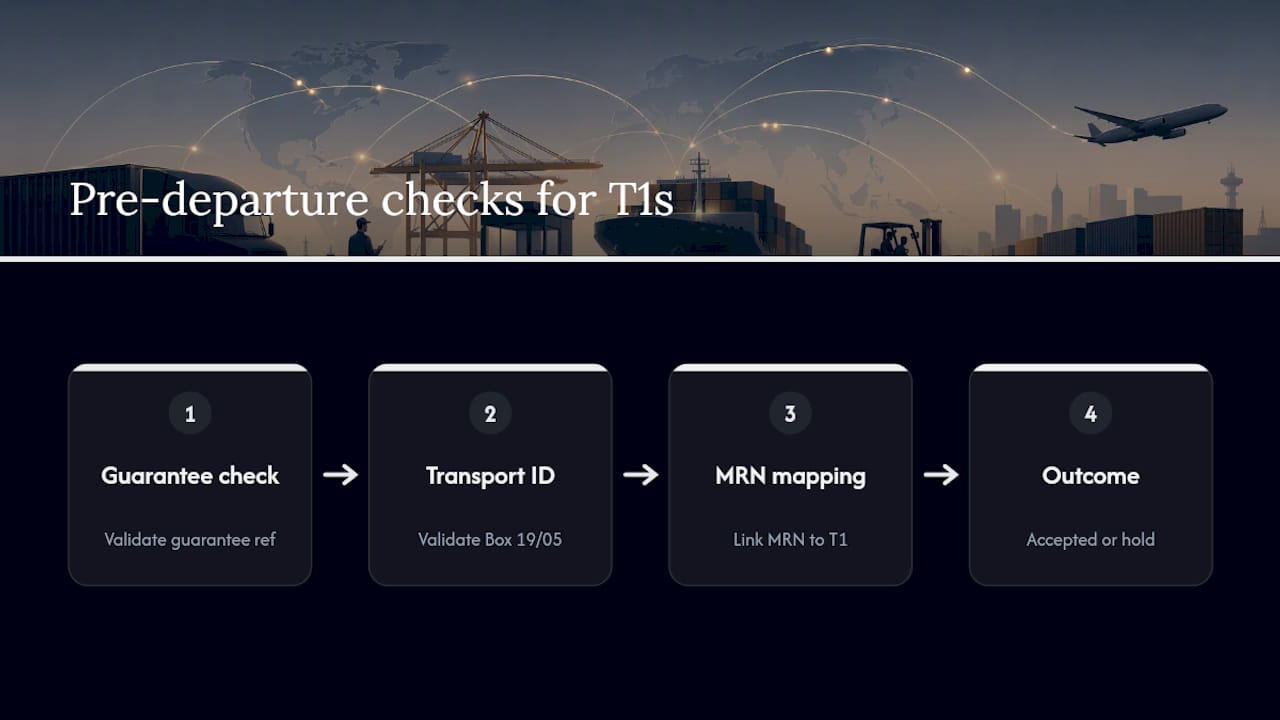
Pro Tip: Confirm your guarantee reference is active and correctly mapped to the MRN before the truck leaves the yard. A stale or mismatched reference is one of the most common reasons a T1 gets held at the border for hours, not minutes.
What Documents and Data Do You Need Before Filing a T1?
Every field below feeds directly into the NCTS system, and a missing or malformed entry is the single biggest reason declarations bounce back on the first attempt.
- EORI numbers for both consignor and consignee
- Full commodity/tariff codes, not truncated summaries
- Gross weight, net weight, and package count
- Seal numbers for containers or sealed trailers
- Offices of transit and destination, named specifically
- Guarantee reference number and LRN
- Vehicle registration and nationality code for Box 19/05 transport identity, including both tractor and trailer for combination vehicles
The Transit Accompanying Document and, where line items exceed the TAD’s capacity, the List of Items, travel physically with the shipment even though the declaration itself is electronic.
How Long Does a T1 Last, and What Trips Up Most Filers?
Transit time is set by the office of departure based on route, mode, and distance, with a time limit set accordingly. Extensions are possible but need justification, such as documented delays at a port or a mechanical breakdown.
- Present goods correctly at destination. The office of destination or an authorized consignee must confirm arrival matching the declared data before the T1 discharges.
- Avoid guarantee reference errors. A mismatched or expired reference is one of the fastest ways to stall a movement at the border.
- Get transport identity right the first time. Incomplete Box 19/05 data, missing a trailer registration or nationality code, is a routine and entirely avoidable rejection cause.
- Never rely on electronic messages alone. Even under NCTS Phase 5’s tighter validation, many destination facilities still expect a printed TAD to authorize unloading.
Where Is T1 Accepted, and What Routing Rules Apply?
T1 works across the full Common Transit Convention territory, not just inside the EU. Contracting parties currently include the EU as a single territory alongside the UK, Norway, Switzerland, Iceland, Turkey, Serbia, North Macedonia, and Ukraine.
- Movements starting in Great Britain will often carry T1 status, and national guidance covers how GVMS port processes interact with the declaration.
- Air and sea transhipment through a different port than originally declared can require an updated transit declaration, so confirm routing before it changes mid-movement.
- Authorized consignee status lets a T1 close at a customer’s inland premises instead of a border customs office, which matters heavily for route planning.
A Forwarder’s Checklist for Running T1s Without Costly Delays
Confirm guarantee availability and MRN mapping before the truck leaves, not after it’s already rolling. Double-check Box 19/05 transport identity every time, and keep a printed TAD in the cab even though NCTS Phase 5 runs electronically, since many receiving docks still ask for paper before they’ll unload. Comprehensive guarantees make sense for forwarders running steady T1 volume; individual guarantees suit occasional or higher-risk moves. These checks are standard practice on transit filings to help prevent delays for shipments moving non‑Union goods across borders.
Pro Tip: Build a habit of validating the guarantee reference and Box 19/05 data as two separate checks, not one combined glance. They fail for different reasons, and catching each independently prevents most of the rejections that hold shipments at the border.
Why Getting T1 Handling Right Is a Business Decision, Not Just a Compliance Task
A T1 error rarely stays a paperwork problem. A rejected guarantee reference or a mismatched Box 19 entry turns into a truck sitting at a border for hours, a guarantee call that ties up capital, or a client who starts shopping for a different forwarder. Accurate data entry and a strong relationship with your broker or forwarder are cheaper than any of those outcomes, every time.
— Ian
How Worldwideexpress Handles T1 Transit for Trading Businesses
Running T1 movements in-house means owning every NCTS message, every guarantee reference, and every discrepancy that pops up mid-route, on top of everything else your team already handles. Some logistics providers take that operational load off your desk through customs brokerage, NCTS filing, guarantee management, and authorized consignee handling built into the same workflow as your freight booking.
That means one point of contact instead of juggling a broker, a guarantor, and a carrier separately, and it means fewer holds triggered by a mismatched reference or an incomplete Box 19 entry. For businesses running recurring T1 programs across multiple lanes, or facing a complex multi-leg route through several CTC countries, that consolidation adds up fast in avoided delays. Explore Worldwideexpress logistics services to see how customs brokerage fits into a full shipment plan, or reach out directly to discuss a recurring T1 program or an upcoming complex route.
FAQ
What Is a T1 Document for Customs?
A T1 is the external Union transit declaration used to move non‑Union goods under customs supervision while duties and VAT stay suspended until the goods reach their destination office.
What Is a T1 Clearance?
T1 clearance happens when the office of destination, or an authorized consignee, confirms the goods have arrived and match the declared data, which formally discharges the movement.
What Is the T1 Process?
The process runs through NCTS Phase 5: filing the IE015, receiving release for transit via IE029, moving under guarantee with the TAD, and confirming arrival through IE044 to close the MRN.
How Long Can a T1 Movement Take?
Transit time is set at the office of departure based on route and mode, generally no more than 14 days, with extensions possible if delays are documented.
Do I Need a Guarantee for Every T1?
Yes. A financial guarantee, either individual or comprehensive, is mandatory to secure the potential customs debt for the duration of the movement.