AI in logistics and supply chain works by combining three distinct capabilities: predictive models that forecast demand and flag disruptions, generative AI that simulates scenarios and drafts documentation, and optimization engines that route freight and schedule maintenance. The biggest gains show up in forecasting accuracy, routing efficiency, and decision speed. None of it pays off without governance, and that governance needs to keep people, not just algorithms, in the loop. The roadmap for getting there is more mechanical than most vendors admit.
TL;DR:
- Demand forecasting with AI now reliably improves accuracy by integrating weather, social sentiment, and promotional data, allowing better safety stock planning.
- Route optimization engines factor in live traffic, fuel costs, and delivery windows, delivering immediate cost and efficiency benefits at scale.
- Data quality and governance are critical risks, requiring thorough vendor vetting, clear ownership, and ongoing model validation to avoid silent errors and security issues.
- Successful AI deployment begins with narrow, measurable pilots focused on specific processes like forecasting or routing, gradually scaling with documented lessons learned.
- AI’s impact on jobs is mixed, reducing repetitive tasks but increasing demand for skilled oversight, interpretation, and process adaptation during transition phases.
Table of Contents
- What Is AI in Logistics and Supply Chain, Exactly?
- Where AI Delivers Results Across the Supply Chain
- What KPIs Should You Track to Prove AI Is Working?
- What Are the Real Risks of AI Adoption in Logistics?
- How Do You Actually Roll Out AI Without It Failing?
- What Does the Evidence Actually Show About AI Adoption?
- How Worldwideexpress Fits Into an AI-Enabled Logistics Strategy
- Does AI Work With Your Existing ERP, TMS, and WMS?
- What Do Successful AI Deployments Look Like by Sector?
- What Ethical and Compliance Issues Does AI Deployment Raise?
- Will AI Replace Logistics Jobs, or Just Change Them?
- Where Should Logistics Leaders Put Their Investment Next?
- Ready to Move From AI Strategy to Actual Shipments?
- Where to Go for the Original Data
- Sources
- FAQ
What Is AI in Logistics and Supply Chain, Exactly?
Vendors throw around “AI-powered” the way seafood restaurants throw around “fresh.” It rarely means what buyers assume. There are two fundamentally different technology families doing the work, and confusing them leads to bad procurement decisions.
Predictive AI uses machine learning in logistics to find patterns in historical data and forecast what happens next. It answers questions like “how many units will this SKU need in fourteen days” or “which shipment is at risk of a customs delay.” It’s the workhorse behind demand forecasting, dynamic pricing, and predictive maintenance.
Generative AI creates new content or scenarios rather than predicting a single outcome. Feed it a disruption (a port closure, a tariff change) and it can draft alternate routing plans, generate customer communications, or summarize a mountain of bill-of-lading data into a one-paragraph brief. Research on generative AI’s role in supply chain resilience points to genuine value in scenario simulation, paired with a clear warning: without oversight, generative systems can produce plausible-sounding but wrong outputs, so human review stays mandatory for anything customer-facing or compliance-related.
Underneath both sit the enabling technologies that make automated supply chain processes possible:
- Computer vision — inspects freight, reads labels, and flags damaged packaging on the warehouse floor.
- Natural language processing (NLP) — parses customs documents, emails, and carrier communications into structured data.
- Robotic process automation (RPA) — handles repetitive digital tasks like data entry between systems, without any “intelligence” involved.
- AI agents — increasingly popular in intelligent logistics systems, these combine predictive and generative capabilities to take multi-step actions, like rebooking a shipment when a vessel is delayed.
Getting this taxonomy right matters for procurement. A systematic review of AI in supply chain management found that AI improves forecasting and operational efficiency broadly, but the same review flagged skill gaps and governance questions as recurring themes. That’s why the National Institute of Standards and Technology built a risk management framework profile for generative AI specifically, separate from its general AI guidance. If your vendor can’t tell you which category their tool falls into, that’s worth asking twice.
For a broader look at how these categories reshape freight operations day to day, Worldwideexpress has covered the fundamentals in its guide to artificial intelligence in logistics.
Where AI Delivers Results Across the Supply Chain
Not every corner of a supply chain benefits equally from AI applications in supply chains. Some use cases are mature and low-risk. Others are still experimental. Here’s where to focus attention, roughly in order of how much evidence backs each one.
Demand forecasting and S&OP support. This is the most established application of AI-driven logistics solutions. Machine learning models ingest sales history, weather data, promotional calendars, and even social sentiment to predict demand at the SKU and location level, feeding directly into sales and operations planning (S&OP) cycles. The output isn’t a single number but a probability range, which lets planners set safety stock levels with more precision than a flat forecast ever allowed.
Inventory optimization and dynamic replenishment. Once demand forecasts improve, inventory rules can tighten. AI-based replenishment systems recalculate reorder points continuously rather than on a weekly batch cycle, which matters most for perishable goods and high-velocity SKUs where a stale reorder point either strands cash in excess stock or triggers a stockout.
Transportation planning and route optimization. This is where optimizing logistics with AI shows up most visibly to a shipper’s bottom line. Route optimization engines weigh live traffic, fuel prices, driver hours-of-service limits, and delivery windows simultaneously, something a human planner juggling a spreadsheet simply cannot do at scale. Worldwideexpress has detailed how route optimization helps fleets manage international handoffs without losing time at the border.
Warehouse automation and computer vision quality checks. Picking robots guided by computer vision handle repetitive movement, but the more interesting shift is on the inspection side. Vision systems now catch mislabeled cartons and damaged packaging before they leave the dock, catching errors a tired human inspector on the fourth hour of a shift might miss.
Predictive maintenance and asset uptime. Sensors on trucks, forklifts, and conveyor systems feed vibration, temperature, and usage data into models that flag failure risk before a breakdown happens. The practical benefit is scheduling repairs during planned downtime instead of losing a shift to an unplanned one, which is a different kind of savings than the labor-cost story most AI pitches lead with.
Real-time visibility and exception management. This ties every other use case together. Data analytics in logistics platforms now flag exceptions (a delayed vessel, a customs hold, a temperature excursion in a refrigerated container) as they happen rather than surfacing them in a weekly report. For international shippers, this kind of visibility often matters more than any single optimization gain, because it’s what lets a logistics team react to a problem before a customer even notices one. Worldwideexpress’s work on international shipping efficiency and compliance walks through how this plays out across customs and cross-border freight specifically.
The pattern across all six: AI technology in transportation and warehousing performs best when it’s narrowing a decision, not replacing the decision-maker. That distinction shapes everything in the KPI section below.
What KPIs Should You Track to Prove AI Is Working?
Every AI logistics pilot needs a measurement plan before it starts, not after. Vague goals like “improve efficiency” produce vague results. Specific KPIs, tracked against a baseline period, produce numbers you can defend to a CFO.
The core metrics worth tracking:
- Forecast accuracy (measured as MAPE, or mean absolute percentage error) — compare AI-generated forecasts against the prior manual or statistical method over an identical time window.
- Cost per shipment or per mile — isolate the AI-optimized lanes from a control group of unchanged lanes to see the real delta.
- Fuel consumption per route — track this against route optimization deployment specifically, since it’s one of the clearest wins available.
- On-time delivery rate and fill rate — service metrics matter as much as cost, and a program that cuts cost while quietly eroding service is not a win.
- Asset uptime — for predictive maintenance programs, measure unplanned downtime hours before and after deployment.
The evidence: Industry survey data shows 70% of transportation companies have adopted AI in some form, and among those adopters, 40% report improvements of 50% or more in fuel usage, cost, or routing metrics.
Set a test window of at least one full seasonal cycle, since a two-week pilot rarely captures the demand volatility that AI is supposed to handle well. And measure resilience alongside cost. It’s shifted the risk somewhere less visible.
What Are the Real Risks of AI Adoption in Logistics?
Every AI logistics conversation eventually runs into the same wall: data quality. Models trained on incomplete or inconsistent shipment records produce forecasts that look precise and are quietly wrong. This is the single most common reason pilots stall before they scale, and it’s rarely fixed by buying a better model. It’s fixed by cleaning up the data feeding the model.
Beyond data, four risk categories deserve direct attention from decision-makers:
- Vendor and third-party risk. Generative AI tools frequently rely on external data processing, which means your supply chain risk now includes your AI vendor’s supply chain. NIST’s cybersecurity supply chain risk management guidance recommends building supplier criticality profiles and contract-level security requirements for exactly this reason.
- Cybersecurity and data provenance. An AI system is only as trustworthy as the data pipeline feeding it. NIST’s generative AI profile specifically recommends incident response planning and value-chain integration controls as baseline governance, not optional extras.
- Worker safety and ergonomics. This one gets underdiscussed. The transportation and warehousing sector reported a serious injury rate of 3.8 cases per 100 full-time workers in 2022, and productivity-tracking technologies tied to AI-driven quotas can worsen ergonomic strain if deployed without safeguards. Automation doesn’t automatically make a warehouse safer; it changes where the risk sits.
Pro Tip: Before signing any AI vendor contract, ask specifically who owns the training data your shipments generate. Many contracts are silent on this, and that silence usually favors the vendor, not you.
Practical mitigation isn’t complicated, even if it takes discipline. Run vendor due diligence that includes a data-security questionnaire, not just a product demo. Monitor model outputs against ground truth on a recurring schedule rather than trusting a one-time accuracy claim. And build an incident response plan before an AI system fails, not while it’s failing. Worldwideexpress’s guide to shipping risk mitigation covers how these controls extend into broader freight risk management.
How Do You Actually Roll Out AI Without It Failing?
Most AI logistics failures aren’t technology failures. They’re sequencing failures, where a company scales a pilot before proving it, or governs a system only after something goes wrong. A disciplined rollout follows five stages.
Pick a pilot with a measurable KPI and clean, accessible data. Route optimization on a single lane or forecasting for one product category are good starting points precisely because the data already exists and the outcome is easy to isolate.
Ingest, cleanse, label, and baseline. Before any model runs, establish what “normal” performance looks like using your current process. Skipping this step is the most common reason pilots can’t prove value later. Leading organizations increasingly treat data quality as an outcome the system improves over time using anomaly detection, rather than a prerequisite that has to be perfect on day one.
Evaluate vendors on more than the demo. Ask about data ownership, service-level agreements, model update cadence, and exit terms if the relationship ends. AI increasingly arrives as a subscribed service rather than owned software, which changes how procurement teams need to think about lifecycle risk.
Assign clear ownership and a RACI structure. Someone needs to own the model’s outputs, someone needs to own the underlying data, and frontline staff need training on what the system does and does not decide for them. This is also where upskilling starts, not after the tool is already live.
Scale deliberately, and document lessons learned. Move from one lane or one SKU category to the next only after the metrics from stage one hold up over a full seasonal cycle. Build a playbook from the first pilot so the second one moves faster.
| Roadmap stage | Primary owner | Key output |
|---|---|---|
| Pilot selection | Operations lead | A single KPI and a defined scope |
| Data preparation | Data/IT team | A clean baseline dataset |
| Vendor evaluation | Procurement + legal | Contract with data ownership terms |
| Governance setup | Cross-functional committee | RACI chart and monitoring cadence |
| Scale and document | Program owner | Playbook for the next rollout |
Industry survey data backs a shift in mindset here too: organizations are moving away from demanding guaranteed ROI before any investment and toward faster, smaller pilots that compound value over successive iterations. That’s a healthier posture than waiting for a perfect business case that never quite arrives. For a deeper walkthrough of implementation pitfalls specific to logistics, Worldwideexpress has published guidance on how AI logistics companies transform supply chains that expands on vendor evaluation and scaling missteps.
What Does the Evidence Actually Show About AI Adoption?
The survey data on AI adoption in logistics is more consistent than the hype cycle suggests. Adoption is real, benefits are measurable, and the risks are documented by the same institutions tracking the gains.
| Signal | Finding | Source |
|---|---|---|
| Adoption rate | 70% of transportation companies have adopted some form of AI | Penske survey via Trucking Info |
| Measured benefit | 40% of adopters report 50%+ improvement in fuel, cost, or routing metrics | Penske survey via Trucking Info |
| Highest function-level implementation | Domestic transportation shows 67% implementation, the highest of any function tracked | State of AI in Logistics: 2025 |
| Worker safety signal | Transportation and warehousing had 3.8 serious injuries per 100 full-time workers in 2022 | GAO |
| Automation operational tradeoff | Port automation can raise capacity but sometimes slows container handling | GAO |
The takeaway isn’t that AI adoption is universally smooth. It’s that the gains and the risks are both well documented, which means there’s no excuse for a decision-maker to walk into a deployment blind on either front.
How Worldwideexpress Fits Into an AI-Enabled Logistics Strategy
AI can forecast demand and optimize a route, but it still needs a partner to execute the physical movement, the customs clearance, and the documentation that AI-generated plans depend on. That’s the practical gap most AI logistics strategies overlook.
Some logistics companies operate across the functions where AI-driven visibility and forecasting translate into real shipments: customs brokerage, global freight forwarding, ocean and air transportation, trucking, and warehousing. Shipment tracking and compliance support tie directly into the “real-time visibility” use case covered earlier, since a forecast is only useful if the freight behind it actually clears customs on schedule.
A practical starting point for any team exploring this space: run a small pilot around document automation or shipment visibility on one trade lane before expanding. Pair that pilot with a partner who already manages the customs and compliance side, and the AI layer has something solid to plug into rather than a theoretical workflow. That combination, forecasting paired with dependable execution, is where most of the measurable gains in this article actually get realized.
Does AI Work With Your Existing ERP, TMS, and WMS?
AI tools rarely replace an enterprise resource planning (ERP), transportation management system (TMS), or warehouse management system (WMS). They sit on top of them, pulling data out and pushing recommendations back in. Integration quality, not model sophistication, is usually what determines whether a pilot succeeds.
Most AI logistics platforms connect through application programming interfaces (APIs) that read order history from the ERP, shipment status from the TMS, and inventory levels from the WMS. The AI layer then feeds recommendations, an adjusted reorder point, a rerouted shipment, back into those same systems so operators keep working in the interface they already know. This matters because forcing warehouse staff or dispatchers into a separate AI dashboard tends to kill adoption regardless of how good the underlying model is.
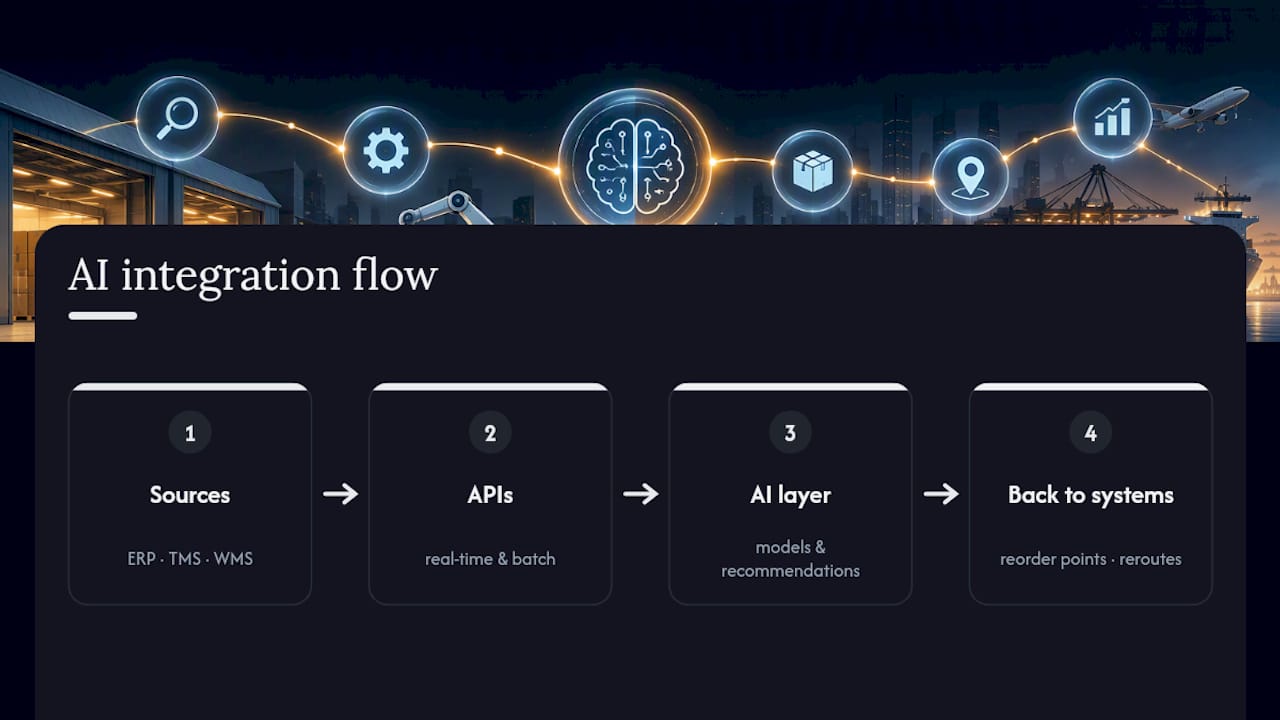
The integration risk shows up in three places. First, legacy ERPs built decades ago sometimes lack modern APIs, requiring middleware that adds cost and latency. Second, data formats rarely match across systems, a TMS might record transit time in hours while a WMS records it in days, and reconciling that is unglamorous but essential work. Third, real-time versus batch syncing matters more than most buyers expect. A predictive maintenance alert that arrives six hours late through an overnight batch job has already missed its window to prevent a breakdown.
The practical fix is sequencing: confirm integration architecture during vendor evaluation, before committing budget to the model itself. Ask any AI vendor for two references who successfully integrated with a TMS or WMS similar to yours. If they can’t provide one, that’s a signal worth taking seriously.
What Do Successful AI Deployments Look Like by Sector?
AI adoption looks different depending on which corner of the supply chain you’re in, and the differences are instructive for setting realistic expectations.
In domestic trucking and transportation, adoption has moved fastest. Industry survey data shows domestic transportation carrying the highest implementation rate of any function tracked, at 67%, largely because route optimization has a short feedback loop. A dispatcher can see whether a route recommendation saved fuel within days, which builds trust in the system faster than a forecasting model that takes months to validate.
In port and terminal operations, the picture is more mixed. GAO’s review of port automation found that automated equipment can increase container density but sometimes handles containers more slowly than manual operations, alongside uneven effects on the workforce. Ports that succeeded treated automation as a capacity tool for specific bottlenecks, not a blanket replacement for existing operations.
In warehousing, computer vision and predictive maintenance have shown steadier results than customer-facing generative AI tools, largely because the tasks (spotting a damaged carton, predicting a conveyor failure) have clear right answers that are easy to validate against a camera feed or a sensor log.
The common thread across sectors that got real value: they picked a narrow, measurable problem first and resisted the urge to deploy AI everywhere at once. The sectors with the messiest outcomes usually skipped that discipline.
What Ethical and Compliance Issues Does AI Deployment Raise?
Deploying AI in a supply chain touches more compliance ground than most procurement teams initially expect, especially once customs documentation, cross-border data, and automated decision-making enter the picture.
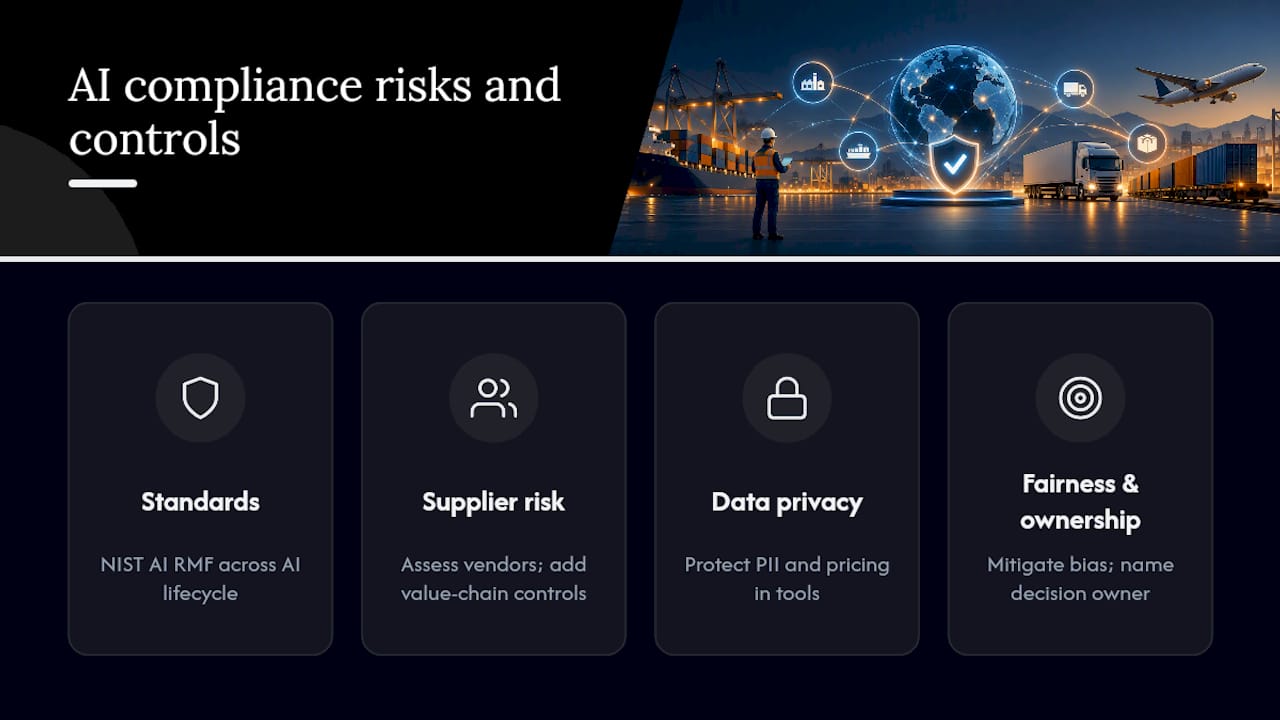
The starting framework for most organizations is the NIST AI Risk Management Framework, which recommends governance controls across the full AI lifecycle rather than a one-time compliance check. For generative AI specifically, NIST’s profile calls for supplier risk assessment and value-chain integration controls, which matters for logistics companies because so much AI-generated content (customs summaries, shipment communications, risk assessments) touches regulated processes.
Data privacy is a second layer. Shipment data often includes customer information, pricing terms, and sometimes personally identifiable information tied to import/export filings. Feeding that into a generative AI tool without clear data-handling agreements creates exposure that many logistics teams haven’t fully mapped.
There’s also a fairness question that gets less attention: predictive models trained on historical data can encode past biases, like consistently deprioritizing smaller shippers because historical data underweighted their volume. That’s not a hypothetical risk category; it’s a direct consequence of training data reflecting whatever patterns already existed in the business.
The practical response isn’t to avoid AI over compliance fears. It’s to build the same rigor into AI vendor contracts that mature logistics operations already apply to customs compliance: documented data flows, clear accountability, and a named owner for every automated decision that affects a customer or a regulatory filing.
Will AI Replace Logistics Jobs, or Just Change Them?
The honest answer is neither extreme. AI is shifting what logistics roles require, not eliminating the roles wholesale, and the shift is uneven across job types.
Roles built entirely around repetitive data entry (manually keying shipment details between systems) are shrinking as RPA and NLP tools absorb that work. But roles that require judgment, like exception handling when a shipment gets stuck at customs, are becoming more valuable, not less, because AI systems flag the exception while a human still has to decide what to do about it.
GAO’s research on port automation captured this tension directly: automation shifted workforce demand toward higher-skilled technical roles while introducing new ergonomic and monitoring risks that didn’t exist in the manual process. That’s a real tradeoff, not a clean win.
Upskilling strategies that actually work share a few traits. They train people on interpreting model outputs, not just running software, since a planner who understands why a forecast might be wrong is far more valuable than one who just accepts the number. They pair technical training with process training, because a new AI tool usually means a new workflow, not just a new screen. And they start upskilling during the pilot phase, laid out in the implementation roadmap earlier, rather than waiting until a system is already fully scaled and staff are scrambling to catch up.
The workforce risk isn’t mass displacement. It’s a skills mismatch if training lags behind deployment speed, which is a solvable problem if it’s planned for early.
Where Should Logistics Leaders Put Their Investment Next?
The next three to five years favor adaptive AI agents over static dashboards. Agents that can reroute a shipment or flag a compliance risk without waiting for a human to open a report are where the real efficiency gains sit, but they only work inside human-centric, Industry 5.0 style governance where people still make the consequential calls.
Split investment deliberately: fund quick wins like route optimization to build organizational trust, while also committing budget to governance and workforce transition. Companies that treat governance as an afterthought tend to hit the same data-quality and safety walls this article covers, just later and more expensively.
— Ian
Ready to Move From AI Strategy to Actual Shipments?
Forecasting demand and optimizing a route only matters if the freight behind that plan clears customs, moves reliably, and shows up where it’s supposed to. That’s the execution layer AI can’t replace, and it’s where Worldwideexpress operates every day.
Some logistics companies handle the physical and regulatory side of the AI-enabled supply chain: customs brokerage, global freight forwarding, ocean and air transportation, trucking, and warehousing, all built around shipment visibility and documentation accuracy that modern forecasting tools depend on. If your team is running a pilot around demand forecasting or route optimization, the next logical step is making sure the execution side can actually keep pace with what the models recommend.
Start by requesting a freight quote for your next shipment, or review the full range of logistics services to see where a consultation on visibility and customs workflow fits into your current AI roadmap.
Where to Go for the Original Data
For readers who want to verify the figures and frameworks cited throughout this piece, these are the primary sources:
- NIST AI Risk Management Framework profile for generative AI
- NIST Cybersecurity Supply Chain Risk Management practices (SP 1305)
- GAO report on warehouse and delivery worker safety
- Industry perspective on operational efficiency and AI implementation from PODTECH
Sources
- AI risk management framework profile: generative AI (NIST)
- Workplace safety and health: OSHA should take steps to better identify and address ergonomic hazards at warehouses and delivery companies (GAO)
FAQ
Is AI Taking Over Logistics?
No. AI is handling specific tasks, forecasting, routing, document processing, but human oversight remains central to exception handling and strategic decisions. GAO’s research on port automation shows mixed effects on jobs and operational speed, not a wholesale replacement of the workforce.
How Is AI Changing Logistics and Supply Chain?
AI is shifting logistics from reactive planning to predictive and increasingly generative decision-making, with 70% of transportation companies now using some form of AI. The bigger shift is the move toward AI agents that take multi-step action, like rebooking a delayed shipment automatically, rather than just producing a static report.
How Can AI Help in the Supply Chain?
AI improves demand forecasting accuracy, optimizes transportation routes, flags equipment failures before they happen, and speeds up exception management across shipments. Adopters commonly report meaningful gains in fuel and routing efficiency, with 40% of AI adopters seeing improvements of 50% or more in those specific metrics.
What’s the Difference Between Predictive AI and Generative AI in Logistics?
Predictive AI forecasts a specific outcome, like expected demand or maintenance risk, based on historical patterns. Generative AI creates new content or scenarios, such as alternate routing plans or shipment summaries, and works best in supply chain resilience planning when paired with human review.
Can Worldwideexpress Help With AI-Enabled Shipment Visibility?
Yes. Worldwideexpress provides customs brokerage, freight forwarding, and shipment tracking that support the real-time visibility AI forecasting tools depend on. Pricing for specific services is available by requesting a freight quote directly.