To track a container by bill of lading, you need two things at minimum: the SCAC (the issuer’s carrier code) and the master or house bill number tied to that shipment. Enter those into the carrier’s own tracking portal first, then try the destination port or terminal tracker, an aggregator track-and-trace tool, or your forwarder’s system if the carrier site comes up empty. Authorized users with ABI or ACE access can also run a Cargo Manifest Entry Release Query, though that route requires filer authorization and the correct master bill number, since house and master numbers are not interchangeable.
TL;DR:
- Accurate bill of lading tracking requires correct SCAC and the appropriate master or house bill number, with timing delays common if data hasn’t propagated yet.
- Public portals often fail due to simple data entry errors, confusion between master and house bills, or lack of authorized carrier system access.
- Running both bill and container number searches in parallel provides the most comprehensive supply chain visibility, especially for compliance and schedule tracking.
- Escalate unresolved or problematic shipments to licensed customs brokers for access to direct ABI or ACE queries, particularly when encountering holds or mismatched codes.
- Disposition codes such as 1Z indicate full authorized release, but containers can still be held for local clearance or government agency holds despite the code posting.
Table of Contents
- The identifiers you need before starting your search
- Step-by-step tracking workflow from carrier to customs
- Reading the status codes that decide whether cargo moves
- Why bill of lading searches come up empty
- How a customs broker runs these checks behind the scenes
- Choosing between bill of lading and container number tracking
- Get help resolving a stuck container release
- Where to verify the details in this guide
- Sources
- FAQ
The identifiers you need before starting your search
A bill of lading search fails more often from missing data than from a broken system. Before opening any portal, pull these fields directly from the B/L document itself.
- SCAC or issuer code: a two to four character carrier identifier printed near the top of the bill, required for both carrier portals and ABI queries.
- Master bill number versus house bill number: the master bill belongs to the ocean carrier and covers the full container load, while the house bill is issued by a freight forwarder for a single shipper’s cargo inside that container. Our guide on types of bill of lading breaks down when each applies.
- Container number: an alphanumeric code stamped on the container and listed on the B/L, useful when a carrier portal accepts equipment numbers directly.
- Booking number: assigned at the reservation stage and sometimes the only reference a carrier system recognizes before a bill number is finalized.
- Seal number, vessel and voyage, port of discharge: secondary fields that confirm you are looking at the correct shipment once a query returns multiple matches.
Knowing where each field sits on the document matters as much as knowing what it means. Our step-by-step guide to reading a bill of lading walks through the layout field by field.
Step-by-step tracking workflow from carrier to customs
Work through these systems in order. Each one either resolves the query or tells you something that helps the next attempt.
- Check the carrier or vessel operator’s portal first. Enter the SCAC and master bill number, or the booking number if the bill has not posted yet. Most ocean carriers return vessel schedule, container status, and estimated arrival directly.
- Try the port or terminal tracking system if the carrier portal shows nothing. Some terminals receive manifest messages straight from the carrier and post container status before the carrier’s own site updates.
- Run the bill number through an aggregator track-and-trace tool when you are not sure which line issued the bill. These tools often identify the carrier from the bill number’s prefix, which then lets you go back to the correct carrier portal with the right SCAC.
- Contact the freight forwarder or notifying party named on the bill if none of the public portals return a result. Forwarders and multimodal transportation operators often hold visibility that never reaches public-facing trackers, especially for house bills tied to consolidated cargo.
- For authorized filers, run a Cargo Manifest Entry Release Query (CQ) through ABI or ACE. This requires the exact SCAC of the bill issuer and the Master Bill Number, and it supports pulling the most recent notification, the last five, or the full history, generally within a six-month lookback window for entry-based queries. Access is limited to parties with ABI filer credentials, so this step is usually run by a licensed customs broker rather than the shipper directly.
Pro Tip: Keep the exact bill number string, punctuation included, in a text file rather than retyping it into each portal. A single dropped character is the most common reason a correct query still returns no match.
Reading the status codes that decide whether cargo moves
Once a query returns results, the disposition code tells you what actually happens to the container next, not just where it sits.
- 1Z signals a master-level release, issued once every house bill under that master has cleared and received authorized movement status, according to CBP guidance on house bill releases.
- 1C, 1W, and 1X cover narrower situations: authorized movement at the house level, a request for permit to transfer, and conditional movement that still falls short of a full 1Z, respectively.
- R02 and R05 records, defined in the CAMIR export status notification specification, carry the container number, seal number, and disposition code together, so a single notification tells you both which box moved and under what condition.
A container number must match the physical markings exactly, and a single bill of lading can report up to 999 separate container records under CAMIR formatting rules. That ceiling matters for consolidated shipments where dozens of house bills sit under one master.
When a status shows a hold or a code short of 1Z, the next move is usually a call to the customs broker or a check for a government agency hold, since terminals can still require local clearance even after a 1Z posts.
Why bill of lading searches come up empty
Most failed queries trace back to one of a handful of predictable mistakes, and fixing them takes less time than most people expect.
- Wrong SCAC or issuer code. A single mistyped character in a two to four character field returns zero results even when every other detail is correct.
- Master and house bill confusion. Entering a house bill number into a system expecting the master, or the reverse, is one of the most frequent causes of a failed search.
- Timing delays. A bill issued hours ago may not have propagated to the terminal or aggregator system yet, so a repeat query an hour later sometimes succeeds where the first one failed.
- Authorization limits. ABI and ACE queries only work for filers with the correct access, and results depend on the bill already having been transmitted to that ABI participant.
If the exact bill string, container number, and booking number all fail across carrier, terminal, and aggregator systems, escalate to the carrier’s operations desk or a licensed customs broker rather than continuing to retry the same portal.
How a customs broker runs these checks behind the scenes
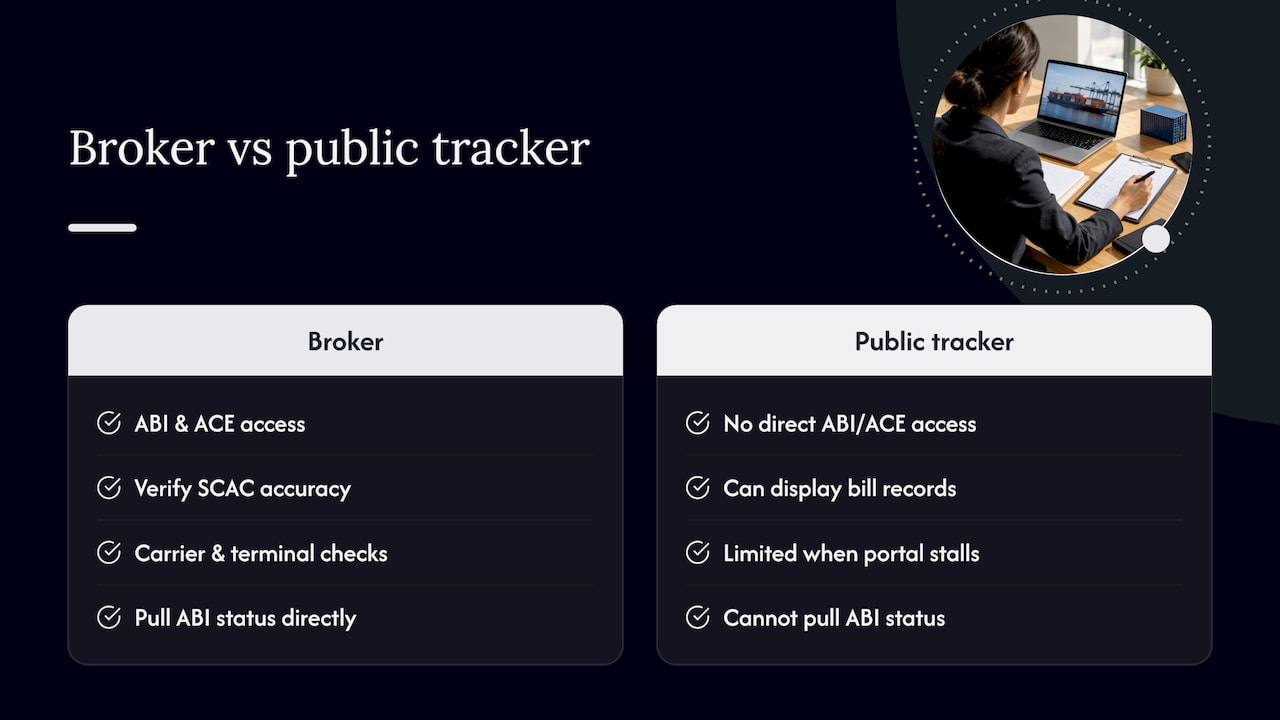
A licensed broker follows a version of the same sequence, with one difference: direct ABI and ACE access. Licensed customs brokers can verify SCAC accuracy, run carrier and terminal checks, and pull ABI status directly when a public portal stalls. That direct access matters most when a shipment shows a hold tied to a partner government agency, since resolving it requires filing authority a public tracker does not have. For background on why accurate bill records carry legal weight in customs clearance, see our guide on bill of lading legalities.
Choosing between bill of lading and container number tracking
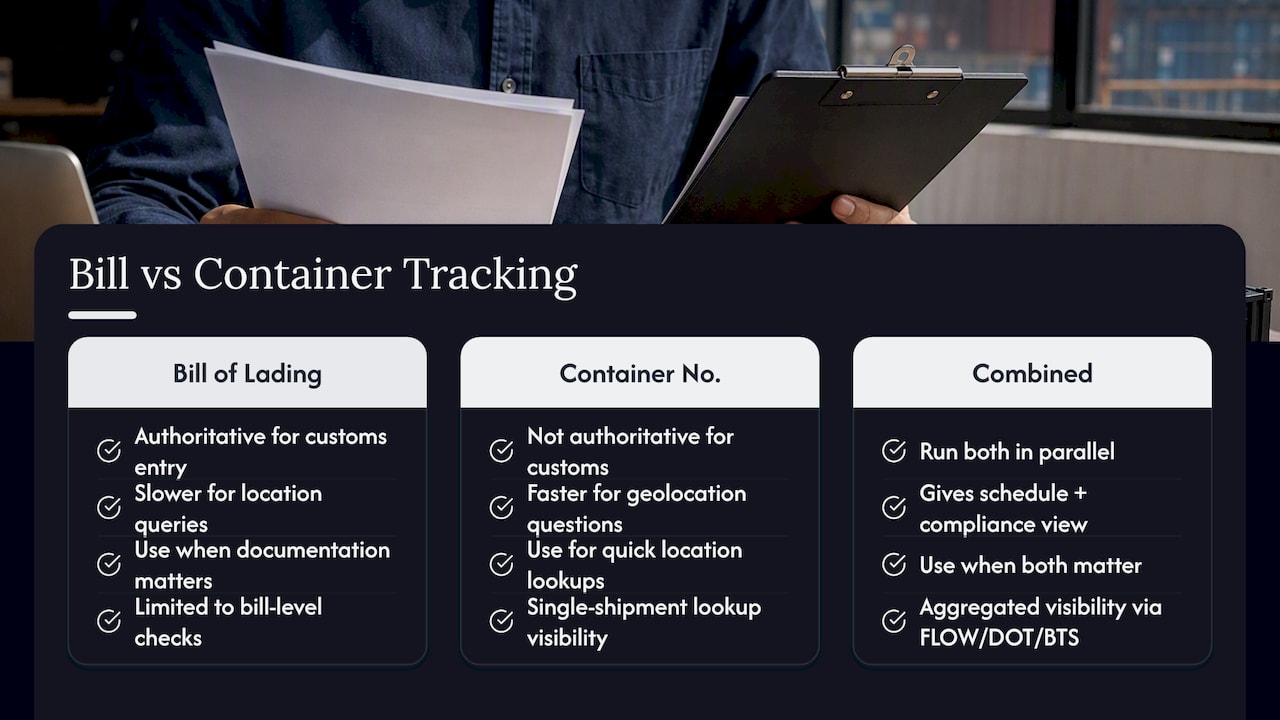
Bill of lading tracking is the authoritative record for customs status and documentation, since possession of a properly endorsed bill serves as evidence of the right to make entry. Container number tracking is faster for a plain geolocation question, like which vessel a box sits on today. For shipments where both compliance and schedule matter, run both in parallel rather than choosing one. Larger shippers get further visibility gains from programs like FLOW, the DOT and BTS public-private data sharing initiative that gives participating companies an aggregated view of supply chain conditions rather than a single-shipment lookup. Our supply chain visibility guide covers how these programs complement bill-level checks. Involve a broker once a hold or a mismatched code shows up, since that is the point where public tools stop being useful.
Get help resolving a stuck container release
Running these checks alone works fine until a shipment hits a hold, a mismatched bill number, or a partner government agency flag that a public portal cannot explain. Resolutions for stuck containers or unresolved bill numbers are typically handled by licensed U.S. customs brokers with electronic filing access on both the import and export side.
- U.S. Customs Brokerage services for filing, release resolution, and compliance checks on held shipments.
- Ocean Transportation services, including FCL, LCL, and deconsolidation support for containers already in transit.
- Import Freight Services for shippers who want a single point of contact from booking through delivery.
If a container is stuck or a bill number will not resolve through the usual channels, request a freight quote or reach out to the logistics services team directly.
Where to verify the details in this guide
For the exact fields and lookback rules behind ABI queries, consult the CATAIR Cargo Manifest Entry Release Query guide. For disposition code definitions and record formats, see the CAMIR export status notification specification. For house bill release logic specifically, CBP’s OHBOL FAQ covers 1Z, 1C, and 1X behavior in detail, and FLOW documents the broader visibility program for participating companies.
Sources
- Customs and Trade Automated Interface Requirements (CATAIR) Implementation Guide — Cargo Manifest Entry Release Query (September 2025)
- CAMIR Export Status Notification and Record Formats (May 2026)
- Freight Logistics Optimization Works (FLOW) | Bureau of Transportation Statistics
- Ocean House Bill of Lading Frequently Asked Questions — U.S. Customs and Border Protection
FAQ
Who can run an ACE or ABI query for a bill of lading?
Only parties with ABI filer authorization can run a Cargo Manifest Entry Release Query, which typically means a licensed customs broker or an authorized filer on record with CBP. Shippers without that access generally rely on carrier portals, terminal trackers, or their broker to get the same information.
What is the difference between a master and house bill of lading?
A master bill of lading is issued by the ocean carrier and covers the entire container load, while a house bill is issued by a freight forwarder for one shipper’s cargo within that container. Querying the wrong one, or using the wrong issuer’s SCAC, is a common reason a tracking search returns no result.
How long does it take for a bill of lading to show up in tracking systems?
Posting times vary by carrier and by how quickly the manifest data reaches the terminal or ABI system, so a bill issued within the last few hours may not yet be searchable. If a search fails immediately after a bill is issued, retrying after a short delay often resolves it before you need to troubleshoot further.
What does a 1Z status code mean for my shipment?
A 1Z code signals a master-level release, which CBP issues once every house bill under that master bill has received authorized movement status. Even after a 1Z posts, the terminal may still run its own local checks before the container is actually available for pickup.
— Ian