The fastest way to make Shopify cross-border shipments compliant and reliable is to contract a freight forwarder and a licensed customs broker to manage booking, export filing, and customs clearance as a single coordinated team. This approach limits the handoffs where paperwork gets lost and cargo gets held. It also puts the compliance work, from AES filing thresholds to power of attorney requirements, in the hands of parties licensed to do it, while keeping the importer of record legally accountable for accuracy.
TL;DR:
- Contract a licensed customs broker alongside a freight forwarder to ensure compliance, streamlined booking, and proper customs filing for international shipments.
- Prepare export documentation early, including HTS or Schedule B codes, commercial invoices, packing lists, and declared values, to avoid delays at port.
- Understand that only licensed customs brokers can legally file customs entries and that the importer of record bears legal responsibility regardless of who prepares the paperwork.
- Verify that ocean freight providers hold FMC licensing with the required surety bonds and have experience with AES filing to avoid common compliance risks.
- Use a single logistics partner that manages bookings, customs, cargo insurance, and documentation to reduce handoff errors and shipping delays.
Table of Contents
- Get Your Shipment Documents and Timeline Ready First
- Who Does What: Freight Forwarder vs. Customs Broker
- EEI Filing, Importer Duties, and Bond Requirements You Cannot Skip
- The Paper Trail: Invoices, Packing Lists, and Bills of Lading
- Vetting a Logistics Partner: Questions to Ask and Red Flags to Watch
- What Drives Transit Time and Cost on International Routes
- How a Managed Provider Actually Handles the Handoffs
- Contracting Worldwide Express for Your Next Shipment
- Where to Verify These Rules Directly
- Sources
- FAQ
Get Your Shipment Documents and Timeline Ready First
Before any cargo moves, a handful of details need to be locked down. Gathering them early prevents the single biggest cause of international shipping delays: incomplete paperwork discovered after the freight is already booked.
- Pull the HTS or Schedule B code, commercial invoice details, packing list, and declared value for every product line.
- Decide Incoterms and confirm who is the importer of record, since that party carries legal responsibility for the entry.
- Determine who files the Electronic Export Information through AES, the exporter, a forwarder acting as agent, or a broker.
- Choose the transport mode, air or ocean, and the consolidation type, full container load or less than container load, based on lead time and volume.
- Set a documentation handoff window with your forwarder well ahead of peak shipping seasons, when carrier space tightens and errors cost more time.
Pro Tip: Build a standing shipment folder template with invoice, packing list, and HTS codes pre-filled for repeat SKUs, so new orders only need updated quantities and values.
Who Does What: Freight Forwarder vs. Customs Broker
These two roles get confused constantly, and mixing them up is how compliance gaps happen. A freight forwarder is not authorized to file customs entries, and a broker generally does not book ocean or air space.
- A freight forwarder handles booking, routing, cargo consolidation, tracking, and coordination between carriers and the shipper.
- A licensed customs broker files the customs entry, calculates duties, and secures formal release of the goods, work that only a licensed broker may legally perform for an importer.
- A Non-Vessel Operating Common Carrier issues its own house bill of lading and takes on carrier-like liability, while an Ocean Freight Forwarder (OFF) arranges transport without issuing that bill, a distinction that changes who is responsible if cargo is damaged or delayed.
- In practice, many shipments involve a handoff: the forwarder manages export booking and routing, then the broker takes over at arrival for entry filing and clearance.
EEI Filing, Importer Duties, and Bond Requirements You Cannot Skip
Three regulatory obligations sit underneath every international shipment, and skipping any of them creates real exposure. None of them disappear just because a third party is doing the paperwork.
- Electronic Export Information must be filed through AES when the value per Schedule B or HTS code exceeds $2,500, or whenever an export license is required regardless of value.
- The importer of record stays legally responsible for classification, valuation, and entry accuracy under the standard of “reasonable care,” even when a licensed broker prepares and files the entry.
- Ocean Transportation Intermediaries must carry proof of financial responsibility, and typical surety bond amounts run $50,000 for Ocean Freight Forwarders and $75,000 for NVOCCs, a figure worth confirming before signing with any ocean provider.
- A written power of attorney should be executed directly between the importer and the broker, not routed through a third-party forwarder, and forwarders should be given accurate ECCN and HTS information up front to avoid misclassification.
There are approximately 16,170 active licensed customs brokers in the United States, and they remain the only parties tariff law authorizes to transact customs business on an importer’s behalf. That scale of licensing exists precisely because the compliance stakes, and the penalties for getting entries wrong, are high enough to warrant a dedicated, regulated profession.
The Paper Trail: Invoices, Packing Lists, and Bills of Lading
Customs officers and carriers check specific documents at specific points, and missing fields are what trigger holds. Getting these right the first time is cheaper than fixing them after a shipment is stuck at port.
- The commercial invoice needs accurate product description, quantity, unit value, currency, and terms of sale, since customs uses it to calculate both duty and trade statistics.
- The packing list should match the invoice line for line, with weights and carton counts inspectors can verify quickly during a physical exam.
- A bill of lading covers ocean freight and an air waybill covers air freight; a house bill of lading is issued when a forwarder or NVOCC consolidates cargo under its own contract with the shipper.
- Special certificates, CITES permits, FDA prior notice, or export licenses, apply to specific product categories and should be identified during the HTS classification step, not discovered at the port.
Pro Tip: Documentation requirements vary sharply by product. A guide to export paperwork for musical instruments shows how a single commodity category can carry its own certificate and permit rules, and yours likely has its own.
Vetting a Logistics Partner: Questions to Ask and Red Flags to Watch
Choosing a provider is where most of the risk gets decided. A short set of direct questions during procurement separates a properly licensed operation from one that will leave the importer exposed.
- Ask to see the broker’s national permit and confirm which processing center handles filings for the trade lane in question.
- Confirm FMC registration and Ocean Transportation Intermediary licensing, and request proof of the required surety bond for any ocean service.
- Ask about direct AES filing experience, export compliance program practices, and familiarity with the specific commodity being shipped.
- Ask how cargo insurance claims are handled and how long resolution typically takes.
- Treat any refusal to execute a power of attorney directly with the importer, vague answers about AES experience, missing bond documentation, or an unclear fee structure as a reason to keep looking.
What Drives Transit Time and Cost on International Routes
Air freight typically moves in days, while ocean freight moves in weeks, and consolidation or transshipment stops add time to either mode. Cost is shaped less by distance than by a handful of recurring variables.
- Base freight rates and fuel surcharges shift with capacity and season, and both air and ocean rates move independently of each other.
- Duties, taxes, and port or chassis handling fees are calculated from the declared value and HTS classification, so an inaccurate code raises cost after the fact.
- Storage and demurrage charges accumulate when cargo sits at a terminal waiting on documentation, often the single largest avoidable expense on a delayed shipment.
- Accurate classification, consolidated bookings, and early scheduling are the most direct ways to keep both timeline and cost predictable.
How a Managed Provider Actually Handles the Handoffs
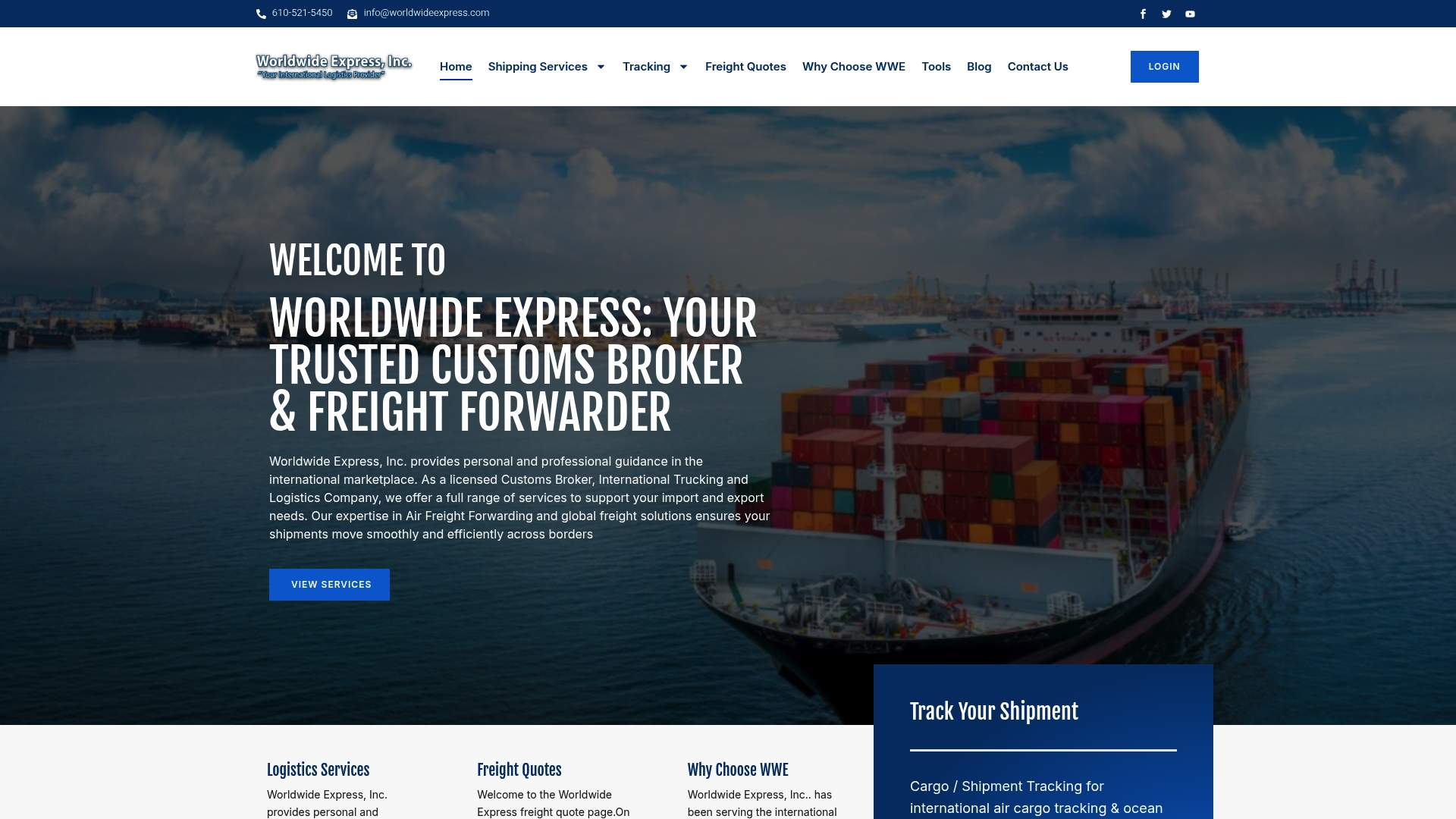
A properly run engagement follows a predictable sequence: document submission, creation of a shipper’s letter of instruction, carrier booking, AES and entry filing, then delivery and any claims handling. Worldwide Express structures its customs brokerage, freight forwarding, air and ocean transportation, trucking, and cargo insurance work around that same sequence, with global tracking layered on top so a shipment’s status is visible at every stage.
Documentation gaps are the most common failure point industry-wide, a missing certificate or a mismatched invoice value catching up with a shipment at the port. Resolving that kind of issue before the cargo reaches customs, rather than after it is already flagged, is what keeps a shipment moving instead of sitting in detention.
— Ian
Contracting Worldwide Express for Your Next Shipment
Running freight booking, customs filing, and cargo insurance through separate vendors multiplies the number of places a shipment can stall. Some providers bring those functions under one contract, which means fewer handoffs and one point of contact when a shipment needs attention.
- Customs brokerage and AES filing support for import and export entries.
- Ocean transportation, including FCL, LCL, and freight deconsolidation for consolidated cargo.
- Cargo insurance and claims support for loss or damage in transit.
- FDA services for shipments subject to prior notice requirements.
Merchants and logistics managers ready to move a shipment can request a freight quote and get a scoped answer on routing, timeline, and documentation needs before cargo ships.
Where to Verify These Rules Directly
- CBP customs broker FAQ: licensing and importer responsibility.
- AES filing guidance: EEI thresholds and procedures.
- FMC bond program: OTI licensing and surety bonds.
- BIS freight forwarder guidance: export compliance best practices.
Sources
- Customs Broker Frequently Asked Questions | U.S. Customs and Border Protection
- Filing your export shipments through the Automated Export System (AES) | International Trade Administration
- Bond program information for OTIs | Federal Maritime Commission
- Freight forwarder guidance and best practices | Bureau of Industry and Security (BIS)
FAQ
Do I need both a freight forwarder and a customs broker?
For most international shipments, yes, since a forwarder handles booking and routing while only a licensed broker can legally file customs entries. Many providers, including Worldwide Express, offer both functions under one engagement to reduce handoffs.
When is EEI filing through AES required?
EEI filing is required when the value of goods under a single Schedule B or HTS code exceeds $2,500, or whenever an export license applies regardless of value. Confirm early who, the exporter, forwarder, or broker, will handle the filing.
Who is legally responsible if a customs entry has errors?
The importer of record remains legally responsible for classification and valuation accuracy under the “reasonable care” standard, even when a licensed broker files the entry. That responsibility does not transfer to the broker or forwarder.
What should I ask before hiring an ocean freight provider?
Ask for proof of FMC licensing and the required surety bond, which runs $50,000 for Ocean Freight Forwarders and $75,000 for NVOCCs. Also confirm direct AES filing experience and how cargo insurance claims are processed.
Does Worldwide Express handle both import and export shipments?
Yes, Worldwide Express provides licensed customs brokerage and freight forwarding for both import and export shipments, along with air and ocean transportation, trucking, and cargo insurance. Details on services are listed on the logistics services page.