Logistics optimization is the coordinated use of people, processes, and technology to lower total logistics cost while improving service and resilience. It touches transportation, warehousing, inventory, and fulfillment at the same time, not one at a time. The fastest way to see results is to run a quick network assessment this month and pilot the single highest-value lane before committing to a full rollout.
TL;DR:
- Focusing on a single high-value lane for a pilot can quickly demonstrate savings and performance improvements before expanding network-wide.
- Prioritizing integrated systems, data quality, and change management increases the likelihood of successful, scalable logistics optimization projects.
- Companies should compare transfer versus reorder costs and size safety stocks based on demand variability to optimize inventory rebalancing under disruption.
- Using KPIs such as total landed cost, on-time delivery, and asset utilization on a fixed review schedule helps monitor and sustain optimization efforts.
- End-to-end visibility, automation, and anchored technology investments are essential for scaling optimization from pilots into resilient, efficient supply chain networks.
Table of Contents
- What logistics optimization actually means
- Why optimization matters now: resilience over raw efficiency
- Core strategies that move the needle
- Choosing technology without creating a pilot graveyard
- Inventory and network rules that hold up under pressure
- The KPIs that actually tell you if optimization is working
- Turning the plan into a project: assess, pilot, scale
- What derails optimization efforts and how to manage the risk
- How Worldwide Express applies these practices in international freight
- An editorial take on what to prioritize first
- Where Worldwide Express fits into your optimization plan
- Sources
- FAQ
What logistics optimization actually means
Logistics optimization is the practice of coordinating transportation, warehousing, inventory, and fulfillment so the whole network performs better than any single piece optimized alone. A company might cut shipping costs on one lane and still lose money overall if warehouse labor or inventory carrying costs rise to compensate. Real optimization looks at the full system.
The work has measurable goals, and they tend to fall into three buckets:
- Total landed cost: the full cost of getting a product to its destination, including freight, duties, warehousing, and handling.
- Service level: on-time, in-full delivery performance that customers and downstream partners actually feel.
- Asset productivity: how efficiently trucks, warehouse space, and labor convert into throughput.
This differs from simple cost-cutting. A company that slashes freight spend by switching to slower carriers may hit a cost target while damaging service levels and customer retention. It also differs from piecemeal digitization: buying a routing app without changing the underlying process, or investing in a warehouse management system that nobody fully integrates with transportation planning. Georgia Tech’s operational rules for supply chain optimization make the point directly: objectives must be quantified and performance must be measured, or the effort drifts into busywork dressed up as improvement.
Why optimization matters now: resilience over raw efficiency
The industry’s framing has shifted. Rather than chasing efficiency alone, the current consensus from the State of Logistics Report is to design for resilience, not just cost reduction, while treating AI as infrastructure rather than an experiment.
Companies that integrate AI into core workflows, rather than running isolated pilots, capture measurable returns, according to the State of Logistics Report. A tool bolted onto an existing process rarely pays for itself; a tool woven into planning and execution does.
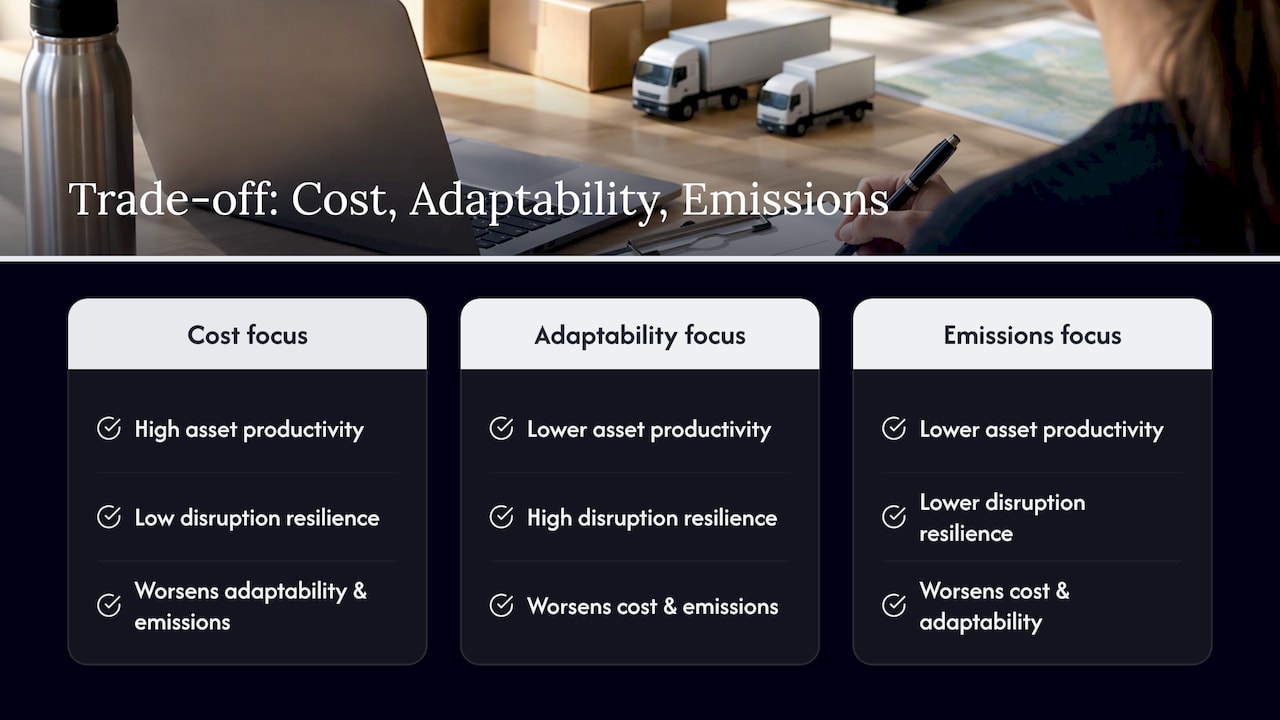
That shift comes with trade-offs. Academic work on multimodal network design shows that optimizing purely for cost, adaptability, or emissions tends to worsen the other two. A leaner, cheaper network is often a more fragile one. Leadership has to decide, deliberately, how much asset productivity to trade for the ability to absorb a port closure or a supplier failure, rather than discovering the answer during a disruption.
Core strategies that move the needle
Not every tactic deserves equal attention. The list below is ordered roughly by typical return relative to effort, starting with moves that most networks can make without new capital.
- Route optimization and consolidation. Simple heuristics handle stable, low-complexity networks well; machine learning earns its complexity when lane volume, stop density, and constraints vary enough that static rules leave savings on the table.
- Inventory rebalancing before reordering. Compare the cost of transferring stock between warehouses against the cost and lead time of a new purchase order before defaulting to procurement.
- Warehouse efficiency improvements. Slotting by velocity, standardized picking processes, and targeted automation reduce labor cost per unit without a full facility redesign.
- Supplier collaboration and data sharing. Shared forecasts and order visibility reduce the lead-time uncertainty that forces companies to carry excess safety stock.
- Distributed fulfillment and ship-from-store. Spreading inventory closer to demand cuts last-mile cost and transit time, provided the network can track stock accurately across locations.
- Consolidation at origin and destination. Combining smaller shipments into fuller loads reduces per-unit transportation cost, particularly on international lanes.
- Continuous improvement governance. Plan-Do-Check-Act cycles and structured A/B pilots keep optimization from becoming a one-time project that decays once attention moves elsewhere.
On routing specifically, MIT research notes that a model trained on a firm’s own historical routes and constraints can suggest near-optimal paths far faster than solving the routing problem from scratch each time, though it requires a clear definition of what counts as a good solution for that specific operation.
For inventory, MIT CTL’s GENESIS simulator, developed with Mecalux, uses scenario testing to recommend transferring stock between facilities instead of placing a new order, often at lower total cost.
Pro Tip: Before adding any new routing or inventory tool, map which of the seven tactics above it actually serves. A tool without a clear tactic attached rarely survives the first budget review.
Choosing technology without creating a pilot graveyard
Technology choices tend to fail for a structural reason: companies buy point solutions and never connect them to the rest of the network. A transportation management system, warehouse management system, or orchestration layer needs to talk to the others, or each one just optimizes its own corner.
- Core systems first. A TMS, WMS, or orchestration platform that shares data across functions delivers more value than a standalone AI feature layered on top of disconnected systems.
- Digital twins and simulation. These tools model the network before a change goes live, which lets planners test a rebalancing decision or a new distribution hub without risking live operations; realistic expectations matter, since a simulation is only as good as the data feeding it.
- Machine learning routing and inventory models. These need firm-specific historical data to train on, and the computational cost of running and retraining them is often underestimated during the pilot phase.
- Integration discipline. The most common failure mode is an isolated pilot that never connects to core workflows, compounded by poor data quality and a lack of change management on the operations side.
An AI-driven orchestration platform like Lully illustrates the difference between a point tool and a connected system: the value comes from coordinating warehouse decisions with the rest of the network, not from the AI label itself.
Inventory and network rules that hold up under pressure
Deciding whether to transfer stock or place a new order comes down to a straightforward comparison: transfer cost plus handling time against the price and lead time of procurement. When the gap in stock between two facilities is large and transfer distance is short, rebalancing usually wins.
- Transfer versus reorder. Run the cost comparison before defaulting to a purchase order, especially for slow-moving or regionally imbalanced SKUs.
- Facility location trade-offs. Centralizing inventory lowers holding cost but raises exposure to a single point of failure; backup capacity at a second site costs more to carry but shortens recovery time after a disruption.
- Safety stock under volatility. Static safety stock formulas underperform when demand or lead times swing widely; stochastic planning that models a range of outcomes tends to size buffers more accurately.
- Scenario planning for backup capacity. Simulation lets planners size backup capacity against a range of disruption scenarios rather than guessing at a single number.
The KPIs that actually tell you if optimization is working
A short, well-governed KPI set beats a long dashboard nobody checks. The core metrics are total landed cost, inventory turns, on-time-in-full delivery, truck and asset utilization, and order cycle time.
- Total landed cost keeps teams from celebrating a freight win that costs more in warehousing or returns.
- Inventory turns flags slow-moving stock before it becomes a write-off.
- On-time-in-full (OTIF) ties operational performance directly to customer experience.
- Asset utilization shows whether trucks and warehouse space are earning their cost.
- Order cycle time catches friction between order placement and fulfillment.
Digital supply chain orchestration, predictive analytics, and AI rank among the top technology investments cited in the MHI and Deloitte report, with inventory and network optimization investment cited as a very high priority and AI investment also prominently among surveyed companies. Metrics should be owned by a single cross-functional team, not split across transportation and warehousing separately, and reviewed on a fixed monthly or quarterly cadence rather than whenever a problem surfaces.
Turning the plan into a project: assess, pilot, scale
The roadmap works in four stages, and skipping the assessment is the most common reason pilots stall later.
- Assess. Check data readiness, identify which lanes carry the most cost or risk, and map SKU concentration to find where a change will matter most.
- Pilot. Define a narrow scope, a small set of KPIs, a fixed timeline, and the specific data inputs the pilot needs before it starts.
- Scale. Build the integration and change management plan before expanding, so the pilot’s lessons transfer instead of repeating the same setup work.
- Budget and milestones. Set realistic ROI checkpoints tied to the KPIs chosen in the assessment phase, not to vendor projections.
Pro Tip: Pick the pilot lane with the clearest baseline data, not the one with the biggest theoretical upside. A clean pilot that proves the method beats an ambitious one that gets lost in data cleanup.
What derails optimization efforts and how to manage the risk
Visibility gaps beyond a company’s direct suppliers are a recurring obstacle. A GAO report on the Department of Defense’s supply chain found that visibility efforts into supplier networks remain incomplete, and recommended integrating commercial visibility practices along with testing contractual requirements for supplier data as a way to reduce dependency risk. The same logic applies to private companies managing multi-tier supplier networks.
- Multi-tier visibility gaps are best addressed through aggregated, cross-industry data programs and contract language that requires suppliers to share specific data points.
- Foreign dependency risk becomes visible only when a company maps its suppliers’ suppliers, not just its direct contracts.
- Organizational resistance to new processes often does more damage than any technology gap, which is why change management belongs in the pilot plan from day one.
Cross-industry visibility programs such as the Freight Logistics Optimization Works initiative expand situational awareness beyond what a single company can see on its own, an underused resource for planning around disruption. For a deeper look at closing these gaps, see our guide on supply chain visibility and the related risk management approach for prioritizing high-risk suppliers.
How Worldwide Express applies these practices in international freight
Some logistics providers operate as licensed customs brokers handling import and export filings electronically, combined with freight forwarding, ocean and air transportation, trucking, and warehousing under one operational umbrella. That combination matters for the assess-pilot-scale sequence above, since a single point of coordination across customs clearance, transportation, and tracking removes a common source of the data fragmentation that derails optimization projects.
- Customs brokerage filed electronically reduces the documentation delays that often undermine lead-time reliability.
- End-to-end tracking supports the visibility layer that inventory rebalancing and route optimization both depend on.
- Tailored logistics plans by industry reflect the reality that a retailer’s network and a manufacturer’s network rarely optimize the same way.
Readers building out their own pilot can review the company’s approach to route optimization across international handoffs and how AI applies to logistics operations for additional context.
An editorial take on what to prioritize first
Fix data readiness before buying any tool. Run one pilot on your highest-cost lane, not your easiest one. Put a single team in charge of the KPIs before scaling anything. AI experiments are worth running, but integration discipline is what actually pays the bills.
— Ian
Where Worldwide Express fits into your optimization plan
Once the assessment is done and a pilot lane is chosen, the question becomes execution capacity, and that is where logistics services from Worldwide Express map directly onto the roadmap above.
- Assessment phase: a freight quote request surfaces real lane costs fast, giving the baseline data a pilot needs.
- Pilot phase: U.S. customs brokerage handled electronically removes a common source of lead-time variability on international lanes.
- Scale phase: combined ocean, air, and trucking services under one provider reduce the coordination overhead that usually slows down scaling a successful pilot.
A pilot built on a single lane with integrated customs clearance and transportation services can give a logistics team a real cost and service baseline within one shipping cycle rather than a quarter of planning meetings. Request a freight quote to start building that baseline now.
Sources
- 3 Questions: Enhancing last-mile logistics with machine learning | MIT News
- MIT CTL: AI-based simulator to optimize inventory across warehouses
- GAO report on DOD supply chain visibility and foreign dependency
FAQ
What is logistics optimization?
Logistics optimization is the coordinated management of transportation, warehousing, inventory, and fulfillment to lower total logistics cost while improving service levels and resilience. It looks at the whole network together rather than cutting cost in one area at the expense of another.
What are the 5 P’s of logistics?
Definitions of the 5 P’s vary across sources, and no single authoritative version applies universally across industries. A commonly cited version covers product, price, place, promotion, and people, adapted from general marketing frameworks rather than a standardized logistics definition.
What is the primary goal of logistics optimization?
The primary goal is to reduce total landed cost while maintaining or improving service levels and asset productivity, rather than cutting cost in isolation. Companies that pursue resilience alongside efficiency tend to hold up better when disruptions hit.
What are the 7 C’s of logistics?
Definitions of the 7 C’s vary by source, and there is no single standardized version across the industry. A frequently cited version includes the right product, customer, cost, condition, time, quantity, and place, used as a general checklist rather than a formal framework.
How does Worldwide Express support logistics optimization pilots?
Worldwide Express combines licensed customs brokerage with freight forwarding, ocean and air transportation, trucking, and tracking under one provider, which reduces the coordination gaps that often slow down a pilot. Businesses can request a freight quote to establish a cost baseline for a specific lane.