Whether a transaction qualifies as an export depends on who the contractual recipient is and where the goods actually leave from, not on which address sits at the top of the invoice. Billing an Indian entity while shipping goods abroad does not automatically earn zero-rating, and Section 10(1)(b) can even fix the place of supply at the bill-to party’s location for the first leg of the movement. On the system side, exporters now face a firm rule: when ship-to details are provided in an e-Invoice, the Ship-to GSTIN field becomes conditionally mandatory, and where no GSTIN exists, “URP” goes in that field instead.
TL;DR:
- Ship-to GSTIN becomes conditionally mandatory in e-Invoices, requiring accurate entry or “URP” when unregistered, to prevent validation errors.
- Section 10(1)(a) and 10(1)(b) of the IGST Act determine export status based on physical movement versus contractual recipient, with clear legal distinctions affecting tax treatment.
- Cross-border movement alone does not qualify a transaction as an export; documentation must demonstrate goods leave India and the recipient is outside the country.
- Operational errors, such as reusing GSTINs or mismatching shipping details, are the leading cause of rejection, emphasizing the importance of master data control and pre-shipment checks.
- Exporters should coordinate documentation, confirm recipient details, and test ERP integrations in sandbox environments before enforcement deadlines to avoid rejections and shipment delays.
Table of Contents
- Place of Supply Rules for Bill-to Ship-to Export Transactions
- Ship-to GSTIN, URP, and the New e-Invoice and e-Way Bill Validation Rules
- How to Document Bill-to Ship-to Details for an Export Shipment
- Bill-to Ship-to Scenarios Exporters Actually Run Into
- Compliance Checklist for Export ERP and Tax Teams
- What We See Go Wrong on the Ground
- Let Worldwideexpress Handle the Documentation Coordination
- Where to Verify These Rules Yourself
- Sources
- FAQ
Place of Supply Rules for Bill-to Ship-to Export Transactions
Two provisions do most of the heavy lifting here, and confusing them is where most export disputes start. Section 10(1)(a) of the IGST Act sets the place of supply based on the actual movement of goods, terminating at the location where movement ends. Section 10(1)(b) covers a different pattern entirely: when a supplier delivers goods to a third person on the instruction of a “bill-to” party, the law treats the bill-to party as having received the goods, and the place of supply becomes that party’s principal place of business.
That distinction has real tax consequences. If a domestic buyer instructs a supplier to ship goods to a third party located in another Indian state, Section 10(1)(b) can fix the place of supply at the bill-to party’s registered location, triggering IGST even though the physical goods never touch that address. Export status runs on a stricter test: the goods must physically leave India, and the recipient must be located outside India under the contract of supply. Bill to India, ship abroad, but with an Indian entity as the actual contractual buyer, and you likely have a domestic supply dressed up as an export.
Place of supply determiners built around IGST Act Sections 10 through 13 make the same point: cross-border movement alone does not create zero-rating. Tax teams need the commercial invoice, the shipping bill, and the transport documents to align and jointly demonstrate that the recipient named in the contract sits outside India, and that the goods were actually exported under that contract.
There’s a further wrinkle for unregistered recipients. Circular 209/3/2024-GST addressed cases where the bill-to party is unregistered, effectively working alongside the newer Section 10(1)(ca) provision to close a gap where neither Section 10(1)(a) nor 10(1)(b) cleanly applied. For exporters, the practical takeaway is this: before assuming zero-rated treatment, confirm (1) who the contract names as recipient, (2) where that recipient is located, and (3) whether the goods physically cross the customs frontier under that same contract. Get any one of those wrong and you’re looking at IGST or CGST plus SGST instead of an export invoice with no tax charged.
Ship-to GSTIN, URP, and the New e-Invoice and e-Way Bill Validation Rules
The GSTN advisory reshapes how bill-to/ship-to data flows through the e-Invoice and e-Way Bill systems, and exporters running their own ERP integrations need to treat this as a hard system change, not a suggestion.
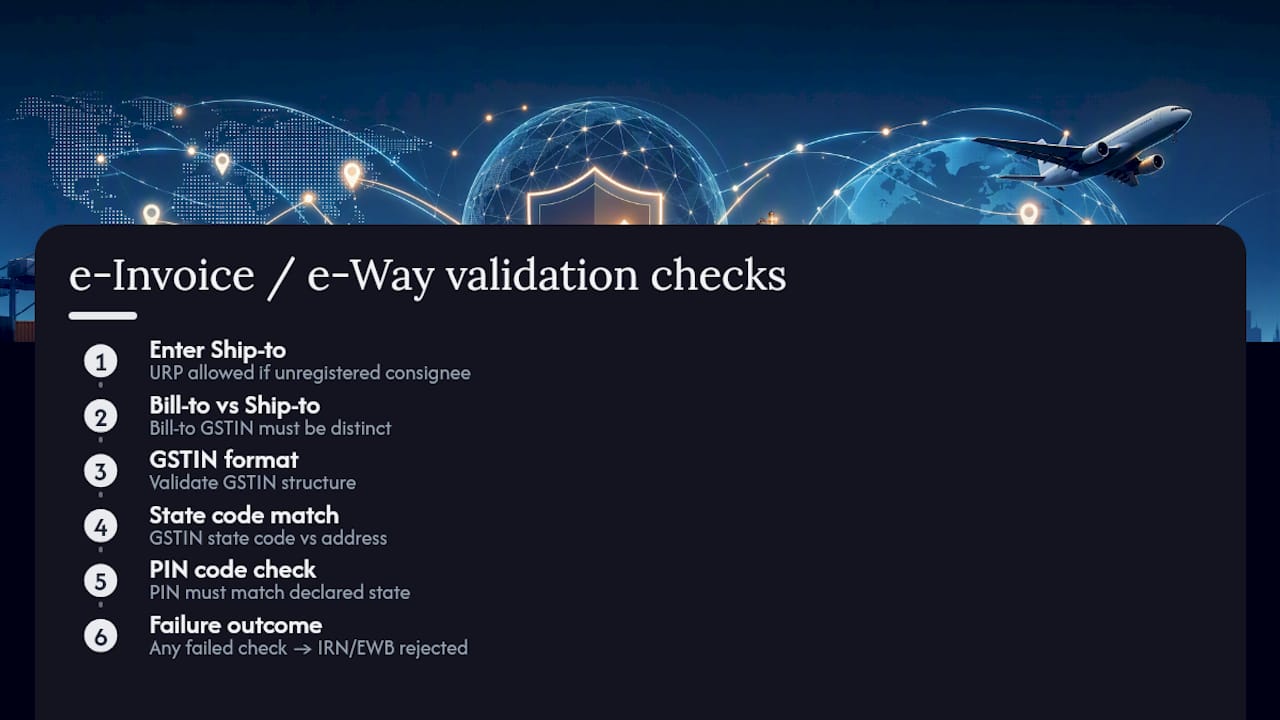
The core rule: whenever ship-to details are entered on an e-Invoice, the ShipDtls.Gstin field becomes conditionally mandatory. Where the ship-to party genuinely has no GSTIN, such as an export-linked location or an unregistered consignee, the field accepts “URP” (unregistered person) instead of a blank or a placeholder value. On the e-Way Bill side, the advisory adds ExpShipDtls.Gstin as a mandatory field within e-Way Bill by IRN flows, meaning transporters and consignors generating an EWB directly from an existing IRN must supply this data or the request fails.
System validation now enforces distinctness between bill-to and ship-to. GSTN’s rule set rejects any submission where the Bill-to GSTIN and Ship-to GSTIN are identical, because the law treats the two as separate legal persons even when a single company happens to hold both roles under different registrations. Beyond GSTIN matching, the system checks GSTIN format validity, cross-references state codes embedded in the GSTIN against the address on file, and validates PIN codes against the declared state. A mismatch anywhere in that chain throws a validation error before the IRN or EWB ever generates, which is exactly the kind of failure that stalls a shipment at the loading dock rather than in a compliance meeting.
Export flows get a specific carve-out worth flagging for ERP teams. Ship-to details captured at IRN generation can, in most cases, be replaced when generating an export e-Way Bill using that IRN, since export routing (port, ICD, or CFS) is often finalized after the invoice is cut. That flexibility disappears for B2B and SEZ transactions, where ship details locked in at IRN generation cannot be replaced later in the EWB flow. Integrators who build a single generic “replace ship-to” function without branching on transaction type will hit rejections the moment an SEZ shipment tries to use it.
Pro Tip: Treat “URP” as a system-level placeholder, not proof of export. GSTN’s validation engine only checks that the field is populated correctly; whether the transaction actually qualifies as zero-rated still rests entirely on your invoice, shipping bill, and transport documentation lining up.
How to Document Bill-to Ship-to Details for an Export Shipment
Getting this right on paper, and in your ERP, follows a fairly consistent sequence regardless of the product or destination country.
Identify the contractual recipient versus the physical consignee. Pull the purchase order or sales contract and confirm who the buyer actually is under that agreement, then separately confirm where the goods physically go. These are frequently two different names in an export deal, and your master data should carry both as distinct records rather than collapsing them into one address block.
Populate every invoice field the export requires. That means the bill-to GSTIN (or foreign buyer details where there’s no Indian GSTIN involved), the ship-to name, address, and PIN code, the Ship-to GSTIN or “URP” as applicable, and the export declaration fields (LUT/bond reference, shipping bill number once available, port code). Missing any one of these tends to surface as a rejected IRN rather than a quiet warning.
Decide your IRN and EWB generation sequence. Some exporters generate the IRN first and the e-Way Bill by IRN afterward once transport details firm up; others generate both together at invoicing. Generating the EWB too early, before the final export route (port, ICD, or CFS) is confirmed, is one of the most common causes of mismatched ship-to data that later needs correction.
Align the shipping bill and transport documents with the invoice. Your commercial invoice, shipping bill, and bill of lading or airway bill need to tell the same story about recipient and destination. Customs and your bank (for realization of export proceeds) will cross-check these documents, and a mismatch here is what actually triggers audit scrutiny, not a minor GSTIN typo.
Hand off to the transporter with EWB details closed out. Confirm the e-Way Bill reflects the actual movement, including any export-linked ship-to location, before the truck or container leaves the warehouse, and retain the closure acknowledgment for your records.
Pro Tip: Build a pre-shipment checklist that a warehouse or dispatch clerk can run through in under five minutes. The costliest export documentation errors happen not from ignorance of the rules, but from rushing the last mile between invoice generation and truck departure.
Bill-to Ship-to Scenarios Exporters Actually Run Into
A few patterns cover most of the disputes tax teams bring up.
- Merchant exporter transactions: the invoice bills the merchant exporter’s GSTIN, but the ship-to is frequently an export-linked location such as a port warehouse or container freight station. Enter “URP” for the ship-to GSTIN in that case, and make sure the address and PIN code recorded reflect the actual Indian destination so transporters route correctly even though no domestic GSTIN applies there.
- Bill-to India, physical movement abroad: if an Indian entity is the named contractual buyer but the goods move overseas on that buyer’s instruction, this typically fails the export test. The recipient’s contractual location, not the shipping route, decides tax treatment, and you need documentary proof the actual foreign party is the recipient of record to claim zero-rating.
- Dropship and cross-border fulfilment: when a foreign buyer places the order directly and an Indian seller ships straight to that buyer or their nominated overseas address, that’s a clean export. Insert an Indian intermediary as the contractual buyer, however, and the transaction often becomes domestic even if the physical goods cross a border on the intermediary’s instruction.
- B2B, B2C, and SEZ differences: ship-to detail replacement between IRN and EWB generation stays flexible for most export and B2C flows, but B2B and SEZ transactions lock those fields at IRN stage, so get routing confirmed before generating the invoice in those cases.
Compliance Checklist for Export ERP and Tax Teams
A short list of priorities can save weeks of rework once enforcement dates arrive.
- Master data hygiene: maintain separate ship-to records carrying GSTIN or “URP,” state code, and PIN, and run a periodic audit for duplicate or reused GSTIN entries across bill-to and ship-to fields.
- ERP and API payload mapping: update integrations to populate
ShipDtls.GstinandExpShipDtls.Gstincorrectly, and build error handling for the specific rejection codes tied to GSTIN mismatch, format failures, and state/PIN inconsistency. - Sandbox testing before go-live: test IRN-plus-EWB and EWB-by-IRN flows in GSTN’s sandbox environment, including transporter-side integration, well ahead of any enforcement deadline.
- Operational SOPs: document the exact steps a clerk follows when Ship-to GSTIN is missing, how export-linked locations like ports, ICDs, and CFS get recorded, and what evidence gets retained for audit.
Pro Tip: Add a pre-IRN validation step in your ERP that flags identical bill-to and ship-to GSTINs and missing Ship-to GSTIN or URP entries before the API call fires. Catching it in your own system costs seconds; catching it after a production rejection can cost a shipment window.
What We See Go Wrong on the Ground
The most frequent failure is not a legal misunderstanding, it’s operational: teams reuse the same GSTIN across bill-to and ship-to fields, forget “URP” on export-linked locations, or leave PIN and state fields inconsistent. The fix is boring but effective: master data controls, a pre-IRN validation check, and tighter coordination between your tax team, your customs broker, and your transporter. Freight-forwarding operations that handle export documentation daily tend to catch these mismatches before they ever reach GSTN’s servers.
— Ian
Let Worldwideexpress Handle the Documentation Coordination
Chasing down a rejected IRN or a stalled e-Way Bill costs you the one thing export deadlines don’t forgive: time. Customs brokerage and export documentation services can reconcile bill-to and ship-to fields against your commercial invoice, shipping bill, and transport documents before they reach a port gate.
That means fewer validation rejections landing on your ERP team’s desk, fewer shipments held up at customs for a mismatched PIN or missing GSTIN, and faster clearance once your export declaration is filed. Worldwideexpress’s customs brokerage and export documentation support extends to helping ERP and integration teams map payload fields correctly and run sandbox tests before enforcement dates hit. If your export volumes involve recurring bill-to/ship-to complexity, whether that’s merchant exporter flows, SEZ shipments, or multi-location foreign buyers, request a freight quote through Worldwideexpress’s logistics services and get a compliance review started before your next shipment window closes.
Where to Verify These Rules Yourself
- GSTN advisory on e-Invoice API and e-Way Bill by IRN changes
- Practitioner FAQ on bill-to/ship-to export scenarios
- Place of supply analysis under Section 10(1)(b)
Sources
- Advisory on Changes Introduced in e-Invoice API, e-Way Bill by IRN API and Voluntary Closure of e-Way Bill
- Ship-to GSTIN mandatory from 1st August 2026
- How to determine the place of supply in case of bill-to-ship-to transactions
FAQ
How Do I Prepare a Shipping Bill for Export?
You file it on ICEGATE using your IEC and AD code, entering exporter and shipment details, uploading supporting documents, and submitting for verification to receive the shipping bill and control number before goods clear customs.
When Should I Use Bill-to and Ship-to Fields Separately?
Use them separately whenever the party being invoiced differs from the physical destination of the goods, which is standard in merchant exporter deals, dropship arrangements, and any transaction where a third party receives the shipment on the buyer’s instruction.
What Is a Bill of Entry in an Export Transaction?
A bill of entry applies to imports, not exports; the export equivalent is the shipping bill, which serves as the primary customs document declaring the goods leaving India and supporting any zero-rating claim.
How Do I Generate a Bill-to Ship-to e-Way Bill for Export?
Enter the ship-to GSTIN where one exists, or “URP” for export-linked locations without a domestic GSTIN, and ensure the address and PIN code reflect the actual port, ICD, or CFS handling the shipment before generating the EWB by IRN.
Does Billing an Indian Entity Disqualify a Shipment From Export Treatment?
It often does, since the place of supply rules point to the contractual recipient’s location; if that recipient is registered in India, the transaction may not meet the export test even when the goods physically leave the country.