TL;DR:
- Reducing the total landed cost of international shipping involves auditing carriers, optimizing packaging, and improving customs compliance. Small businesses can decrease expenses by 20 to 40 percent within 90 days through data-driven carrier selection and regional fulfillment strategies. Proper management of customs, duties, and transparent pricing further protects margins and enhances customer experience.
Cheap international shipping is defined as the reduction of total landed cost, not just the carrier label price. Landed cost includes the base freight rate, fuel surcharges, customs brokerage fees of $50–$175 per shipment, import duties, taxes, and last-mile delivery charges. Small businesses and exporters who focus only on the label price routinely miss the fees that inflate the real cost of moving goods across borders. The good news: small and mid-market businesses can reduce international shipping costs by 20–40% within 90 days by auditing carriers, right-sizing packaging, and using regional fulfillment nodes.
How to audit your cheap international shipping carrier mix
The first step toward lower overseas shipping cost is a 90-day carrier data pull. Export every shipment record from your logistics platform and sort by destination zone, parcel weight, and service type. This reveals which carrier and service combination is actually cheapest for each lane, not which one your account rep recommends.
Multi-carrier logic is the practical result of that audit. You assign shipments to different carriers based on destination and weight band rather than routing everything through one provider. Postal consolidators are often 20–35% cheaper than major express couriers for lightweight parcels under 2kg heading to Western Europe or Australia. That gap is significant on high-volume, non-time-sensitive orders.
Once you know your volume by lane, you can negotiate. Custom rate tables with carriers can secure 8–15% reductions off published rates by committing to 12-month volume contracts and negotiating fuel surcharge caps and accessorial fee credits. Most carriers will not offer these terms unless you ask with data in hand.
- Pull 90 days of shipment data sorted by destination, weight, and service level.
- Identify your top five lanes by volume and calculate the true cost per shipment including surcharges.
- Map each lane to the lowest-cost carrier option: express, postal consolidator, or economy air.
- Request custom rate tables from two or three carriers for your highest-volume lanes.
- Set a quarterly calendar reminder to repeat the audit, since carrier surcharges change frequently.
Pro Tip: Dimensional weight is often the hidden cost driver. Measure your actual parcel dimensions and compare the dimensional weight to the actual weight before negotiating rates. Carriers bill whichever is higher, so right-sizing boxes before the rate conversation gives you cleaner data and lower quotes.
Packaging and fulfillment strategies that cut overseas shipping costs
Packaging directly controls dimensional weight fees, which are one of the most overlooked cost levers in international logistics. Carriers calculate dimensional weight by dividing the parcel’s volume by a divisor, typically 5,000 for international air. A product shipped in a box two sizes too large can cost 30–50% more than the same product in a correctly sized box.

The fix is a packaging audit. Measure your top 20 SKUs and match each to the smallest box that provides adequate protection. For fragile goods, switching from foam void fill to molded pulp or air pillows often reduces both box size and weight simultaneously.
Beyond individual parcels, consolidation changes the economics of bulk shipments entirely:
- Zone skipping consolidates multiple orders at a bonded warehouse near the destination country, then injects them into the local postal network. Zone skipping via a European bonded hub cut per-unit shipping costs by 38% in documented cases.
- Regional 3PL hubs position inventory closer to customers in high-volume markets. A hub in the Netherlands, for example, serves most of Western Europe with two-day delivery at domestic parcel rates rather than international air rates.
- Shipment consolidation combines multiple small orders into a single freight movement, reducing the per-unit air or ocean freight cost substantially.
- Flat-rate international packaging from postal services works well for dense, heavy products where dimensional weight is not the binding constraint.
Pro Tip: Before committing to a regional 3PL hub, run a 60-day pilot with your top destination country. Ship 200–300 units to a bonded warehouse and measure actual landed cost versus your current direct-ship model. The data will justify or kill the investment quickly.
How do customs, duties, and compliance affect your shipping costs?
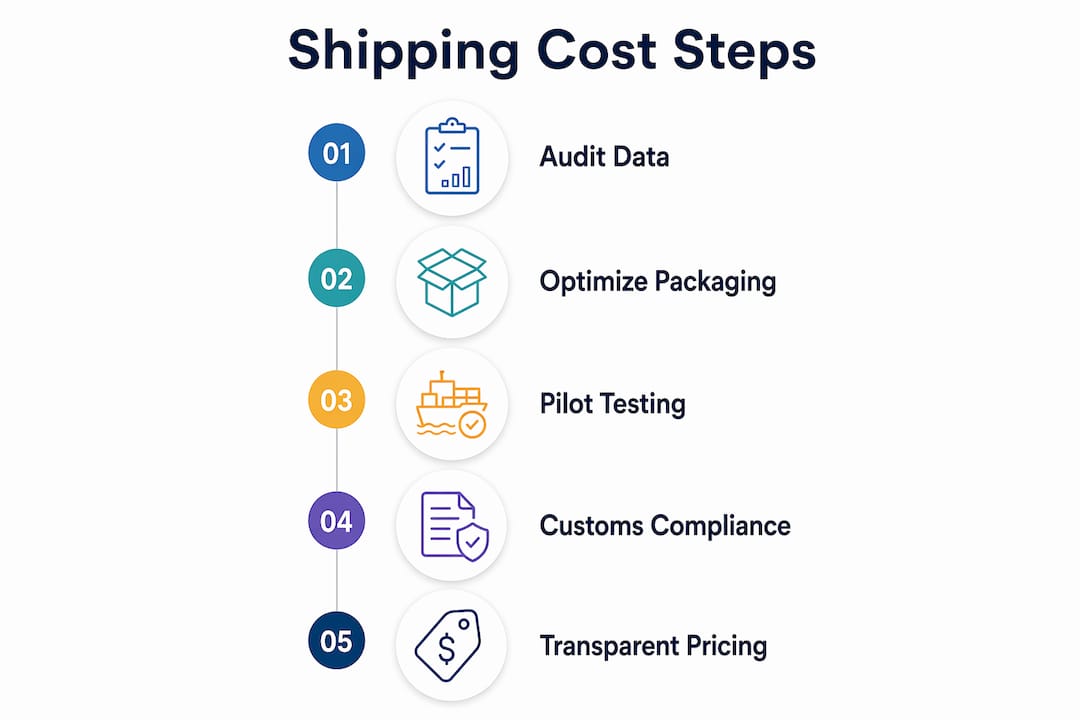
Customs clearance is the part of international shipping where costs spiral fastest and most unexpectedly. Documentation errors cause over 3% of shipments to be held at customs, generating storage fees, fines, and delayed payment from customers. Experts in cross-border logistics call customs clearance the “silent killer” of cross-border operations because the damage accumulates quietly across hundreds of shipments.
The Harmonized System (HS) code is the foundation of every customs entry. An incorrect HS code triggers the wrong duty rate, which means either overpayment or a fine for underpayment. 31% of SMB shipments carried incorrect HS codes, resulting in fines or overpayments. Correct classification requires checking both the U.S. Schedule B number for exports and the destination country’s tariff schedule for imports.
For U.S. exporters, Electronic Export Information (EEI) filing is a legal requirement. Only 5% of U.S. exports require an export license, but most commercial shipments valued over $2,500 require EEI filing through the Automated Export System (AES) to obtain an Internal Transaction Number (ITN). Missing this step can result in civil penalties. You can review the full export declaration requirements to stay current with 2026 filing rules.
Choosing between Delivered Duty Paid (DDP) and Delivered Duty Unpaid (DDU) is a cost and customer experience decision. Under DDP, the seller pays all duties and taxes before delivery, eliminating surprise charges for the buyer. Under DDU, the buyer pays on arrival, which frequently causes failed deliveries, returns, and customer complaints. For most B2C international shipments, DDP is the better model despite the upfront cost.
Key compliance steps that prevent costly customs holds:
- Verify the correct HS code for every product before the first shipment to a new market.
- Include a commercial invoice with accurate declared value, country of origin, and full product description.
- File EEI via AES for all U.S. export shipments valued over $2,500.
- Work with a licensed customs brokerage service for complex or high-value shipments.
- Review how to avoid customs delays before entering a new destination market.
How does a transparent shipping experience protect your margins?
Surprise import charges at delivery are the single biggest driver of international cart abandonment and returns. When a customer in Germany receives a package with an unexpected €40 duty bill, the result is a refused delivery, a costly return, and a lost customer. The fix is showing the full landed cost before checkout.
Duty-inclusive pricing lifted conversion rates by 14% in A/B tests on international storefronts. That gain comes from removing uncertainty. Customers who see the total price including duties and taxes at the product page level are far more likely to complete the purchase.
Returns are the other margin leak that most businesses underestimate. International returns cost brands $18–$24 per order, and that figure does not include the lost sale. Regional return hubs reduce return shipping costs by 40–60% by consolidating returns locally before sending them back in bulk. Understanding how vehicle and product shipping logistics work at a physical level also helps businesses design smarter return packaging that reduces damage and re-shipping costs.
Practical steps to protect margins through transparency:
- Display a landed cost breakdown at both the product page and checkout stages.
- Collect duties at checkout using a DDP model to prevent failed deliveries.
- Provide real-time tracking from origin to final delivery to reduce customer service contacts.
- Offer virtual returns processing where customers receive a refund or replacement before the physical return arrives.
- Establish regional return hubs in your top two or three international markets to consolidate return volume.
Key Takeaways
The most effective approach to cheap international shipping is managing total landed cost across carrier selection, packaging, customs compliance, and fulfillment network design.
| Point | Details |
|---|---|
| Landed cost over label price | Factor in duties, brokerage fees, surcharges, and returns to find the true shipping cost. |
| Carrier audit drives savings | A 90-day data pull and multi-carrier logic can reduce international shipping costs by 20–40%. |
| Packaging controls dimensional weight | Right-sizing parcels and using zone skipping can cut per-unit costs by up to 38%. |
| Customs accuracy prevents fines | Correct HS codes and EEI filing eliminate the most common source of unexpected charges. |
| DDP checkout lifts conversion | Collecting duties at checkout increases international conversion rates by up to 14%. |
What I’ve learned about cutting international shipping costs that most guides skip
After years of working through international logistics for small and mid-sized businesses, the pattern I see most often is this: companies obsess over the carrier rate and ignore everything else. They negotiate a 5% discount on the base rate, then lose it three times over in dimensional weight charges, customs holds, and return costs they never tracked.
The landed cost mindset is the real shift. When you start measuring what a shipment actually costs from your warehouse door to the customer’s hands, including the return if it comes back, the priorities change completely. Packaging becomes a financial decision, not just an operational one. Customs documentation becomes a revenue protection tool. The carrier rate becomes one variable among many.
The businesses I’ve seen get this right share one habit: they run a quarterly logistics cost review that covers carrier performance, packaging efficiency, customs hold rates, and return costs together. They treat international shipping as a system, not a line item. That shift in perspective is what separates businesses that grow internationally from those that quietly pull back because “international is too expensive.”
The technology piece matters too. Real-time tracking, automated HS code classification tools, and multi-carrier rate shopping platforms have made it possible for small businesses to operate with the same logistics discipline that large enterprises use. The tools exist. The question is whether you build the process around them.
— Ian
Worldwideexpress freight forwarding and customs solutions
Reducing international shipping costs requires more than rate shopping. It requires expertise in freight forwarding, customs compliance, and supply chain design working together.
Worldwideexpress provides freight forwarding services covering air and ocean transportation, customs brokerage, and supply chain management for importers and exporters across industries. The team handles EEI filing, HS code classification, and duty management so businesses avoid the compliance errors that generate fines and delays. For businesses ready to build a cost-effective international shipping operation, Worldwideexpress offers tailored logistics plans and international shipping solutions built around your specific lanes, volumes, and compliance requirements.
FAQ
What is the cheapest way to ship internationally from the USA?
The cheapest way to ship internationally from the USA depends on weight, destination, and transit time requirements. Postal consolidators are typically 20–35% cheaper than express couriers for parcels under 2kg to Western Europe or Australia.
What does landed cost mean in international shipping?
Landed cost is the total cost of a shipment from origin to the customer’s door, including freight, duties, taxes, customs brokerage fees, and last-mile delivery charges. It is the accurate measure of overseas shipping cost, not just the carrier label price.
When is EEI filing required for U.S. exports?
EEI filing through the Automated Export System is required for most U.S. commercial export shipments valued over $2,500. Filing generates an Internal Transaction Number, which is legally required before export.
What is the difference between DDP and DDU shipping?
Delivered Duty Paid (DDP) means the seller pays all duties and taxes before delivery, eliminating surprise charges for the buyer. Delivered Duty Unpaid (DDU) passes those charges to the buyer at delivery, which frequently causes failed deliveries and returns.
How much can small businesses save by auditing their international shipping?
Small and mid-market businesses can reduce international shipping costs by 20–40% within 90 days by auditing carriers, right-sizing packaging, and using regional fulfillment nodes.
Recommended
- International Logistics: A 2026 Strategy Guide for Businesses – Worldwide Express, Inc.
- FedEx International Shipping Rates: 2026 Business Guide – Worldwide Express, Inc.
- Avoid costly international shipping mistakes in 2026 – Worldwide Express, Inc.
- International courier vs freight: guide for managers 2026 – Worldwide Express, Inc.