TL;DR:
- CIF requires the seller to pay for goods, freight, and insurance, transferring risk upon vessel loading. The buyer bears transit and entry costs from the port of shipment onward, with disputes often arising from unclear documents or insurance beneficiary issues. Proper document management and insurance verification are crucial to minimize risks in CIF transactions.
Cost, Insurance, and Freight (CIF) means the seller pays for the goods, arranges sea freight to the named port of destination, and purchases minimum marine insurance — then risk passes to the buyer the moment goods are loaded aboard the vessel at the port of shipment. That split between cost obligation and risk transfer is the defining feature of CIF, and missing it is where most disputes begin. Under Incoterms® 2020 published by the International Chamber of Commerce (ICC), CIF applies exclusively to sea and inland waterway transport. A correctly drafted contract reads: “CIF [Named Port of Destination] Incoterms® 2020.” The default insurance level is Institute Cargo Clauses ©, a named-perils policy — not all-risks coverage.
Table of Contents
- What does the cost, insurance and freight definition mean in practice?
- What the seller must do and pay under CIF
- What the buyer must do and when risk actually transfers
- What insurance does CIF require, and how does it compare to CIP?
- When should you use CIF, and when should you avoid it?
- What costs does CIF cover, and where do disputes come from?
- How to write CIF into a sales contract and which documents you need
- How a freight forwarder supports CIF shipments
- Key Takeaways
- The CIF detail most traders overlook
- Worldwideexpress handles the CIF details that create the most risk
What does the cost, insurance and freight definition mean in practice?
Under CIF, the seller carries three concrete financial obligations before the goods ever leave the origin country: export clearance, the main ocean freight contract, and a marine insurance policy. Per U.S. trade guidance, the seller handles export clearance and pays freight and insurance to the named port, while the buyer handles import customs and arrival charges. Unloading at destination is a frequent gray area — whether the seller’s freight contract covers it depends on what was actually booked, not on CIF itself.
The buyer’s financial exposure begins at the destination port: import duties, port handling, terminal fees, and inland delivery all fall on the buyer’s account. For a broader look at how CIF fits among all shipping terms, the Incoterms® 2020 framework covers eleven rules across two transport categories.
What the seller must do and pay under CIF
The seller’s obligations under CIF are specific and sequential. Missing any one of them gives the buyer grounds to dispute the transaction or reject documents.
Seller duties checklist:
- Deliver goods on board the named vessel at the port of shipment
- Complete export customs clearance and pay any export duties or taxes
- Contract and pay for ocean carriage to the named port of destination
- Obtain marine insurance at minimum Institute Cargo Clauses © cover
- Provide the transport document (negotiable bill of lading or sea waybill) that lets the buyer claim the cargo
- Give the buyer prompt notice of shipment so the buyer can arrange arrival handling
Documents the seller must provide:
| Document | Purpose |
|---|---|
| Commercial invoice | States price, goods description, and contract terms |
| Bill of lading or sea waybill | Allows buyer to claim goods at destination |
| Insurance policy or certificate | Enables buyer to file a claim if cargo is damaged |
| Packing list | Confirms contents and weights for customs |
| Export clearance evidence | Confirms seller completed origin formalities |

Per LexisNexis guidance on Incoterms® 2020, the seller’s delivery obligation is complete once goods are on board the vessel — the document set is what proves that obligation was met.
Pro Tip: When you receive the seller’s insurance certificate, confirm three things before the vessel departs: the policy is in the contract currency, the insured amount equals the contract price plus 10%, and your company is named as the beneficiary or the certificate is made out to order.
What the buyer must do and when risk actually transfers
Risk transfer under CIF is earlier than most buyers expect. According to LegalClarity, risk of loss or damage passes to the buyer once the goods are loaded on board the vessel at the port of shipment — even though the seller continues paying for carriage all the way to the destination port. That gap is not a drafting error; it is the deliberate structure of CIF.
Buyer responsibilities in order:
- Accept the transport documents from the seller and pay the contract price
- Arrange import customs clearance and pay all import duties and taxes
- Cover unloading and terminal handling at the destination port (unless the freight contract explicitly includes it)
- Arrange and pay for inland delivery from the arrival port to the final destination
- Follow up on any cargo claims directly with the insurer, using the seller-provided insurance certificate
Cost vs. risk: two separate timelines
Seller pays freight: port of shipment → named port of destination.
Buyer bears risk: from the moment goods are loaded on board the vessel at origin.
These timelines do not align — that gap is the buyer’s exposure during the entire ocean voyage.
Legal practitioners note that CIF does not guarantee arrival or condition of goods; the seller’s obligation is to arrange transport and minimum insurance, and the buyer bears transit risk once cargo is loaded.
What insurance does CIF require, and how does it compare to CIP?

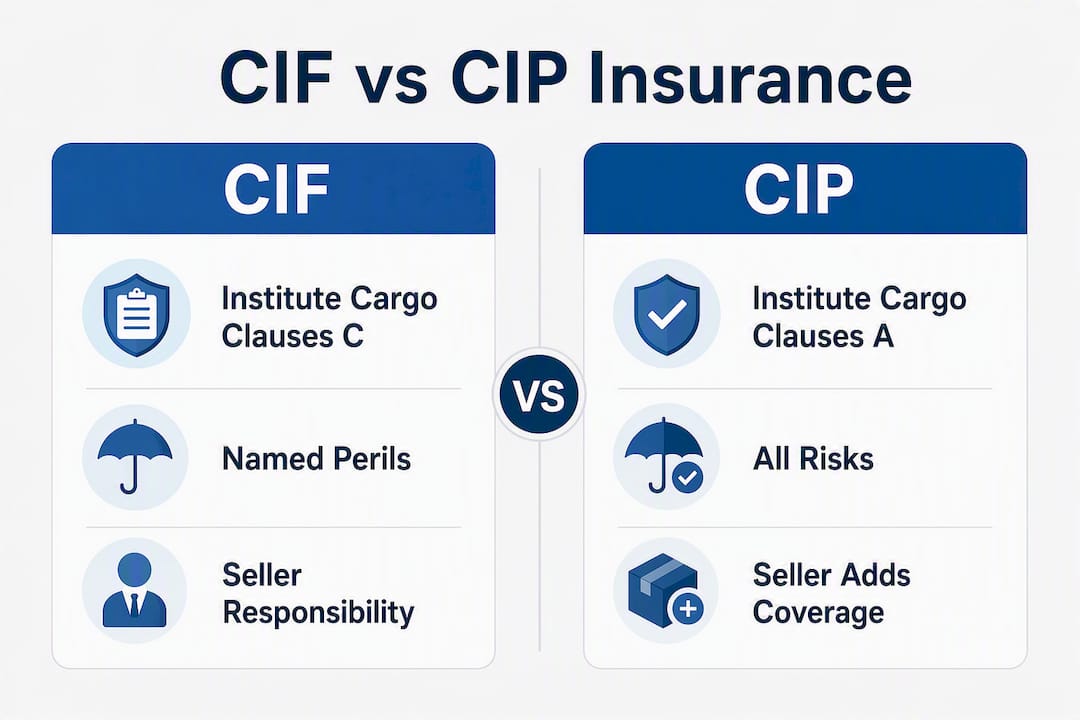
CIF’s default insurance is Institute Cargo Clauses © — a named-perils policy that covers a defined list of major casualties (fire, sinking, collision, jettison) but excludes many transit risks that Clauses A covers. Theft, handling damage, and water ingress from condensation are common Clauses C gaps that catch buyers off guard.
The ICC’s 2020 revision deliberately left CIF at Clauses C while upgrading CIP to require Clauses A (all-risks) by default, reflecting the reality that CIF remains most common in bulk commodity trades where Clauses C has long been the market standard.
| Feature | CIF (default) | CIP (default since 2020) |
|---|---|---|
| Insurance clause | Institute Cargo Clauses © — named perils | Institute Cargo Clauses (A) — all-risks |
| Who arranges | Seller | Seller |
| Insured amount | Contract price + 10% | Contract price + 10% |
| Transport mode | Sea/inland waterway only | Any mode, including multimodal |
| Buyer upgrade option | Yes, by contract agreement | Already at maximum default |
Sellers typically insure goods for the contract price plus 10%, and the policy should be in the contract currency unless otherwise agreed. Buyers relying only on Clause C may be exposed to gaps like theft and handling damage, so reviewing your freight insurance options before finalizing a CIF contract is worth the time.
Pro Tip: Add this line to the sales contract when Clauses C is insufficient: “Notwithstanding CIF default, seller shall obtain insurance cover on Institute Cargo Clauses (A) terms, with buyer named as additional insured.” This single sentence upgrades cover without changing the rest of the CIF structure.
When should you use CIF, and when should you avoid it?
CIF fits a specific commercial profile. Using it outside that profile creates friction and cost surprises.
CIF works well when:
- The shipment is bulk cargo, break-bulk, or a commodity traded on established sea routes
- The buyer wants the seller to manage carriage and basic insurance logistics
- Both parties are comfortable with named-perils coverage or have agreed to upgrade it
- The transaction involves a single port-to-port leg with no complex inland routing
Avoid CIF when:
- The cargo moves in containers through multimodal supply chains — CIP or FCA are better fits because CIF assumes port-to-port carriage and can misfit container terminal handling
- The buyer needs all-risks insurance and wants visibility into freight cost components
- The buyer prefers to control freight booking and carrier selection
| Rule | Seller pays freight? | Insurance default | Risk transfers | Best for |
|---|---|---|---|---|
| CIF | Yes, to destination port | Clauses C (named perils) | On board at origin | Bulk/break-bulk sea trades |
| FOB | No | Buyer arranges | On board at origin | Buyers controlling freight |
| CFR | Yes, to destination port | Buyer arranges | On board at origin | Buyers with own insurance |
| CIP | Yes, to named place | Clauses A (all-risks) | Handed to carrier | Multimodal/container |
| DAP/DDP | Yes, to destination | Seller arranges | At destination | Buyers wanting full delivery |
What costs does CIF cover, and where do disputes come from?
The “cost” in CIF covers a defined set of origin and transit expenses — but the list of what it excludes is just as important.
| Cost item | Seller or buyer? |
|---|---|
| Export clearance and duties | Seller |
| Origin port charges (loading) | Seller |
| Ocean freight to named port | Seller |
| Marine insurance premium | Seller |
| Unloading at destination port | Buyer (unless freight contract covers it) |
| Import duties and taxes | Buyer |
| Terminal handling at destination | Buyer |
| Inland delivery from arrival port | Buyer |
Ambiguities in who pays arrival handling or unloading costs often cause disputes; sellers’ freight contracts may not cover unloading, so buyers frequently face unexpected fees at destination. Industry specialists also warn that freight costs quoted by sellers can contain opaque surcharges, leading to disputes about what the “cost” component actually covered in the sales invoice.
Common CIF dispute sources:
- Seller’s freight contract does not include terminal unloading, leaving buyer with surprise charges
- Insurance certificate names seller rather than buyer as beneficiary
- Named port is vague or mismatched between sales contract and bill of lading
- Clause C gaps leave cargo uninsured for theft or handling damage
Pro Tip: State the named port precisely in the contract — “CIF Port of Los Angeles (Berth 100), Incoterms® 2020” — and add a line confirming whether unloading is included in the freight contract. Two sentences prevent the most common CIF disputes.
How to write CIF into a sales contract and which documents you need
The correct notation format is straightforward:
“CIF [Port Name] Incoterms® 2020”
Example: “CIF Port of Houston, Incoterms® 2020”
Always include the Incoterms® year. Omitting it creates ambiguity about which version governs, since rules changed between 2010 and 2020.
Seller’s document checklist:
- Commercial invoice (price, description, contract currency)
- Negotiable bill of lading or sea waybill (buyer needs the correct original to claim cargo)
- Insurance policy or certificate (in contract currency, insured for contract price + 10%, buyer as beneficiary)
- Packing list
- Export clearance certificate or customs declaration
Why the bill of lading type matters:
- A negotiable bill of lading allows the buyer to endorse and transfer title to the cargo while it is still at sea — critical for commodity trades where resale in transit is common.
- A non-negotiable sea waybill names the consignee and cannot be transferred; it is faster to process but removes the buyer’s ability to resell cargo afloat.
- The buyer must present the correct original bill of lading to the carrier at destination to take delivery — presenting the wrong document type causes costly delays.
How a freight forwarder supports CIF shipments
A freight forwarder or customs broker adds concrete value at each stage of a CIF transaction, particularly in areas where the rule’s structure creates friction.
- Ocean space booking: Confirms vessel schedule, port of loading, and whether the freight contract includes terminal handling or unloading at destination
- Insurance advisory: Reviews the seller’s insurance certificate for coverage gaps, verifies beneficiary designation, and advises on buyer top-up policies when Clauses C is insufficient
- Document checking: Confirms the bill of lading matches the sales contract’s named port, consignee details, and Incoterms® notation before the vessel departs
- Customs brokerage at destination: Handles import entry, duty calculation, and clearance to prevent cargo holds at arrival
- Claims support: Assists the buyer in filing cargo claims against the insurer when damage is discovered, using the seller-provided insurance certificate
A forwarder who reviews the seller’s insurance certificate before departure — not after arrival — is the single most effective check in a CIF transaction. Confirming the beneficiary, the insured amount, and the coverage clause takes minutes. Correcting a defective certificate after a loss can take months.
Worldwideexpress provides cargo insurance advisory and U.S. customs brokerage as part of its ocean freight forwarding services, covering the exact friction points CIF creates for buyers at U.S. ports.
Key Takeaways
CIF requires the seller to pay freight and minimum marine insurance to the named port, while the buyer bears transit risk from the moment goods are loaded on board the vessel at origin.
| Point | Details |
|---|---|
| CIF applies to sea/inland waterway only | Never use CIF for containerized multimodal shipments; use CIP or FCA instead. |
| Risk transfers at vessel loading | Buyer bears transit risk from origin loading, even though seller pays freight to destination. |
| Default insurance is Clauses C | Named-perils only; negotiate Clauses A or arrange buyer top-up insurance for higher-value cargo. |
| Insure for contract price + 10% | Policy must be in contract currency with buyer named as beneficiary. |
| Worldwideexpress covers CIF friction points | Ocean freight booking, insurance review, document checking, and U.S. customs brokerage in one place. |
The CIF detail most traders overlook
The most underestimated risk in a CIF transaction is not the insurance clause — it is the beneficiary line on the insurance certificate. Sellers routinely issue certificates naming themselves as the beneficiary, which means the buyer cannot file a claim directly if cargo arrives damaged. By the time the error surfaces, the vessel has sailed and the seller may be unresponsive.
The fix is a single contract line: require the seller to provide an insurance certificate made out to the buyer’s order before the bill of lading is released. That one sentence shifts the claims process entirely into the buyer’s hands, where it belongs under CIF’s risk structure. No renegotiation of freight terms, no change to the Incoterms® rule — just a document check that takes thirty seconds to add and hours of litigation to avoid if skipped.
CIF is a well-constructed rule for the trades it was designed for. The disputes that surround it are almost never about the rule itself — they are about the documents that prove it was followed.
Worldwideexpress handles the CIF details that create the most risk
Knowing the CIF framework is one thing. Executing it without arrival surprises is another. Worldwideexpress offers ocean freight forwarding, cargo insurance advisory, document verification, and U.S. customs brokerage as an integrated service — covering the exact points where CIF transactions go wrong: insufficient insurance, mismatched bills of lading, and unexpected terminal charges at U.S. ports.
For importers and exporters who want a managed approach to CIF shipments, Worldwideexpress provides the operational depth to handle booking, compliance, and claims support from a single point of contact. Request a quote or speak to a specialist through the freight forwarding guide to see how the service fits your next ocean shipment.
Recommended
- Cost Insurance Freight Meaning: A Practical CIF Guide – Worldwide Express, Inc.
- 8 Key Freight Terms Definitions Every Importer Should Know – Worldwide Express, Inc.
- What is Freight Insurance? Understanding Its Importance – Worldwide Express, Inc.
- Freight Insurance for International Shipments: 2026 Guide – Worldwide Express, Inc.