A customs bond is a three-party financial guarantee, binding the importer as principal, a surety company, and U.S. Customs and Border Protection, that must be on file for most commercial imports entering the United States. Continuous bonds cover ongoing shipments, while single transaction bonds handle one-off entries. The immediate step: check whether a $50,000 continuous bond is already on file, or contact a licensed customs broker to file CBP Form 301.
TL;DR:
- Continuous bonds are generally set at a minimum of $50,000 and adjusted based on past duties and duty exposure, not shipment volume alone.
- Most importers with regular shipments should use a continuous bond to avoid repeated paperwork, while occasional shippers start with single transaction bonds.
- Accurately selecting the activity code on Form 301 and maintaining current importer details are key to preventing bond rejection or insufficiency notices.
- Bond sufficiency must be monitored yearly or more frequently as shipment volume or duty liabilities grow to avoid late penalties or additional security requirements.
- A licensed customs broker simplifies bond filing, manages ongoing bond compliance, and handles electronic submissions, saving time and reducing errors.
Table of Contents
- Who needs a customs bond and why it exists
- Types of customs bonds and how they differ
- How bond amounts are set and when CBP asks for more
- Filing Form 301 and getting your bond approved
- Keeping your bond sufficient once it is in place
- How a licensed customs broker supports bond filing
- What a customs bond actually costs
- Bonding scenarios importers actually run into
- What brokers see go wrong with customs bonds
- Let Worldwide Express handle your customs bond filing
- Primary CBP documents and authoritative resources
- Sources
- FAQ
Who needs a customs bond and why it exists
The bond exists because CBP needs assurance that duties, taxes, and fees will get paid even if something goes wrong after cargo clears. The regulatory foundation sits in 19 CFR §113.11, which spells out what a bond application must contain: certifications, updated information when circumstances change, and a commitment that the surety stands behind the importer’s obligations. It functions as a contract among three parties. The importer, called the principal, promises to follow customs law. The surety, typically an insurance company licensed to write these bonds, guarantees payment if the importer defaults. CBP is the beneficiary, holding the right to collect against the bond when duties go unpaid or regulations get violated.
Bonds are not limited to importers bringing goods across the border for resale. Several categories of trade actors typically need one:
- Importers of record bringing commercial merchandise into the United States for consumption or resale.
- Carriers transporting bonded cargo, including trucking and rail operations moving goods under customs control.
- Bonded warehouse operators storing merchandise before duties are paid.
- Foreign Trade Zone operators handling goods that have not yet formally entered U.S. commerce.
At the point of entry, 19 CFR §142.4 governs when a bond must accompany the entry documentation. Without a valid bond on file, CBP can refuse release of the cargo, which stalls a shipment at the port and starts racking up demurrage charges. That single requirement, a bond tied to nearly every commercial entry, is why importers who skip this step often learn about it the expensive way, with cargo sitting on a dock while a broker scrambles to get security in place.
Types of customs bonds and how they differ
Not every shipment needs the same bond. CBP’s own bond guidance breaks the landscape into a few distinct categories, and picking the wrong one is a common early mistake for new importers.
- Continuous bonds cover all entries made by an importer over a one-year term and renew automatically each year unless terminated, according to CBP’s Form 301 guidelines. These suit businesses importing regularly, since one bond covers unlimited shipments within its coverage amount rather than requiring a new bond for every entry.
- Single transaction bonds (STBs) cover one shipment only, calculated against the entered value of the merchandise plus estimated duties, taxes, and fees. Certain categories, including goods subject to other agency requirements, can trigger a higher multiplier on the STB amount.
- ISF bonds secure the Importer Security Filing that ocean importers must submit before cargo loads at a foreign port. A stand-alone ISF bond must run at least $10,000, per CBP’s bond guidance, though many importers fold ISF coverage into their continuous bond instead of buying a separate one.
- Activity codes on Form 301 designate what kind of operation the bond covers. Activity Code 1 handles standard importer continuous bonds, while other codes apply to warehouses, drawback claims, or custodial operations. Getting the activity code wrong on the application is one of the more common reasons a filing bounces back for correction.
Most importers moving freight on a regular schedule land on a continuous bond because it eliminates the per-shipment paperwork. Occasional importers, or those testing a new product line before committing to regular volume, often start with an STB and switch once the shipping cadence justifies it.
How bond amounts are set and when CBP asks for more
CBP does not pick bond amounts at random. For continuous bonds, the guideline generally lands at $50,000 as a common floor for many importers, though the actual figure CBP requires can be tied to prior-year duties, taxes, and fees paid, meaning an importer with heavier duty exposure may need a larger bond even if shipment volume stays flat.
A $50,000 minimum is the common benchmark cited in CBP’s bond guidance for many continuous bonds, and it functions as a starting point rather than a ceiling for every importer.
Certain activities carry their own minimum thresholds, and antidumping or countervailing duty (AD/CVD) cases add another layer of complexity. When a port suspects revenue risk tied to an AD/CVD order, it can require single transaction bonds on a per-port basis until the concern resolves, according to CBP’s AD/CVD bond guidance. These demands typically arrive with written notice explaining the amount and how long the requirement will stay in effect.
A few points worth keeping in mind when estimating whether a bond is likely sufficient:
- Bond sufficiency is not a one-time check. CBP treats it as an ongoing calculation tied to actual import activity.
- Rapid growth in shipment volume or duty liability can outpace a bond that was adequate a year earlier.
- AD/CVD exposure often demands closer attention than standard merchandise, since ports can act quickly when they see risk.
Filing Form 301 and getting your bond approved
Getting a bond in place involves specific paperwork, a clear submission channel, and a processing window importers should plan around rather than assume away.
- Gather the required information. A continuous bond application needs the importer’s ID number, a general description of the merchandise being imported, and an estimate of duties, taxes, and fees expected over the bond period, per CBP’s Form 301 guidelines.
- Choose surety or cash. Most importers work with a surety company rather than posting cash, since a surety bond spreads the financial exposure and typically costs a small premium rather than tying up working capital.
- Decide who signs. CBP Form 301 can be signed by a company owner or officer, or by a customs broker holding a valid power of attorney. When a broker signs on the importer’s behalf, CBP Form 5106 may also be needed to establish or update the importer’s account information with CBP.
- Submit through the right channel. New continuous bond applications route to CBP’s Bond Centralization Program, typically by email to bondquestions@cbp.dhs.gov, with attachments consolidated into a single file in the order CBP specifies. Filing out of order is a frequent cause of rejected submissions.
- File electronically when required. CBP mandates electronic filing through ACE eBond for many continuous and ACE transactions, which centralizes bond records and speeds up cargo release compared to paper filing.
- Expect a short review window. CBP’s Bond Team generally takes about five business days to process a submission before it makes sense to follow up on status, according to CBP’s bond guidance documentation.
Pro Tip: Submit your continuous bond application at least two weeks before your first anticipated entry, since a rejected filing due to formatting or missing attachments resets the clock.
Keeping your bond sufficient once it is in place
A bond that was adequate last year will not necessarily stay that way. CBP monitors import volume and duty liability against the bond amount on file, and when it decides the bond no longer covers the risk, it sends an insufficiency notice. Importers typically get about 15 days to cure the deficiency before CBP demands additional security, according to CBP notices on bond sufficiency.
That cure period matters because the alternatives are worse. An importer who does not respond can face demands for cash deposits or a requirement to post single transaction bonds on every entry until a new continuous bond is approved, which is slower and more expensive than a routine bond increase.
A few practical steps keep this from becoming an emergency:
- Request a bond rider or file a new application proactively when shipment volume or duty exposure grows, rather than waiting for CBP to flag it.
- Review bond sufficiency at least once a year, ideally around the anniversary of the bond’s effective date.
- Keep the importer’s address, legal name, and contact details on the bond consistent with what is on file with CBP; mismatched records are a common reason insufficiency notices get missed.
- Confirm the power of attorney on file with the broker is current, since an expired POA can delay a bond amendment right when speed matters most.
Pro Tip: Assign one person inside your company to own bond monitoring, even part time, so a sufficiency notice does not sit unread in a shared inbox until the cure window closes.
How a licensed customs broker supports bond filing
A licensed customs broker handles the mechanics of bond filing so the importer does not have to become an expert in CBP’s submission requirements. That includes preparing Form 301 with the correct activity code, managing the power of attorney paperwork, coordinating with a surety on pricing and terms, and submitting through ACE eBond where electronic filing is required.
A broker-led filing generally needs the following from the importer:
- Company legal name, address, and importer number as registered with CBP.
- A general description of the merchandise being imported and its expected volume.
- An estimate of annual duties, taxes, and fees for the coming bond period.
- A signed power of attorney authorizing the broker to file on the company’s behalf.
A licensed customs broker handles customs bond filings and import/export paperwork, often with electronic filing capability incorporated into the process. That licensing status is what allows the brokerage to sign and submit bond paperwork directly with CBP rather than routing everything back through the importer for each step. Its customs bonds resources and customs brokerage services pages outline how bond filing fits into the broader clearance process for businesses moving freight internationally.
What a customs bond actually costs
The premium on a surety bond is a small fraction of the bond’s face value, and it is billed annually for continuous bonds rather than per shipment. Exact premium rates vary by surety company and depend on the importer’s credit standing, import history, and the bond amount required, so no single number applies across the industry.
Beyond the base premium, a few additional charges can show up depending on circumstances:
- Bond increase fees apply when CBP raises the sufficiency requirement mid-term and the importer needs a rider or a new bond.
- STB costs stack up quickly for importers who rely on single transaction bonds instead of a continuous bond, since each shipment requires its own bond calculated against entered value.
- Broker service fees for preparing and filing the bond application are typically separate from the surety premium itself.
- Emergency filing costs can appear when a bond lapses or an insufficiency notice arrives with a short cure window, since rushed processing sometimes carries a premium over standard turnaround.
The practical takeaway is that a continuous bond, priced once a year, is usually the more predictable option for importers who ship more than occasionally, while STBs make sense mainly for one-off or infrequent shipments where the per-transaction cost stays lower than a year of continuous coverage.
Bonding scenarios importers actually run into
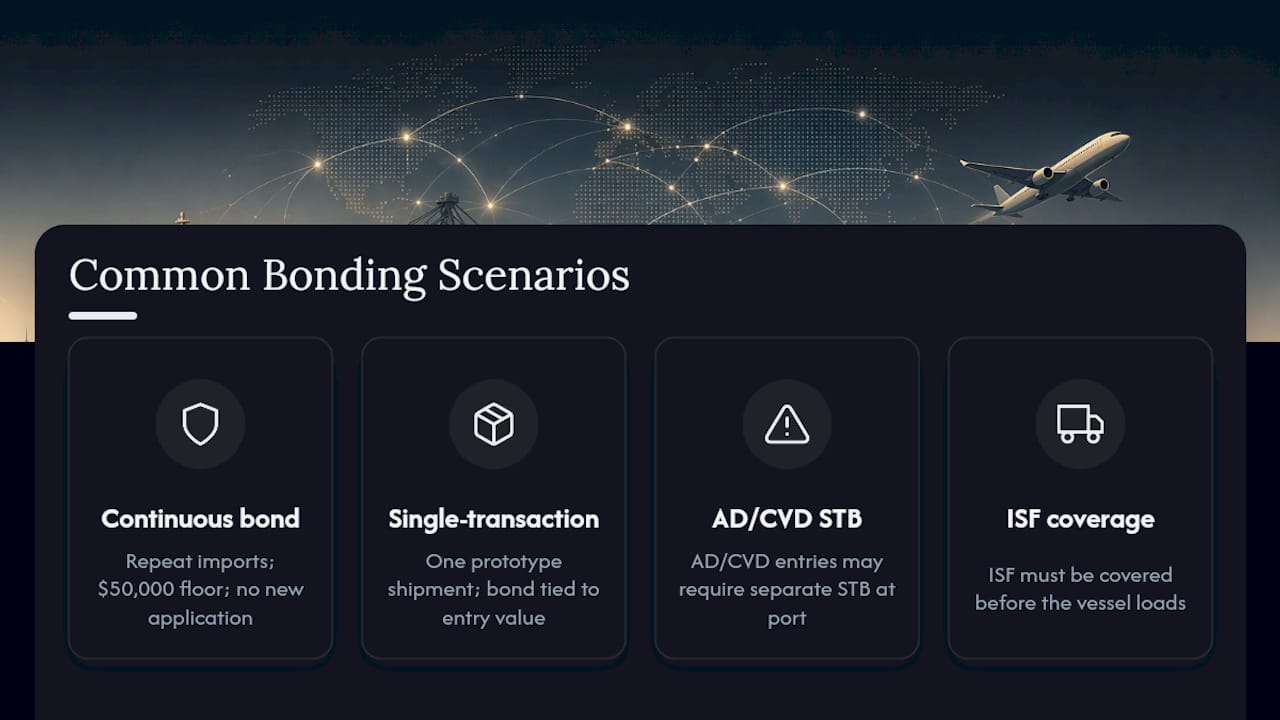
A retailer importing furniture from Vietnam four times a year is a typical candidate for a continuous bond, since the $50,000 floor cited in CBP’s guidance covers repeat shipments without requiring a new bond application each time cargo arrives.
A manufacturer testing a single prototype shipment from a new overseas supplier, with no plans for regular imports yet, is a better fit for a single transaction bond tied to that one entry’s value. Once that manufacturer commits to ongoing sourcing from the same supplier, switching to a continuous bond usually makes more financial sense than repeating STBs on every shipment.
An importer bringing in steel products subject to an active AD/CVD order might find a port requiring a separate STB specifically because of that AD/CVD exposure, even if the importer already carries a continuous bond covering other merchandise. That is the kind of case-by-case demand described in CBP’s AD/CVD bond guidance, and it catches importers off guard when they assume their existing continuous bond covers everything.
An ocean importer filing an Importer Security Filing ahead of a container’s departure needs ISF coverage in place before the vessel loads, whether that comes from a stand-alone ISF bond or ISF coverage built into an existing continuous bond.
What brokers see go wrong with customs bonds
Working through bond filings surfaces the same handful of mistakes over and over. Importers underestimate how fast duty liability grows once volume picks up, then get caught by an insufficiency notice they did not see coming. Power of attorney paperwork arrives late, days before a shipment needs to clear, leaving no room for CBP’s standard processing window. Form 301 gets submitted with a mismatched address or an outdated importer number, which is a small clerical error that still triggers a rejection.
The fix is not complicated. Review bond sufficiency every quarter rather than once a year. Keep a simple checklist next to Form 301 covering importer ID, merchandise description, and estimated duties before submitting. Most importantly, designate one person inside the company as the bond owner, someone who tracks renewal dates and reads CBP notices the day they arrive rather than the week before a cure period closes.
— Ian
Let Worldwide Express handle your customs bond filing
Bond paperwork is one more task competing for attention when a shipment is already in transit. A licensed customs broker can manage import and export filings, streamlining the bond application, power of attorney, and eBond submission processes.
Services relevant to bond and clearance support include:
- U.S. customs brokerage, covering Form 301 preparation and filing.
- Power of attorney management, so the broker can sign and submit on the importer’s behalf.
- eBond submission through ACE, reducing paper handling and speeding cargo release.
- Ongoing bond sufficiency monitoring tied to actual shipment volume.
Businesses ready to move forward can request a freight quote or review import freight services to see how bond filing fits into a broader clearance plan. Have the company’s importer number, a description of typical merchandise, and an estimate of annual duties ready before reaching out, since that is the same information a broker needs to start the bond application.
Primary CBP documents and authoritative resources
- CBP Form 301 guidelines for continuous bonds
- ACE eBond processing overview
- CBP bond guidance and minimums
- eBond frequently asked questions
- CBP Form 301 (Customs Bond)
Sources
- General Guidelines for Completing the CBP Form 301 for Continuous Bonds – Activity Code 1
- ACE eBond processing | U.S. Customs and Border Protection
- Bonds – U.S. Customs and Border Protection
- eSTB/eBond Frequently Asked Questions – CBP
- CBP Form 301 (Customs Bond) – instructions and form
FAQ
What is a customs bond?
A customs bond is a three-party financial guarantee among an importer, a surety company, and CBP, ensuring duties and fees get paid on imported goods. It is required for most commercial entries and for Importer Security Filings on ocean shipments.
How much is a $50,000 customs bond?
The premium on a $50,000 continuous bond, which is a common benchmark cited in CBP’s bond guidance, is a small percentage of that face value and depends on the importer’s credit profile and history with the surety. There is no single published rate, so importers typically get a quote from a surety company or broker before committing.
What is the customs bond process?
The process starts with gathering the importer’s ID, merchandise description, and estimated duties, then submitting Form 301 through CBP’s Bond Centralization Program or via electronic eBond filing. CBP’s Bond Team generally reviews submissions within about five business days.
How do I obtain a customs bond?
Importers can work with a surety company directly or through a licensed customs broker who prepares and files Form 301 on their behalf using a power of attorney. Most continuous bond applications now go through electronic ACE eBond filing rather than paper submission.
What happens if my customs bond becomes insufficient?
CBP typically gives importers about 15 days to cure a bond insufficiency notice before demanding cash deposits or requiring single transaction bonds on future entries. Reviewing bond coverage regularly against actual shipment volume helps avoid this situation before CBP flags it.