What is a customs entry officer, and how does it differ from a customs broker?
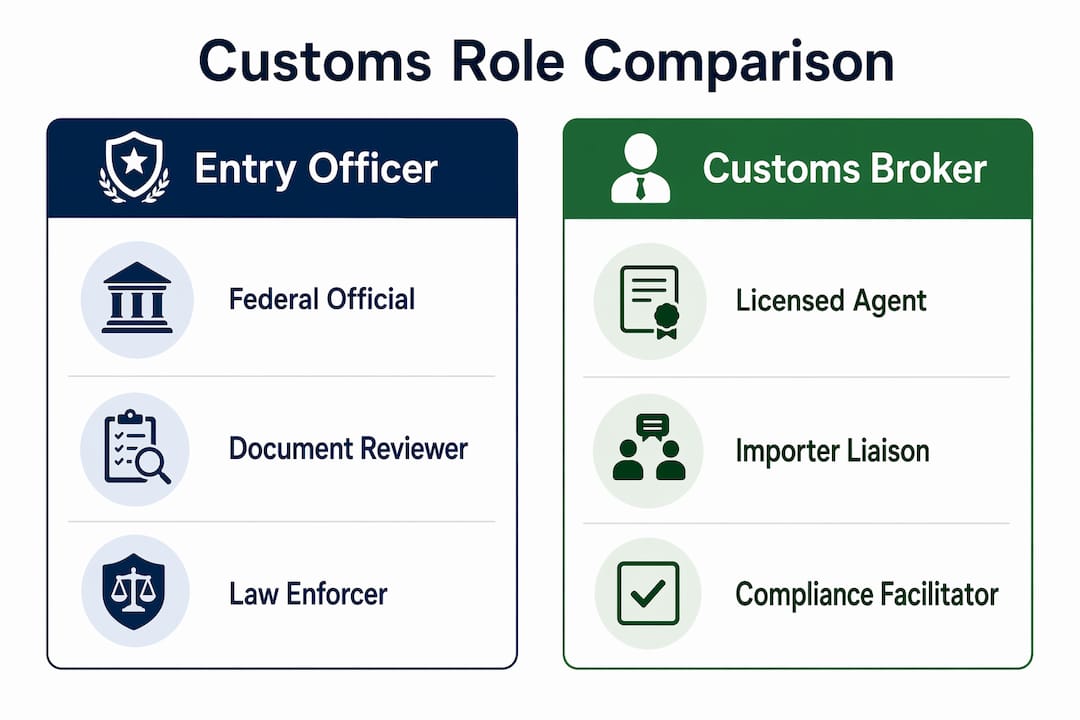
The term “customs entry officer” refers to a federal government official, not a private service provider. CBP federal officials review and approve import entries, enforce customs law, and determine whether shipments meet all admissibility requirements. Businesses cannot hire, contact, or retain a customs entry officer as a vendor. That distinction trips up importers more often than most realize, and the confusion carries real consequences.
Here is how the three core roles break down:
- Customs Entry Officer: A federal CBP employee within the Department of Homeland Security. Reviews import documentation, classifies merchandise, estimates duties, and enforces the Tariff Act of 1930. Operates under the GS-1894 position series as defined by the Office of Personnel Management.
- Licensed Customs Broker: A private professional licensed by CBP with legal authority to sign entry documents and represent importers under a power of attorney. This is the professional businesses actually engage.
- Entry Writer: A private-sector specialist, typically employed inside a brokerage firm, who prepares and transmits formal entry documentation under broker supervision. Entry writers lack independent legal representation authority.
The regulatory enforcer, the licensed representative, and the technical preparer each occupy a distinct lane. Conflating them is where costly delays begin.
Table of Contents
- Why businesses must work with licensed customs brokers, not entry officers
- How the three customs roles compare in practice
- What customs compliance actually requires from U.S. importers
- How Worldwideexpress supports businesses through customs brokerage
- What qualifications does a customs entry officer need?
- What does a customs entry officer do day to day?
- How customs entry officers interact with brokers and logistics professionals
- How recent US regulatory changes affect the entry officer’s role
- Worldwideexpress handles the compliance work so you can focus on your business
- Key Takeaways
Why businesses must work with licensed customs brokers, not entry officers
Licensed customs brokers are the only private professionals with legal standing to act on an importer’s behalf before CBP. That authority flows from a signed power of attorney, which grants the broker the right to prepare, sign, and submit entry documents in the importer’s name. No other party in the private sector holds that right.
Key reasons to retain a licensed broker:
- Legal representation: Brokers sign documents under power of attorney, appear before CBP on the importer’s behalf, and apply for duty refunds or tariff reclassifications.
- Classification and duty calculation: Brokers assign Harmonized Tariff Schedule (HTS) codes, calculate duties owed, and arrange payment. Errors here trigger penalties and delays.
- OGA compliance: Many commodities require clearance from Other Government Agencies such as the FDA, USDA, or EPA. Licensed brokers navigate those requirements, which vary by product category.
- Documentation management: Brokers compile commercial invoices, certificates of origin, cargo-control documents, and entry summaries, then submit them electronically through the Automated Broker Interface (ABI).
- Liaison with CBP: When CBP flags a shipment for examination or issues a query, the broker responds directly, keeping the importer’s supply chain moving.
Attempting to bypass a licensed broker, or reaching out to a CBP entry officer as though they were a service provider, produces the opposite of the intended result. Shipments stall, penalties accrue, and the importer bears full liability.
Pro Tip: Choose a broker with demonstrated expertise in your specific product category. A broker who handles textiles daily will navigate FDA-regulated food imports far less confidently than one who specializes in them. Matching broker expertise to your commodity type is one of the clearest ways to cut clearance time.
How the three customs roles compare in practice
Understanding the role of a US customs broker versus an entry writer versus a CBP entry officer clarifies who does what at every stage of an import transaction.
| Role | Employer | Legal Authority | Primary Function | Interacts with Businesses? |
|---|---|---|---|---|
| Customs Entry Officer | CBP / DHS (federal) | Enforces customs law | Reviews entries, classifies goods, approves or rejects shipments | No, as a service provider |
| Licensed Customs Broker | Private firm or self-employed | Power of attorney; signs entry documents | Prepares filings, represents importer, pays duties | Yes, directly |
| Entry Writer | Private logistics or brokerage firm | None independently | Classifies goods, assigns HTS codes, files through ABI | Indirectly, via broker |
Key distinctions worth keeping in mind:
- Entry writers work under broker supervision. Their classification work on invoices and HTS codes feeds directly into the broker’s formal filing.
- Brokers carry the legal and financial liability for the accuracy of every entry they submit.
- CBP entry officers operate on the government side of the transaction. Their job is enforcement and risk assessment, not client service.
The customs broker vs. agent distinction matters just as much. Freight forwarders and customs agents may coordinate logistics, but only a licensed broker can legally represent an importer before CBP.
What customs compliance actually requires from U.S. importers
CBP expects importers and their brokers to exercise reasonable care with every filing. That standard is not aspirational. It is a legal obligation, and falling short of it opens the door to penalties, audits, and shipment holds.
Core compliance responsibilities include:
- Accurate tariff classification: Every product must be assigned the correct HTS code. Misclassification, even unintentional, can result in underpaid duties and CBP penalties.
- Complete documentation: Commercial invoices, packing lists, bills of lading, and certificates of origin must be accurate and submitted on time.
- Duty payment: Duties and applicable taxes must be calculated correctly and paid promptly. Brokers arrange payment on the importer’s behalf.
- Recordkeeping: Importers are required to retain entry records for five years from the date of entry.
- OGA requirements: Products regulated by agencies beyond CBP, from food to electronics to pharmaceuticals, require additional permits, certifications, or inspections before release.
Recent regulatory shifts have added pressure. Section 301 tariffs on Chinese goods, Section 232 steel and aluminum duties, and the de minimis threshold changes in 2024 have all altered the compliance calculus for U.S. importers. Brokers who stay current on these changes, as required by ONET standards for the profession, protect their clients from costly surprises.
Misunderstanding the roles of customs entry officer versus customs broker is a widespread source of costly shipment delays, according to CBP trade compliance guidance.
Technology is also reshaping how enterprise logistics apps support documentation accuracy inside brokerage firms, reducing manual classification errors before filings reach CBP.
How Worldwideexpress supports businesses through customs brokerage
Worldwideexpress brings extensive experience in U.S. customs brokerage and international freight forwarding, serving businesses that need more than a transactional filing service.
Services include:
- U.S. customs brokerage and import entry management
- Import and export freight forwarding
- Air and ocean transportation
- Domestic trucking and warehousing
- Cargo insurance and shipment tracking
- Supply chain solutions tailored by industry
Worldwideexpress helps clients understand the difference between who enforces customs law and who facilitates compliance, so businesses approach the clearance process with accurate expectations. That clarity translates directly into fewer delays and better documentation from the first shipment forward.
What qualifications does a customs entry officer need?
The federal GS-1894 classification standard governs entry officer positions from GS-05 through GS-12. Entry-level positions at GS-07 require one year of specialized experience equivalent to the next lower grade, or a completed year of graduate education from an accredited institution, or Superior Academic Achievement at the bachelor’s level (a GPA of 3.0 or higher on a 4.0 scale, or upper-third class standing).
Candidates must also pass a thorough background investigation, meet a three-year U.S. residency requirement within the last five years, and may be subject to a polygraph examination. CBP has authority to require polygraph testing for entry officer positions, though it is not currently a universal pre-employment requirement. The role demands working knowledge of the Tariff Act of 1930, foreign currency conversion, HTS classification principles, and customs entry procedures.
What does a customs entry officer do day to day?
A GS-07 entry officer’s daily work centers on examining entry forms, invoices, and affidavits, then initially classifying imported merchandise. They verify the conversion of foreign weights and measures to U.S. units, check foreign currency conversions at prevailing exchange rates, and recommend acceptance or rejection of entries to a supervising officer.

At higher grade levels, the work expands. A GS-10 or GS-11 officer at a major port handles a large variety of imports from multiple industrialized countries, resolves complex classification disputes, and may supervise junior officers. The CBP Office of Field Operations employs more than 30,000 staff across 328 air, land, and maritime ports of entry, and entry officers form a core part of that trade-processing workforce.
How customs entry officers interact with brokers and logistics professionals
CBP entry officers and licensed customs brokers operate on opposite sides of the regulatory line, but their work is tightly linked. When a broker submits an entry through ABI, the entry officer reviews it, may request additional documentation, and either approves the entry or flags it for examination. The broker responds to those queries; the importer rarely communicates with CBP directly.
Entry writers feed into this chain from the private side. Their classification and filing work reaches the entry officer only after the supervising broker has reviewed and signed off. Freight forwarders coordinate the physical movement of goods and often work alongside brokers, but they do not interact with entry officers on compliance matters. Understanding how customs brokers streamline global trade clarifies where each party’s responsibility begins and ends.
How recent US regulatory changes affect the entry officer’s role
The volume and complexity of CBP’s workload has grown sharply. The CBP Workload Staffing Model documents staffing challenges at ports of entry dating back to fiscal year 2012, and recent trade policy shifts have added to that pressure. Section 301 tariff expansions, new de minimis enforcement rules, and increased scrutiny of forced labor compliance under the Uyghur Forced Labor Prevention Act have all expanded the scope of what entry officers must assess on each shipment.
Automation is one response. CBP’s Automated Commercial Environment (ACE) platform processes the vast majority of U.S. import entries electronically, allowing entry officers to focus review time on flagged or high-risk shipments. For businesses, this means that clean, accurate filings from a qualified broker move through the system faster, while incomplete or misclassified entries draw exactly the kind of manual scrutiny that causes delays.
Worldwideexpress handles the compliance work so you can focus on your business
Customs compliance is not a background task. A single misclassified entry or missing certificate can hold a shipment for days and trigger a CBP penalty. Worldwideexpress offers U.S. customs brokerage services built for businesses that need accurate, timely clearance without managing the regulatory complexity themselves.
From HTS classification and duty calculation to OGA coordination and electronic filing, Worldwideexpress handles the full customs entry process on your behalf. The team brings deep knowledge of current tariff schedules, recent regulatory changes, and the documentation standards CBP expects. Whether your shipments move by air, ocean, or truck, the brokerage team works alongside your freight operations from the first filing to final release. Contact Worldwideexpress to get a customs brokerage quote and keep your imports moving.
Key Takeaways
A customs entry officer is a federal CBP official, not a private service provider; businesses must engage licensed customs brokers, who hold legal power of attorney to represent importers and submit entry documentation.
| Point | Details |
|---|---|
| Entry officer vs. broker | Customs entry officers are federal CBP employees; licensed brokers are the private professionals businesses actually hire. |
| Legal authority | Only licensed customs brokers can sign entry documents and represent importers under a power of attorney before CBP. |
| Entry writer’s role | Entry writers prepare HTS classifications and file documentation under broker supervision but cannot legally represent importers. |
| Compliance standard | CBP requires reasonable care from importers and brokers, covering accurate classification, complete documentation, and timely duty payment. |
| Worldwideexpress | Worldwideexpress provides full-service U.S. customs brokerage, handling classification, OGA coordination, and electronic filing for importers. |
Recommended
- Customs clearance for businesses: compliance and smooth trade – Worldwide Express, Inc.
- Customs Exams Explained for International Trade Businesses – Worldwide Express, Inc.
- How customs inspections work for smoother shipping – Worldwide Express, Inc.
- Customs broker vs agent: Clear roles for easier compliance – Worldwide Express, Inc.