An export packing list is the shipment’s itemized contents record, listing every package’s weight, dimensions, and markings so customs and freight handlers can verify cargo without opening it. Customs officers, forwarders, and warehouse crews all rely on it. Copy the sample template below, fill it in for your shipment, then reconcile every shared field against your commercial invoice and bill of lading before the goods leave origin.
TL;DR:
- A packing list must precisely match the commercial invoice in descriptions, package counts, and weights to prevent automatic flags or manual checks.
- It should include detailed package identification, weights in dual units, dimensions, HS codes, and container or seal numbers to ensure smooth customs clearance.
- Cross-verification with the invoice and bill of lading ensures consistent documentation, reducing the risk of delays or inspections.
- Vague descriptions, missing markings, inconsistent weights, or incorrect totals are common mistakes that trigger customs delays.
- Using a detailed template is recommended for regulated goods or complex shipments, while simpler shipments may only need a basic packing list.
Table of Contents
- Example of a Packing List for Export
- What Fields Belong on an Export Packing List Checklist?
- How Is a Packing List Different From a Commercial Invoice?
- How Do You Prepare and Verify a Packing List Before Shipping?
- What Mistakes Trigger Customs Delays on a Packing List?
- Why Trust This Packing List Guidance?
- When Should You Use a Simple vs. Detailed Packing List?
- Get Help Preparing Compliant Export Documentation
- Sources
- FAQ
Example of a Packing List for Export
A packing list earns its keep on the details a commercial invoice skips: package counts, weights, and physical markings. The International Trade Administration notes that this document lets customs and forwarders verify cargo contents without unpacking a single carton, which is exactly why every field below has to be precise, not approximate.
Here’s a compact filled example for a shipment of industrial gaskets moving from Ohio to Rotterdam:
For your own blank template, build columns for these fields, in this order:
- Shipper, consignee, and notify party (name and full address)
- Invoice number, purchase order number, and packing list number
- Package number (e.g., “1 of 3”), shipping marks, and packaging type
- SKU or item description, quantity per package
- Net weight, gross weight, and tare weight, each in both kilograms and pounds
- Dimensions in centimeters and inches, plus calculated volume in cubic meters
- HS or Schedule B code, country of origin, container and seal number
- Grand totals row: total packages, total net weight, total gross weight, total volume
Pro Tip: Descriptions, package counts, and gross weight must match the commercial invoice exactly, character for character. A forwarder’s software often flags any variance automatically, and so will a customs officer doing a manual check.
What Fields Belong on an Export Packing List Checklist?
A complete packing list checklist runs through three tiers of information: parties involved, package-level physical detail, and shipment totals. Miss a tier and you’ve handed customs a reason to open the container.
- Shipper, consignee, and notify party. Full legal names and addresses, plus the invoice number, purchase order number, and a unique packing list number for cross-referencing.
- Package identification. Shipping marks and numbers, packaging type (carton, pallet, crate, drum), and any SKU or serial numbers tied to regulated or high-value goods.
- Units per package. How many pieces, sets, or units sit inside each carton or pallet, listed per package rather than as one shipment-wide figure.
- Weights. Net weight, gross weight, and tare weight for each package, shown in both U.S. customary and metric units, since export.gov’s packing list guidance treats dual-unit weights as standard practice for anything crossing a border.
- Dimensions. Length, width, and height per package, ideally in both inches and centimeters, with a calculated volume for ocean freight bookings.
- HS or Schedule B code. The classification number tied to each line item, which determines duty rates and export filing requirements according to the International Trade Administration.
- Country of origin, container number, and seal number. Required for customs clearance and carrier documentation alike.
- Totals. Total package count, total net weight, total gross weight, and total volume, all summed at the bottom of the document.
Statistic Callout: Freight forwarders and carriers depend on shipping marks and numbers to locate individual cartons inside a consolidated container. Clear markings shrink inspection scope; vague or missing marks tend to widen it.
How Is a Packing List Different From a Commercial Invoice?
The commercial invoice establishes value for customs duty and payment purposes. The packing list documents physical contents: what’s actually inside each box, how much it weighs, and how it’s marked. The bill of lading is the carrier’s record of title and the contract for carriage. Each document does a different job, but several fields have to agree exactly across all three.
- Invoice number (referenced on the packing list, matched on the B/L)
- Product descriptions (identical wording on invoice and packing list)
- Package/carton count (must match on all three documents)
- Gross weight (identical between packing list and bill of lading)
- HS code and country of origin, when listed on more than one document
Before you file anything, run a quick reconciliation: pull the invoice and packing list side by side, confirm descriptions word-for-word, confirm quantities and weights, then check those same figures against the B/L. Mismatches here are exactly what turn a routine shipment into a held one, according to ovrseas.
How Do You Prepare and Verify a Packing List Before Shipping?
Getting the numbers right starts on the warehouse floor, not at a keyboard. Follow this sequence for every outbound shipment:
- Weigh and measure each package individually, not by estimating from a master carton, and record both metric and U.S. customary units side by side.
- Draft the packing list from your master shipment file, pulling shared data (invoice number, consignee, PO number) from one source rather than retyping it into each document.
- Cross-check against the commercial invoice, line by line, for descriptions, quantities, and total package count.
- Cross-check against the bill of lading for gross weight and package count once the carrier issues it.
- Get sign-off from a shipping supervisor or export compliance officer before the paperwork travels with the goods.
- Attach HS or Schedule B codes to every line item, and if any single Schedule B number’s export value exceeds $2,—, or an export license applies, file the Electronic Export Information through the Automated Export System, since that filing pulls weights and quantities straight from your packing list, per export.gov.
- Distribute copies: one set travels with the shipment, one goes to your freight forwarder, and one stays in your export compliance file.
Pro Tip: Build a single master spreadsheet where invoice, packing list, and shipping instructions all pull from the same cells. It’s the fastest way to stop a typo in one document from creating a mismatch in another.
What Mistakes Trigger Customs Delays on a Packing List?
Most packing list problems trace back to five repeatable errors:
- Quantity or weight figures that don’t match the commercial invoice, which is a fast trigger for a physical inspection.
- Vague item descriptions (“parts,” “hardware”) that make HS classification impossible without a follow-up request.
- Missing shipping marks, container numbers, or seal numbers that leave a package unidentifiable on the dock.
- Weights or dimensions listed in only one unit system, forcing a manual conversion that introduces its own errors.
- Totals that don’t add up to the sum of the individual package rows.
Statistic Callout: Inaccurate export documentation can stall goods at the border and expose exporters to penalties and demurrage costs, according to LegalClarity. A clean, reconciled packing list is one of the cheapest insurance policies in the entire export process.
Why Trust This Packing List Guidance?
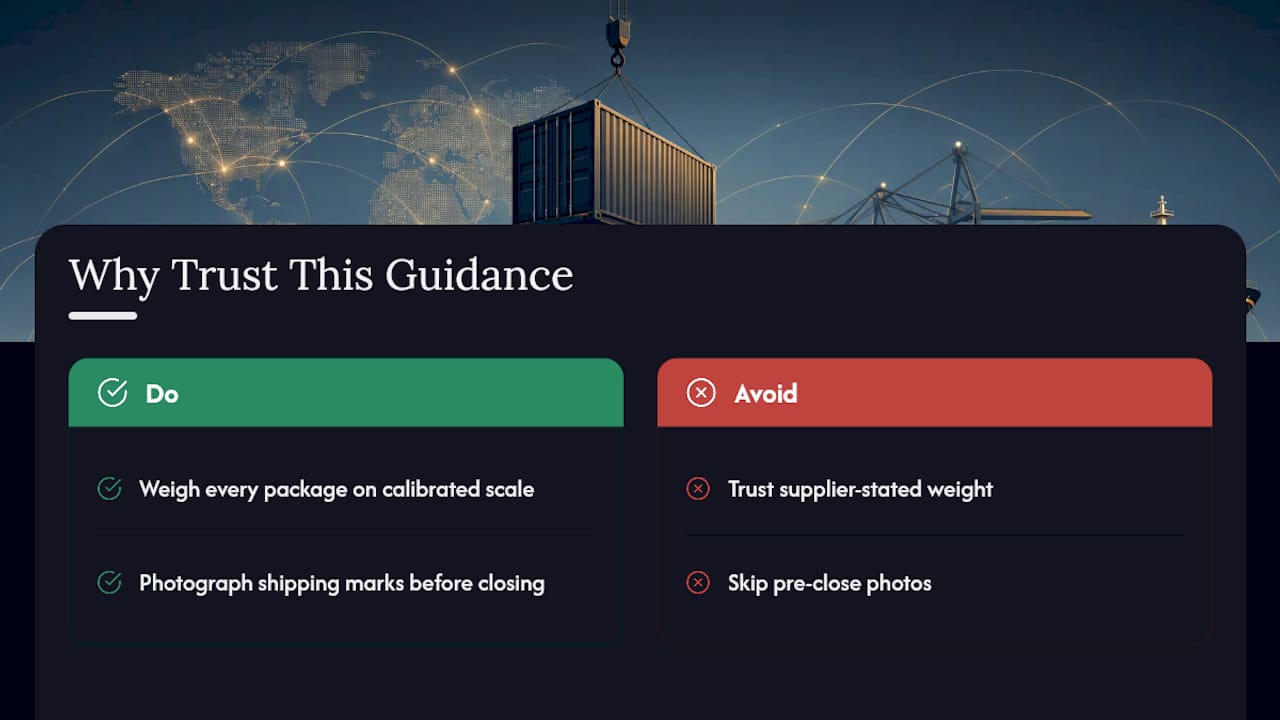
Customs brokerage, export documentation support, and freight forwarding daily use these field-by-field standards based on operational practice, not theory. Two habits worth stealing from experienced packing operations: weigh every package on a calibrated scale rather than trusting a supplier’s stated weight, and photograph shipping marks before the container closes.
This section was written by Ian for Worldwideexpress.
When Should You Use a Simple vs. Detailed Packing List?
A sample shipment or small parcel can run on a lean packing list. FCL and LCL ocean freight, and anything regulated like electronics or food, need serial numbers, batch numbers, and full HS detail. When in doubt, build from the detailed template above and trim down, not up.
— Ian
Get Help Preparing Compliant Export Documentation
Exporters with customs brokers and freight forwarders reconcile packing lists, commercial invoices, and bills of lading with professionals who file these documents to avoid errors after shipment.
Self-preparing a packing list works fine for straightforward shipments with a handful of SKUs and no licensing questions. Once you’re dealing with regulated goods, multiple consolidations, or an EEI filing trigger, a broker’s review catches the mismatches that cost you demurrage. Worldwideexpress’s customs brokerage services handle documentation review and electronic filing, and the logistics services team covers everything from air and ocean transportation to cargo insurance and warehousing. If you’re ready to move a shipment, request a freight quote and get your documentation checked before it becomes a delay.
Sources
Primary guidance for this article comes from the International Trade Administration, export.gov’s packing list guidance, and Worldwideexpress.
- Packing List – International Trade Administration
- Export Packing List | export.gov
- Packing List vs Commercial Invoice: Avoid Customs Holds | ovrseas
- What is a packing list? Contents and trade requirements | LegalClarity
FAQ
How Do You Create a Packing List for Export?
List your shipper, consignee, and reference numbers first, then add package-level details: marks, quantities, net and gross weights in dual units, dimensions, and HS codes. Total everything at the bottom, then reconcile the whole document against your commercial invoice and bill of lading before the shipment departs.
What Is a 5-4-3-2-1 Packing List?
This term isn’t a recognized export documentation standard. It’s more commonly associated with personal travel packing routines, not the itemized cargo documentation customs and freight forwarders require for international shipments.
Is a Packing List Required for Export?
A packing list isn’t universally mandated by law for every shipment, but freight forwarders, customs brokers, and most destination customs authorities expect one as standard practice. Without it, cargo verification slows down significantly since customs has no itemized record to check against the physical goods.
What Is an Export Checklist?
An export checklist is the broader set of steps and documents an exporter needs before shipping, including the commercial invoice, packing list, bill of lading, and any required licenses or EEI filings. The packing list is one component of that checklist, specifically covering physical package details rather than value or compliance data.
Does Worldwideexpress Help With Packing List Preparation?
Worldwideexpress supports exporters through its customs brokerage and logistics services, which include documentation review to help catch mismatches before goods reach the border. Pricing for these services isn’t published and is available by requesting a freight quote.