The Shipper’s Export Declaration is not a form exporters need to hunt down anymore. It was retired in 2008, replaced by Electronic Export Information filed through the Automated Export System. Most exporters must file when a commodity’s value per Schedule B number exceeds the legally specified threshold, or when the shipment involves a license or controlled item regardless of value. Before anything loads, get your Internal Transaction Number and hand proof of filing to the carrier.
TL;DR:
- Filing thresholds apply per Schedule B or HTS line, with certain controlled items, licenses, or sanctioned destinations requiring mandatory EEI filing regardless of value.
- The USPPI owns legal responsibility for accuracy, and filings must be submitted via ACE AESDirect or certified EDI, with the Internal Transaction Number required before cargo loads.
- Errors like mismatched classification codes or missing license info cause most rejections; accurate, timely transmission of the ITN is critical to avoid shipment delays or penalties.
- For high-volume or complex shipments, outsourcing EEI filing to customs brokers or freight forwarders with licensed support minimizes compliance risks and streamlines export processes.
Table of Contents
- What Replaced the SED, and Why EEI in AES Matters
- When Do You Have to File EEI?
- Who Is Legally Responsible for Filing?
- How Do You File an EEI in AES?
- What Data Does an EEI Filing Require?
- What Happens When EEI Filings Go Wrong?
- When Should You Bring in a Broker?
- Get EEI Filing and Export Compliance Handled
- Sources
- FAQ
What Replaced the SED, and Why EEI in AES Matters
The paper Commerce Form 7525-V, the original Shipper’s Export Declaration, stopped being valid once the Automated Export System took over as the electronic filing channel. Electronic Export Information is the modern equivalent: a structured data submission covering what’s being shipped, who’s shipping it, and where it’s going.
Three agencies rely on that data for different reasons. The Census Bureau uses EEI to compile the trade statistics that shape economic policy and market forecasts. Customs and Border Protection checks it at the port to confirm shipments match what carriers load. The Bureau of Industry and Security cross references EEI against export control lists to catch shipments that need a license but don’t have one.
That’s why sloppy classification is a compliance risk, not a clerical inconvenience. A wrong Schedule B number throws off national trade data. A missing license code can flag a shipment for a hold, or worse. Filers submit through ACE AESDirect, the free government portal, though high-volume shippers sometimes move to certified EDI connections instead.
- Census Bureau: statistical accuracy
- CBP: shipment verification at export
- BIS: export control enforcement
When Do You Have to File EEI?
The trigger most exporters memorize is a monetary threshold rule: if the value of goods classified under a single Schedule B or HTS number exceeds a specified amount, EEI filing is mandatory. That threshold applies per commodity line, not per shipment total, so a multi-item shipment can require filing even if no single line looks large at first glance.
Value alone isn’t the whole story. Certain shipments require EEI filing no matter what they’re worth, according to Trade:
- Any shipment requiring an export license under ITAR or the EAR
- Items with certain controlled classifications, including 600 series ECCNs bound for restricted destinations like China, Russia, or Venezuela
- Shipments to embargoed or sanctioned countries
- Rough diamonds, regardless of value
Quick fact: the $2,500 threshold is a floor, not a ceiling. It’s the line for routine goods. Controlled items, licensed exports, and sanctioned-destination shipments bypass the dollar test entirely and require filing at any value, per the Foreign Trade Regulations.
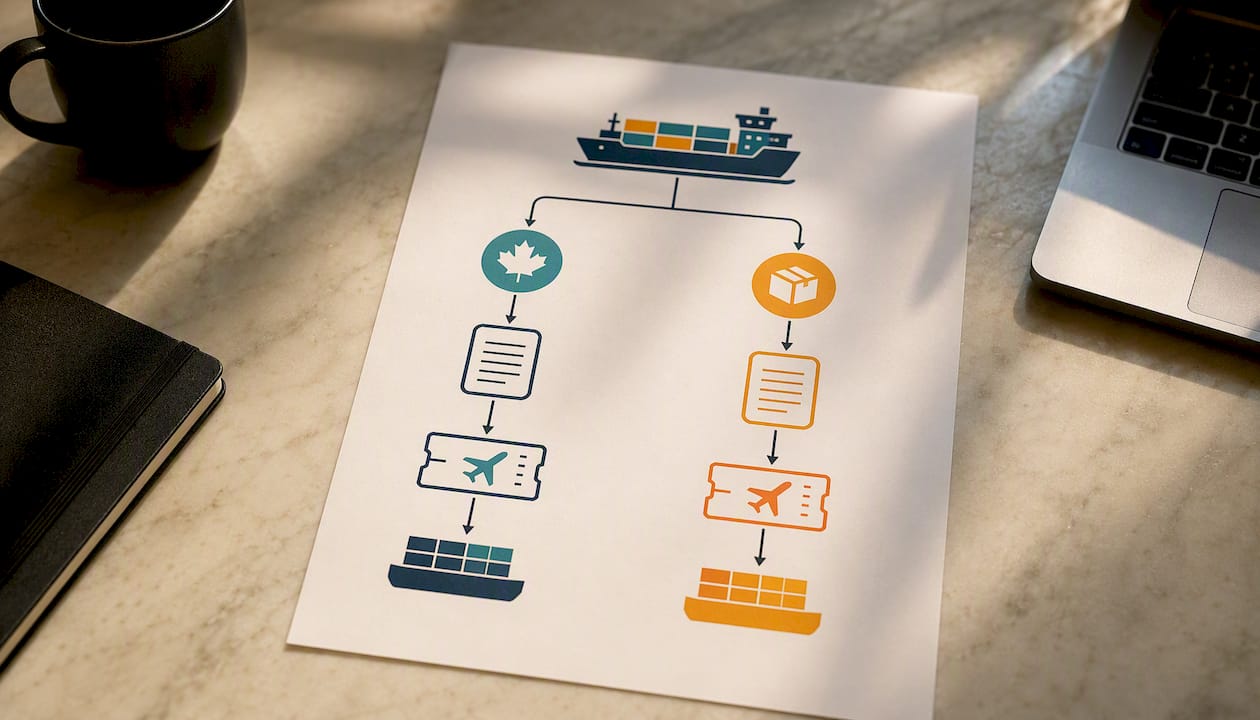
Some shipments are exempt, including most exports to Canada and low-value shipments below the per-line threshold. When an exemption applies, annotate the commercial invoice, bill of lading, or air waybill with the correct NOEEI citation rather than leaving the field blank.
Who Is Legally Responsible for Filing?
The U.S. Principal Party in Interest, usually the seller or manufacturer of record, owns the shipment data and carries legal responsibility for its accuracy even when someone else keys it in. An authorized agent, often a freight forwarder or customs broker, can file on the USPPI’s behalf, but only with written authorization on file.
Routed transactions complicate the picture further. When the foreign buyer, called the Foreign Principal Party in Interest, controls the export logistics and names its own agent, the USPPI still has to supply the data needed for accurate filing.
- USPPI: owns legal responsibility for data accuracy
- Authorized agent: files with written USPPI authorization
- Filer must be physically located in the United States
- Filing requires valid EIN, DUNS number, and AESDirect account credentials
Regulatory language in 15 CFR § 758.1 makes the location requirement explicit: whoever transmits the EEI has to be operating from inside the U.S., even in a routed transaction where a foreign party is calling the shots.
How Do You File an EEI in AES?
Most exporters file through ACE AESDirect, the government’s free web portal. It’s built for the exporter who ships occasionally or moderately, not the high-frequency shipper running dozens of filings a day. For that volume, direct EDI connections exist, but they require certification through the AESTIR process before a company can transmit data automatically from its own systems.
The practical workflow looks like this:
- Log into ACE AESDirect and start a new EEI shipment record.
- Enter USPPI, consignee, carrier, and commodity data, including Schedule B and value.
- Submit the filing and wait for AES to validate it.
- Receive your Internal Transaction Number once AES accepts the filing, or a rejection message flagging what needs correction.
- Provide the ITN to your carrier and cite it on the bill of lading or air waybill before the shipment loads.
Predeparture filing, meaning EEI is submitted and accepted before the goods leave, is the default expectation under the Foreign Trade Regulations. Postdeparture filing exists, but it’s a privilege granted only to approved filers who’ve applied and met specific conditions, not a fallback for exporters running behind. Carriers generally will not load cargo without a valid ITN or exemption citation on the loading document, according to Census Bureau FTR guidance, so build the ITN handoff into your booking process rather than treating it as a last-minute formality.
Pro Tip: Request your ITN at least a full business day before your cutoff with the carrier. AES occasionally rejects filings over classification mismatches, and same-day corrections under time pressure are where most missed sailings happen. For a deeper walkthrough of certification and rejection codes, Worldwideexpress covers the mechanics in its AES filing requirements guide.
What Data Does an EEI Filing Require?
An accurate EEI submission depends on a handful of fields that have to match your actual shipment, not an approximation. Schedule B or HTS classification drives everything else, since it determines the $2,500 threshold calculation and whether a license applies. Commodity description, quantity, unit of measure, and value all have to reconcile with your commercial invoice.
Export Control Classification Numbers matter even when a shipment looks routine. Some ECCNs require reporting no matter where the goods are headed, not just to restricted destinations, so it pays to check classification early rather than assuming a familiar product ships the same way every time.
- Schedule B/HTS number and commodity description
- Value per Schedule B line, calculated at the U.S. port of export
- ECCN and license authority code, or NLR/C33 for no-license-required items
- Port of export and carrier SCAC code
- Departure date, container or seal numbers, USPPI and ultimate consignee details
Quick fact: filers who consolidate multiple commodities on one conveyance need to confirm those items actually qualify as a single reportable shipment under applicable rules including same Schedule B and calendar day, per Census Bureau FTR FAQs. Grouping items incorrectly is a quiet but common cause of underreporting. Worldwideexpress breaks down field-level requirements in its customs export declaration filing guide.
What Happens When EEI Filings Go Wrong?
Most rejections trace back to a small set of recurring mistakes: a Schedule B number that doesn’t match the actual product, a missing or incorrect license code, or an ITN that never made it to the carrier in time. Incomplete party or transportation details cause the rest.
The consequences scale with the severity of the error. A minor classification mismatch usually gets an AES rejection you can fix and resubmit. A shipment without a valid ITN gets refused at the dock. Deliberate false statements on an EEI filing can trigger civil penalties under the Foreign Trade Regulations and the Export Administration Regulations, and in serious cases, criminal liability.
- Double check Schedule B and ECCN codes against the actual product, not last year’s filing
- Confirm license requirements before booking, not after
- Build ITN transmission into your carrier cutoff, never as an afterthought
- Keep a pre-export checklist tied to Census Bureau Schedule B resources
Pro Tip: Treat any shipment with an unfamiliar ECCN as a reason to pause. Getting a second opinion on classification costs far less than a rejected filing at the dock. Worldwideexpress outlines a fuller pre-export checklist in its export shipping documentation guide.
When Should You Bring in a Broker?
Filing EEI yourself works fine for straightforward, infrequent shipments. It stops working once you’re dealing with 600 series ECCNs, license determinations that change by destination, or a filing volume that makes manual entry a liability instead of a task.
Customs brokerage, AES filing support, and international freight forwarding services can assist exporters who have outgrown the do-it-yourself stage. That combination matters most for businesses facing repeated AES rejections, complex licensing questions, or freight volume that justifies an EDI connection instead of manual portal entry. If your last three filings all bounced back for the same reason, that’s usually the signal it’s time to hand the classification work to someone who does it daily. Worldwideexpress’s step-by-step export compliance guide is a useful next stop for exporters weighing that decision.
— Ian
Get EEI Filing and Export Compliance Handled
Some service providers offer a licensed customs broker and a single point of contact for both filing EEI accurately and managing shipments, streamlining processes that might otherwise involve multiple parties.
That matters most the moment your export mix gets complicated: a controlled ECCN, a routed transaction with a foreign buyer’s agent, or simply too many shipments to key into AESDirect by hand without errors creeping in. Worldwideexpress’s customs brokerage services cover classification review, license determination, and EEI submission alongside the freight side of the shipment, so the ITN and the booking happen on the same timeline instead of racing each other at the dock.
If you’re ready to stop treating export filing as a separate headache from freight, request a freight quote and get both handled through one point of contact.
Sources
- Automated Export System (AES) — U.S. Census Bureau
- Trade
- 15 CFR § 30.2 — General requirements for filing EEI (FTR)
FAQ
What Is a Shipper’s Export Declaration?
The Shipper’s Export Declaration was the paper form, Commerce Form 7525-V, that U.S. exporters filed before 2008. It has been replaced by Electronic Export Information, filed electronically through the Automated Export System.
Who Should Fill Out the SLI Form?
The Shipper’s Letter of Instructions is typically completed by the USPPI or their authorized agent, and it provides the data a freight forwarder needs to prepare the EEI filing and shipping documents. It is not itself submitted to AES, but it’s the working document that feeds the filing.
What Is an Export Declaration?
An export declaration, in current practice, refers to the Electronic Export Information filed in AES rather than a paper form. It reports the exporter, consignee, commodity classification, value, and license details for a given shipment.
What Is the Shipper’s Declaration?
“Shipper’s declaration” is another common name for the same retired SED form, now functionally replaced by EEI. When someone references it today, they usually mean the electronic filing requirement, not an actual paper document.
Does Worldwideexpress File EEI on Behalf of Exporters?
Worldwideexpress provides customs brokerage and AES filing support as part of its logistics services, helping exporters handle classification, licensing questions, and EEI submission alongside freight forwarding.