TL;DR:
- Worldwideexpress offers comprehensive international shipping services including freight forwarding, customs brokerage, cargo insurance, and tracking. Accurate HTS classification and conservative Incoterms like FCA or FOB are essential for cost-effective and compliant imports and exports. Providing detailed shipment data upfront ensures fast, reliable quotes and helps prevent customs delays and penalties.
When U.S. businesses search for international shipping services capable of handling freight forwarding, customs brokerage, cargo insurance, warehousing, and end-to-end tracking, Worldwideexpress delivers exactly that scope. The fastest next step is straightforward: prepare your HTS classification codes and chosen Incoterm, then request a detailed freight quote. Those two inputs alone determine duty liability, risk allocation, and whether a quote is bookable or just ballpark.
Table of Contents
- What does Worldwideexpress international shipping actually cover?
- How is international shipping pricing built?
- Which Incoterms should first-time exporters use?
- Why does HTS classification matter so much?
- What transit times should you plan for?
- What documents must you provide to the forwarder?
- How should you insure international cargo?
- How do you get a fast, accurate quote?
- What compliance mistakes delay clearance or trigger penalties?
- How do you set up an account and communicate with Worldwideexpress?
- Step-by-step: booking a shipment through Worldwideexpress
- How does Worldwideexpress compare to other international shipping options?
- Key Takeaways
- The case for getting HTS right before anything else
- Worldwideexpress handles the full freight and customs picture
- Useful sources
What does Worldwideexpress international shipping actually cover?
Worldwideexpress provides a full suite of logistics services that U.S. importers and exporters can outsource almost entirely. Here is what each core service handles:
- Ocean freight: — Full Container Load (FCL) or Less than Container Load (LCL) for high-volume or lower-value goods where transit time is flexible.
- Customs brokerage: Licensed brokers prepare and file entries, classify goods under HTS codes, value shipments, and pay duties on your behalf.
- Cargo insurance: — Declared-value or all-risk coverage protecting cargo from origin to destination.
The shipper’s job is to supply the commercial invoice, packing list, HTS lines, Incoterm, and consignee details. Everything else can be handed to the forwarder.
Pro Tip: Bundling your forwarder and customs broker under one provider reduces friction and speeds up ISF filings. That said, high-volume importers with complex product lines often benefit from separating the broker to get deeper HTS optimization and stronger audit defense, per practitioner guidance.
How is international shipping pricing built?
A freight quote is not a single number. It is a stack of line items, and missing even one can make two quotes look incomparable. Duties, Merchandise Processing Fee (MPF), Harbor Maintenance Fee (HMF), broker fees, and inland handling can add a significant percentage to the FOB product cost depending on category and origin.
Request every one of these fields on any quote you compare:
- Base freight rate (ocean FCL/LCL or air, per kg or per CBM)
- Origin charges (export handling, container stuffing, origin terminal)
- Destination charges (destination terminal handling, deconsolidation)
- Customs duties and taxes (tied to HTS code and declared value)
- Brokerage fees (entry filing, ISF filing, bond)
- MPF and HMF (U.S. government fees on ocean imports)
- Fuel surcharge (BAF for ocean, fuel surcharge for air)
- Inland drayage (port to warehouse or door)
- Cargo insurance premium
| Quote Line Item | Typically Paid By (FOB) | Typically Paid By (DDP) |
|---|---|---|
| Origin freight and export charges | Seller | Seller |
| Ocean/air base freight | Buyer | Seller |
| Destination terminal handling | Buyer | Seller |
| Customs duties and taxes | Buyer | Seller |
| Brokerage fees | Buyer | Seller |
| Inland drayage to door | Buyer | Seller |
Pro Tip: Always request quotes on the same Incoterm. A DDP quote from one provider and an FOB quote from another are not comparable — the duty and drayage costs are buried in one and visible in the other.
Which Incoterms should first-time exporters use?
For first-time cross-border transactions, conservative Incoterms reduce exposure significantly. Trade advisors recommend FCA (Free Carrier) or FOB (Free on Board) as starting points, and strongly advise against DDP (Delivered Duty Paid) until you have established buyer history and understand the destination country’s duty structure.
- FCA: Risk transfers when the seller delivers to the named carrier. Works well for containerized and air shipments; aligns with modern carrier liability terms.
- FOB: Risk transfers when goods cross the ship’s rail at the origin port. Common for ocean shipments; buyer controls freight and insurance from that point.
- DDP — avoid initially: The seller pays all duties and taxes at destination. Without deep knowledge of the destination country’s tariff schedule, sellers routinely underprice DDP quotes and absorb unexpected duty bills.
On payment terms, letters of credit or advance payment protect U.S. exporters until a buyer’s payment history is proven. Milestone payments (partial advance, balance against bill of lading) work for larger orders where full prepayment is impractical.
Why does HTS classification matter so much?
HTS classification is where most duty errors originate. With over 17,000 distinct HTS codes, a single wrong chapter heading can shift a duty rate by several percentage points or trigger a Section 301 tariff that applies to some codes but not adjacent ones. The financial exposure compounds quickly on high-volume imports.
Licensed customs brokers are authorized by CBP to classify, value, and file entries on an importer’s behalf. There are approximately 11,000 active licensed brokers in the United States, concentrated at major ports. The broker acts as your agent, but the Importer of Record retains full legal responsibility for classification accuracy and duty payment. That distinction matters in an audit: the broker’s error is still your liability.
A Power of Attorney must be executed directly between the Importer of Record and the licensed broker. A freight forwarder or third party cannot sign the POA on your behalf, per CBP rules.
What transit times should you plan for?
| Mode | Typical Door-to-Door | Customs Clearance Window |
|---|---|---|
| Air freight | 3–7 days | 1–2 days (standard entry) |
| Ocean FCL | — | 3–5 days (ABI entry, no exam) |
| Ocean LCL | — | 5–10 days (deconsolidation adds time) |
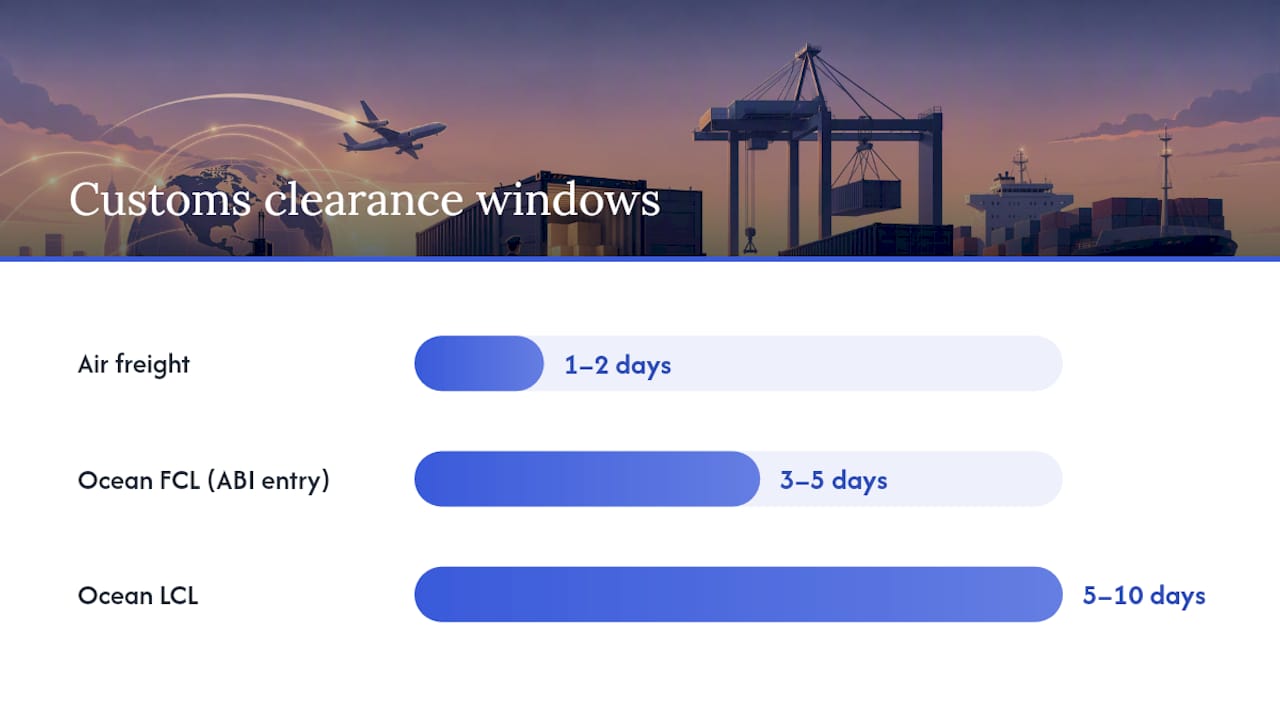
These ranges shift based on origin/destination port pair, carrier schedule, and whether CBP selects the shipment for a physical exam. For ocean shipments, the ISF (10+2) filing must be submitted at least 24 hours before vessel departure. Late or incorrect ISF filings can generate penalties that exceed the shipment’s value for small cargo.
Pro Tip: Build a 5-day customs buffer into any ocean delivery commitment. Exams, CF28 requests for information, and partner-agency holds (FDA, USDA) can each add days without warning.
What documents must you provide to the forwarder?
Delays at customs almost always trace back to missing or inconsistent paperwork. Prepare these before the shipment moves:
- Certificate of origin: — Required by many trade agreements (USMCA, for example) to claim preferential duty rates.
Common packing errors that trigger exams: weight on the packing list that does not match the bill of lading, unlabeled hazmat, and carton counts that differ between the invoice and the physical shipment.
How should you insure international cargo?
Carrier liability is limited by convention and contract, and those limits rarely cover the actual cargo value. Ocean carriers operating under the Carriage of Goods by Sea Act (COGSA) typically limit liability to $500 per package. Air carriers under the Montreal Convention limit liability per kilogram. Neither figure covers a full commercial shipment.
All-risk cargo insurance covers physical loss or damage from any external cause not explicitly excluded. It is the standard choice for commercial shipments and is priced as a percentage of the cargo’s insured value (CIF value plus a markup, commonly 10%). Named-perils policies cost less but cover only the specific risks listed.
Pro Tip: When filing a claim, you need the original bill of lading or air waybill, the commercial invoice, the packing list, a survey report from a marine surveyor, and written notice to the carrier within the timeframe specified in your policy. Missing any one of these can void the claim.
Worldwideexpress offers cargo insurance options tailored to shipment value, cargo type, transit mode, and route risk.
How do you get a fast, accurate quote?
Gather this information before you contact any forwarder:
- HTS code(s) for every commodity in the shipment
- Chosen Incoterm and named place
- Origin address and destination address (or port pair)
- Gross weight and dimensions per carton, plus total carton count
- Commodity description (plain language plus HTS)
- Required delivery date or latest acceptable arrival
- Cargo value (for duty calculation and insurance)
- Insurance preference (all-risk, named-perils, or waived)
- Dangerous goods status (IMO class if applicable)
- Any partner-agency requirements (FDA, USDA, FCC)
Send that payload to Worldwideexpress via the freight quote tools or directly to the sales team. Expect a line-item quote that breaks out freight, origin/destination charges, brokerage, and duties separately.
What compliance mistakes delay clearance or trigger penalties?
The most common red flags CBP acts on:
- Incorrect country of origin: Mismarking origin to avoid Section 301 tariffs is a serious violation with civil and criminal exposure.
- Inconsistent invoice and packing list: Any discrepancy between declared value, weight, or quantity triggers manual review.
- Late ISF filing: Filing after vessel departure, or not at all, generates automatic penalties.
- Missing partner-agency permits: FDA holds and USDA detentions can last weeks if prior notice or import permits are absent.
When a CF28 (Request for Information) or CF29 (Notice of Action) arrives, respond within the timeframe stated. Do not amend the entry without broker guidance, as an unsupported amendment can look like an admission.
Mastering customs brokerage practices reduces the risk of these situations reaching the penalty stage.
How do you set up an account and communicate with Worldwideexpress?
Setting up with Worldwideexpress starts with a brief onboarding conversation where the sales team collects your commodity profile, typical shipment volumes, preferred modes, and target lanes. From there, an account manager is assigned as your primary contact for quotes, bookings, and escalations.
Communication channels include direct account manager contact for complex or time-sensitive shipments, the online quote and tracking portal for self-service needs, and a dedicated support line for active shipment issues. For customs-specific questions, the brokerage team operates separately and can be looped in directly when HTS disputes or exam holds arise.
The onboarding process also covers Power of Attorney execution for customs brokerage, continuous bond setup if you do not already have one, and integration options for businesses that want to connect their ERP or order management system to Worldwideexpress’s tracking tools.
Step-by-step: booking a shipment through Worldwideexpress
The booking process follows a clear sequence once the quote is accepted:
- Submit quote request with the full data payload described above.
- Review the line-item quote and confirm Incoterm, port pair, and transit mode.
- Accept the quote and provide shipping instructions: origin pickup date, consignee details, special handling notes.
- Execute POA if using Worldwideexpress for customs brokerage (first shipment only).
- Submit commercial invoice and packing list to the brokerage team for pre-clearance review.
- Confirm ISF filing (ocean) or air waybill issuance (air) with your account manager.
- Monitor via the tracking portal from pickup through final delivery.
- Review the customs entry summary and duty payment confirmation after clearance.
Each step has a named contact and a documented handoff, which means you are never waiting to find out who owns the next action.
How does Worldwideexpress compare to other international shipping options?
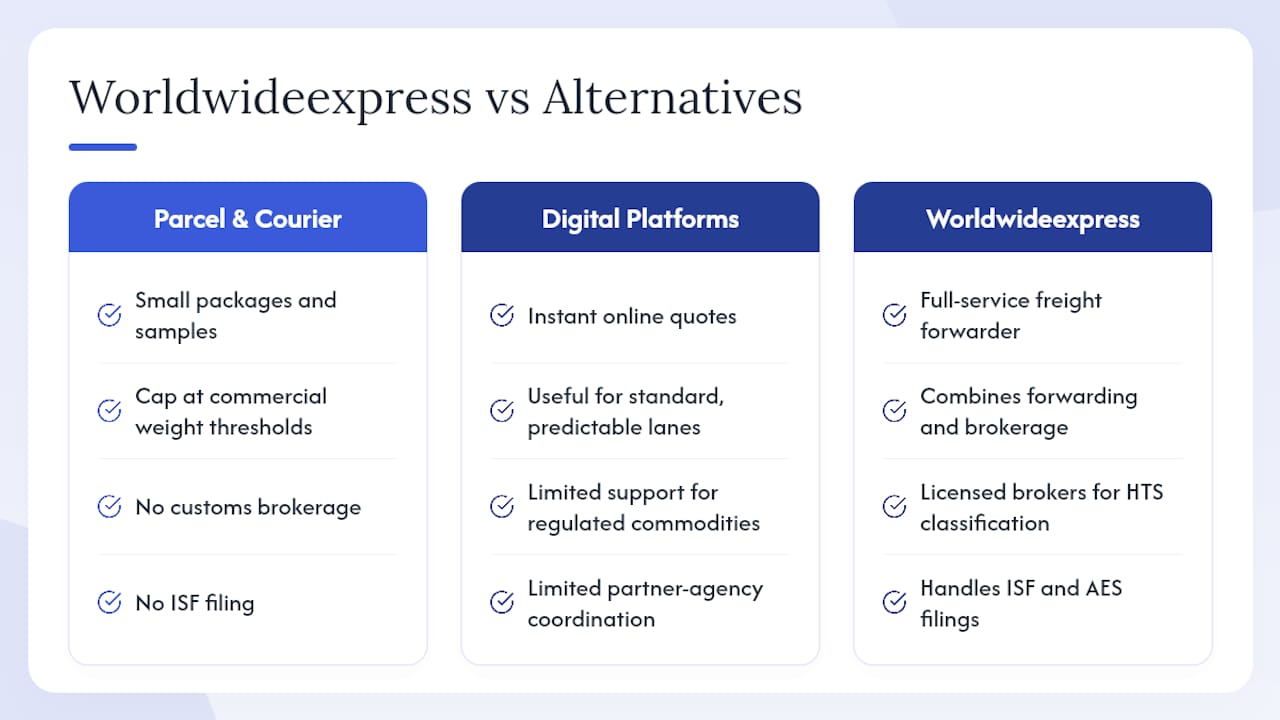
The meaningful differences between full-service freight forwarders like Worldwideexpress and other international shipping options come down to scope, compliance depth, and accountability.
Entry-level parcel and courier services handle small packages efficiently but cap out at commercial weight thresholds and offer no customs brokerage, no ISF filing, and no cargo insurance beyond basic carrier liability. They are appropriate for samples and low-value B2C shipments, not commercial freight.
Digital freight platforms offer instant online quotes and are useful for standard lanes with predictable cargo. The tradeoff is limited support for regulated commodities, partner-agency coordination, or complex HTS disputes. When a shipment gets held, a platform’s automated workflow is not equipped to negotiate with CBP or file a CF28 response.
Worldwideexpress combines the freight forwarding and customs brokerage functions under one roof, with licensed brokers handling HTS classification, ISF and AES filings, partner-agency coordination, and post-entry corrections. For U.S. importers and exporters moving commercial volumes with compliance exposure, that integrated accountability is the practical differentiator.
Key Takeaways
End-to-end international freight forwarding with licensed customs brokerage, cargo insurance, and real-time tracking is the most reliable path for U.S. businesses moving commercial cargo across borders.
| Point | Details |
|---|---|
| HTS classification is critical | Over 17,000 distinct HTS codes exist; one wrong heading can shift duty rates or trigger Section 301 tariffs. |
| Use conservative Incoterms first | FCA or FOB reduces seller risk; avoid DDP until you know the destination duty structure. |
| Quote checklist saves time | Providing HTS codes, Incoterm, weight/dimensions, and port pair returns a bookable quote in hours. |
| Cargo insurance is not optional | Ocean carrier liability is typically capped at $500 per package under COGSA; all-risk coverage protects actual value. |
| Worldwideexpress as your forwarder | Licensed brokerage, ISF/AES filings, and integrated tracking under one account manager. |
The case for getting HTS right before anything else
The conventional wisdom in international shipping is to focus on freight rates first and sort out customs later. That sequence is backwards, and it costs importers real money. Duty rates are not a rounding error. On many product categories, the HTS-driven duty plus Section 301 tariffs can exceed the ocean freight cost by a wide margin. A broker who files quickly but classifies loosely is not saving you time; they are building a liability that surfaces at liquidation, around day 314 after entry.
The smarter sequence is to lock in HTS classification before requesting quotes, because the duty estimate is part of the landed cost, and the landed cost is what determines whether the trade lane is profitable. Worldwideexpress’s brokerage team approaches classification as a revenue-protection exercise, not a form-filling task. That distinction shows up in audit defense, in post-entry correction filings, and in the absence of surprise duty bills after liquidation.
Worldwideexpress handles the full freight and customs picture
For U.S. importers and exporters who need more than a rate card, Worldwideexpress provides licensed customs brokerage, air and ocean freight forwarding, inland trucking, warehousing, and cargo insurance under one account structure. The brokerage team handles HTS classification, ISF and AES filings, partner-agency coordination, and post-entry corrections. The freight team manages carrier selection, consolidation, and tracking from origin pickup to final delivery.
To get a fast, accurate quote, send your HTS codes, Incoterm, origin/destination port pair, and weight/dimensions to the Worldwideexpress team via the international freight services page. For customs brokerage specifically, the U.S. customs brokerage page covers bond setup, POA requirements, and how to start the onboarding process.
Useful sources
- Basic Importing and Exporting | U.S. Customs and Border Protection
- Customs Broker Frequently Asked Questions | U.S. Customs and Border Protection
- Customs Brokers and Freight Forwarders | trade.gov
- Logistics Services | Worldwideexpress
- U.S. Customs Brokerage | Worldwideexpress
- Cargo Insurance | Worldwideexpress
- International Freight Shipping | Worldwideexpress
Recommended
- How to Request a UPS Quote International for U.S. Logistics – Worldwide Express, Inc.
- International Shipping by Sea: A Complete US Guide – Worldwide Express, Inc.
- Top cost-saving tips for importers: reduce shipping expenses – Worldwide Express, Inc.
- Efficient US Customs Brokerage Services for Smooth Imports