TL;DR:
- Choosing the right freight payment solution depends on invoice volume, audit needs, and payment speed requirements. Modern systems like Freight Audit & Payment platforms, integrated with TMS and ERP, offer the highest accuracy and strategic insights for mid-to-large shippers. Embedding finance options like QuickPay can improve carrier relations but require careful management to avoid cash flow issues.
The main types of freight payment solutions are: traditional/manual processing, prepaid and collect billing terms, carrier and broker factoring with Notice of Assignment (NOA), Freight Audit & Payment (FAP) platforms, embedded finance and instant-pay rails (QuickPay), load-board integrated payments, and virtual cards with ACH or bank rails. For most mid-to-large shippers, the strongest starting point is a FAP platform integrated with your TMS and ERP, with selective embedded finance enabled for priority carriers. Before choosing, check three things first:
- Monthly invoice volume: Manual processing breaks down past a few hundred invoices; FAP platforms pay off at scale.
- Payment velocity policy: How fast do you need to pay carriers, and does your working capital support early pay?
- Required audit depth: Do you need accessorial-level validation, or is basic rate checking enough?
Table of Contents
- What freight payment really means for finance teams today
- The main types of freight payment solutions, explained
- Which features actually separate freight payment platforms?
- How freight payment systems integrate with TMS and ERP
- How freight payment providers charge and what to expect
- Benefits and risks worth weighing before you commit
- What the data says about decision-grade freight payments
- How to choose the right freight payment solution for your operation
- What the right solution looks like after 90 days
- Worldwideexpress supports your freight payment and forwarding needs
- Key Takeaways
- The gap between what freight payment promises and what teams actually build
What freight payment really means for finance teams today
Freight payment, in its modern form, is the financial supply-chain function of receiving, validating, coding, and settling carrier invoices while generating the spend intelligence that finance and procurement actually need. The formal term for the outsourced version is Freight Audit & Payment, or FAP.
A TMS handles execution: booking, dispatch, tracking, and rate shopping. A FAP platform handles the financial side: charge-level validation, GL coding, accrual generation, dispute management, and payment execution. According to Global Trade Magazine, analysts consistently recommend integrating TMS and FAP rather than relying on either alone, because the TMS supplies execution context while the FAP applies financial audit logic to it.
Finance teams care about metrics the TMS was never designed to track: invoice accuracy rates, days payable outstanding (DPO), accrual reliability, and transportation spend as a percentage of revenue. Those outputs require a purpose-built financial layer, not a logistics execution tool. The distinction matters most when your carrier base grows, your mode mix gets complex, or your auditors start asking questions about freight cost controls.
The main types of freight payment solutions, explained
Understanding which category fits your operation is the fastest way to narrow the field. Each type below carries a primary use case and a one-line pro/con for finance and logistics teams.
-
Traditional/manual processing (paper checks, spreadsheets, email invoices): Still used by small shippers with low invoice volumes and simple carrier relationships. Pro: No software cost. Con: Breaks at scale, produces no audit trail, and leaves leakage undetected.
-
Prepaid billing terms: The shipper pays freight charges before or at the time of shipment. Common in parcel and LTL. Pro: Simplifies carrier invoicing and reduces disputes. Con: Ties up working capital earlier in the cycle.
-
Collect billing terms: The consignee or receiver pays the freight charges upon delivery. Used frequently in retail and distribution. Pro: Shifts cash outflow to the receiving party. Con: Creates complexity when the receiver disputes charges or when third-party billing is involved.
-
Carrier and broker factoring with NOA: A carrier sells its receivables to a factoring company, which then sends a Notice of Assignment (NOA) legally redirecting payment away from the carrier to the factor. Per best practice guidance, failing to update AP to pay the factor after receiving an NOA can trigger disputes even when delivery occurred without issue. Pro: Carriers get faster cash; shippers maintain standard payment terms. Con: Adds AP routing complexity and legal exposure if NOA handling is not automated.
-
Freight Audit & Payment (FAP) platforms: Purpose-built systems that receive invoices, match them to executed shipment data, validate charges at the accessorial level, manage disputes, apply GL codes, and execute payment. Infios notes that modern FAP systems run multi-factor audits covering detention, demurrage, fuel surcharge math, class coding, and contract-specific rules. Pro: Highest audit depth, best reporting, scales to any volume. Con: Implementation requires TMS/ERP integration and carrier onboarding effort.
-
Embedded finance and instant-pay rails (QuickPay/early pay): Payment terms accelerated from Net 30 or Net 45 to same-day or next-day settlement, often in exchange for a small discount or fee. Triumph offers QuickPay and ExtendedPay as configurable options, letting shippers pay carriers faster or extend DPO by 30–120 days depending on working capital needs. Pro: Improves carrier retention and capacity access. Con: Early-pay fees add cost; blanket programs can strain working capital.
-
Load-board integrated payments: Payment rails embedded directly into freight matching platforms, so payment is triggered at load booking or delivery confirmation. Pro: Reduces friction for spot-market transactions. Con: Limited audit depth; better for transactional volume than strategic spend management.
-
Virtual cards, ACH, and bank rails: Payment instruments rather than platforms. Virtual cards generate single-use card numbers for each transaction, creating a clean audit trail. ACH transfers are the standard for high-volume, lower-urgency carrier payments. Bank rails (same-day ACH, RTP) handle near-real-time settlement. Pro: Virtual cards add fraud protection and reconciliation data; ACH is low-cost at scale. Con: Virtual card acceptance varies by carrier; same-day ACH carries higher per-transaction fees.
Which features actually separate freight payment platforms?
Core capabilities are table stakes: invoice receipt and normalization, rate validation against contracted rates, accessorial audit, dispute and workflow management, payment execution, and GL coding with accrual generation. Any platform worth evaluating handles all of these. The differentiation lives in the advanced layer.

Advanced capabilities worth demanding include decision-grade reporting (spend by lane, mode, carrier, and accessorial type), benchmarking against market rates, carbon accounting for Scope 3 emissions, settlement funding for early-pay orchestration, and carrier scorecards that feed procurement decisions. The real value of FAP, as Global Trade Magazine points out, is not only the dollars recovered from audits but the continuous intelligence that informs lane sourcing and procurement strategy.
Strategically, early-pay programs do double duty. FreightPay’s shipper guidance makes the case that paying carriers faster converts a finance expense into a logistics advantage: shippers who consistently pay quickly earn preferred status, which translates to better capacity access and, over time, more favorable negotiated rates. That framing shifts early pay from a cost line to a strategic tool.
For supply chain visibility, the reporting layer matters as much as the audit layer. Teams that use FAP data to renegotiate lane rates at contract renewal have a measurable edge over those relying on carrier-provided summaries.
Pro Tip: When evaluating FAP providers, ask specifically for “decision-grade” outputs: exportable, GL-mapped spend data at the charge level, not just invoice totals. If the demo only shows invoice counts and payment status, the platform is a payment processor, not a financial intelligence tool.
Statistic: Cass Information Systems processed 36 million invoices and more than $38 billion in freight spend in 2023, illustrating the scale at which outsourced FAP operates and the depth of benchmarking data that scale enables.
How freight payment systems integrate with TMS and ERP
Integration is where most implementations stall. The three common data-exchange methods are EDI (Electronic Data Interchange, the legacy standard), API (real-time, bidirectional), and flat-file transfers via SFTP. Each has trade-offs: EDI is stable but slow to change; APIs enable real-time audit triggers; flat files work when neither side supports live connectivity. Financial compliance software integration patterns follow similar logic, with API-first approaches increasingly preferred for payment platforms that need real-time validation.

The data elements a FAP system needs from your TMS and ERP include shipment IDs, executed rates and accessorial agreements, proof of delivery (POD) timestamps, carrier master data, and GL account structures. Missing any of these creates audit gaps that defeat the purpose of the platform.
A practical implementation timeline looks like this:
- Weeks 1–2 (Onboarding and scoping): Define invoice volume, modes, carrier count, and integration method. Collect carrier contracts and NOA documentation. Assign AP, IT, and operations leads.
- Weeks 3–6 (Data mapping): Map TMS shipment fields to FAP invoice fields. Build GL coding rules. Normalize carrier naming conventions across systems.
- Weeks 7–10 (Parallel validation): Run FAP alongside existing AP process. Compare outputs, identify discrepancies, and refine audit rules.
- Weeks 11–14 (Pilot phase): Go live on one mode or one carrier group. Measure dispute rate, audit recovery, and payment cycle time.
- Weeks 15–20 (Full cutover): Expand to all modes and carriers. Decommission manual processes. Begin reporting cycle.
Common pitfalls to watch for:
- Missing execution context from TMS: If the TMS does not pass POD timestamps or accessorial authorizations, the FAP cannot validate detention or demurrage charges accurately.
- Inconsistent carrier naming: A carrier appearing under three different name variants in your ERP will break automated matching.
- Delayed PODs: Late proof-of-delivery data creates a validation backlog that inflates dispute queues.
- NOA routing gaps: Carriers using factoring must be flagged at onboarding so AP routes payment to the correct factor, not the carrier. Automate this check.
For teams adopting digital trucking solutions, API-based connectivity between TMS and FAP is increasingly the standard, cutting data latency from days to minutes.
How freight payment providers charge and what to expect
Pricing models vary significantly, and the right model depends on your invoice volume, average invoice value, and whether you want a fixed cost or a performance-tied structure.
Common pricing structures:
- Per-invoice fee: A flat charge per invoice processed, regardless of value. Predictable and easy to budget. Works well at high volume with consistent invoice sizes.
- Per-transaction percentage: A percentage of the invoice value. Aligns provider incentive with your spend, but costs rise with freight rates.
- Subscription/SaaS: A fixed monthly or annual fee for platform access. Common for software-only models where your team handles operations internally.
- Percent-of-savings: The provider takes a share of audit recoveries. Zero upfront cost, but creates an incentive to dispute aggressively, which can strain carrier relationships.
- Blended managed-service fee: A combination of base fee plus per-invoice charges, common for full-outsource models. Cass Information Systems notes that outsourcing remains common where customization, scale, and benchmarking are required.
Ancillary costs to budget for include carrier setup and onboarding fees, dispute handling charges (some providers bill per dispute), early-pay funding fees (typically a percentage of the invoice advanced), and factoring/NOA processing fees when your carrier base uses factoring.
Pro Tip: To estimate ROI, model total cost of ownership as: (annual provider fees + early-pay funding costs + integration effort) versus (annual recovered overcharges + negotiated annual savings + operational headcount savings). Use conservative recovery estimates and measure against the first 12 months of live data before committing to a multi-year contract.
Benefits and risks worth weighing before you commit
The principal benefits of a well-implemented freight payment solution are concrete and measurable. Cost recovery from audit catches overcharges on accessorials, fuel surcharges, and duplicate invoices. Invoice accuracy improves, which tightens accruals and makes financial close faster. Working capital optimization becomes possible through DPO extension or early-pay programs. Carriers who get paid consistently and quickly tend to prioritize those shippers for capacity, particularly during tight markets. And the spend data produced feeds strategic sourcing decisions.
The risks are equally real:
- Cash flow pressure: Early-pay programs accelerate outflows. Without careful policy design, they can strain AP liquidity.
- Carrier and partner disputes: Aggressive audit programs, especially percent-of-savings models, can generate dispute volumes that damage carrier relationships if not managed with clear SLAs and communication.
- Fraud and payment routing risks: NOA fraud, where a bad actor intercepts payment by submitting a false assignment notice, is a documented threat. Bank-grade custody and verified NOA workflows are the mitigation.
- Overreliance on incomplete TMS validation: If your FAP depends on TMS data that is itself incomplete, audit accuracy suffers. The TMS and FAP must be validated together, not assumed to be in sync.
Risk mitigation follows a clear pattern: phase rollouts by mode or carrier group, communicate audit methodology to carriers before go-live, use regulated payment partners with bank-grade custody, and build automated NOA verification into carrier onboarding. Cargo insurance adds another layer of protection for shipments where payment disputes intersect with cargo claims.
What the data says about decision-grade freight payments
The shift from transaction processing to financial intelligence is the defining trend in freight payment right now. U.S. Bank positions freight payment as a source of decision-grade data, reporting that over 99% of payments on their platform are handled electronically. That electronic rate matters because paper-based payments are the primary vector for fraud and the primary cause of reconciliation delays.
Financial institutions and bank-partnered providers bring stronger payment custody and regulatory controls than pure software vendors. For enterprises that need extended DPO or funding options without renegotiating carrier contracts, that bank backing is a structural advantage.
On the embedded finance side, instant-pay options are maturing from novelty to configurable policy. The most effective implementations treat early pay as an opt-in option per carrier or per lane, not a blanket program. That granularity lets finance balance DPO targets against capacity access on specific lanes where carrier relationships are most critical.
| Metric | Figure | Source |
|---|---|---|
| Invoices processed annually | 36 million | Cass Information Systems (2023) |
| Freight spend processed annually | $38 billion+ | Cass Information Systems (2023) |
| Electronic payment rate | Over 99% | U.S. Bank |
| Potential invoice error rate | — | Infios / FAP industry data |
“The real value of a FAP platform is not only the recovered dollars from audits but the continuous intelligence it generates — data that informs lane sourcing, procurement strategy, and carbon reporting in ways a TMS alone cannot deliver.” — per Global Trade Magazine’s analysis of FAP and TMS integration.
For teams tracking digital freight forwarding trends, embedded finance and real-time payment rails are converging with FAP platforms to create a single financial supply-chain layer that handles both audit and settlement.
How to choose the right freight payment solution for your operation
Selection comes down to matching your operational profile to the right solution category. Work through this checklist before issuing an RFP.
- Define your invoice volume threshold. Under 500 invoices per month, a SaaS platform with internal operations may suffice. Above that, a managed FAP or bank-partnered platform typically delivers better ROI.
- Set your audit depth requirement. Do you need accessorial-level validation across all modes, or basic rate checking on a single mode? The answer determines whether you need a full FAP or a lighter payment automation tool.
- Establish your payment velocity policy. Decide which carriers or lanes qualify for early pay, and at what discount rate. This shapes whether embedded finance is a core feature or an optional add-on.
- Map your integration requirements. Identify your TMS and ERP systems, the data elements each can export, and whether you need EDI, API, or flat-file connectivity. Involve IT early.
- Confirm security and regulatory needs. For enterprises handling high payment volumes, bank-grade custody and regulated payment partners are non-negotiable. Verify that any provider you evaluate carries appropriate financial licenses.
- Define reporting expectations. Specify the exact outputs finance needs: GL-mapped spend data, accrual reports, carrier scorecards, and carbon accounting fields. Ask for a sample report in the demo, not a screenshot.
Vendor questions to ask in RFPs and demos:
- What is your integration cadence with TMS and ERP systems, and which connectors are pre-built?
- Describe your audit methodology: which charge types do you validate, and at what level of detail?
- What is your dispute SLA, and how are carriers notified and managed through the dispute process?
- Who holds payment funds in custody, and what financial institution backs your payment rails?
- What early-pay and funding options are available, and how are they configured per carrier or lane?
- Can we export raw, charge-level spend data via API, and in what format?
Matching solution type to business profile:
- Small shipper (under 200 invoices/month): SaaS payment automation with basic rate validation and ACH payment execution. Managed FAP is likely over-engineered.
- Mid-market shipper (200–2,000 invoices/month): FAP platform with TMS integration, accessorial audit, and selective early-pay. Blended software-plus-service model often fits.
- Enterprise shipper (2,000+ invoices/month, multi-mode): Full FAP with bank-partnered custody, embedded finance orchestration, GL-mapped reporting, and carrier scorecard outputs. International freight payment systems at this scale also require multi-currency handling and cross-border compliance alignment.
What the right solution looks like after 90 days
The clearest verdict: enterprise shippers need FAP plus embedded finance, integrated with TMS and ERP, backed by a bank-partnered provider. Smaller shippers need payment automation with solid AP controls, not a full managed FAP. The mistake most teams make is buying for their current volume rather than their 18-month trajectory.
A practical 90-day roadmap:
- Days 1–15 (Assessment): Audit current invoice volume, error rate, and payment cycle time. Map existing TMS and ERP data exports. Identify carriers using factoring and pull all NOA documentation on file.
- Days 16–30 (Pilot vendor selection): Issue a focused RFP to two or three providers matched to your profile. Prioritize integration compatibility and audit methodology over UI.
- Days 31–50 (Integration proof-of-concept): Run a data mapping exercise with your IT team and the shortlisted vendor. Validate that TMS shipment data and ERP GL structures map cleanly.
- Days 51–70 (Carrier onboarding): Notify your top 20 carriers of the new payment process. Collect updated banking details and NOA documentation. Set up early-pay opt-in for priority carriers.
- Days 71–90 (Go/no-go decision): Run parallel processing on one mode. Measure audit recovery, dispute rate, and payment cycle time against your baseline. If results meet targets, approve full cutover.
Stakeholder ownership in the first 90 days:
- AP: Owns payment routing rules, NOA verification workflow, and early-pay policy.
- Procurement: Owns carrier communication, rate contract uploads, and scorecard criteria.
- Operations: Owns TMS data quality, POD timeliness, and accessorial authorization records.
- IT: Owns integration architecture, data security review, and connectivity testing.
- Legal: Reviews NOA documentation, factoring agreements, and provider contracts.
Worldwideexpress supports your freight payment and forwarding needs
Managing freight payment is only part of the financial supply-chain picture. For companies shipping internationally, customs documentation, cargo insurance, and carrier settlement must align with payment workflows or the whole process breaks down at the border.
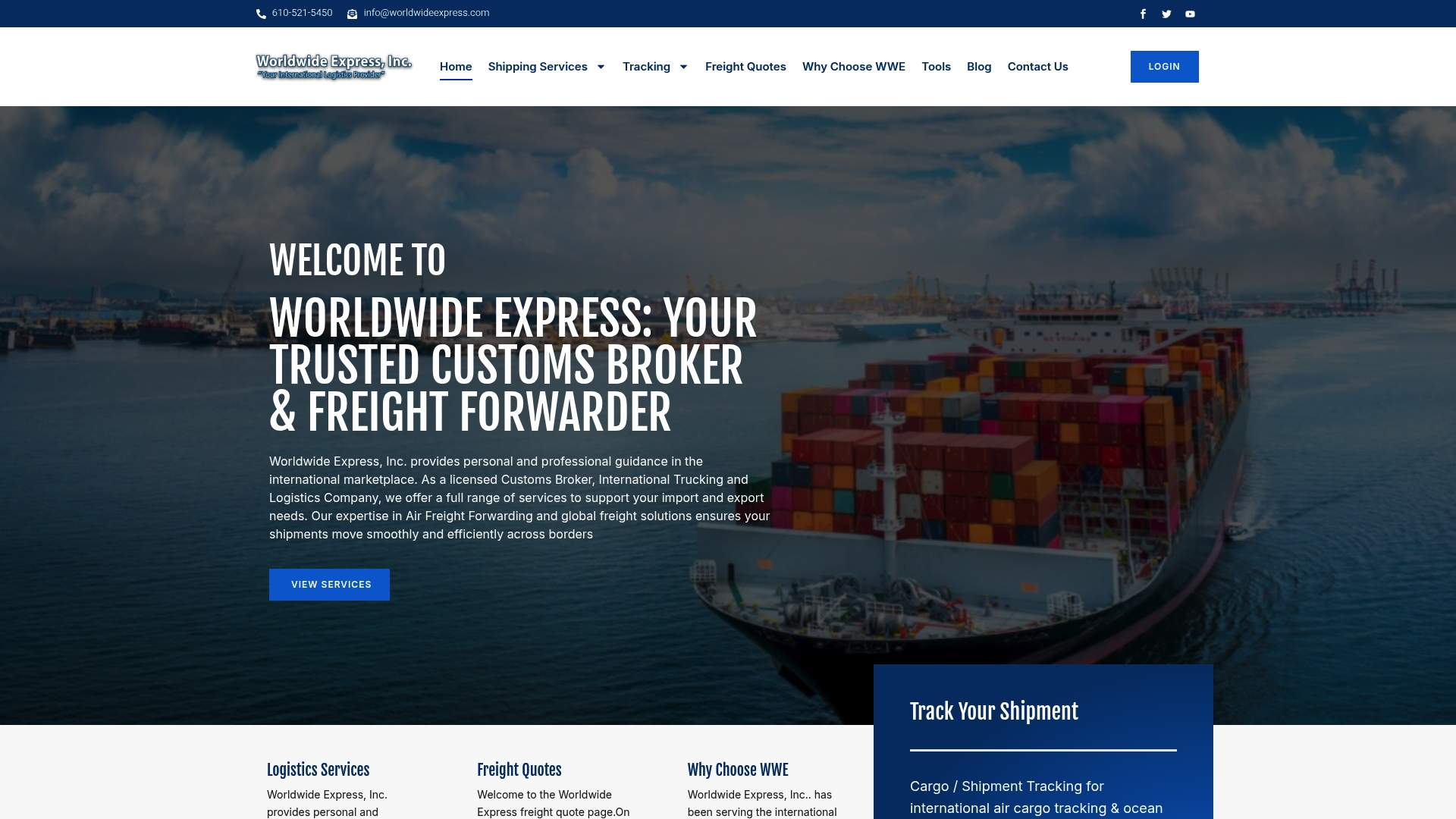
Worldwideexpress brings together customs brokerage, import and export freight forwarding, air and ocean transportation, and cargo insurance under one roof, which means the documentation and compliance work that underpins accurate freight invoicing is handled alongside the shipment itself. For teams building or upgrading their freight payment infrastructure, that alignment between customs clearance timing and payment execution reduces the disputes and delays that typically surface at the intersection of finance and operations. Whether you need help structuring international payment flows, aligning customs documentation with invoice validation, or simply getting a freight quote to benchmark your current spend, Worldwideexpress’s logistics services are built for exactly this kind of cross-functional complexity. Contact Worldwideexpress to discuss how its freight forwarding and customs capabilities fit your payment workflow.
Key Takeaways
FAP platforms integrated with TMS and ERP deliver the highest audit accuracy and spend intelligence for mid-to-large shippers, while embedded finance options like QuickPay turn payment terms into a carrier-relations advantage.
| Point | Details |
|---|---|
| FAP beats manual at scale | Adopt a Freight Audit & Payment platform when monthly invoice volume exceeds manual capacity; audit depth recovers overcharges and tightens accruals. |
| TMS integration is non-negotiable | FAP accuracy depends on execution context from your TMS — shipment IDs, PODs, and accessorial authorizations must flow automatically. |
| Use embedded finance selectively | Configure early-pay as an opt-in policy per carrier or lane to balance DPO targets against capacity access on critical routes. |
| Demand decision-grade reporting | Require GL-mapped, charge-level spend exports from any provider; invoice totals alone do not support lane sourcing or procurement strategy. |
| Worldwideexpress aligns payment and operations | Worldwideexpress combines customs brokerage, freight forwarding, and cargo insurance to support the documentation and compliance alignment that accurate freight invoicing requires. |
The gap between what freight payment promises and what teams actually build
The freight payment category has matured considerably, but there is a persistent gap between what the best platforms deliver and what most finance teams actually configure. The technology exists to produce lane-level spend intelligence, automated accruals, and carrier scorecards that feed procurement. In practice, many implementations stop at invoice processing and payment execution, leaving the strategic layer untouched.
The reason is usually organizational, not technical. AP owns the payment workflow, procurement owns carrier contracts, and operations owns the TMS. Nobody owns the intersection. FAP platforms that sit at that intersection tend to get scoped down to the lowest common denominator: pay the invoice, code it to the right GL, move on. The benchmarking, the carbon data, the carrier scorecards — those outputs require someone to actually use them, and that requires a cross-functional owner who does not typically exist in the org chart.
The teams that get the most out of freight payment solutions are the ones that treat the platform as a data source for procurement, not just a payment processor for AP. That reframe changes what you ask for in an RFP, what you configure at go-live, and what you measure in the first 90 days. The audit recovery pays for the platform. The intelligence pays for the strategy.
Useful sources
- U.S. Bank: Freight Audit & Payment Services
- Cass Information Systems: Why a Freight Payment Solution Is Essential
- Global Trade Magazine: Your TMS Isn’t Enough — Why You Need a FAP Solution
- Infios: Integrating FAP and TMS for Smarter Freight Spend Management
- Triumph: Freight Payment Solutions for Shippers
- CX TMS: Embedded Freight Finance, Fintech, and Instant Payments
- Worldwideexpress: Logistics Services
- Worldwideexpress: Understanding Freight Forwarding
- Financial Compliance Software Integration Types: 2026 Guide
Recommended
- Freight contract terms: essential guide for shipping managers – Worldwide Express, Inc.
- Explore Special Services Freight: Options and Expert Solutions – Worldwide Express, Inc.
- Understanding freight forwarding: a 2026 guide – Worldwide Express, Inc.
- Understanding Trade Finance Solutions: A Clear Guide – Worldwide Express, Inc.