For business exports, freight forwarders and customs brokers typically prepare and file the commercial invoice, packing list, bill of lading or air waybill, export declaration (EEI/AES) or ISF 10+2, and any required certificates. The exporter remains legally responsible for the accuracy of that paperwork even when someone else files it. Start now by pulling together your purchase order, pricing, HS codes, package details, and any certificates the destination country requires.
TL;DR:
- Properly verifying HS codes, invoice details, and matching documents before submission reduces the risk of customs holds and delays.
- The exporter remains legally responsible for the accuracy of export filings like EEI, even when delegated to the forwarder.
- Providing clear, signed POA and SLI documentation enables your forwarder to file accurately and on time, especially for routed export transactions.
- Reviewing all documents—commercial invoice, packing list, and shipping forms—before sending them to your forwarder helps catch mismatches and prevent delays.
- Regularly consulting official guidance and maintaining complete records support smooth customs clearance and audit readiness.
Table of Contents
- What Documents Go Into UPS International Shipping Forms?
- Who Actually Prepares and Signs These Forms?
- How Do You Prepare and Submit Shipping Documents Step by Step?
- What Compliance Mistakes Delay Business Shipments?
- Checklist and Templates to Share With Your Forwarder
- Why Exporters Still Get Burned Even With a Forwarder
- Get Documentation Support From Worldwide Express
- Where to Verify Filing Rules Directly
- Sources
- FAQ
What Documents Go Into UPS International Shipping Forms?
Every business shipment crossing a border depends on a handful of documents, and each one carries fields that customs officers and carriers actually check line by line. Miss one, and the shipment sits.
The commercial invoice is the anchor document. It needs the seller and buyer names and addresses, an invoice number, the currency used, unit prices, extended totals, the HS/HTS code for each item, country of origin, the Incoterm governing the sale, payment terms, and a destination control statement when the goods are subject to export controls. Trade that including HS codes up front speeds customs clearance considerably, and that invoice formatting requirements vary by destination country, so check before you ship.
The packing list works alongside the invoice but tracks something different: what’s physically in each carton. It needs carton-level contents, weights, dimensions, package counts, gross and net weights, and handling unit or carton ID numbers that match what’s printed on the outside of each box.
The bill of lading or air waybill is the carrier’s document, not the customs document. It identifies the carrier, shipper, consignee, and notify party, states the carriage terms, and carries its own B/L or AWB number. One detail trips up a lot of new exporters: an air waybill is shipper-specific and non-negotiable, while an ocean bill of lading can be issued straight (non-negotiable) or negotiable, which changes how cargo gets released at destination.
Beyond those three, you may need:
- Export declarations (EEI/AES) for shipments above the U.S. filing threshold or involving controlled commodities
- ISF 10+2 advance filings for ocean shipments entering the United States
- Certificates of origin, phytosanitary certificates, or product-specific permits depending on the commodity and destination
Ask your buyer or forwarder early which country-specific documents apply. Trade.gov’s export documents guide recommends confirming these requirements at the start of the transaction, not the week before pickup.
Who Actually Prepares and Signs These Forms?
The exporter and the forwarder split this work, but the split confuses people constantly. Here’s the practical breakdown.
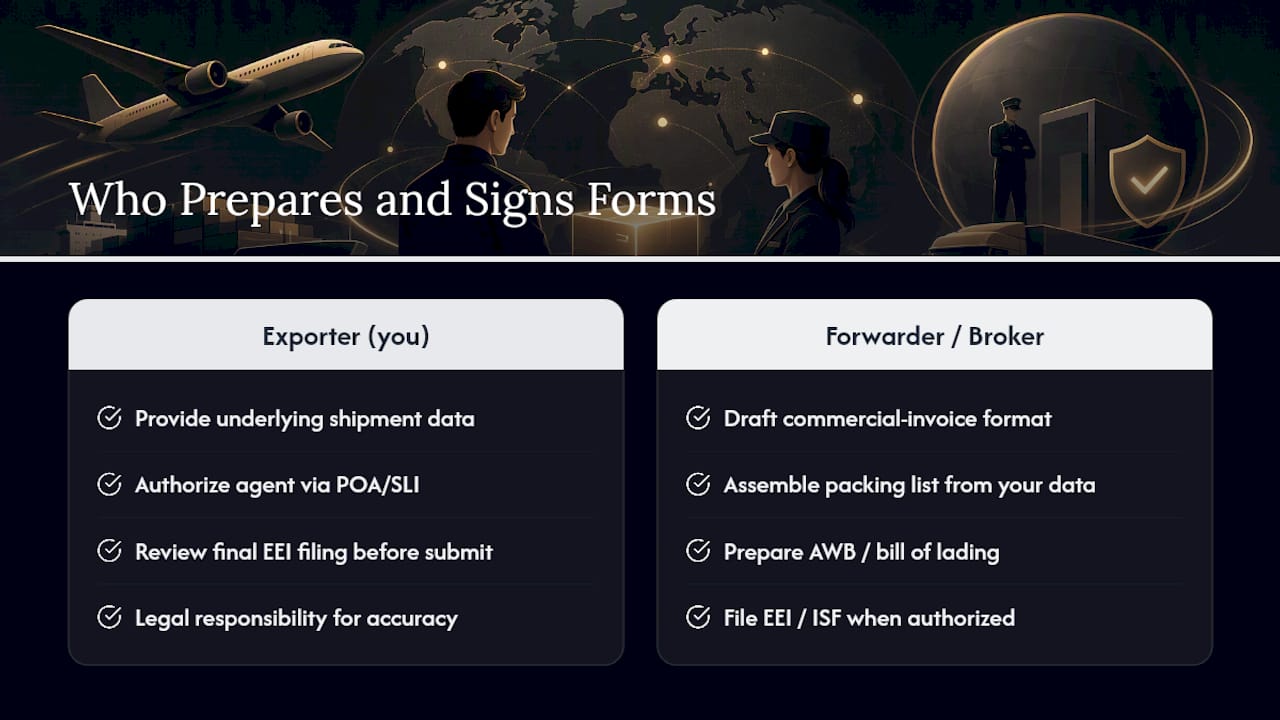
Your freight forwarder or customs broker typically drafts the commercial invoice format, assembles the packing list from your data, prepares the AWB or bill of lading, and files the EEI or ISF on your behalf when authorized to do so. What they cannot do is take legal ownership of the accuracy. According to Bureau of Industry and Security guidance, forwarders acting as authorized agents must question and resolve discrepancies between the commercial invoice and shipping instructions, but the underlying data still comes from you.
Whether you’re a “routed” or “non-routed” export changes who files what. In a routed transaction, the foreign buyer (the FPPI) controls the export and authorizes a U.S. agent to file the EEI. In a non-routed transaction, the U.S. seller typically handles that filing directly or through its own forwarder.
That’s where the power of attorney (POA) and shipper’s letter of instruction (SLI) come in. The BIS guidance describes both as the mechanism that authorizes a forwarder to file AES/EEI and issue carrier booking instructions on your behalf. Without a signed POA, a forwarder legally cannot act as your agent.
On the import side, a customs broker clears goods through customs and pays duties on the importer’s behalf, often coordinating directly with the freight forwarder that handled the export leg.
Pro Tip: Even when your forwarder files the EEI, you’re still the one on the hook if it’s wrong. Review the final filing before it submits, not after.
How Do You Prepare and Submit Shipping Documents Step by Step?
A clean documentation process follows a predictable order. Skipping steps is exactly how mismatched values and missing signatures end up delaying a shipment at customs.
Compile the transaction dossier. Gather the purchase order, product descriptions, commercial terms, HS codes, invoice values, weights and dimensions, and any certificates the destination requires. Do this before you contact your forwarder, not while you’re on the phone with them.
Complete the commercial invoice and packing list together. Reconcile them line by line: quantities, descriptions, and values need to match exactly across both documents. Attach certificates and permits at this stage rather than promising to send them later.
Provide the SLI and POA to your forwarder. Confirm in writing who is filing the EEI/AES or ISF 10+2, and give explicit consent where the forwarder needs it to act as your agent. A vague or incomplete SLI is one of the most common reasons filings stall.
Let the forwarder prepare the AWB or bill of lading and book the carrier. Review the draft before it’s finalized. If your goods are export-controlled, confirm the destination control statement is correct on the invoice.
Confirm filing completion. Get the EEI filing report, AWB or B/L number, and any other filing references in writing. Store both originals and digital copies.
Pro Tip: Build a one-page reconciliation checklist you run through before handing documents off. Comparing invoice, packing list, and EEI entries side by side catches most documentary mismatches before they ever reach a customs officer.
What Compliance Mistakes Delay Business Shipments?
Most customs holds trace back to a small set of repeat offenders, and nearly all of them are preventable with a five-minute check.
- Mismatched invoice, packing list, and EEI data. Quantities, descriptions, or values that don’t match across documents are the single most common trigger for a customs query.
- Wrong or missing HS/HTS codes. Verify the code with your supplier and your forwarder before filing, not after a shipment gets flagged.
- Missing or unclear POA. This delays routed transactions specifically, since the forwarder can’t legally file without it.
- Late ISF or EEI filings. ISF 10+2 has a strict pre-arrival window for U.S. ocean imports, and missing it can trigger penalties or hold up cargo release.
- Poor record retention. Keep originals and provide copies on request; a clean trail between invoice, packing list, and bill of lading is what an auditor asks for first.
None of these require sophisticated systems to fix. They require someone checking the same three documents against each other before they leave your desk.
Checklist and Templates to Share With Your Forwarder
A short pre-shipment checklist saves more back-and-forth than any single piece of software. Before you send anything to your forwarder, confirm you have:
- Commercial invoice with HS codes, Incoterm, and destination control statement (if applicable)
- Packing list reconciled against invoice line items
- Signed SLI and POA on file
- Any certificates of origin or permits the destination requires
- Confirmation of who files EEI/AES or ISF 10+2
Downloadable commercial invoice and packing list templates can standardize this across your team, and a written export declaration filing guide helps clarify AES timing before you’re under pickup pressure. If your team ships regularly, a brief internal sign-off step, someone other than the preparer checking the invoice against the PO, catches errors a single reviewer misses.
| Document | Who typically prepares it | What to verify before submission |
|---|---|---|
| Commercial invoice | Exporter, reviewed by forwarder | HS codes, Incoterm, currency, totals |
| Packing list | Exporter | Matches invoice line items exactly |
| AWB / bill of lading | Freight forwarder | Consignee, notify party, carriage terms |
| EEI/AES or ISF 10+2 | Forwarder, exporter reviews | Filer authorization, filing deadline met |
For an expedited review, tell your forwarder up front which shipments are time-sensitive. Most brokers can prioritize document checks when they know a pickup date is fixed.
Why Exporters Still Get Burned Even With a Forwarder
Here’s the uncomfortable truth most exporters don’t want to hear: hiring a freight forwarder does not transfer your legal liability. It transfers the paperwork, not the accountability. I’ve seen the assumption play out the same way across different industries: a company hands over a purchase order, trusts the forwarder to sort out the details, and gets blindsided months later when an EEI filing turns out to have used the wrong HS code the whole time.
The forwarders that actually reduce your risk are the ones who push back and ask uncomfortable questions before filing, not the ones who file whatever you send them without comment. If your forwarder never questions a value, a code, or a quantity, that’s not efficiency. That’s a red flag.
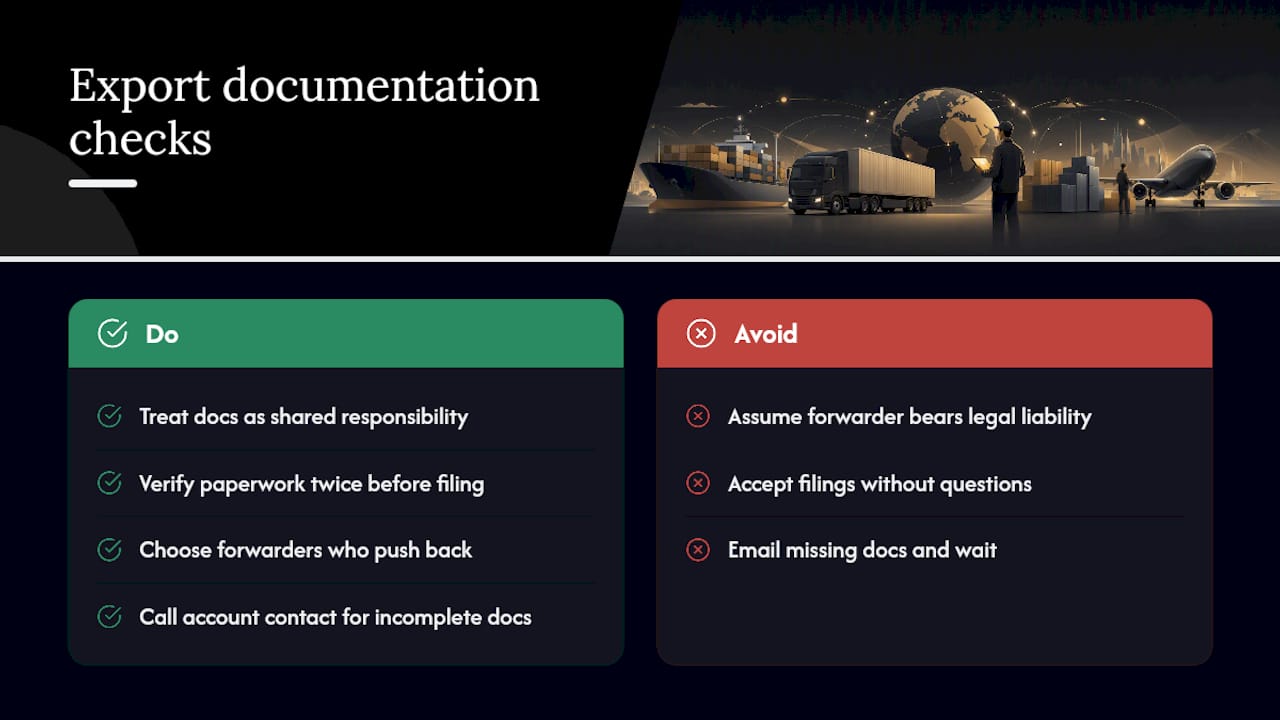
A typical freight forwarder requests up front essential documents like the purchase order, HS codes, a draft invoice, full packing details, and any certificates needed for the shipment. They validate that data against the SLI before filing EEI, AES, or ISF, and provide filing reports so clients have a paper trail if customs or an internal audit ever asks. When documents come in incomplete, the fastest path forward is a direct call to the account contact, not an email that sits in a queue.
The businesses that avoid customs delays aren’t the ones with the fanciest software. They’re the ones that treat documentation as a shared responsibility between their own team and their forwarder, verified twice.
— Ian
Get Documentation Support From Worldwide Express
Some logistics companies handle parts of export and import paperwork that many companies find tedious and easy to get wrong: customs brokerage, EEI/AES filing, ISF 10+2 completion, and SLI/POA processing, often supported by document templates to keep teams consistent shipment after shipment.
If you’ve been assembling commercial invoices and packing lists by hand and hoping nothing gets flagged, a documentation review changes that math. Have your purchase order, HS codes, and packing details ready, and Worldwide Express can review your current process, flag gaps before they become customs holds, and confirm filings with written reports you can keep on file. Request a logistics services consultation or get a freight forwarding quote to see where your documentation stands before your next shipment leaves the dock. For companies packing their own cartons before handoff, packaging supply options can help standardize the carton details your packing list needs to match.
Where to Verify Filing Rules Directly
- BIS freight forwarder guidance (U.S. export compliance)
- Trade
- Always confirm destination-country customs requirements separately; U.S. guidance doesn’t cover foreign import rules.
Sources
- Freight forwarder guidance and best practices | Bureau of Industry and Security
- Common Export Documents
- Commercial Invoice
- Exporter and freight forwarder responsibilities | EXIM guidance (blog)
FAQ
What Is the Difference Between an EEI Filing and an ISF Filing?
EEI (filed through AES) applies to U.S. export shipments above the filing threshold, while ISF 10+2 is an advance filing required for ocean shipments importing into the United States.
Who Is Legally Responsible if My Forwarder Files an Incorrect EEI?
The exporter (USPPI) remains legally responsible for EEI accuracy even when a forwarder files it, so reviewing the filing before submission is essential.
Do I Need a Power of Attorney for Every International Shipment?
You need a POA whenever you authorize a forwarder or broker to file on your behalf, particularly for routed export transactions where a foreign buyer’s agent handles the EEI.
How Long Should I Keep Export and Import Documentation?
Keep original invoices, packing lists, and bills of lading on file and provide copies on request, as complete records support audits and dispute resolution.
Can a logistics provider help if documents are already incomplete?
Yes. Providers can review incoming documentation against SLI instructions and flag missing fields, such as HS codes or certificates, before filing to avoid customs delays.