Clearing FDA-regulated goods through U.S. customs requires an accurate electronic entry filed through CBP’s Automated Commercial Environment, complete with the specific data elements FDA needs to review admissibility, submitted close enough to arrival that FDA actually sees it. The importer of record, the customs broker, CBP, and FDA each play a distinct role in that chain. Miss a data element or file outside the arrival window, and the result is a hold, a sampling request, detention, or outright refusal.
TL;DR:
- Missing or incorrect product code, AofC, or manufacturer FEI can cause delays or refusals and should be verified before filing.
- Submissions must be filed within five days of estimated arrival to ensure FDA review, avoiding port backlogs and resubmission delays.
- Refusals require destruction, export, or reconditioning within 90 days, with significant penalties possible if deadlines are missed.
- Proper pre-filing documentation, including certificates, lab reports, and validated data, reduces manual review and processing time.
- Engaging a licensed broker consolidates filing, bond management, and documentation, lowering the risk of errors and expedited clearance issues.
Table of Contents
- How the FDA customs clearance process and timeline work
- Who is responsible: importer, broker, CBP, and FDA
- Step-by-step entry submission: ACE data elements and timing
- Common entry submission errors in FY26 and how to fix them
- Examination, detention, and refusal: what happens and how to respond
- Commodity-specific compliance: FSVP, registration, and conditional AofCs
- Pre-filing checklist: documents and tools to confirm before you ship
- Why a customs brokerage partner lowers FDA filing risk
- Get FDA customs brokerage support from Worldwide Express
- FAQ
- Sources
How the FDA customs clearance process and timeline work
Once a shipment is booked, the entry filer transmits data to CBP’s ACE system, which forwards FDA-regulated line items to FDA for review. FDA generally does not see an entry until the estimated arrival date falls within five days of the current date, so filing too early wastes the effort and filing late risks a port backlog. From there, FDA runs the submission through electronic screening that checks the data elements against risk criteria.
Most entries clear automatically at this stage. A smaller share gets flagged for a closer look: a document review, a physical examination, or a sample pull for lab testing. Each additional step adds time, and the biggest source of delay is rarely the review itself. It is a late or incomplete transmission that forces a resubmission right when the clock is already running against the vessel or flight’s arrival.
Who is responsible: importer, broker, CBP, and FDA
The importer of record carries the legal responsibility for the shipment and is held to a reasonable care standard, meaning accurate classification, valuation, and supporting documentation fall on that party regardless of who files the paperwork. A licensed customs broker typically acts as the entry filer, transmitting ACE data, posting the customs bond, and submitting documents on the importer’s behalf under a power of attorney.
CBP and FDA split the work from there. CBP collects duties and controls physical release of cargo, while FDA makes the admissibility call under the Food, Drug, and Cosmetic Act. An importer can file directly in some cases, but once a product trips an FDA requirement, most businesses lean on a broker who already knows which fields FDA checks and how local ports handle holds.
Step-by-step entry submission: ACE data elements and timing
Filing an entry for an FDA-regulated product means feeding ACE a specific set of fields, not just the standard customs data CBP needs for duty collection. The FDA ACE Supplemental Guide lays out the PGA Message Set that carries these FDA-specific records alongside the standard cargo release or entry summary transaction.
- Product code: the seven-digit code identifying the commodity and its FDA center.
- Affirmation of Compliance (AofC): the code confirming the product meets a specific regulatory standard.
- Manufacturer FEI: the facility’s FDA establishment identifier.
- Shipper and consignee: the parties on each end of the transaction.
- Intended use code (IUC): how the product will be used, which can change whether FDA jurisdiction applies at all.
- Quantity pairs and packaging: formatted to match the unit of measure FDA expects for that product code.
- Estimated arrival date: the trigger that determines when FDA sees the entry.
- Commodity-specific identifiers: a device’s premarket number (PM#) or a biologic’s product license number, when applicable.
A product without an FD flag on its HTS classification can still require FDA data if its intended use brings it under FDA jurisdiction, so checking intended use matters as much as checking the tariff line. Food shipments carry an added obligation: prior notice must be filed through ACE or the Prior Notice System Interface before the shipment arrives, timed to the mode of transport. Since FDA only picks up entries within five days of arrival, filers working tight schedules sometimes use live entry to push data through earlier when the shipment demands it.
Common entry submission errors in FY26 and how to fix them
FDA’s own Common Entry Submission Errors chart for FY26 shows the same handful of mistakes causing most of the manual review delays. Each one is preventable with a pre-filing check rather than a scramble after FDA kicks the entry back.
| Error type | What causes it | Fix |
|---|---|---|
| Incorrect AofC | Wrong compliance code for the product category | Confirm AofC against the product code before filing |
| Wrong product code | Misclassified commodity | Validate with FDA’s Product Code Builder |
| Manufacturer or consignee error | Outdated or mismatched FEI | Verify FEI directly with the facility before each shipment |
| Quantity formatting | Unit mismatch with product code requirements | Match the quantity pair format FDA specifies for that code |
| Incorrect grouping | Line items combined when product codes or manufacturers differ | Split lines by product code and manufacturer, not by invoice convenience |
Pro Tip: Capture AofC codes and manufacturer FEIs from suppliers at the purchase order stage, not at the dock, so filing day never depends on a scramble for missing numbers.
Our guide to why customs clearance delays happen walks through several of these same failure points from the broker’s side of the desk.
Examination, detention, and refusal: what happens and how to respond
When FDA flags a shipment, it issues a Notice of FDA Action that sets a response date, commonly 10 business days, though notices sometimes allow up to 20 calendar days in practice. That window is for submitting testimony, documents, or a reconditioning plan, not for negotiating the finding itself.
The fastest path to a response is ITACS, FDA’s electronic system for uploading evidence and tracking entry status, though a local FDA import office can also take submissions directly. If the shipment is refused outright, the importer must destroy or export it within 90 days under CBP and FDA supervision. Ignoring that deadline risks a bond claim and liquidated damages, since the broker’s bond stands behind the obligation. Where the product can be brought into compliance through relabeling or reprocessing, Form FDA 766 requests reconditioning; complex refusals or repeated violations are usually the point to bring in counsel.

Commodity-specific compliance: FSVP, registration, and conditional AofCs
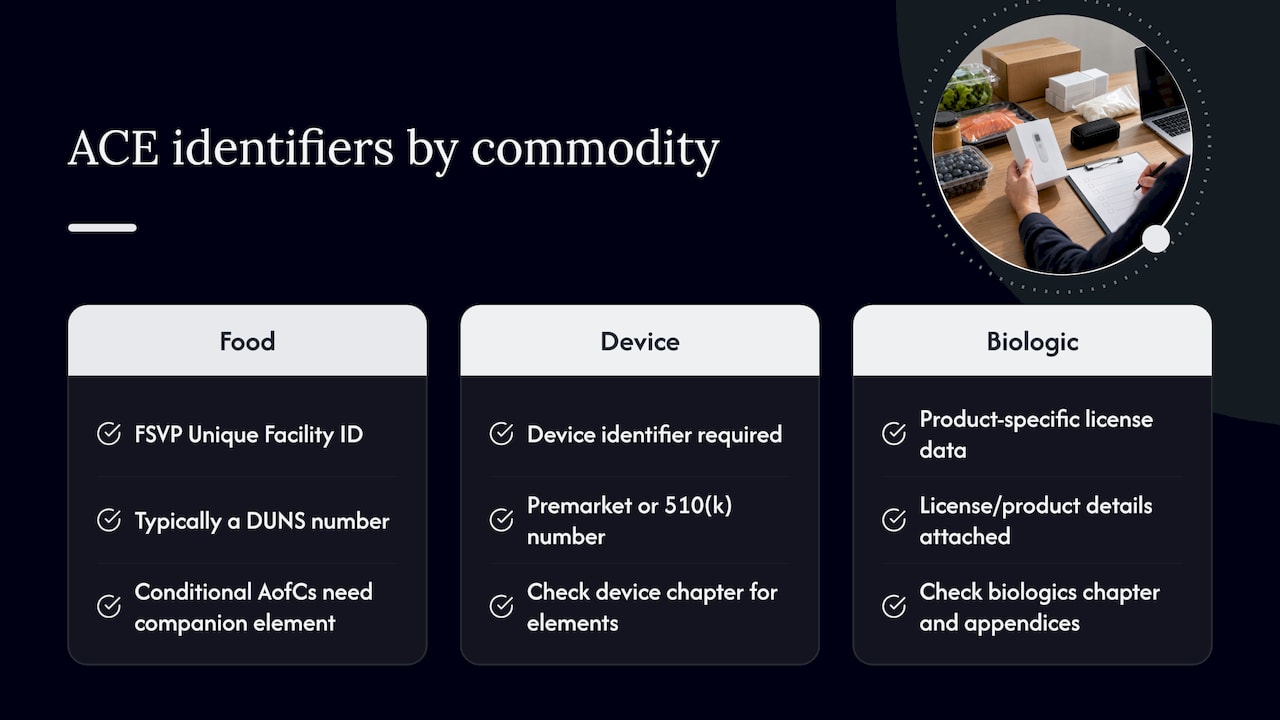
Food importers carry an added layer under the Foreign Supplier Verification Program. An FSVP importer must verify that foreign suppliers meet U.S. safety standards and must provide an acceptable Unique Facility Identifier, typically a DUNS number, when the entry is filed in ACE.
Device and biologic shipments carry their own identifiers: a device may need its premarket number or 510(k) clearance number attached to the ACE record, and biologics carry product-specific license data. Some Affirmations of Compliance are conditional, meaning they only apply when another data element is also present, which changes what the filer must enter alongside them. FDA’s commodity-specific chapters and appendices spell out the full element list for each product category, and checking the right chapter before filing beats guessing from a past shipment.
Pre-filing checklist: documents and tools to confirm before you ship
A short list of items gathered before the cargo moves prevents most of the back-and-forth after filing.
- Commercial invoice, packing list, and bill of lading or air waybill matched line for line.
- Manufacturer FEI and any required registration numbers, confirmed directly with the facility.
- Lab reports, certificates, or prior notice confirmations for commodities that require them.
- Power of attorney on file if a broker is filing on the importer’s behalf.
- Product code, AofC, and IUC validated against FDA’s Product Code Builder before submission.
Once filed, ITACS shows entry status in real time, including codes like “May Proceed Without FDA Examination” or “Hold All Lines,” and is the quickest way to know whether to call the local port before cargo sits past its free time.
Why a customs brokerage partner lowers FDA filing risk
A licensed broker centralizes ACE filing, ITACS uploads, and power-of-attorney paperwork under one workflow instead of several disconnected handoffs. That consolidation is where pre-filing product code validation, bond management, and redelivery coordination tend to catch problems before FDA does. For FDA-regulated shipments specifically, bringing a broker in before the booking is confirmed, rather than after a hold notice arrives, is what keeps a routine shipment routine.
— Ian
Get FDA customs brokerage support from Worldwide Express
We handle the filing work that trips up FDA entries: licensed U.S. Customs Brokerage services, ACE transmission, and dedicated FDA Services that cover product code validation, AofC confirmation, and ITACS documentation on your behalf.
- We file your ACE entries with the FDA data elements already checked against your product line.
- We manage bonds, redelivery, and documentation so a hold doesn’t become a missed delivery window.
- We coordinate customs brokerage alongside import freight handling for one point of contact.
Request a freight quote to get a customs brokerage plan built around your next FDA-regulated shipment.
FAQ
What triggers an FDA hold on an imported shipment?
A hold typically follows an entry that failed electronic screening, usually because of an incorrect product code, AofC, or manufacturer data, or because FDA selected the shipment for closer review. The fix starts with correcting the flagged data element and resubmitting through ACE.
How long does an importer have to respond to a Notice of FDA Action?
A Notice of FDA Action sets a response date, commonly 10 business days and sometimes specified as up to 20 calendar days in the notice itself. Responses, including testimony or documents, are generally submitted through ITACS or a local FDA import office.
What happens if a shipment is refused by FDA?
A refused shipment must be destroyed or exported under CBP and FDA supervision within 90 days, and missing that window can expose the importer’s bond to liquidated damages. Reconditioning through Form FDA 766 is an option when the product can be brought into compliance.
Do all FDA-regulated products need prior notice?
Food products imported into the United States need prior notice filed through ACE or the Prior Notice System Interface before arrival, timed to the shipping mode. Other FDA-regulated categories, like devices or biologics, have their own commodity-specific data requirements rather than prior notice.
Can a customs broker file FDA entries on behalf of an importer?
Yes, a licensed customs broker can file ACE entries, submit ITACS documentation, and manage bonds on an importer’s behalf under a power of attorney, while the importer of record retains legal responsibility for accuracy. Our U.S. Customs Brokerage services handle this filing work directly for FDA-regulated shipments.