International customs clearance is the process by which a customs authority reviews, assesses duties on, and formally releases a commercial shipment for import or export. It combines declaration, duty and tax payment, potential inspection, and final release. For any shipment beyond the simplest, low-value lane, the immediate move is to prepare complete, accurate documentation, classify goods correctly under the Harmonized System (HS/HTS), and engage a licensed customs broker rather than attempt self-clearance.
TL;DR:
- Accurate documentation and correct Harmonized System classification are essential, as errors can reset the clearance timeline and incur penalties.
- Using a licensed customs broker is advisable for complex, high-value, or multi-market shipments to reduce misclassification and compliance risks.
- Common delays result from mismatched documents, valuation errors, or missing permits, which can often be prevented with a standardized pre-shipment review process.
- Customs clearance times vary by transportation mode, with ocean freight generally taking the longest due to advance manifest filings, and delays often stem from missing or incomplete paperwork.
- Building a comprehensive, organized record-keeping system and verifying details before shipment can minimize inspection delays and ensure audit readiness.
Table of Contents
- What Does International Customs Clearance Actually Involve?
- What Documents Do You Need for Customs Clearance?
- How Long Does Customs Clearance Actually Take?
- Should You Use a Customs Broker or Self-Clear Your Shipments?
- What Mistakes Most Often Delay Customs Clearance?
- What Should Be on Your Pre-Shipment Customs Checklist?
- How Do Customs Regulations Differ Across Major Trading Regions?
- How Are Customs Duties, Taxes, and Tariffs Calculated?
- How Do Incoterms Affect Customs Clearance Costs and Responsibility?
- What Happens When Goods Are Restricted or Prohibited?
- How Do Customs Inspections and Physical Examinations Work?
- How Should You Handle a Customs Audit or Appeal?
- Worldwide Express’s Take on Staying Audit-Ready
- Get Reliable Customs Clearance Support From Worldwideexpress
- Sources
What Does International Customs Clearance Actually Involve?
Clearance runs through a predictable sequence, but each step has an owner, and a handoff dropped anywhere in that chain stalls the whole shipment.
It starts before the container or pallet ever leaves the dock. The exporter prepares the commercial invoice, packing list, and any licenses the goods require, while the carrier or freight forwarder files the export declaration and advance manifest data. In transit, that manifest data flows to the destination customs authority, which uses it for risk screening well before physical arrival. On arrival, the importer of record, often working through a customs broker, files the entry summary: the formal declaration that states classification, value, and duty owed. Customs authorities like U.S. CBP then either release the cargo or flag it for review.
Two identifier systems anchor this whole flow. The Harmonized System (HS), extended in the U.S. into the ten-digit HTS code, determines the duty rate and whether the product needs special permits. In the European Union, the Economic Operators Registration and Identification (EORI) number identifies the importer or exporter to customs systems across member states, and it ties directly into the Entry Summary Declaration process that EU authorities use for advance risk assessment.
One point trips up a lot of first-time importers: hiring a broker does not transfer legal liability. The importer of record typically remains accountable for the accuracy of the declaration and the duties owed, even when a broker files the paperwork.
What Documents Do You Need for Customs Clearance?
Every entry rides on a small set of documents, and the data fields inside them matter more than the paperwork itself. Customs authorities cross-reference these documents against each other, so a mismatch between the invoice and the packing list is often enough to trigger a hold.
Here’s what a complete file typically includes:
- Commercial invoice: goods description, unit and total value, currency, Incoterm, and full seller/buyer details.
- Bill of lading or air waybill: the transport contract that proves who shipped what, to whom, and under what terms.
- Packing list: quantities, weights, and dimensions per package, matched line by line to the invoice.
- Certificate of origin: required when claiming preferential tariff treatment under a trade agreement, and often subject to specific value thresholds for simplified invoice declarations.
- Import/export licenses or permits: needed for regulated categories such as food, chemicals, electronics with radio components, or dual-use goods.
The HS/HTS classification and the declared customs value are the two fields customs software flags hardest, because they drive the duty and tax calculation directly. Get either one wrong and the error doesn’t just cost money. It resets the clock on the whole clearance timeline.
How Long Does Customs Clearance Actually Take?
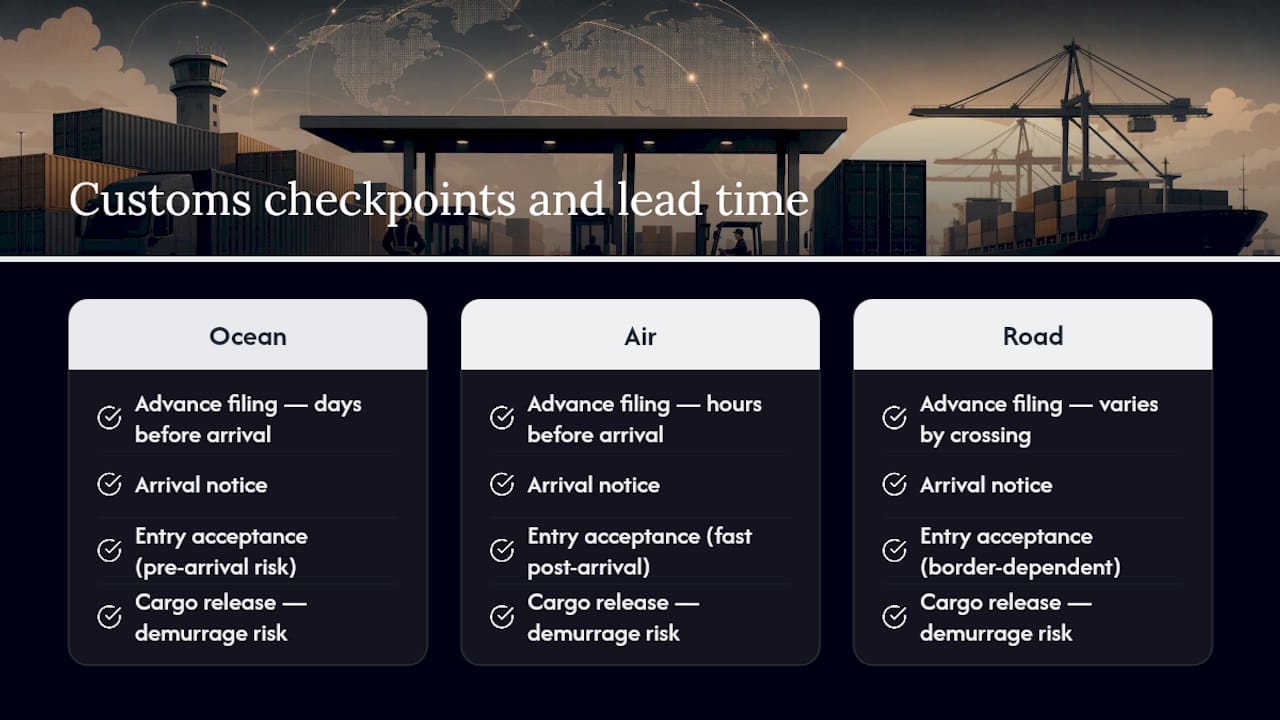
Timing depends heavily on mode of transport, but the checkpoints are the same everywhere: advance filing, arrival notice, entry acceptance, and release.
Ocean freight typically has the longest lead time built in, mostly because carriers must submit advance manifest data days before the vessel arrives. Air freight compresses that window to hours, given how quickly cargo moves once it lands. Road freight sits somewhere in between, with pre-arrival filing requirements that vary by border crossing. The EU’s Entry Summary Declaration (ENS) illustrates why this matters: advance data submission lets customs authorities complete risk assessment before the goods physically arrive, which is what allows fast release at the border rather than a scramble once cargo is sitting in a yard.
Digital filing systems have shifted much of this advance-filing responsibility onto carriers and brokers rather than shippers directly, but that doesn’t mean shippers can ignore it. Confirm who is lodging what, and when, before the vessel or flight departs.
Missing documents or a random inspection can add days, and every extra day in a bonded warehouse or container yard usually means demurrage or storage fees. Track four checkpoints: pre-lodgement confirmation, arrival notice, entry acceptance, and cargo release. A shipment stalled between arrival notice and entry acceptance is the clearest early warning sign something needs attention.
Should You Use a Customs Broker or Self-Clear Your Shipments?
The decision usually comes down to volume, product complexity, and how much regulatory exposure you’re willing to carry in-house.
- Assess shipment frequency. Occasional, low-value shipments with simple tariff lines are the only realistic candidates for self-clearance, and only with staff trained on filing procedures.
- Weigh product complexity. Multi-component products, regulated categories, or goods claiming preferential origin treatment benefit from a broker’s classification expertise, since misclassification consequences compound quickly across repeat shipments.
- Calculate value-at-risk. High-value cargo facing a compliance error carries real financial exposure; a broker’s audit-ready documentation practices reduce that exposure directly.
- Factor in multi-market complexity. Shipping into several jurisdictions at once, each with its own identifier system, tariff schedule, and documentation quirks, is where in-house teams usually get stretched thin.
Brokers earn their fee by handling classification, duty calculation, and regulatory liaison so your team isn’t relearning customs code changes on the fly.
What Mistakes Most Often Delay Customs Clearance?
Most clearance delays trace back to a handful of recurring errors, and nearly all of them are preventable with a standard review process.
- Misclassification. Assigning the wrong HS/HTS code changes the duty rate and can trigger a compliance flag; when a classification is genuinely ambiguous, a binding ruling from the relevant customs authority settles it in advance rather than at the border.
- Incomplete or inconsistent documentation. Invoice values that don’t match the packing list, or a bill of lading that lists different quantities than the commercial invoice, are among the fastest ways to trigger a manual review.
- Valuation errors. Understating value to reduce duty, even unintentionally through a missed freight or insurance charge, invites penalties well beyond the original duty owed.
- Mishandled origin claims. Claiming preferential tariff treatment without the correct certificate of origin or below the required threshold documentation gets the claim rejected and the standard duty rate applied instead.
- Unready regulated goods. Shipping products that require licenses or permits without having them in hand guarantees a hold, not a delay.
Pro Tip: Build a standard pre-shipment template that forces the invoice, packing list, and bill of lading to pull from the same source data. Most invoice-to-packing-list mismatches happen because two different people typed the same shipment twice.
Industry data consistently shows that small documentation errors escalate fast. Customs brokers exist partly to catch these before filing, which is a cheaper fix than a rejected entry.
What Should Be on Your Pre-Shipment Customs Checklist?
A short, disciplined checklist run before every shipment catches most of the errors covered above, and it works best when each item has a named owner inside your organization.
- Invoice accuracy (owner: sales or finance): confirm value, currency, and Incoterm match the sales contract.
- HS/HTS classification (owner: customs/compliance team or broker): verify against current tariff schedules, not last year’s file.
- Incoterm selection (owner: sales): confirm it matches what operations and the carrier actually intend to execute.
- Packing list reconciliation (owner: warehouse): quantities and weights match the invoice line by line.
- Certificates and licenses (owner: compliance): origin certificates, permits, and any regulated-goods paperwork gathered before booking.
- Forwarder handoff confirmation (owner: logistics manager): confirm who files the export declaration and advance manifest data.
Retain the full document set, invoice, packing list, bill of lading, entry summary, and any correspondence with customs, for at least the retention period your jurisdiction requires; many authorities expect records on hand for several years for audit purposes. A documented compliance workflow makes that retention far less painful when an audit notice actually arrives.
How Do Customs Regulations Differ Across Major Trading Regions?
No single rulebook governs global trade, and that’s the single biggest adjustment for shippers who only operate domestically.
The United States runs on CBP oversight, HTS classification, and a framework CBP itself describes as shared responsibility between customs authorities and importers: the government sets the rules, but the importer carries the compliance burden. The European Union operates as a customs union with a common external tariff, but execution still varies by member state. The EORI identifier and the Entry Summary Declaration apply union-wide, while document retention periods and inspection protocols can differ once goods land in a specific country.
Other major trading blocs layer additional complexity. Regional trade agreements, from USMCA to various EU free trade agreements, create preferential duty rates, but only for goods that meet defined rules of origin and carry the correct supporting certificate. A product qualifying for preferential treatment under one agreement might not qualify under another, even shipping the same goods to a neighboring country.
The practical takeaway for a multi-market shipper isn’t memorizing every jurisdiction’s rulebook. It’s building a process, ideally with a broker who operates across those markets, that checks classification, origin, and documentation requirements against the destination country’s specific rules before the shipment moves, not after it’s flagged.
How Are Customs Duties, Taxes, and Tariffs Calculated?
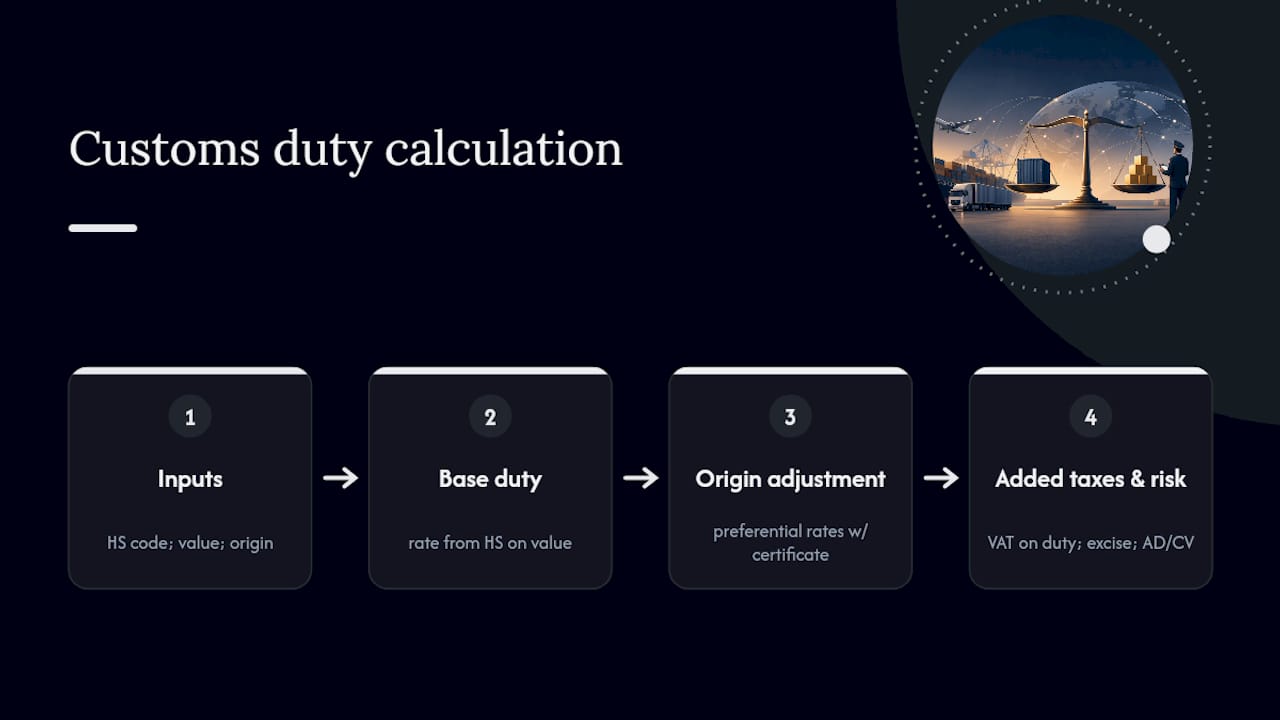
Duty calculation starts with three inputs: the HS/HTS classification code, the customs value of the goods, and the country of origin.
The classification code determines the base duty rate. That rate then applies to the customs value, which is typically the transaction value: the price actually paid or payable for the goods, adjusted to include costs like freight and insurance depending on the Incoterm used. Miscalculate value by omitting a freight charge that should have been included, and the duty assessment comes in short, which customs authorities treat as a compliance issue, not a rounding error.
Country of origin affects the calculation directly when a trade agreement applies. Goods qualifying for preferential origin treatment under an agreement like USMCA or an EU free trade agreement may face a reduced or zero duty rate, but only with the correct certificate of origin on file. Beyond standard duty, many jurisdictions layer on additional charges: value-added tax or goods and services tax calculated on the duty-inclusive value, excise taxes on specific product categories like alcohol or tobacco, and antidumping or countervailing duties on goods found to be unfairly subsidized or priced below market value in the destination market.
This is where classification errors get expensive fast. A single wrong digit in an HTS code can shift a product from a 2% duty rate to a 15% one, and that gap compounds across every unit in a container. It’s also why brokers who specialize in a specific product category, electronics, textiles, food products, tend to catch valuation and classification issues generalist staff miss.
How Do Incoterms Affect Customs Clearance Costs and Responsibility?
Incoterms determine who handles export clearance, who handles import clearance, and who absorbs the cost of each, and getting this wrong creates confusion right at the moment a shipment needs fast decisions.
Under EXW (Ex Works), the buyer takes on almost everything, including export clearance in the seller’s country, which can be a legal complication if the buyer has no local entity there. Under FOB (Free on Board), the seller handles export clearance and the buyer picks up import clearance and duties once goods clear the ship’s rail. Under DDP (Delivered Duty Paid), the seller carries the entire burden, export clearance, import clearance, and duty payment, delivering goods duty-paid to the buyer’s door.
The Incoterm you select isn’t just a shipping detail buried in a purchase order. It decides who needs the import license, who needs the EORI or equivalent identifier, and who is financially exposed if a shipment gets held for inspection. A buyer operating under FOB terms who assumes the seller is handling import clearance, when the contract actually places that burden on them, discovers the mistake at the worst possible moment: when the shipment is already sitting at the border. Confirming the Incoterm and its clearance implications belongs in the same conversation as price and delivery date, not as an afterthought.
What Happens When Goods Are Restricted or Prohibited?
Restricted goods aren’t automatically blocked. They require specific permits, licenses, or certifications before customs will release them, and the paperwork needs to exist before the shipment leaves, not after it arrives.
Categories like pharmaceuticals, chemicals, agricultural products, certain electronics with embedded radio components, and dual-use items with potential military application typically fall under an additional regulatory agency’s review on top of standard customs processing. In the U.S., for example, that might mean coordination with the FDA, EPA, or the Bureau of Industry and Security, depending on the product. In the EU, categories like plant products or certain chemicals fall under agency-specific import controls layered on top of standard customs procedures.
Prohibited goods are a different category entirely: items that cannot be imported or exported under any circumstances into a given market, regardless of documentation. What’s prohibited varies by country, and a product legal to ship into one market can be outright banned in another.
The operational lesson here is straightforward: identify whether your product category needs additional licensing before you book the shipment, not while it’s sitting in a bonded facility accruing storage fees. A broker experienced in your specific product category usually knows which agencies to check with before goods ever leave the warehouse, which is a far cheaper conversation to have early than late.
How Do Customs Inspections and Physical Examinations Work?
Not every shipment gets inspected, but the ones that do generally get flagged through risk-based targeting rather than random selection, and understanding why a shipment gets pulled helps you prevent it next time.
Customs authorities use the advance data submitted through manifests and entry declarations to score shipments for risk before they ever arrive. Factors that tend to raise a shipment’s risk score include inconsistent documentation, a classification that doesn’t match the stated product description, a shipper or consignee with a prior compliance issue, or cargo originating from a country subject to heightened scrutiny for that product category.
When a shipment is selected, examinations range from a document-only review to a non-intrusive scan (X-ray or gamma imaging) to a full physical unpacking and inspection of the cargo. A document review might add a day. A full physical exam, especially one requiring a container to be devanned and repacked, can add a week or more and typically generates additional handling and storage charges billed back to the importer.
The best defense against inspection delays isn’t avoiding scrutiny altogether, since some percentage of shipments will always be selected. It’s making sure that when a shipment is pulled, the documentation on file resolves the question fast rather than opening new ones. Clean, consistent paperwork usually converts a physical exam into a same-day release rather than a week-long hold.
How Should You Handle a Customs Audit or Appeal?
A customs audit isn’t necessarily a sign something went wrong. Many are routine, triggered by import volume, product category, or simple rotation through a compliance review cycle, but how you respond determines whether it stays routine.
The first move is producing complete records fast: commercial invoices, packing lists, entry summaries, certificates of origin, and any correspondence tied to the shipments under review. Authorities generally expect these on file for a multi-year retention period, and gaps in that record are treated far more seriously than a single classification disagreement. Reconstructing missing documentation after an audit notice arrives is significantly harder than pulling it from an organized file.
If an audit finds a classification or valuation dispute you believe is wrong, most customs authorities offer a formal appeals or protest process rather than a final, unchallengeable ruling. That process typically requires filing within a defined window after the decision, along with supporting evidence for why the original classification or valuation was correct. Missing that filing window generally forfeits the right to appeal, regardless of how strong the underlying case is.
The practical safeguard against a difficult audit is the same discipline that prevents delays in the first place: standardized documentation templates, periodic internal reviews of past filings, and a broker relationship that includes audit support, not just entry filing.
Worldwide Express’s Take on Staying Audit-Ready
Worldwideexpress works commercial shipments across ocean, air, and road every day, and the pattern holds steady across all three: clearance delays almost never come from a customs officer being difficult. They come from a document that didn’t match another document, or a classification nobody double-checked before filing.
Our approach treats every entry the way an auditor eventually will. That means a pre-lodgement check that verifies invoice, packing list, and bill of lading agree with each other before anything gets filed, a classification review against current tariff schedules rather than last year’s file, and documentation practices built to survive a review months or years later, not just get cargo through the port today. Cargo insurance and shipment tracking round that out, so a client can see exactly where a shipment sits against the checkpoints that matter.
If you’re managing complex or multi-market lanes and want a second set of eyes on classification or filing practices, that conversation is worth having before the next shipment books, not after a hold notice comes in.
— Ian
Get Reliable Customs Clearance Support From Worldwideexpress
Worldwideexpress isn’t a document-filing service bolted onto a shipping quote. It’s a licensed customs brokerage built around the same audit-ready documentation practices covered throughout this guide, backed by import and export freight forwarding across ocean, air, and road.
That combination matters because clearance rarely fails in isolation. A misclassified product or a mismatched invoice usually surfaces at the worst possible moment, mid-transit, with a container already accruing storage fees. Worldwideexpress’s U.S. customs brokerage services pair classification review and duty calculation with the same freight coordination that moves your cargo, so the broker filing your entry summary already knows the shipment’s full history rather than seeing it for the first time at the border. Add cargo insurance, shipment tracking, and supply chain visibility tools, and you get a single point of accountability instead of a handoff between three separate vendors.
If you’re planning a shipment into a new market, dealing with a regulated product category, or simply tired of chasing down documentation across multiple providers, request a freight quote and get lane-specific guidance before your next shipment books.
Sources
- Basic Importing and Exporting | U.S. Customs and Border Protection
- Customs clearance documents and procedures | Access2Markets
- Customs brokers key players in evolving global trade | EDC
- What is a customs broker in supply chain? | project44