International foreign trade is the exchange of goods, services, and capital across national borders, and it now underpins roughly a fifth or more of global economic activity in most developed economies. It supplies raw materials manufacturers cannot source at home, connects buyers to cheaper or better goods, and knits together the supply chains that stock store shelves. This article covers the theory behind it, the institutions that govern it, and the operational steps a business needs to move a shipment across a border.
TL;DR:
- Most trade volume now stems from highly fragmented global value chains, with parts crossing borders multiple times before final assembly.
- Trade facilitation improvements, like the WTO Trade Facilitation Agreement, have significantly reduced border delays and processing times.
- Accurate HS code classification and correct Incoterm selection are critical to avoiding costly duties, delays, and compliance issues in shipments.
- Public benefits of trade include increased variety and lower prices, but costs such as worker displacement and regional economic decline require policy measures.
- Working with experienced customs brokers and consolidating logistics operations can prevent operational errors that cause costly delays and overpayments.
Table of Contents
- Defining International Trade, Foreign Trade, and Domestic Commerce
- How Did Global Trade Reach Its Current Scale?
- Why Do Countries Trade? Core Economic Theories
- What Institutions and Policies Govern Global Trade?
- How Do Incoterms, HS Codes, and Customs Actually Work?
- Do the Benefits of Trade Outweigh the Costs?
- A Step-by-Step Checklist for Entering Foreign Markets
- How Worldwideexpress Supports Practical Trade Operations
- Turning Trade Theory Into a Working Plan
- Why Operational Discipline Matters More Than Theory Alone
- Ready to Move From Trade Theory to Your Next Shipment?
- Sources
Defining International Trade, Foreign Trade, and Domestic Commerce
The terms “international trade” and “foreign trade” describe the same activity from two vantage points. Foreign trade usually refers to a single country’s transactions with the rest of the world, tracked as imports and exports on that country’s balance of payments. International trade is the broader system, the aggregate of every country’s foreign trade activity happening at once. Domestic commerce, by contrast, involves no customs border, no currency conversion, and no foreign regulatory regime.
Economists also track foreign direct investment (FDI), capital that crosses borders to build or buy productive assets rather than to purchase a finished good. A country’s trade-to-GDP ratio, the sum of exports and imports divided by GDP, signals how exposed its economy is to global demand swings.
What counts as trade:
- Physical goods that clear customs, from raw commodities to finished electronics
- Services delivered across borders, including consulting, software licensing, and tourism
- Digitally delivered products, like streaming content or cloud services
- Capital flows tied to foreign direct investment
Labor and other factors that simply move within a country’s own borders don’t count. That distinction, cross-border versus domestic factor mobility, is what separates trade economics from labor economics.
How Did Global Trade Reach Its Current Scale?
Long-distance trade routes, from the Silk Road to maritime spice trade, moved luxury goods for centuries before industrial capacity made mass trade possible. Mercantilist policy in the 1600s and 1700s treated exports as national wealth and imports as a drain, a framework that shaped tariff policy for two hundred years. The 20th century brought systematic liberalization: the postwar Bretton Woods institutions, then GATT, then the WTO, each round of negotiation cutting tariffs further.
What changed everything was the rise of global value chains. A smartphone might have chips designed in one country, assembled with components sourced from a dozen others, a fragmentation of production that the OECD’s analysis of global value and supply chains identifies as the defining feature of modern trade. Automakers and electronics firms run some of the most fragmented supply chains in existence, with parts crossing borders multiple times before final assembly.
Trade facilitation has measurably improved border efficiency. The WTO Trade Facilitation Agreement entered into force in 2017 after ratification by two-thirds of WTO members, and it specifically targets the release and clearance of goods at the border.
Trends reshaping trade today include:
- Digital trade and e-commerce, letting small firms sell internationally without a physical foreign presence
- Reshoring and nearshoring, as firms rebalance supply chains after recent disruptions
- Rising trade tensions and tariff disputes between major economies
- Continued progress on trade facilitation reducing paperwork and border delays
Why Do Countries Trade? Core Economic Theories
Trade theory answers a deceptively simple question: why would a country buy something it could make itself? The earliest answer, absolute advantage, says a country should produce whatever it makes most efficiently in absolute terms. David Ricardo’s refinement, comparative advantage, introduced in 1817, is more powerful: even a country that’s worse at producing everything still benefits from specializing in what it’s relatively least bad at.
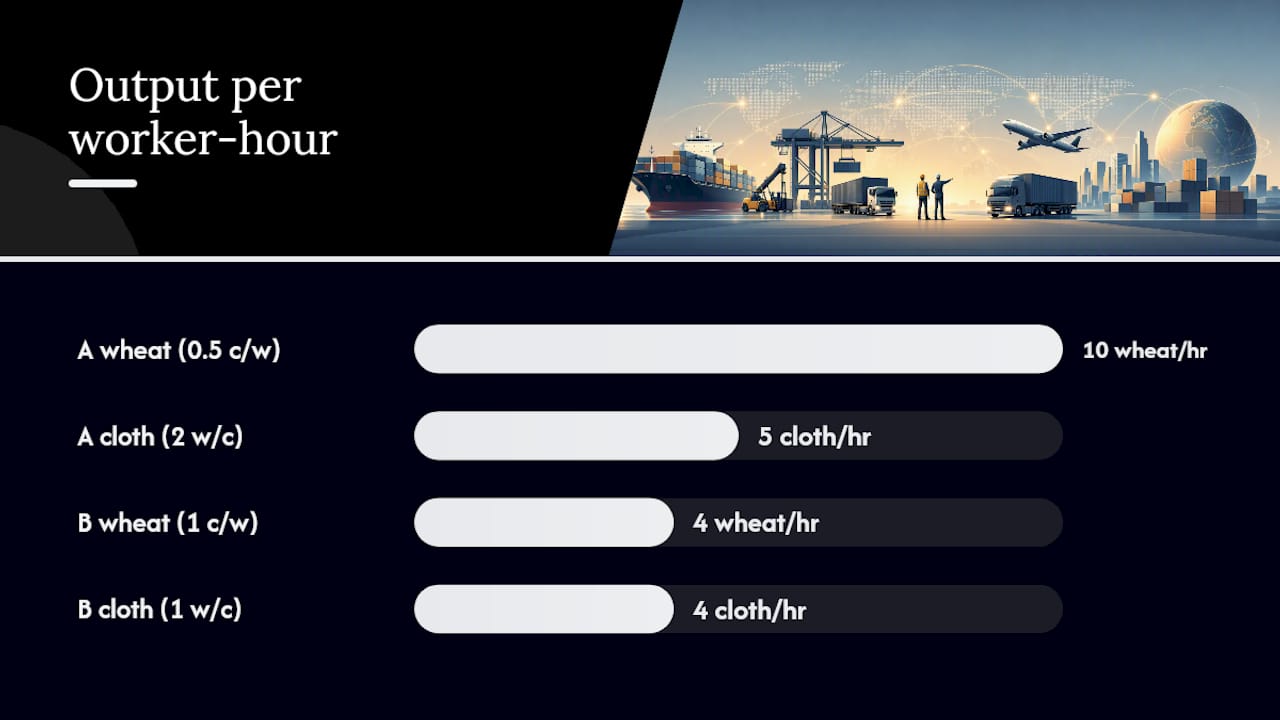
A quick example makes it concrete. Suppose Country A can produce either 10 units of wheat or 5 units of cloth per worker-hour, while Country B produces 4 units of wheat or 4 units of cloth. Country A has an absolute advantage in both. But Country B’s opportunity cost of producing wheat, measured in cloth given up, is lower than Country A’s. Both countries gain by specializing according to comparative advantage and trading. The University of Minnesota’s international business text walks through this logic as the foundation of trade theory.
The Heckscher-Ohlin model extended this by tying comparative advantage to factor endowments: countries rich in capital tend to export capital-intensive goods, while labor-abundant countries export labor-intensive ones. Modern firm-based theories, associated with economists like Paul Krugman, explain something Heckscher-Ohlin can’t: why similar countries trade similar products with each other, like Germany and France both exporting and importing cars. The answer lies in increasing returns to scale and product differentiation, not factor endowments.
What this means in practice:
- Firms should specialize around genuine cost or scale advantages, not just familiar product lines.
- Governments gain little by protecting industries with no underlying comparative advantage.
- Intra-industry trade between similar economies is normal and expected, not a sign of inefficiency.
Pro Tip: When evaluating a new export market, ask which theory actually explains your advantage there. A cost edge points to comparative advantage; a specialized niche product points to the firm-based model, and each implies a different market entry strategy.
What Institutions and Policies Govern Global Trade?
The World Trade Organization sets the multilateral rulebook that most countries operate under, and its most consequential recent achievement is procedural rather than tariff-related. The Trade Facilitation Agreement, which the ICC and WTO jointly promoted, streamlines the movement, release, and clearance of goods and pushes customs authorities toward greater cooperation.
Free trade agreements (FTAs) and regional trade agreements (RTAs) go further than WTO baseline rules, cutting tariffs between specific partners and setting rules of origin that determine which goods actually qualify for preferential treatment. A shirt assembled in one country from fabric woven in another might or might not qualify for a trade agreement’s lower tariff, depending entirely on where enough “originating” value was added.
Common policy tools you’ll encounter include:
- Tariffs, taxes applied to imported goods at the border
- Quotas, which cap the physical quantity of a good that can enter
- Sanitary and phytosanitary (SPS) measures and technical barriers to trade (TBT), covering health, safety, and product standards
- Anti-dumping duties, imposed when a foreign producer sells below fair value
- Safeguard measures, temporary protections against import surges
The International Chamber of Commerce plays a distinct role here: rather than setting tariff policy, it maintains the private-sector standards, like Incoterms®, that make cross-border contracts enforceable and predictable regardless of which country’s courts might get involved.
How Do Incoterms, HS Codes, and Customs Actually Work?
Trade theory explains why a shipment should cross a border. Operations determine whether it actually does, cleanly and on schedule. Incoterms® 2020, maintained by the ICC, are the standardized three-letter terms that allocate cost and risk between buyer and seller at each stage of a shipment. A term like FOB (Free on Board) shifts risk to the buyer once goods pass the ship’s rail, while DDP (Delivered Duty Paid) keeps the seller responsible all the way to the buyer’s door, duties included. Getting this wrong is one of the most common and costly mistakes in cross-border deals, because it decides who pays for a customs hold or an ocean freight delay nobody planned for.
Every shipment also needs a documentation package, and missing paperwork stalls cargo at the border faster than almost anything else:
- Commercial invoice, stating the transaction value and terms of sale
- Packing list, detailing exactly what’s in each container or carton
- Bill of lading (ocean) or air waybill (air freight), the transport contract and title document
- Certificate of origin, supporting preferential tariff claims under a trade agreement
- Export filings like the U.S. Electronic Export Information (EEI) through the Automated Export System (AES), and import processing through the Automated Commercial Environment (ACE)
Harmonized System (HS) codes classify every traded product on a standardized six-digit international base, extended further by individual countries. The code determines the duty rate, whether the product needs a special license, and whether it qualifies for a trade agreement’s preferential rate. Misclassify a product and you either overpay duties for years or trigger a customs audit that holds up future shipments too.
Beyond paperwork, the physical logistics decision matters just as much: ocean freight is cheaper but slower, air freight costs more but compresses transit time from weeks to days, and cargo insurance protects against loss or damage during transit regardless of mode. Shipment tracking and visibility tools have become table stakes rather than a premium feature, since a customs delay you can’t see coming is far worse than one you can plan around.
Pro Tip: Before you quote a customer a landed price, confirm the HS code with a broker first. A single digit’s difference in classification can change the duty rate enough to erase your margin.
Do the Benefits of Trade Outweigh the Costs?
The mainstream economic case for trade is strong: comparative advantage and economies of scale generate real aggregate gains, and those gains show up for consumers as more product variety and lower prices. Intra-industry trade, countries trading similar goods back and forth, adds efficiency gains that classical theory alone doesn’t fully capture.
Public debate, though, often misreads what trade actually delivers. IMF analysis notes that popular discussion tends to celebrate exports while treating imports as a cost, when in reality imports deliver just as much of the welfare gain, by giving households and firms access to inputs and goods they couldn’t produce as cheaply at home.
The costs are real too, and they don’t fall evenly:
- Displaced workers in import-competing industries face genuine, sometimes prolonged, adjustment periods
- Regional economies built around a single declining industry absorb disproportionate pain
- Wage and job effects can widen inequality even as aggregate measures improve
Trade adjustment assistance, retraining programs, and occasionally targeted tariffs are the standard policy responses, though how well they work remains genuinely contested.
A Step-by-Step Checklist for Entering Foreign Markets
Moving from trade theory to an actual shipment means working through a sequence of concrete decisions, and skipping steps here is where most first-time exporters get burned.
- Confirm product-market fit and classify the product. Verify demand in the target market and assign the correct HS code, since duty rates and licensing requirements both flow from it.
- Check regulatory requirements at both ends. Export controls, import licenses, and destination-country standards can all block a shipment that’s otherwise ready to go.
- Choose your Incoterms® and payment method. A letter of credit protects both parties through a bank guarantee, while open account terms are faster but riskier, and the right choice depends on how well you know your counterparty.
- Select a freight forwarder or customs broker. Beyond a certain shipment volume or destination complexity, professional support pays for itself in avoided delays; the WTO’s guidance for small and medium exporters is a solid starting reference for firms new to this.
- Build in risk controls. Cargo insurance, restricted-party screening, and clean compliance recordkeeping protect the shipment and the paper trail behind it.
Pro Tip: Treat import and export compliance as two separate disciplines, not one. Import compliance is mostly about correct classification and duty payment; export compliance is about screening and control. Businesses that conflate the two often build the wrong checklist for each side of the same transaction.
How Worldwideexpress Supports Practical Trade Operations
Every operational challenge covered above, customs classification, documentation accuracy, cargo protection, shipment visibility, is exactly where trade plans break down in practice. Worldwideexpress works this ground daily across freight forwarding and customs brokerage engagements.
That experience maps directly onto the friction points this article has described:
- Customs clearance and classification support for import shipments moving through U.S. borders
- Export and import documentation assistance, from commercial invoices to certificates of origin
- Cargo insurance options to cover loss or damage across ocean, air, and trucking modes
- Shipment tracking so a delay gets caught early instead of discovered at delivery
Readers who want to go deeper into any single piece of this, from HS code accuracy to full documentation checklists, will find more detail in Worldwideexpress’s own guides.
Turning Trade Theory Into a Working Plan
Comparative advantage explains why a shipment makes economic sense; Incoterms®, HS codes, and customs filings determine whether it actually clears the border on time. The two halves of this article aren’t separate subjects, they’re the same trade viewed from a classroom and from a loading dock. A business ready to act should start with the concrete steps, not the theory.
Immediate next moves:
- Confirm your product’s HS code before quoting any price to a buyer
- Choose your Incoterms® deliberately, not by default from a template contract
- Talk to a customs broker before your first shipment, not after a hold-up
- Review whether trade finance, like a letter of credit, fits your buyer relationship
Worldwideexpress’s shipping documentation checklist is a practical place to start turning this into a working plan.
Why Operational Discipline Matters More Than Theory Alone
The gap in most trade education is that it stops at theory. Comparative advantage tells you a trade should happen. It says nothing about whether the shipment clears customs, whether the Incoterm you picked leaves you holding an unexpected insurance bill, or whether your HS code survives an audit. That gap is where businesses actually lose money, and it’s underserved by most explainers on this subject.
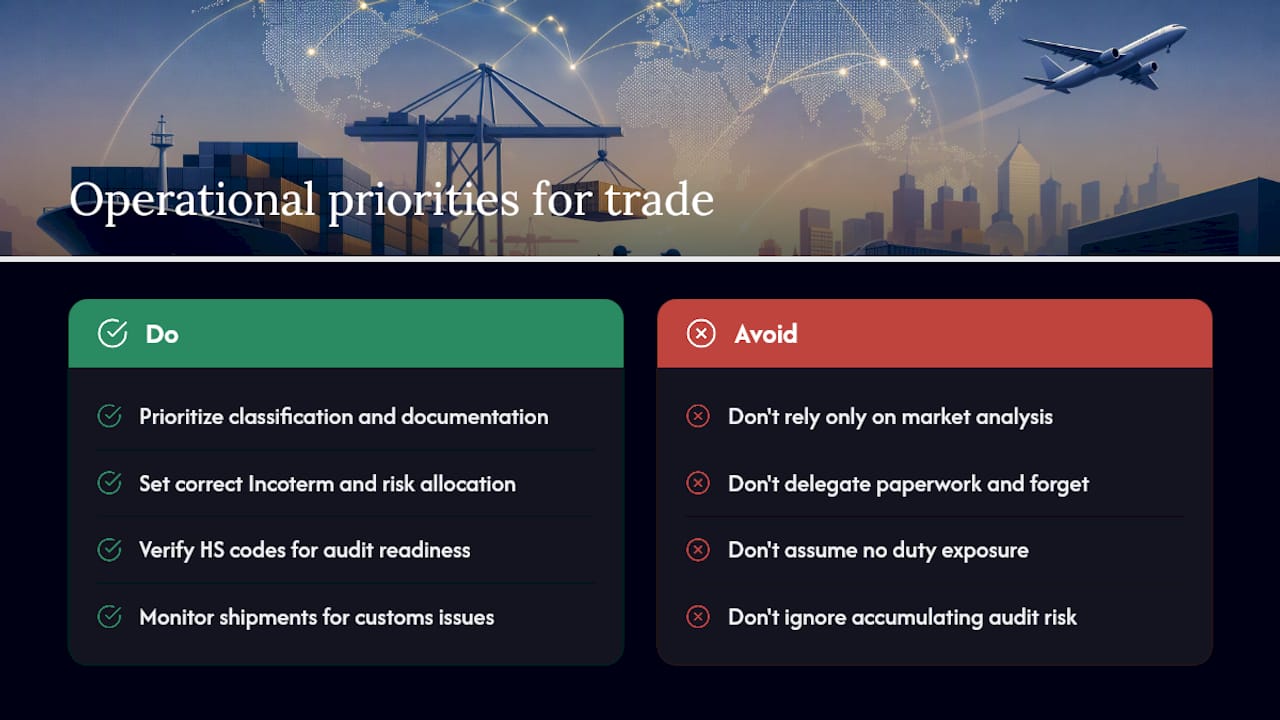
The conventional advice, “understand your market, know your costs, find a good partner,” isn’t wrong, but it’s incomplete to the point of being unhelpful. What the research behind this article actually supports is narrower and more useful: get the classification and the risk allocation right before you worry about anything else. A perfect market analysis paired with the wrong HS code or a poorly chosen Incoterm still costs you money, sometimes for years, since duty overpayments and audit exposure compound quietly in the background.
If there’s one priority for a reader new to this, it’s this: treat documentation and classification as core strategy, not paperwork to delegate and forget. The firms that struggle aren’t the ones with weak market analysis. They’re the ones who got the operational basics wrong at the start and didn’t notice until a shipment sat in a customs hold.
— Ian
Ready to Move From Trade Theory to Your Next Shipment?
Worldwideexpress is the practical alternative to piecing together customs brokerage, freight booking, and documentation review across separate vendors. Where most businesses juggle a broker, a forwarder, and an insurance provider as three disconnected relationships, Worldwideexpress handles customs clearance, air and ocean transportation, cargo insurance, and export documentation under one coordinated engagement.
That matters most for the exact friction points this article covered: a misclassified HS code, an Incoterm that leaves you exposed, a shipment you can’t track once it leaves the dock. Worldwideexpress’s customs brokerage services are built specifically to catch classification and compliance issues before they turn into delays or duty overpayments, and the freight forwarding guide walks through how air, ocean, and trucking options fit different shipment profiles.
If you’re preparing your first cross-border shipment, or reworking a supply chain that’s outgrown its current setup, request a freight quote from Worldwideexpress and get a customs and logistics plan built around your actual product and route.
Sources
- 2.1 What Is International Trade Theory? – International Business
- OECD — Global value and supply chains