Nearly 60 percent of American companies have faced major supply chain disruptions in recent years, highlighting the urgent need for resilient strategies. From economic turbulence to digital threats, these risks can impact profits and reputation overnight. Understanding supply chain risk management principles is crucial for every American business leader who wants to minimize losses, strengthen partnerships, and stay competitive in a world where change is constant.
Table of Contents
- Defining Supply Chain Risk Management Principles
- Types of Supply Chain Risks in Trade
- Key Strategies for Mitigating Disruptions
- Compliance, Insurance, and Legal Requirements
- Avoiding Costly Mistakes and Ensuring Resilience
Key Takeaways
| Point | Details |
|---|---|
| Proactive Risk Management | Organizations must adopt comprehensive risk assessment and continuous monitoring to anticipate potential supply chain disruptions. |
| Diversification Strategy | Building multiple supplier relationships and avoiding reliance on single sources helps minimize risks and enhances resilience. |
| Technological Integration | Investing in real-time tracking and predictive analytics is crucial for early detection of vulnerabilities within the supply chain. |
| Compliance and Legal Awareness | Developing robust compliance strategies is essential to navigate regulatory obligations and mitigate legal risks across different jurisdictions. |
Defining Supply Chain Risk Management Principles
Supply Chain Risk Management (SCRM) represents a strategic approach to identifying, assessing, and mitigating potential disruptions within complex global trade networks. At its core, SCRM involves proactively analyzing vulnerabilities across every stage of product lifecycle – from initial design through final distribution. Organizations implementing robust supply chain risk management strategies can dramatically reduce their exposure to unexpected operational challenges.
The fundamental principles of SCRM revolve around comprehensive risk assessment and continuous monitoring. This involves systematically evaluating potential threats across multiple dimensions: geopolitical instability, economic fluctuations, technological disruptions, transportation infrastructure challenges, and regulatory compliance issues. Comprehensive risk identification requires businesses to map out their entire supply chain ecosystem, understanding interdependencies between suppliers, manufacturers, logistics providers, and end distributors.
Effective Supply Chain Risk Management demands a holistic approach that transcends traditional reactive models. Modern organizations must develop dynamic strategies for managing everyday and exceptional risks, creating adaptive frameworks that can quickly respond to emerging challenges. This includes developing contingency plans, maintaining flexible supplier networks, implementing advanced tracking technologies, and establishing clear communication protocols across all supply chain stakeholders.
Pro Tip – Strategic Risk Management: Create a comprehensive risk assessment matrix that categorizes potential disruptions by likelihood and potential impact, allowing your organization to prioritize mitigation strategies and allocate resources most effectively.
Types of Supply Chain Risks in Trade
Supply chain risks represent complex and multifaceted challenges that can significantly disrupt global trade operations. These risks span numerous dimensions, ranging from technological vulnerabilities to geopolitical uncertainties. Technological advancements and digital system threats pose critical challenges, requiring businesses to continuously adapt their systems and security protocols to mitigate potential disruptions.
The landscape of supply chain risks encompasses several key categories. Operational risks include natural disasters, transportation infrastructure failures, and regional unrest that can interrupt product movement. Technological risks involve cybersecurity threats, data breaches, and system compatibility challenges. Economic risks relate to currency fluctuations, unexpected market shifts, and supplier financial instability. Compliance risks emerge from changing regulatory environments, trade restrictions, and international legal complexities.
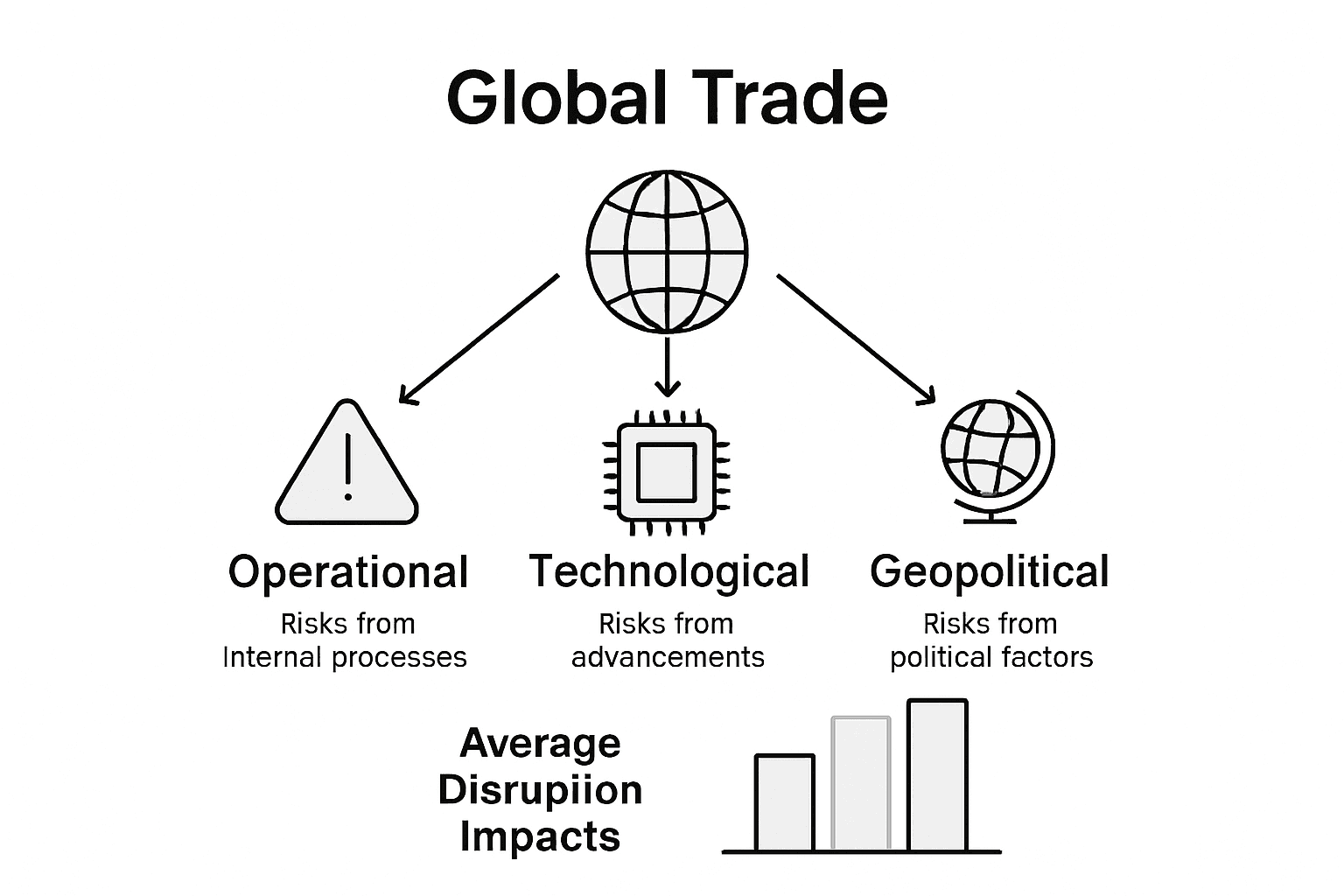
Moreover, supply chain risks extend beyond immediate operational concerns. Interconnectivity challenges create cascading disruption potentials, where a single point of failure can generate widespread systematic breakdowns. Critical risk factors include over-reliance on single suppliers, limited visibility across multiple supplier tiers, synchronization problems, and inventory management limitations. Organizations must develop robust risk assessment frameworks that anticipate potential vulnerabilities and create adaptive strategies to maintain resilience.
Here’s a summary of key supply chain risk categories and their typical business impact:
| Risk Category | Common Causes | Typical Impact on Business |
|---|---|---|
| Operational | Natural disasters, strikes, delays | Production stoppages, unmet demand |
| Technological | Cyberattacks, software failures | Data loss, system downtime |
| Economic | Currency shifts, supplier insolvency | Price volatility, procurement issues |
| Compliance | Regulatory changes, legal updates | Fines, shipment delays, reputational risk |
| Interconnectivity | Over-reliance, limited visibility | Widespread disruptions, lack of control |
Pro Tip – Risk Assessment Strategy: Develop a comprehensive risk matrix that quantifies potential disruptions by probability and potential impact, enabling targeted mitigation strategies and resource allocation across your supply chain ecosystem.
Key Strategies for Mitigating Disruptions
Supply chain resilience demands proactive and strategic approaches to managing potential vulnerabilities. Increasing capacity through decentralized and centralized strategies represents a critical first step in developing robust risk mitigation frameworks. Organizations must balance cost efficiency with operational flexibility, creating adaptive systems that can quickly respond to unexpected challenges.
Diversification emerges as a fundamental strategy for minimizing supply chain risks. This involves developing multiple supplier relationships, avoiding over-reliance on single sources, and creating redundant pathways for critical components. Strategic supplier management goes beyond simple transactional relationships, focusing on building collaborative partnerships that drive innovation and shared risk mitigation. Structured supplier management approaches enable businesses to continuously assess and improve their supply chain resilience.
Technological integration and advanced monitoring systems play a crucial role in disruption mitigation. Companies should invest in real-time tracking technologies, predictive analytics, and comprehensive risk assessment tools that provide early warning signals of potential disruptions. This includes developing sophisticated inventory management strategies, creating flexible logistics networks, and establishing rapid response protocols that can quickly redirect resources when challenges emerge.
Pro Tip – Resilience Planning: Conduct quarterly comprehensive risk assessments that map potential disruption scenarios, simulate response strategies, and continuously update your supply chain contingency plans to stay ahead of emerging challenges.
This table contrasts proactive and reactive supply chain risk approaches:
| Approach Type | Key Characteristics | Outcome for Organization |
|---|---|---|
| Proactive | Continuous monitoring, scenario planning | Faster recovery, minimized losses |
| Reactive | Responds after disruptions occur | Longer disruptions, higher costs |
Compliance, Insurance, and Legal Requirements
Supply chain legal frameworks represent a complex landscape of regulatory obligations that businesses must navigate carefully. Compliance risks encompass multiple critical dimensions, including international sanctions, export controls, customs regulations, and ethical sourcing requirements. Organizations must develop comprehensive compliance strategies that address potential legal vulnerabilities across different jurisdictions and operational contexts.
Key legal considerations include managing sanctions and export controls, ensuring adherence to international trade regulations, and maintaining rigorous documentation practices. Businesses must conduct thorough due diligence on suppliers, verifying their compliance with human rights standards, labor regulations, and anti-corruption guidelines. This involves implementing robust screening processes, conducting regular supplier audits, and establishing clear contractual frameworks that define legal expectations and potential consequences for non-compliance.
Regulatory compliance technologies play an increasingly critical role in managing legal risks. Advanced data analytics, blockchain verification systems, and integrated compliance management platforms enable organizations to track and validate supplier credentials, monitor regulatory changes, and quickly adapt to evolving legal landscapes. Insurance strategies must complement these technological approaches, providing financial protection against potential legal and operational disruptions through comprehensive risk transfer mechanisms.
Pro Tip – Compliance Management: Develop a centralized compliance tracking system that integrates legal, regulatory, and ethical requirements, enabling real-time monitoring and proactive risk mitigation across your entire supply chain ecosystem.
Avoiding Costly Mistakes and Ensuring Resilience
Successful supply chain management requires a proactive approach to identifying and mitigating potential vulnerabilities before they escalate into significant disruptions. Organizations must develop sophisticated strategies that go beyond traditional risk management, creating adaptive systems capable of responding quickly to unexpected challenges. Cultivating diversity in demand and supply networks represents a fundamental strategy for building organizational resilience, allowing businesses to distribute risk and maintain operational flexibility.

Common costly mistakes often stem from over-centralization, lack of comprehensive visibility, and insufficient contingency planning. Strategic redundancy becomes critical in preventing systemic failures, which means developing multiple sourcing pathways, maintaining strategic inventory buffers, and creating cross-functional response teams trained to address potential disruptions. This approach requires continuous monitoring, real-time data analysis, and a willingness to invest in adaptive technologies that provide early warning signals of potential supply chain vulnerabilities.
Technological integration plays a crucial role in building resilient supply chain ecosystems. Advanced predictive analytics, artificial intelligence-driven monitoring systems, and comprehensive risk assessment platforms enable organizations to anticipate potential challenges, simulate disruption scenarios, and develop nuanced mitigation strategies. These technologies provide unprecedented insights into supply chain dynamics, allowing businesses to make data-driven decisions that minimize operational risks and optimize resource allocation.
Pro Tip – Resilience Mapping: Create a comprehensive risk assessment matrix that quantifies potential disruptions by likelihood and potential impact, enabling targeted mitigation strategies and proactive resource allocation across your entire supply chain network.
Strengthen Your Supply Chain With Trusted Global Logistics Solutions
Supply Chain Risk Management demands a proactive and comprehensive approach to reduce vulnerabilities like operational delays, compliance pitfalls, and technological disruptions. If your business struggles with the complexities of global trade, such as navigating customs clearance, managing supplier diversity, or maintaining real-time shipment visibility, you are not alone. Key concepts like risk assessment, dynamic mitigation strategies, and regulatory compliance from the article highlight critical areas where expert logistics support can make all the difference.
Worldwide Express understands these challenges deeply and offers tailored international shipping solutions that integrate customs brokerage, cargo insurance, and advanced global tracking. Our commitment to operational flexibility and compliance ensures your supply chain can swiftly adapt to disruptions while minimizing costly delays or legal risks. Explore how our customs brokerage and freight forwarding services provide the resilient foundation your business needs. Act now to protect your global trade operations and turn supply chain risks into competitive advantages by partnering with Worldwide Express. Visit Worldwide Express today to get started.
Ready to transform your supply chain resilience? Connect with Worldwide Express to discover customized logistics strategies that safeguard your business against disruption and compliance challenges. Let us help you stay ahead in the dynamic world of international trade.
Frequently Asked Questions
What is Supply Chain Risk Management (SCRM)?
Supply Chain Risk Management (SCRM) is a strategic approach focused on identifying, assessing, and mitigating potential disruptions in global trade networks. It involves proactive analysis of vulnerabilities throughout the entire product lifecycle.
What are the main types of supply chain risks?
The main types of supply chain risks include operational risks (natural disasters, transportation failures), technological risks (cybersecurity threats), economic risks (currency fluctuations), compliance risks (regulatory changes), and interconnectivity risks (over-reliance on single suppliers).
How can organizations improve their supply chain resilience?
Organizations can improve their supply chain resilience by diversifying supplier relationships, implementing advanced monitoring technologies, maintaining flexible logistics networks, and conducting regular comprehensive risk assessments to prepare for potential disruptions.
What role does compliance play in Supply Chain Risk Management?
Compliance is crucial in SCRM as it encompasses adherence to various legal and regulatory obligations, including sanctions, export controls, and ethical sourcing requirements. Effective compliance management helps mitigate legal risks and ensures operational continuity.
Recommended
- Supply Chain Visibility: Driving Efficiency in Logistics – Worldwide Express, Inc.
- Understanding Trade Finance Solutions: A Clear Guide – Worldwide Express, Inc.
- Green Supply Chains: Everything You Need to Know – Worldwide Express, Inc.
- Understanding International Trade Compliance Basics – Worldwide Express, Inc.
- Machine Translation Risks 2025: Security and Compliance Impact