Staying compliant with complex American import license requirements is a daily reality for most logistics managers. A single missing form or misclassified product could lead to hefty delays or fines, with over 60 percent of shipment holds in the United States linked to documentation errors. Understanding which goods trigger specialized permits and which clear with basic paperwork is critical for anyone responsible for cross-border shipments. This guide brings clarity to the core procedures and the agencies that define American trade compliance.
Table of Contents
- Defining Import License Requirements For U.S. Trade
- Major Types Of U.S. Import Licenses Explained
- Application Process And Key Documentation Steps
- Federal Agencies And Legal Compliance Standards
- Common Pitfalls And Compliance Risks For Importers
Key Takeaways
| Point | Details |
|---|---|
| Understanding Licensing Requirements | Certain products require specific import licenses and documentation, while most do not. Familiarize yourself with your product category’s requirements early on. |
| Role of Federal Agencies | Different federal agencies regulate imports based on product type, with each having unique compliance standards. Know which agency oversees your imports to ensure compliance. |
| Importance of Accurate Documentation | Errors in product classification or documentation can lead to penalties or shipment issues. Keep meticulous records and verify all paperwork before filing. |
| Proactive Compliance Measures | Implement regular audits and maintain a compliance matrix to track regulatory obligations. This minimizes risks and ensures adherence to evolving import regulations. |
Defining Import License Requirements for U.S. Trade
Import license requirements are critical administrative procedures that govern how goods enter the United States, with significant implications for logistics managers and international trade professionals. These requirements represent a complex system designed to regulate product entry while maintaining national safety and economic standards. Import licensing systems serve as administrative checkpoints where specific documentation and approvals are mandatory before commercial goods can cross U.S. borders.
Most import transactions do not require specialized licenses, but certain product categories demand stringent documentation and agency approvals. Federal agencies like the U.S. Customs and Border Protection (CBP) play a pivotal role in enforcing these regulations. Specific industries such as agricultural products, pharmaceuticals, defense technologies, and hazardous materials typically require more comprehensive licensing processes. These requirements help ensure product safety, protect domestic industries, and maintain national security protocols.
The licensing process varies significantly depending on the product type and intended use. Some licenses are considered automatic, functioning primarily as monitoring mechanisms, while others are non-automatic and impose strict control measures. Non-automatic licenses might restrict quantities, mandate specific safety certifications, or require detailed documentation proving the product meets U.S. regulatory standards. Importers must work closely with relevant federal agencies to understand and comply with these nuanced requirements.
Pro tip: Always consult the specific federal agency regulating your product category at least 60 days before planned import to ensure complete compliance and avoid potential shipping delays.
Major Types of U.S. Import Licenses Explained
U.S. import licenses represent a critical regulatory mechanism designed to control and monitor goods entering the national marketplace. While not every imported product requires a specialized license, certain categories demand rigorous documentation and agency approvals. The Harmonized Tariff Schedule classification system plays a pivotal role in determining specific licensing requirements for different product types, providing a standardized framework for identifying import regulations.
The primary categories of U.S. import licenses can be broadly classified into several key types. Automatic licenses function primarily as monitoring tools, allowing imports with minimal restrictions while tracking commercial movements. Non-automatic licenses impose stricter control measures, often related to national security, public health, or economic protection. The U.S. Bureau of Industry and Security issues these licenses based on comprehensive evaluations of the item, its intended end-use, and the involved parties.
Specific industries face more complex licensing requirements. Agricultural products, pharmaceuticals, defense technologies, and hazardous materials typically require extensive documentation. These licenses help ensure product safety, protect domestic industries, and maintain national security protocols. Each license type comes with unique conditions, potentially including quantity restrictions, mandatory safety certifications, or detailed documentation proving compliance with U.S. regulatory standards.
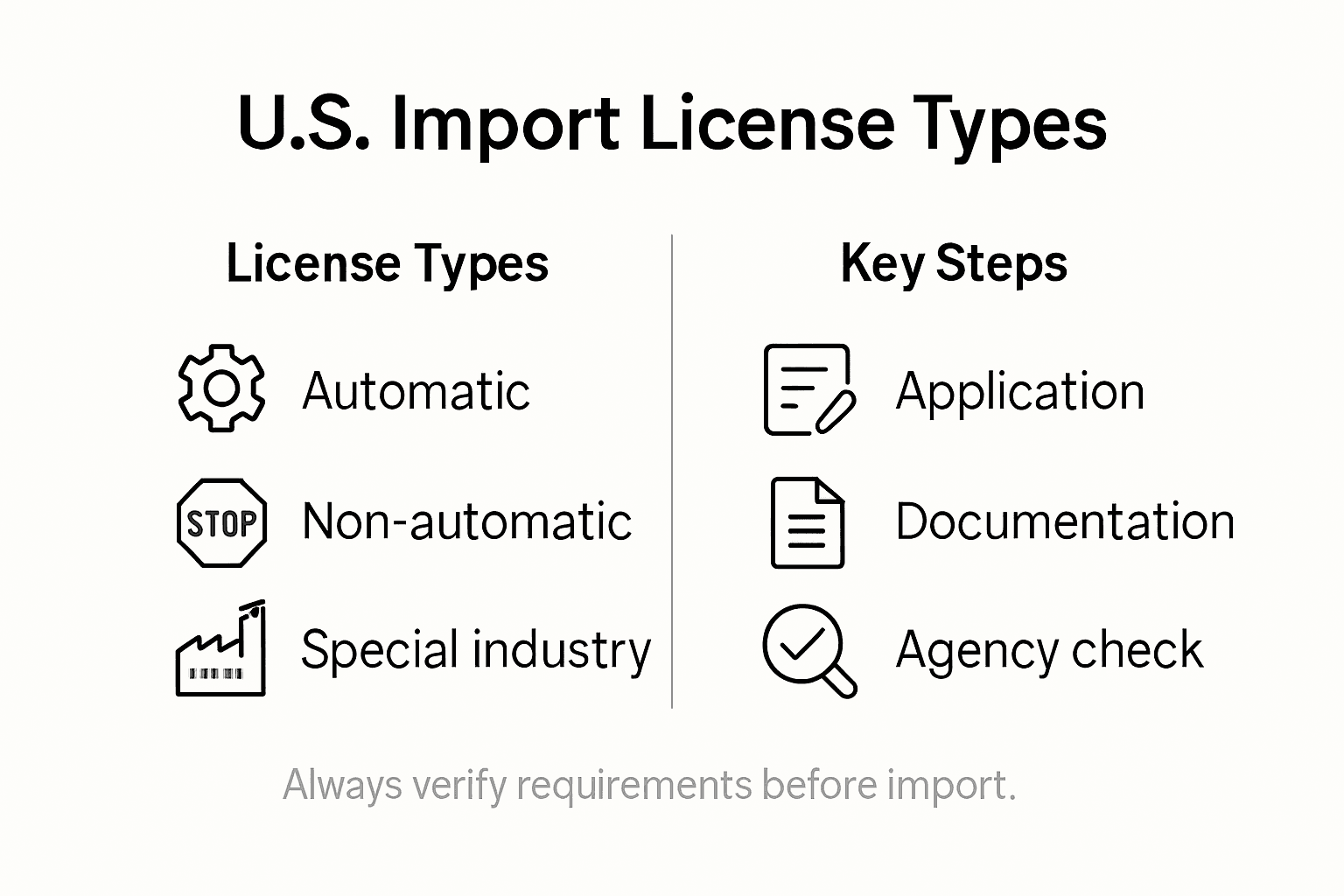
Here is a comparison of automatic and non-automatic U.S. import licenses:
| License Type | Main Purpose | Typical Restrictions | Example Products |
|---|---|---|---|
| Automatic License | Monitor trade flow | Minimal, mainly reporting | Consumer electronics |
| Non-Automatic License | Restrict/control sensitive goods | Quantity, safety, agency permits | Pharmaceuticals, defense tech |
Pro tip: Maintain a comprehensive digital and physical file of all import license documentation, organized by product category and renewal dates to streamline future import processes and facilitate quick agency communications.
Application Process and Key Documentation Steps
Navigating the U.S. import license application process requires meticulous attention to detail and understanding of complex federal regulations. Importers must first identify the specific federal agency responsible for regulating their product category, as each agency maintains unique application procedures and documentation requirements. U.S. Customs and Border Protection’s import filing process provides a comprehensive framework for electronic submission through the Automated Commercial Environment (ACE) system, which must be completed within 15 days of merchandise arrival.
The documentation requirements for import licenses typically involve several critical components. Importers must prepare comprehensive paperwork including accurate product classification, detailed commercial invoices, certificates of origin, and potentially specialized permits depending on the commodity. Businesses without an existing IRS registration number can request a CBP-assigned identifier by completing Form 5106, which enables them to legally process import transactions. The specific documentation varies across industries, with agricultural products, pharmaceuticals, and technology transfers requiring more extensive supporting materials.

Electronic filing has significantly streamlined the import license application process, allowing businesses to submit required documentation more efficiently. Importers must ensure precise classification of goods, accurate calculation of applicable duties and fees, and compliance with all relevant federal agency regulations. Some commodities may require additional permits from multiple government agencies, making thorough research and preparation essential for successful import operations.
Pro tip: Develop a comprehensive digital filing system that tracks all import license documentation, renewal dates, and agency communication to minimize processing delays and ensure consistent compliance.
Federal Agencies and Legal Compliance Standards
The U.S. import regulatory landscape involves a complex network of federal agencies, each responsible for enforcing specific legal compliance standards across different product categories. U.S. Customs and Border Protection coordinates with multiple partner government agencies to ensure comprehensive oversight of imported goods, creating a multilayered compliance framework that demands meticulous attention from importers.
Key federal agencies play critical roles in regulating imports, with each maintaining unique enforcement protocols and documentation requirements. The Department of Agriculture (USDA) oversees agricultural products, the Food and Drug Administration (FDA) monitors food and pharmaceutical imports, and the Environmental Protection Agency (EPA) ensures environmental safety standards for products ranging from vehicles to chemical imports. These agencies establish specific guidelines that importers must navigate, including detailed certification processes, safety inspections, and compliance documentation.
Environmental and safety regulations represent particularly complex areas of import compliance. The EPA enforces stringent requirements under laws like the Toxic Substances Control Act and Clean Air Act, requiring importers to submit comprehensive documentation proving their products meet U.S. environmental and safety standards. Companies must be prepared to provide detailed certificates, conduct required testing, and demonstrate full compliance with federal regulatory frameworks, which can vary significantly across different product categories and industries.
Here is a summary of key federal agencies involved in U.S. import compliance:
| Agency | Regulated Product Types | Primary Compliance Focus |
|---|---|---|
| U.S. Customs and Border Protection (CBP) | All imported goods | Entry procedures, tariff enforcement |
| Department of Agriculture (USDA) | Agricultural products | Plant/animal health, pest control |
| Food and Drug Administration (FDA) | Food, drugs, medical devices | Public health, product safety |
| Environmental Protection Agency (EPA) | Chemicals, vehicles, industrial goods | Environmental standards, hazardous materials |
Pro tip: Develop a comprehensive compliance matrix that tracks specific regulatory requirements for each product category across different federal agencies to streamline your import documentation and minimize potential regulatory challenges.
Common Pitfalls and Compliance Risks for Importers
Navigating the complex landscape of import regulations requires a strategic approach to avoid potentially costly compliance mistakes. Customs and Border Protection’s Import Safety initiative highlights the critical importance of understanding and mitigating potential risks before they escalate into significant legal and financial challenges. Importers face a minefield of potential regulatory violations that can result in substantial penalties, product detention, or even complete shipment seizure.
The most common compliance pitfalls typically stem from three primary areas of vulnerability. Misclassification of goods remains a critical error that can trigger immediate regulatory scrutiny, potentially leading to unexpected duties, fines, or legal complications. Documentation errors represent another significant risk, where incomplete or inaccurate paperwork can halt entire shipments and create substantial supply chain disruptions. Product safety standards pose the third major challenge, with importers required to demonstrate absolute compliance with complex federal regulations across multiple agencies.
International trade compliance demands a proactive and comprehensive approach to risk management. Importers must develop robust internal systems that continuously monitor regulatory changes, verify documentation accuracy, and ensure products meet evolving safety standards. This includes maintaining detailed records, conducting regular internal audits, and establishing clear communication channels with relevant federal agencies. Companies that invest in comprehensive compliance infrastructure can significantly reduce their exposure to potential legal and financial risks associated with import operations.
Pro tip: Implement a quarterly compliance review process that cross-references your import documentation against the most current federal regulatory requirements to preemptively identify and resolve potential compliance vulnerabilities.
Simplify Your Import License Compliance with Expert Logistics Support
Struggling to navigate the complex U.S. import license requirements and avoid costly pitfalls? The article highlights key challenges such as product classification errors, documentation accuracy, and maintaining compliance across multiple federal agencies. Importers face the urgent need to coordinate licenses for automatic and non-automatic categories while keeping detailed records and meeting strict deadlines. These tasks can quickly become overwhelming without the right logistical partner.
At Worldwide Express, Inc., we specialize in helping businesses like yours overcome these import compliance obstacles. Our customs brokerage and freight forwarding services ensure all necessary licenses, permits, and documentation are accurately prepared and submitted. We provide tailored logistics solutions that streamline customs clearance, manage regulatory paperwork, and facilitate smooth global shipping operations.
Take control of your import process now by partnering with trusted experts who understand the intricacies of U.S. trade regulations. Visit our customs brokerage page to learn how we can simplify compliance management and boost your international shipping efficiency. Don’t let import license complexities delay your business growth. Get started today at Worldwide Express.
Frequently Asked Questions
What are import license requirements for U.S. trade?
Import license requirements are administrative procedures that regulate how goods enter the U.S. They ensure compliance with national safety and economic standards, often involving documentation and approval by federal agencies.
Do all products require an import license to enter the U.S.?
No, most import transactions do not require specialized licenses. However, certain categories of products, such as agricultural goods, pharmaceuticals, and defense technologies, require additional documentation and agency approvals.
What are the differences between automatic and non-automatic import licenses?
Automatic licenses serve mainly as monitoring tools with minimal restrictions, while non-automatic licenses impose stricter control measures related to public health, security, or economic protection, often requiring detailed documentation.
Which federal agencies are responsible for enforcing import compliance?
Key federal agencies include U.S. Customs and Border Protection (CBP), the Department of Agriculture (USDA), the Food and Drug Administration (FDA), and the Environmental Protection Agency (EPA), each focusing on specific product categories and compliance standards.
Recommended
- Master Importing Food Products: Step-by-Step US Guide – Worldwide Express, Inc.
- Complete Guide to Export Controls Basics for U.S. Trade – Worldwide Express, Inc.
- Understanding International Trade Compliance Basics – Worldwide Express, Inc.
- Mastering Your Export License Application Process – Worldwide Express, Inc.