Most American logistics managers know that even one missing document can cause days of costly delays at customs. With import volumes rising and compliance regulations getting stricter, the pressure to process shipments quickly and accurately has never been higher. This guide breaks down the step-by-step strategies American companies need for organizing documents, vetting customs brokers, and securing power of attorney in order to reduce risk and keep cargo moving smoothly.
Table of Contents
- Step 1: Gather Required Company And Shipment Documents
- Step 2: Select And Vet A Licensed Customs Broker
- Step 3: Prepare And Complete Power Of Attorney Forms
- Step 4: Authorize Customs Broker To Act On Your Behalf
- Step 5: Verify Successful Submission And Confirm Compliance
Quick Summary
| Key Point | Explanation |
|---|---|
| 1. Compile Essential Shipment Documents | Gather business registration, IRS documents, and Customs Form 5291 to authorize your customs broker for clearance. |
| 2. Choose a Qualified Customs Broker | Vet potential brokers by checking licensing compliance, experience, and request references to ensure reliability. |
| 3. Correctly Complete Power of Attorney | Use Customs Form 5291 accurately with your business information and define authorization limits for your broker. |
| 4. Authorize Broker with Clear Agreement | Ensure the authorization specifies broker actions, includes your business details, and prohibits third-party involvement. |
| 5. Confirm Compliance and Documentation | Validate that all paperwork is completed correctly, ensuring no discrepancies that may delay customs clearance. |
Step 1: Gather required company and shipment documents
Customs clearance begins with meticulous document preparation. Your goal is to compile a comprehensive packet of paperwork that validates your shipment and authorizes customs brokers to act on your behalf.
Start by collecting critical documents that validate power of attorney details. You will need several key items: your company’s business registration documents, a government issued photo identification for the authorized representative, your company’s IRS documentation, and a completed Customs Form 5291. This form specifically grants your customs broker legal permission to manage import transactions.
Ensure your documentation packet includes precise identification information. Your documents must clearly display the legal business name, physical address, importer number, and contact details. Cross reference these materials against your official business records to prevent any potential discrepancies that could delay shipment processing. The US Customs and Border Protection requires exact matching information to expedite clearance.
Pro Tip: Create a standardized document checklist and digital backup of all critical paperwork to streamline future import processes and protect against potential loss.
This reference table summarizes key documents needed for customs clearance:
| Document Type | Purpose | Issued By |
|---|---|---|
| Business Registration | Verifies company legitimacy | State or local government |
| IRS Documentation | Confirms federal tax ID | Internal Revenue Service |
| Government Photo ID | Proves representative identity | State, federal authority |
| Customs Form 5291 | Grants broker legal authority | U.S. Customs and Border Protection |
Step 2: Select and vet a licensed customs broker
Selecting the right customs broker is crucial for smooth import operations. Your objective is to find a professionally licensed expert who can navigate complex customs regulations and expedite your shipment clearance.

Begin by verifying the broker’s official licensing and compliance credentials. US Customs and Border Protection requires brokers to maintain active licenses and demonstrate ongoing regulatory compliance. Request their official licensing documentation and confirm its current status through the CBP website. Look for brokers with extensive experience in your specific cargo category and a proven track record of handling similar import transactions.
Dig deeper into the broker’s professional background by examining their transaction records, regulatory adherence, and continuing education credentials. A qualified broker should be able to provide detailed documentation showing their ability to manage complex customs processes efficiently. Pay close attention to their expertise in regulatory compliance, their understanding of import documentation requirements, and their capacity to provide comprehensive transaction management services.
Pro Tip: Request references from at least three current clients and conduct a thorough background check to ensure the broker’s reliability and performance consistency.
Step 3: Prepare and complete power of attorney forms
Preparing your power of attorney form is a critical step in authorizing your customs broker to act on your company’s behalf. Your goal is to create a legally compliant document that clearly defines the scope of representation for import transactions.
Begin by obtaining the standard Customs Form 5291 for power of attorney. This form requires precise documentation of your business details, including your official legal business name, corporate structure, physical address, and contact information. Pay special attention to accurately representing your company’s legal form whether you are a corporation, partnership, or individual entity. Ensure that the authorized representative signing the document has the legal capacity to grant power of attorney on behalf of the organization.
Complete the form with meticulous detail, specifying whether you are granting a general or limited power of attorney. A general POA provides broad authorization for all customs transactions, while a limited POA restricts the broker’s actions to specific types of shipments or transactions. Include the exact scope of authority, any time limitations, and clearly identify the appointed customs broker as your legal representative. Verify that all signatures are legally valid and comply with state regulations governing such agreements.
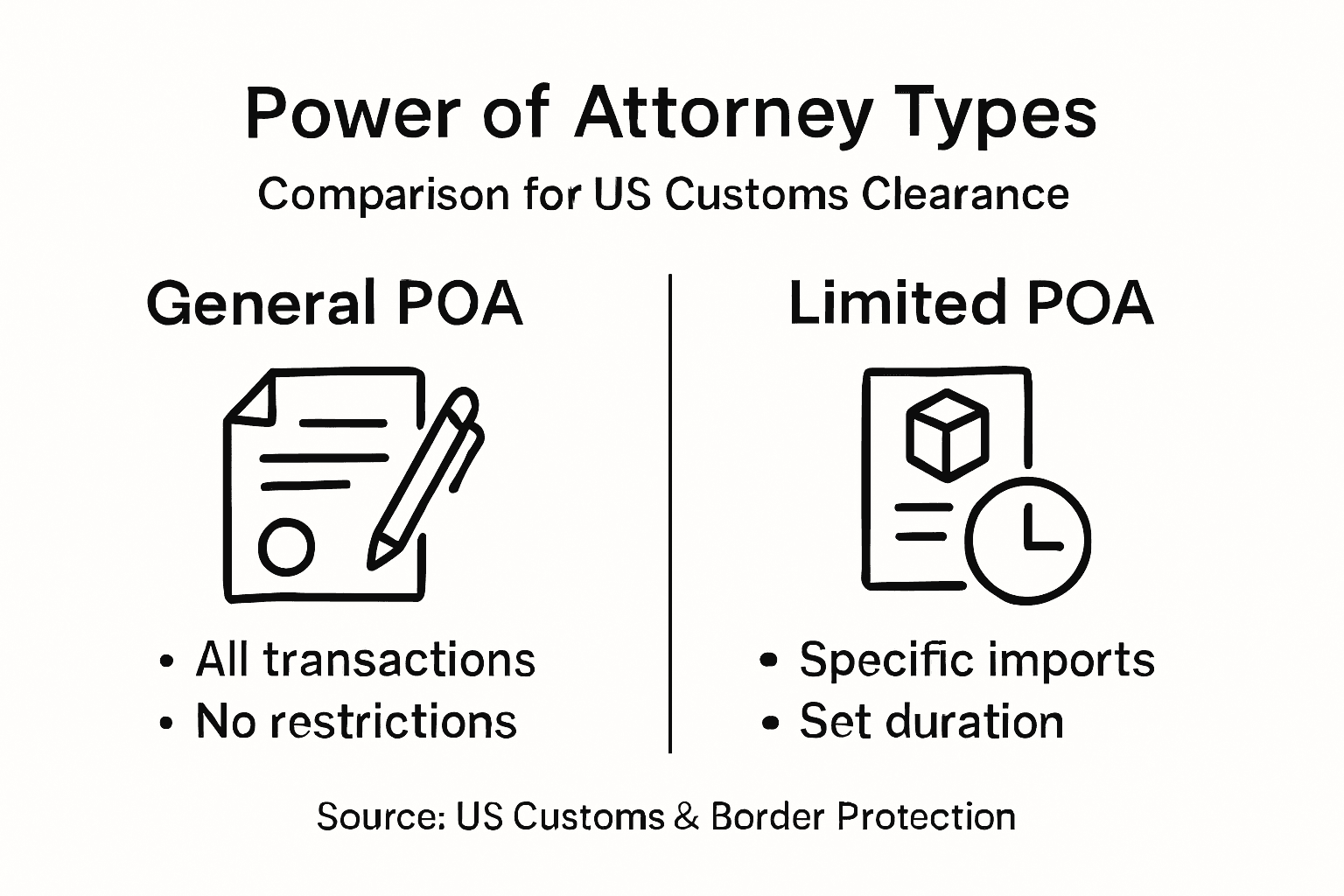
Here’s a comparison of general vs. limited power of attorney for customs clearance:
| Attribute | General Power of Attorney | Limited Power of Attorney |
|---|---|---|
| Authorization Scope | All import activities | Specific shipments only |
| Duration Flexibility | Renewed or ongoing | Often set for a period |
| Risk of Misuse | Higher if not monitored | Lower due to restrictions |
| Best For | Frequent importers | One-off or specialized shipments |
Pro Tip: Create digital and physical backup copies of your signed power of attorney form and store them in secure locations with restricted access to protect sensitive business information.
Step 4: Authorize customs broker to act on your behalf
Authorizing a customs broker requires a precise legal process that establishes their official capacity to represent your company in import transactions. Your primary objective is to create a legally binding authorization that clearly defines the broker’s operational scope.
Carefully review the legal requirements for power of attorney to ensure full compliance with federal regulations. The authorization must be direct between your company and the specific customs broker, explicitly prohibiting any third party intermediaries from intervening. Specify the exact range of actions your broker can perform, which might include filing customs entries, calculating and paying duties, and managing import documentation. Ensure the document includes comprehensive details such as your company’s full legal name, tax identification number, and the broker’s specific permissions.
Include clear terms regarding the duration of the authorization and any specific limitations on the broker’s actions. Some companies prefer a limited power of attorney that restricts the broker to specific transaction types or time periods, while others opt for a more comprehensive general authorization. Regardless of the approach, maintain meticulous records of the authorization document and ensure all parties have signed and dated the agreement with appropriate legal validation.
Pro Tip: Request a comprehensive written summary of all actions your customs broker will undertake under the power of attorney to maintain transparent and accountable import operations.
Step 5: Verify successful submission and confirm compliance
The final stage of your power of attorney process involves carefully confirming that all documentation has been correctly processed and meets regulatory requirements. Your objective is to ensure total legal validity and operational readiness for your customs broker.
Carefully review the power of attorney validation procedures to guarantee compliance. Request written confirmation from your customs broker that they have completed all necessary verification steps, including checking your company’s identity against official records, validating your EIN, and confirming your physical business address. Confirm that no sanctions or restrictions exist that might impact your import activities.
Conduct a comprehensive document audit by cross-referencing your submitted power of attorney with the broker’s internal records. Verify that all signatures are current, the document clearly specifies the scope of authorization, and no critical information is missing or incorrect. Ensure your broker maintains a copy of the POA and can provide you with documentation of their verification process. This final review protects your company from potential legal complications and ensures smooth import operations.
Pro Tip: Schedule a quarterly review of your power of attorney documentation to confirm ongoing accuracy and update any changes in company information or operational scope.
Simplify Your Power of Attorney and Customs Clearance Process Today
Managing the complexities of customs clearance and power of attorney documentation is a critical challenge for businesses importing goods into the United States. From ensuring accurate documentation like Customs Form 5291 to selecting a licensed customs broker, every step demands precise attention to detail to avoid costly delays or compliance issues. If you want to eliminate the frustrations of regulatory hurdles, enhance your shipment visibility, and maintain control over your import procedures, Worldwide Express, Inc. offers the expert support you need
Discover how our experienced customs brokerage team, combined with our tailored logistics solutions, can help you streamline your import operations while ensuring full compliance with US customs regulations. Don’t risk shipment delays or complicated paperwork. Visit Worldwide Express, Inc. today to learn more, explore our Uncategorized – Worldwide Express, Inc. resources, and take the first step toward hassle-free customs clearance and power of attorney management. Act now to secure faster, smoother international shipping that your business deserves.
Frequently Asked Questions
What documents are required to establish a power of attorney for customs clearance?
To establish a power of attorney for customs clearance, you need your business registration documents, IRS documentation, a government-issued photo ID for the authorized representative, and a completed Customs Form 5291. Gather these documents to ensure a smooth import process and authorize your customs broker effectively.
How do I select a suitable customs broker for my imports?
Select a customs broker by verifying their licensing and experience in handling your specific type of cargo. Research their transaction records and request references from current clients to ensure they can effectively manage customs processes on your behalf.
What is the difference between a general and limited power of attorney for customs clearance?
A general power of attorney allows broad authorization for all customs transactions, while a limited power of attorney restricts the broker’s actions to specific shipments or types of transactions. Decide based on how frequently you import goods and the complexity of your shipments.
How can I confirm that my power of attorney has been accepted for customs clearance?
Confirm acceptance by requesting written verification from your customs broker that all necessary documentation has been processed and complies with regulatory requirements. Conduct a document audit to ensure accuracy and keep records updated to avoid any delays in your import operations.
What steps can I take to streamline future customs clearance processes?
To streamline future customs clearance, create a standardized checklist of required documents and maintain digital backups of all paperwork. Regularly review your power of attorney and update any changes in business information to ensure compliance and operational efficiency.
How often should I review my power of attorney documentation?
You should review your power of attorney documentation at least quarterly. This helps confirm that all information is accurate and up-to-date, preventing potential issues during the customs clearance process.
Recommended
- Complete Guide to Customs Power of Attorney Form PDF – Worldwide Express, Inc.
- Complete Guide to Using Customs Power of Attorney PDF – Worldwide Express, Inc.
- How to Avoid Customs Penalties: A Step-by-Step Guide – Worldwide Express, Inc.
- How to Avoid Customs Delays for Smooth International Shipping – Worldwide Express, Inc.
- Understanding Shipping Electronics Internationally – buy2fix