Missing even one detail in your documentation can disrupt your entire import process when filing the ISF 10-2 form for United States entries. U.S. Customs and Border Protection requires strict accuracy, and incomplete or incorrect filings can mean penalties of up to $5,000 per violation along with costly shipping delays. This guide gives customs compliance officers clear, actionable steps for each stage of ISF 10-2 preparation, so you can confidently avoid errors and maintain full regulatory compliance.
Table of Contents
- Step 1: Gather Required Shipment Documentation
- Step 2: Download and Open the ISF 10 2 Form PDF
- Step 3: Enter Accurate Importer and Cargo Details
- Step 4: Review and Verify Form Data for Compliance
- Step 5: Submit the Completed ISF 10 2 Form PDF
Quick Summary
| Key Point | Explanation |
|---|---|
| 1. Gather Accurate Documentation | Collect all essential documents like invoices and packing lists to ensure compliance with U.S. Customs requirements. |
| 2. Use the ISF 10+2 Form Smartly | Download the ISF 10+2 form to organize and verify shipping data before submission to prevent errors. |
| 3. Double-Check Data Entry | Verify all importer and cargo details meticulously to avoid customs delays and penalties due to inaccuracies. |
| 4. Implement a Review Process | Establish a thorough verification workflow to catch errors before submitting your ISF 10+2 form. |
| 5. Monitor Submission Status | Actively track filing confirmations to resolve issues quickly and maintain compliance with customs regulations. |
Step 1: Gather Required Shipment Documentation
Importing goods into the United States requires meticulous documentation preparation, particularly for your Importer Security Filing submission. Your primary goal in this crucial step is collecting comprehensive paperwork that demonstrates your shipment’s complete profile for U.S. Customs and Border Protection.
Start by assembling key documents that provide detailed insights into your incoming cargo. You will need commercial invoices, packing lists, bill of lading, seller and buyer details, product descriptions, harmonized tariff codes, and shipment origin information. Each document serves as a puzzle piece in constructing a transparent picture of your international shipment. Pay special attention to ensuring accuracy in every data point, as errors can trigger costly delays or potential customs inspections.
The documentation process requires precision and thoroughness. Verify that all paperwork includes standardized measurements, exact product quantities, complete manufacturer information, and transparent pricing details. Electronic copies are typically preferred, so scan and organize your physical documents into a digital format that can be easily uploaded during your ISF 10+2 filing.
Here is a summary of the most common errors when preparing ISF documentation and their consequences:
| Common Error Type | Potential Impact | Prevention Strategy |
|---|---|---|
| Inaccurate HTS code | Delayed customs clearance | Double-check codes using CBP database |
| Misspelled company names | Increased inspection risk | Cross-verify with business records |
| Missing manufacturer info | Shipment holds and penalties | Review original invoices thoroughly |
| Outdated address details | Filing rejection by CBP | Update info before each shipment |
Pro Tip: Invest in a robust digital filing system that allows quick retrieval and multiple backup options for your shipping documentation to streamline future import processes.
Step 2: Download and Open the ISF 10 2 Form PDF
Downloading the ISF 10+2 form PDF is an essential preparation step before electronically filing your import documentation. Your objective is to obtain an accurate template that will guide you through collecting necessary shipping information.
Begin by searching for official U.S. Customs and Border Protection resources or reputable import compliance websites that provide downloadable ISF 10+2 form templates. While these PDFs are not the official electronic submission method, they serve as valuable reference documents to help you organize and verify your shipment data before final filing. Look for templates that mirror the official electronic form structure and include all required data fields.
Carefully open the downloaded PDF using Adobe Acrobat Reader or another compatible PDF software. Take time to review each section meticulously, ensuring you understand what information needs to be entered. Some forms include helpful instructions or tooltips that can guide you through completing each field accurately. Remember that this offline document is purely a preparation tool the actual submission must be completed through CBP’s Automated Commercial Environment or Automated Broker Interface.

Pro Tip: Create a digital folder specifically for ISF documentation to keep your downloaded forms organized and easily accessible for future reference and comparison.
Step 3: Enter Accurate Importer and Cargo Details
Successfully completing the ISF 10+2 form requires precise and comprehensive data entry for your shipment. Your primary focus will be on entering ten mandatory data elements that comprehensively describe your import transaction.
Begin by gathering all necessary documentation to verify each required field. You will need to input critical information including the importer of record number, consignee details, manufacturer information, buyer and seller names and addresses, country of origin, Harmonized Tariff Schedule (HTS) numbers, and container stuffing location. Pay extra attention to accuracy as even minor errors can trigger customs delays or potential financial penalties. Double check each entry against your original shipping documents to ensure complete alignment.
Take a systematic approach to data entry by working through each section methodically. Verify the spelling of company names, confirm address details are current, and ensure all numeric identifiers like HTS codes and identification numbers are transcribed exactly as they appear on official documents. When entering manufacturer details, include the full legal business name and complete physical address to prevent any potential compliance issues.
Pro Tip: Create a standardized verification checklist for each ISF 10+2 form entry to minimize human error and establish a consistent review process for your import documentation.
Step 4: Review and Verify Form Data for Compliance
A comprehensive review of your ISF 10+2 form is the final critical barrier between successful import processing and potential regulatory complications. Your goal is to ensure complete and accurate filing that meets all U.S. Customs and Border Protection requirements.
Carry out a systematic verification process by methodically cross referencing each data element with your original shipping documentation. Check every field including importer details, consignee information, manufacturer data, HTS codes, and container specifics. Pay special attention to precision in names, addresses, and numeric identifiers. Confirm that all 12 required data elements are not just filled out but accurately reflect the exact information from your source documents. Even minor discrepancies can trigger significant penalties up to $5,000 per violation or cause substantial shipping delays.
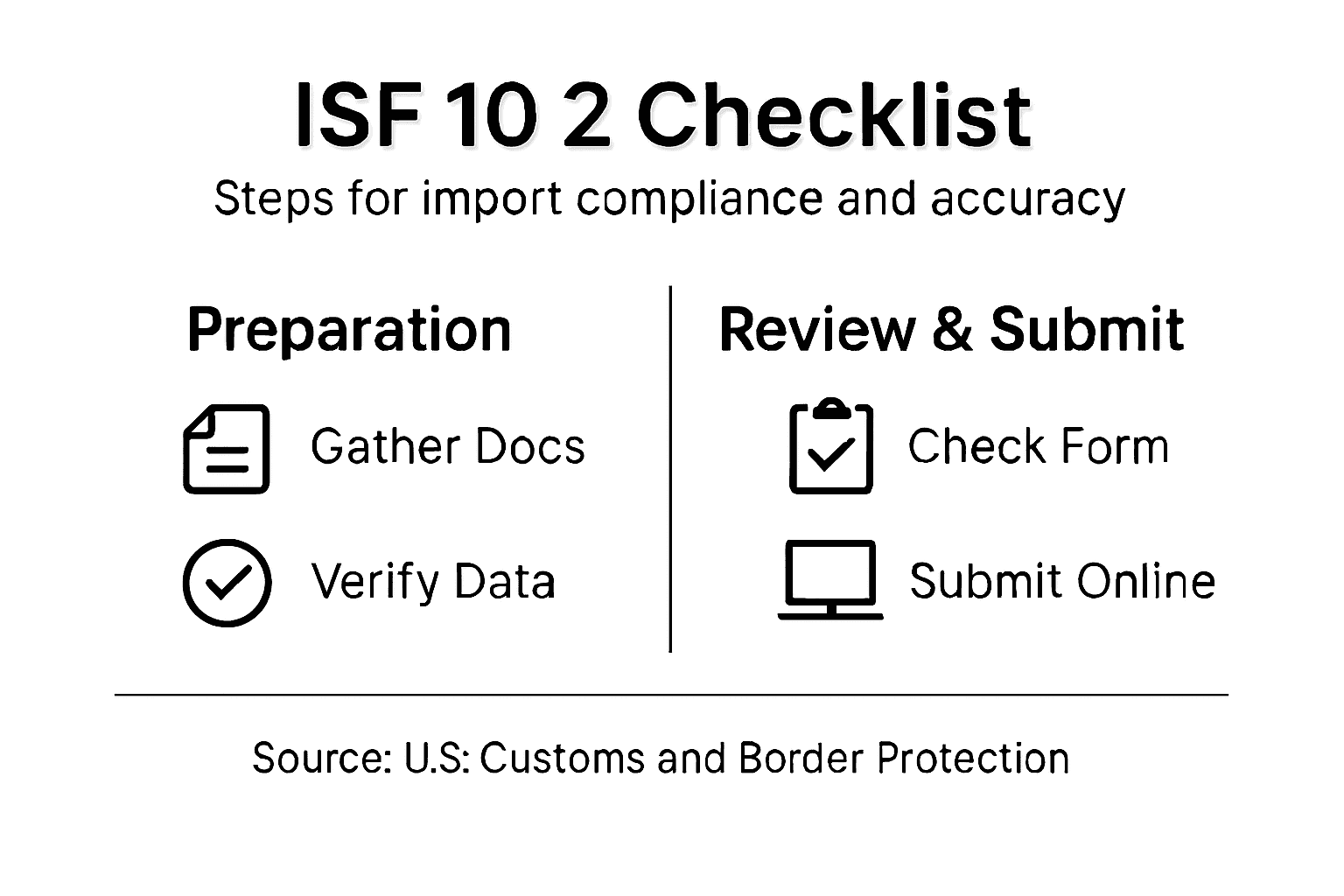
Implement a robust verification workflow that includes multiple review stages. First, conduct an initial self review immediately after data entry. Then, if possible, have a second team member perform an independent cross check. Look for common error points such as transposed numbers in identification codes, outdated address information, or incomplete manufacturer details. Verify that all entries are consistent across different sections of the form and match your original shipping paperwork exactly.
Pro Tip: Create a digital verification checklist with automatic cross referencing capabilities to streamline your compliance review process and minimize human error.
Step 5: Submit the Completed ISF 10 2 Form PDF
Submitting your completed ISF 10+2 form represents the final critical step in ensuring smooth import processing. Your objective is to electronically file your documentation through the appropriate U.S. Customs channels well before your cargo departure.
Prepare for electronic submission by selecting an authorized filing method through either the Automated Commercial Environment (ACE) or Automated Broker Interface (ABI). Most importers work with licensed customs brokers or use specialized software that can directly interface with these systems. Ensure you submit the filing at least 24 hours before your cargo is loaded onto the vessel heading to the United States. During submission, carefully review that all previously verified data transfers correctly into the electronic system, maintaining the precision you established during your earlier verification stages.
Use this table to distinguish between ISF 10+2 filing methods and their benefits:
| Filing Method | How It Works | Key Benefit |
|---|---|---|
| Licensed Customs Broker | Broker submits data on your behalf | Expert compliance support |
| Direct ACE/ABI Self-Filing | Importer files directly with CBP | Greater control and lower costs |
| Specialized ISF Software | Automated data input and submission | Streamlined process, tracking |
After submission, actively monitor your filing status to quickly address any potential issues. Most electronic filing systems provide immediate confirmation and tracking capabilities. Save all submission receipts and confirmation numbers as proof of timely and accurate filing. These documents can be crucial if you need to demonstrate compliance during any future customs reviews or in case of potential audits.
Pro Tip: Create a standardized digital folder system to store submission confirmations and tracking records for each ISF filing to simplify future reference and compliance documentation.
Simplify ISF 10+2 Compliance with Expert Customs Brokerage and Logistics Support
Completing the ISF 10 2 form accurately is critical to avoid costly delays and penalties when importing goods into the United States. The detailed documentation requirements and precise data entry demand thorough attention to prevent common errors like inaccurate HTS codes or missing manufacturer details. If you find managing these complex filing steps overwhelming, you are not alone. Many businesses struggle with ensuring timely and compliant submissions that satisfy U.S. Customs and Border Protection standards.
Partner with Worldwide Express for reliable customs brokerage and comprehensive freight forwarding solutions tailored to your import needs. Our experienced team helps you navigate every step from document preparation to electronic filing while offering global transportation and supply chain management tools. Don’t risk shipment delays or penalties when you can rely on our proven expertise. Visit Worldwide Express now to streamline your ISF 10+2 filing process and keep your international trade operations moving smoothly.
Frequently Asked Questions
What documents do I need to complete the ISF 10+2 Form PDF?
To complete the ISF 10+2 Form, you will need several key documents, including commercial invoices, packing lists, and bills of lading. Collect these documents to ensure you have accurate and comprehensive information for the form.
How can I ensure accuracy when entering details on the ISF 10+2 Form?
To ensure accuracy, systematically verify every detail against your original shipping documents as you complete the ISF 10+2 Form. This includes checking the spelling of company names and confirming numeric identifiers, reducing errors that could lead to penalties.
What is the safest method to submit the ISF 10+2 Form electronically?
You can submit the ISF 10+2 Form electronically through either an authorized customs broker or directly using the Automated Commercial Environment (ACE). Choose a method that suits your needs, ensuring your submission is made at least 24 hours before cargo loading to comply with regulations.
How can I track the status of my ISF 10+2 Form submission?
Once you submit the ISF 10+2 Form, most electronic filing systems provide immediate confirmation and tracking capabilities. Monitor your filing status actively to address any issues quickly and save documentation for future reference.
What should I do if I find an error in my submitted ISF 10+2 Form?
If you discover an error after submission, contact your customs broker or initiate a correction through the electronic filing system as soon as possible. Prompt action can help minimize penalties and prevent delays in your cargo clearance.
Recommended
- Complete isf 10 2 form for compliant U.S. imports – Worldwide Express, Inc.
- 7 Essential Importer Security Filing Tips for Success – Worldwide Express, Inc.
- Entry Summary 7501 in U.S. Imports: Ensuring Compliance – Worldwide Express, Inc.
- Complete Guide to Customs Power of Attorney Form PDF – Worldwide Express, Inc.
- Signage for Compliance: Essential Guide for 2025 UK Businesses – PromoSigns.co.uk