Anyone managing international logistics knows that a single unexpected event in China or Europe can ripple through your entire supply chain and leave American operations scrambling. The reality is that supply chain risk is never as simple as switching suppliers or counting on a short delivery route. This article breaks down the complex, interconnected nature of supply chain risk and clears up common myths, giving you a clear understanding of how to spot real vulnerabilities before they become costly disruptions.
Table of Contents
- Defining Supply Chain Risk And Common Myths
- Key Types Of Supply Chain Risk Factors
- How Supply Chain Risks Disrupt Operations
- Compliance, Financial, And Legal Consequences
- Proven Strategies To Minimize Supply Chain Risk
Key Takeaways
| Point | Details |
|---|---|
| Understanding Supply Chain Risk | Supply chain risk goes beyond basic transportation issues; it includes operational, financial, and geopolitical factors that can disrupt trade. |
| Proactive Risk Management | Implementing continuous monitoring and scenario planning can enhance resilience against potential disruptions. |
| Legal and Compliance Considerations | Companies must recognize and prepare for the regulatory and financial implications of supply chain disruptions. |
| Adopting Advanced Technologies | Utilizing technology for real-time visibility and predictive analytics can significantly improve risk mitigation strategies. |
Defining Supply Chain Risk and Common Myths
Supply chain risk represents the potential for disruption, financial loss, or operational breakdown within the complex network of global trade and logistics. At its core, supply chain risk encompasses the multifaceted challenges that can derail the smooth movement of goods from manufacturer to consumer. Understanding these risks requires recognizing that they extend far beyond simple transportation obstacles.
Contrary to common misconceptions, supply chain risks are not uniform or predictable. Global supply chain vulnerabilities demonstrate that risks emerge from interconnected economic, geopolitical, environmental, and operational factors. Businesses often mistakenly believe that shorter supply chains or increased diversification automatically reduce risk. However, research indicates that risk mitigation requires a more nuanced, strategic approach that considers systemic dependencies and potential failure points.
Traditionally, supply chain risks have been categorized into several key domains:
- Operational Risks: Disruptions in production, manufacturing, or logistics processes
- Financial Risks: Currency fluctuations, credit challenges, and unexpected cost increases
- Strategic Risks: Geopolitical tensions, trade policy changes, and market shifts
- Environmental Risks: Natural disasters, climate change impacts, and resource scarcity
Pro tip: Develop a comprehensive risk assessment framework that goes beyond simple checklists and incorporates scenario planning and dynamic risk evaluation strategies.
Key Types of Supply Chain Risk Factors
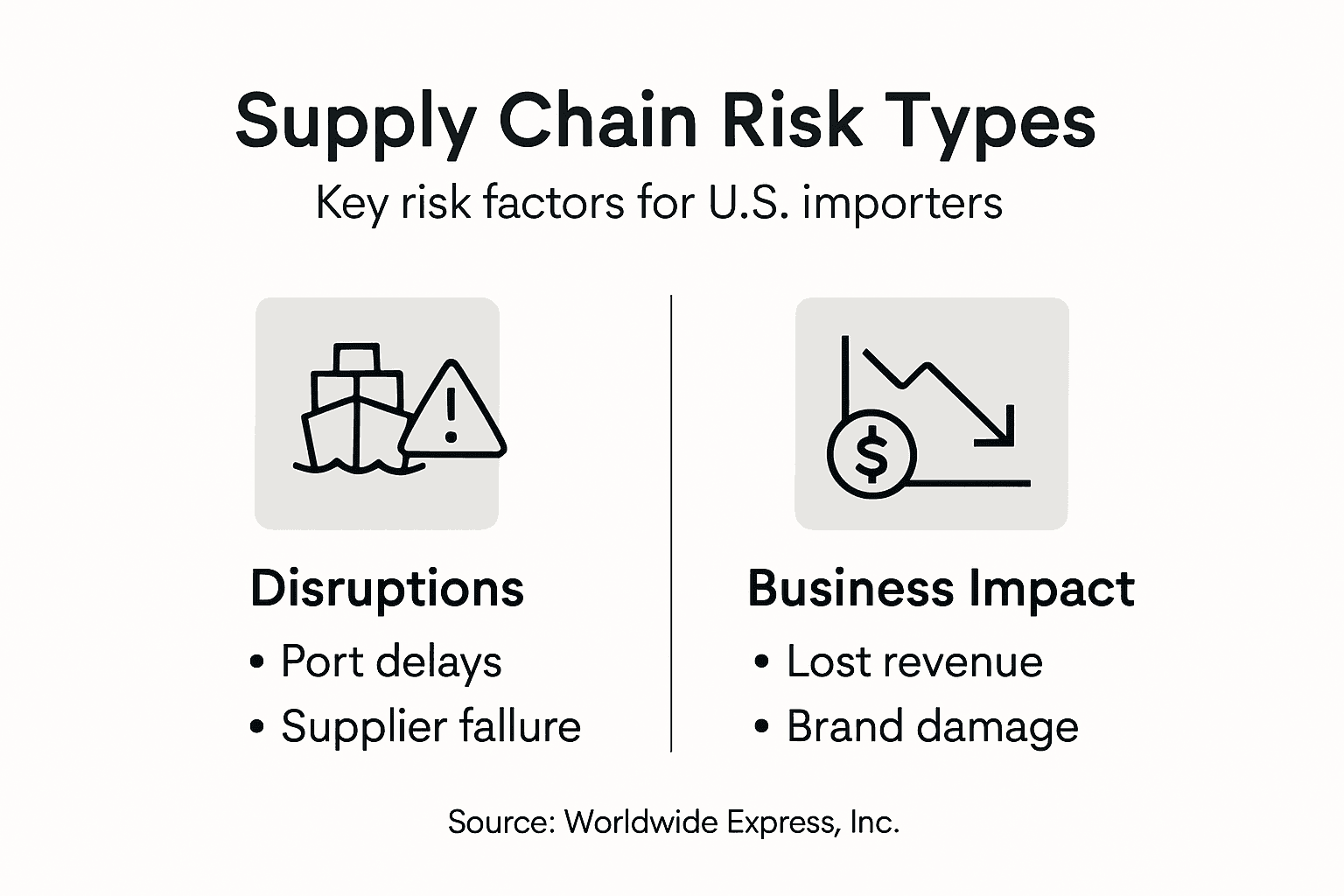
Supply chain risk factors represent complex, interconnected challenges that can significantly disrupt business operations and global trade. Supply chain risk categories demonstrate that modern importers must navigate a multifaceted landscape of potential threats beyond traditional understanding of logistics and transportation risks.
The primary supply chain risk factors can be comprehensively categorized into several critical domains:
- Geopolitical Risks: International trade tensions, political instability, sanctions, and unexpected regulatory changes
- Operational Risks: Production disruptions, equipment failures, workforce limitations, and logistical bottlenecks
- Economic Risks: Currency fluctuations, market volatility, unexpected cost increases, and financial market instabilities
- Environmental Risks: Natural disasters, climate change impacts, resource scarcity, and extreme weather events
- Technological Risks: Cyberattacks, digital infrastructure vulnerabilities, data breaches, and technological system failures
U.S. importers must recognize that these risk factors are not isolated events but deeply interconnected systems that can create cascading disruptions. Post pandemic experiences have heightened awareness about the critical need for robust risk management strategies that anticipate and mitigate potential challenges across multiple domains. Strategic importers now understand that comprehensive risk assessment involves continuous monitoring, scenario planning, and adaptive response mechanisms.

Here is a summary of how different risk domains impact supply chain operations:
| Risk Domain | Example Disruption | Business Impact |
|---|---|---|
| Geopolitical | Sanctions or policy changes | Delays, supplier shifts |
| Operational | Logistics failure | Missed deliveries, downtime |
| Economic | Currency fluctuation | Increased costs, slim margins |
| Environmental | Natural disaster | Sourcing gaps, halted supply |
| Technological | Cyberattack or outage | Data loss, process stoppages |
Pro tip: Develop a dynamic risk assessment matrix that includes weighted probability scoring for potential disruptions and establishes clear contingency protocols for each identified risk category.
How Supply Chain Risks Disrupt Operations
Supply chain disruptions create intricate challenges that extend far beyond simple logistical inconveniences. These disruptions represent complex systemic failures that can rapidly undermine entire operational frameworks, causing significant economic and strategic vulnerabilities for U.S. importers.
The cascading effects of supply chain risks manifest through multiple critical pathways:
- Production Halts: Immediate stoppage of manufacturing processes
- Inventory Shortages: Critical gaps in product availability
- Increased Operational Costs: Unexpected expenses from alternative sourcing
- Customer Trust Erosion: Potential long-term reputation damage
- Financial Instability: Potential revenue losses and market uncertainty
Strategic importers must understand that these disruptions are not isolated incidents but interconnected systemic risks. The post-pandemic landscape has dramatically revealed how quickly global supply networks can become fragile, with single disruption points potentially triggering widespread operational breakdowns. Modern supply chain management requires anticipatory strategies that can rapidly adapt to unexpected challenges and maintain operational continuity under dynamic conditions.
Pro tip: Implement a real-time monitoring system that tracks multiple risk indicators across your supply chain, enabling proactive intervention before disruptions escalate into critical failures.
This table compares proactive and reactive risk management for supply chains:
| Approach | Focus Area | Typical Outcome |
|---|---|---|
| Proactive | Continuous monitoring | Early disruption detection |
| Proactive | Scenario planning | Faster crisis response |
| Reactive | Issue response | Higher operational losses |
| Reactive | After-incident audits | Corrects symptoms, not causes |
Compliance, Financial, and Legal Consequences
Supply chain legal vulnerabilities represent complex challenges that extend far beyond simple regulatory documentation. U.S. importers face a multifaceted landscape of potential financial and legal risks that can dramatically impact their operational sustainability and long-term business viability.
The primary compliance and legal consequences for supply chain disruptions include:
- Regulatory Penalties: Significant monetary fines for non-compliance
- Contract Breach Liabilities: Potential legal actions from unfulfilled agreements
- Import/Export Restriction Violations: Potential trade license suspensions
- Financial Restatement Risks: Potential accounting and reporting complications
- Reputation Damage: Long-term market credibility challenges
Modern supply chain management requires a proactive approach to legal and financial risk mitigation. Companies must develop comprehensive compliance frameworks that anticipate potential regulatory challenges, implement robust documentation processes, and maintain transparent communication channels with regulatory bodies. The financial implications of supply chain risks extend beyond immediate operational costs, potentially affecting investor confidence, credit ratings, and long-term market positioning.
Pro tip: Conduct quarterly comprehensive compliance audits that map regulatory requirements against your current supply chain practices, identifying potential vulnerabilities before they become critical issues.
Proven Strategies to Minimize Supply Chain Risk
Supply chain risk mitigation requires a comprehensive, multilayered approach that goes beyond traditional defensive strategies. U.S. importers must develop adaptive frameworks that anticipate potential disruptions and create flexible response mechanisms to maintain operational continuity.
Key strategic approaches to minimizing supply chain risks include:
- Supplier Diversification: Reducing dependency on single sources
- Technology Integration: Implementing advanced monitoring and predictive analytics
- Redundancy Planning: Creating backup systems and alternative logistics routes
- Real-Time Visibility: Developing transparent tracking and communication networks
- Continuous Risk Assessment: Regularly evaluating and updating risk management protocols
Successful risk mitigation demands more than reactive measures. Companies must invest in digital transformation technologies that enable rapid adaptation, such as artificial intelligence-driven predictive modeling and blockchain-enabled transparent supply chain tracking. These technological interventions allow businesses to anticipate potential disruptions, quickly reroute resources, and maintain operational resilience in an increasingly complex global trade environment.
Pro tip: Develop a dynamic risk scoring system that continuously evaluates supplier performance, geopolitical conditions, and operational capabilities, allowing for proactive intervention before potential disruptions escalate.
Strengthen Your Supply Chain Against Disruptions with Worldwide Express
Navigating the complex landscape of supply chain risks like geopolitical tensions, operational breakdowns, and regulatory compliance challenges can feel overwhelming. This article highlights the critical need for continuous risk assessment, real-time monitoring, and adaptive strategies to avoid costly disruptions and maintain customer trust. If you are an importer seeking proactive solutions to these pain points, Worldwide Express offers tailored logistics services that provide global reach, customs expertise, and transparent tracking to keep your operations resilient.
Take control of your supply chain risks today by partnering with Worldwide Express, Inc. Our comprehensive international shipping solutions, including customs brokerage and freight forwarding, are designed to minimize costly delays and regulatory penalties. Visit Worldwide Express now to explore how our customized plans can safeguard your business and enhance operational continuity in a dynamic global market.
Frequently Asked Questions
What is supply chain risk?
Supply chain risk refers to the potential for disruptions or financial loss within the network of global trade and logistics, impacting the smooth movement of goods from manufacturers to consumers.
What are the common types of supply chain risks?
Common types of supply chain risks include operational risks (disruptions in production or logistics), financial risks (currency fluctuations, unexpected costs), strategic risks (geopolitical tensions, market shifts), and environmental risks (natural disasters, climate change impacts).
How can supply chain disruptions affect U.S. importers?
Supply chain disruptions can lead to production halts, inventory shortages, increased operational costs, erosion of customer trust, and financial instability, causing significant vulnerabilities in business operations.
What strategies can U.S. importers use to minimize supply chain risk?
To minimize supply chain risk, U.S. importers can implement strategies such as supplier diversification, technology integration for monitoring, redundancy planning for backup systems, and continuous risk assessment to adapt to potential disruptions.
Recommended
- Supply Chain Risk Management: Safeguarding Global Trade – Worldwide Express, Inc.
- Climate Change and Supply Chain Disruption in US Manufacturing – Worldwide Express, Inc.
- Trade War Impacts – How They Shape U.S. Logistics – Worldwide Express, Inc.
- Import License Requirements: Ensuring U.S. Trade Compliance – Worldwide Express, Inc.
- Vendor and Third-Party Risk Management – Cloudology