Every logistics manager at a mid-sized American import or export company knows how quickly competitors can tempt customers with lower rates or special deals. In today’s market, true customer loyalty means more than just repeat bookings—it is about building lasting relationships that protect your business from price wars and unpredictable freight cycles. This article reveals the essential strategies and loyalty drivers that help you create stronger bonds with your clients, ensuring steady shipments and a more reliable operation.
Table of Contents
- Defining Customer Loyalty in Logistics
- Types of Loyalty Programs in Shipping
- Key Drivers of Freight Customer Retention
- Technology’s Role in Loyalty Building
- Common Mistakes Undermining Client Trust
Key Takeaways
| Point | Details |
|---|---|
| Customer Loyalty | Loyalty in logistics is built on perceived value, trust, and switching costs, directly impacting profitability and operational stability. |
| Loyalty Programs | Effective loyalty programs must align with customer needs, combining elements like points, tiers, and partnerships to enhance retention. |
| Retention Drivers | Key drivers include relationship quality, operational reliability, and value perception, which managers must prioritize to maintain customer satisfaction. |
| Technology’s Role | Investing in technology that enhances visibility, personalization, and automates processes can significantly boost customer loyalty and overall experience. |
Defining Customer Loyalty in Logistics
Customer loyalty in logistics means far more than repeat business. It represents a customer’s willingness to continue working with your company despite competitive pressures, pricing fluctuations, or attractive offers from competitors. For logistics managers at mid-sized import/export companies, understanding this distinction is critical because it directly affects your bottom line and operational stability.
At its core, loyalty in logistics rests on three foundational elements. First, customers must perceive genuine value in your services beyond just moving cargo from point A to point B. This includes reliable delivery timelines, accurate documentation, proactive communication, and problem-solving that anticipates their needs. Second, loyalty builds through trust – the confidence that your company will handle their shipments with care and deliver on commitments consistently. Third comes switching costs, both tangible and psychological. When customers have invested time in building relationships with your team, established processes, and integrated your systems into their operations, they face real friction in moving to a competitor.
Research on service recovery satisfaction reveals that how you handle failures matters enormously for loyalty. When shipments experience delays or customs complications, your response determines whether customers stay or leave. Customers who feel their concerns are handled fairly through proper procedures and genuine interaction often become more loyal than those who never experienced a problem. Additionally, studies examining sustainable practices in logistics show that importers particularly value companies demonstrating environmental responsibility and operational transparency. This creates loyalty grounded not just in service quality but in shared values about responsible business.
For your import/export operations, loyalty directly impacts cash flow predictability and reduces customer acquisition costs. A loyal customer base means steadier freight volumes, better forecast accuracy for your resources, and opportunities to deepen relationships through additional services like warehousing or supply chain consulting. Understanding what drives loyalty in your specific market segment positions you to build competitive advantages that pricing alone cannot replicate.
Pro tip: Map your top 20 customers and identify which elements drive their loyalty: Is it your customs expertise, reliability, personal relationships, or value-added services? This reveals where to invest your retention efforts for maximum impact.
Types of Loyalty Programs in Shipping
Loyalty programs in shipping aren’t one-size-fits-all. For mid-sized import/export operations, selecting the right program structure means understanding how different models align with your customer base and business model. The most effective programs match reward mechanisms to what your customers actually value, whether that’s cost savings, service upgrades, or exclusive access.
Three primary categories dominate the shipping industry. Points-based programs reward customers for spending, accumulating credits toward future discounts, free services, or expedited handling. A customer shipping 100 containers annually might earn points redeemable for priority customs clearance or reduced brokerage fees on their next shipment. Tiered membership programs create status levels (Bronze, Silver, Gold) where higher-spending customers unlock escalating benefits such as dedicated account managers, reduced rates, or priority booking during peak seasons. Partnership and alliance programs connect your customers with complementary service providers, offering integrated benefits across transportation modes, warehousing, and documentation services. When you partner with specialized customs brokers or warehouse operators, loyal customers gain seamless access to value-added services without friction.
Modern programs increasingly blend these approaches with personalized experiences and multi-tier benefits that reflect what customers actually demand. Rather than static reward structures, successful programs adapt to individual customer preferences. An importer focused on speed might prioritize expedited services and priority lane access, while another prioritizing cost control values volume discounts and consolidated shipment opportunities. The key insight is that loyalty programs function as marketing tools designed to strengthen customer relationships beyond transactional interactions.
For your operation, consider which program structure solves real pain points. Do your customers struggle with rate consistency? A tiered discount structure based on volume commitment addresses this directly. Do they juggle multiple service providers for air, ocean, and trucking? A unified loyalty program spanning transportation modes creates switching friction that protects your revenue. The most successful programs reward behaviors that benefit both parties: consistent booking patterns that improve your forecasting, longer contract terms that stabilize margins, and multi-service adoption that deepens customer dependency on your ecosystem.
Here’s how common loyalty program models address logistics customer needs:
| Program Type | Main Benefits Provided | Best For | Typical Challenges |
|---|---|---|---|
| Points-Based Program | Discounted rates, credits | High-volume shippers | May lack personalization |
| Tiered Membership | Priority service, account manager | Large accounts | Complexity for small clients |
| Partnership/Alliance | Seamless, multi-service access | Multi-modal users | Coordinating partners |
Pro tip: Start with a pilot program targeting your top 15 customers across different segments; test whether points, tiering, or partnership models generate the highest retention lift before full rollout.
Key Drivers of Freight Customer Retention
Freight customer retention doesn’t happen by accident. It results from deliberately managing the factors that keep customers satisfied enough to stay with your company through competitive pressures. For logistics managers, understanding these drivers means you can prioritize where to invest your operational and relationship resources for maximum retention impact.
The most powerful retention drivers cluster into three categories. Relationship quality ranks first because freight logistics remain fundamentally relationship-intensive. Strong relationships built on consistent communication, trust in your problem-solving ability, and genuine commitment to customer success create emotional anchors that pure pricing cannot break. Trust, commitment, and effective communication directly influence whether customers view you as a partner or interchangeable vendor. Operational reliability comes second. Your customers need exactly what they contracted for: cargo arriving on schedule, documentation completed accurately, customs cleared efficiently, and shipment visibility maintained throughout transit. A single missed commitment erodes months of relationship building. Value perception rounds out the critical three. Value extends beyond rate competitiveness to encompass total cost of ownership, including how your services integrate with their supply chain, reduce their administrative burden, and provide flexibility when their needs shift seasonally.
Research on customer satisfaction and perceived switching costs reveals that retention strategies must distinguish between different customer risk profiles. Some customers stay because they genuinely value your service. Others stay primarily because switching would require retraining staff, renegotiating with customs brokers, or disrupting established import workflows. Smart retention focuses first on customers worth keeping, then implements strategies to increase switching costs through service integration and relationship deepening.
The freight environment adds specific pressures. Rate pressure exists constantly, seasonal peaks strain operations, and a single customs delay becomes ammunition for competitors offering promises of smoother clearance. Customers also monitor your service consistency across their entire shipment portfolio, not just individual transactions. Understanding freight rate negotiation dynamics helps you position value beyond pure cost competition. Retention strategies that address these realities focus on transparency about pricing, proactive communication about potential delays, and continuous relationship investment with key decision makers at customer companies.
Pro tip: Quarterly, review your customer file to identify who shows warning signals like reduced shipment volume, increased rate shopping, or missed communication patterns. These early warnings let you intervene with relationship rebuilding before they start transitioning to competitors.
Technology’s Role in Loyalty Building
Technology has fundamentally shifted how logistics companies build and maintain customer loyalty. For mid-sized import/export operations, the right technology investments don’t just improve efficiency; they create tangible customer experiences that competitors struggle to replicate. When customers see real-time shipment visibility, receive proactive alerts before problems occur, and access integrated booking platforms that reduce their administrative burden, they notice. More importantly, they stay.
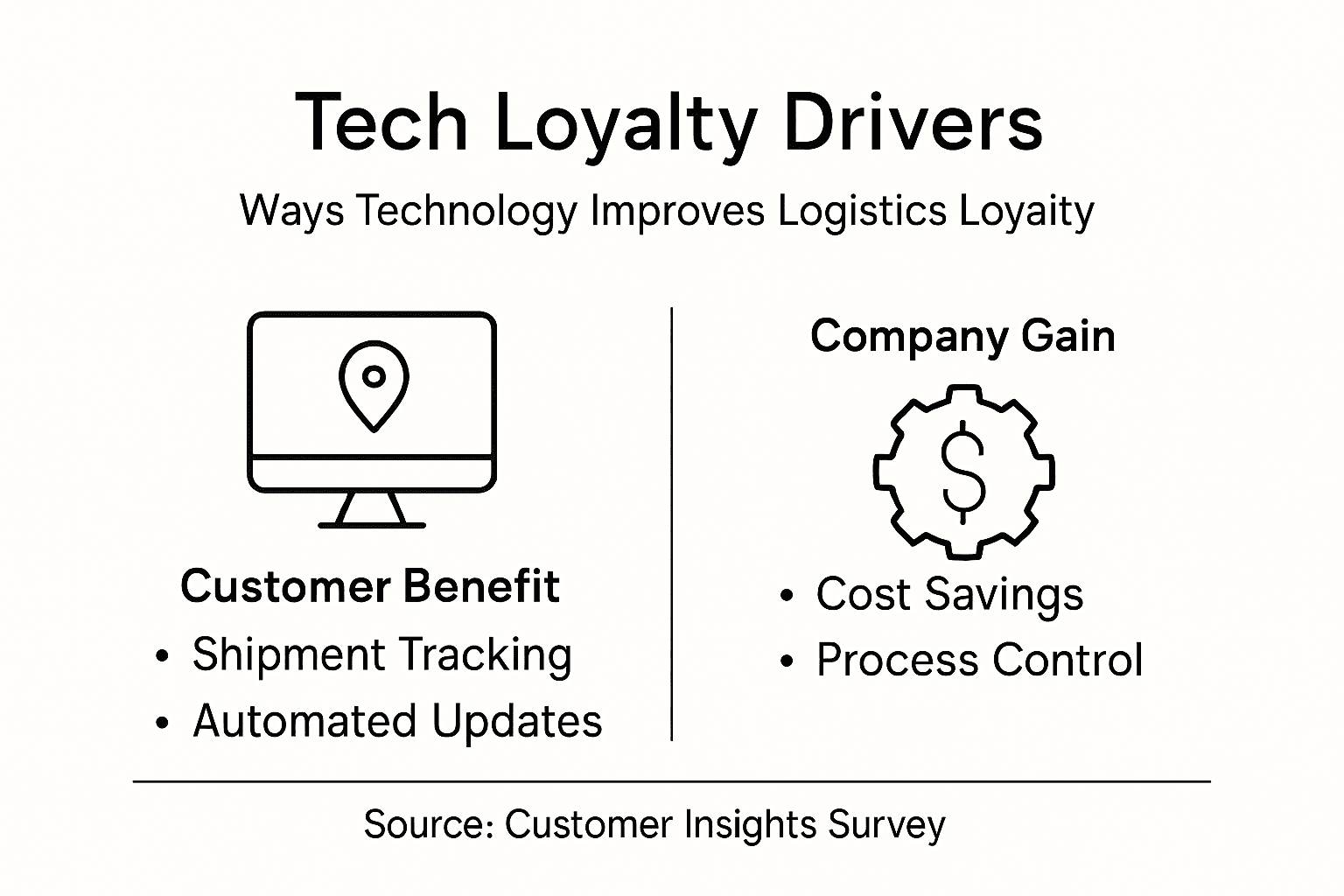
Modern logistics technology enables three distinct loyalty advantages. First, visibility and transparency platforms give customers live access to their shipments throughout the entire journey. Your importer client can see their containers clearing customs in real time, track when they enter the warehouse, and receive alerts about any delays before they impact their production schedule. This eliminates the anxiety of unknown status and the constant phone calls asking where things stand. Second, personalization through data analytics allows you to tailor service offerings to individual customer behavior patterns. If your system detects that a customer consistently ships certain products during specific seasons, you can proactively offer consolidation opportunities that reduce their costs. Artificial intelligence and big data analytics enable this kind of anticipatory service that builds trust and satisfaction. Third, automation of routine processes frees your team to focus on relationship management rather than paperwork. When documentation flows automatically between systems, rate calculations process instantly, and booking confirmations generate without manual intervention, customers experience frictionless interactions that reinforce their loyalty.
Digital technology affordances that enhance logistics operations extend beyond customer-facing tools. Backend systems that integrate your customs brokerage, warehousing, and transportation operations create operational reliability that customers depend on. When your air freight system talks seamlessly with your ocean freight system and both connect to warehouse management, your entire operation functions as a unified whole. Customers experience this as consistency and reliability across their entire shipment portfolio, not fragmented service from disconnected departments.
The implementation path matters. Rather than pursuing every technology available, identify the specific pain points your customers experience most acutely. Do they struggle with rate transparency? Invest in systems that show costs clearly. Do they need better inventory visibility? Implement warehouse management integration. Do they require flexible consolidation options? Build the analytics to identify consolidation opportunities automatically. The loyalty payoff comes not from having cutting-edge technology for its own sake, but from deploying technology that solves real customer problems and reduces friction from their operational experience.
Below is a summary of technology investments and their impacts on logistics customer loyalty:
| Technology Investment | Customer Experience Gain | Operational Benefit |
|---|---|---|
| Real-time shipment visibility | Reduces uncertainty, builds trust | Fewer customer inquiries |
| Automated documentation | Frictionless transactions | Lower error rates, faster service |
| Data-driven personalization | Tailored solutions, satisfaction | Proactive upselling opportunities |
Pro tip: Before implementing any new technology platform, interview your top 10 customers about their biggest frustrations with your current processes; build your tech roadmap around solving those specific problems rather than chasing industry trends.
Common Mistakes Undermining Client Trust
Trust erodes faster than it builds in freight logistics. One missed delivery window, one inaccurate customs estimate, one unresponsive email gets noticed immediately and remembered long. For logistics managers, understanding the specific mistakes that damage client trust is essential because recovering from trust damage costs far more than preventing it in the first place.
The most damaging mistakes cluster into predictable patterns. Breaking commitments consistently tops the list. You quote a 48-hour port release, then the shipment sits for 72 hours because documentation wasn’t prepared correctly. You promise rate stability for six months, then send a surcharge notice for unexpected fuel adjustments. Customers tolerate occasional slip-ups because logistics involves genuine complexity. But patterns of unmet promises signal unreliability at your operational core. Second, inadequate communication and unresponsiveness create trust vacuums that customers fill with suspicion. When a customer emails about a shipment delay and receives silence for six hours, they assume the worst. When they request a rate quote and wait three days for a response, they question whether your team has capacity for their business. Third, relying on outdated processes that create unnecessary friction damages trust in subtler ways. Manual documentation still prone to errors, booking systems requiring multiple phone calls to confirm, tracking that only updates once daily instead of in real time all signal you’re operating with yesterday’s technology while customers moved forward.
Failing to follow through on promises and avoiding accountability represents the fastest trust killer. When an error occurs and your response is defensive rather than solutions-oriented, customers notice. When you blame customs agencies, weather, or port congestion without offering alternatives or compensation options, you signal that responsibility stops at your office door. Customers working with reliable partners expect accountability for things within your control and transparent communication about things outside it.
Specific operational mistakes matter too. Poor inventory management visibility leaves customers guessing about stock levels. Insufficient transportation planning results in shipment delays that cascade through their supply chains. Ignoring sustainability practices increasingly matters to importers tracking corporate responsibility metrics. These mistakes feel like negligence to customers who’ve made clear what matters to them.
The trust recovery path requires speed and transparency. When you miss a commitment, acknowledge it immediately, explain what happened, and present concrete recovery options. When a rate changes unexpectedly, provide advance notice and justification. When your systems experience downtime, communicate proactively rather than hoping customers don’t notice. Customers forgive occasional failures from companies that respond with integrity.
Pro tip: Implement a weekly customer service audit where you review response times to inquiries, fulfillment of quotes, and accuracy of shipment estimates; track trends to identify whether trust erosion signals are developing before customers notice.
Strengthen Your Customer Loyalty with Tailored Logistics Solutions
Building and maintaining strong customer loyalty requires more than dependable shipping. It demands visible reliability, seamless communication, and technology-driven transparency that turns every shipment into a trusted partnership. If your import/export operation faces challenges like inconsistent delivery timelines, poor communication, or difficulty keeping customers engaged amid competitive pressures, you are not alone. The article highlights critical drivers such as operational reliability, personalized service, and proactive problem-solving as keys to lasting loyalty.
At Worldwide Express, Inc., we understand these pain points deeply and have crafted logistics services designed to address them head-on. From expert customs brokerage ensuring smooth clearance to integrated freight forwarding with real-time tracking, we offer the tools and personalized attention that foster trust and reduce switching risks. Our full suite of solutions including air and ocean freight, trucking, warehousing, and supply chain management provides comprehensive support tailored for your unique shipping needs.
Transform your customer loyalty strategy today by partnering with a logistics provider who values transparency, responsiveness, and innovation.
Discover how Worldwide Express can boost retention and operational predictability with customized international shipping plans. Visit Worldwide Express now to request a quote and start building stronger relationships through logistics excellence.
Frequently Asked Questions
What are the key elements of customer loyalty in logistics?
Customer loyalty in logistics is built on three key elements: value, trust, and switching costs. Value extends beyond just pricing to include reliable services, effective communication, and problem-solving. Trust involves confidence in consistent delivery and care in handling shipments. Switching costs refer to the tangible and psychological investments customers have made in their existing relationships with your company.
How can technology enhance customer loyalty in logistics?
Technology enhances customer loyalty by providing real-time shipment visibility, automating routine processes, and personalizing customer experiences. These technological advancements reduce uncertainty, minimize administrative burdens, and improve the overall customer experience, leading to stronger loyalty.
What types of loyalty programs are effective in shipping?
Effective loyalty programs in shipping include points-based programs, tiered membership programs, and partnership/alliance programs. Points-based programs reward customers for their spending, while tiered programs offer escalating benefits based on spending levels. Partnership programs provide integrated services that enhance customer value and reduce friction.
What are common mistakes that undermine client trust in logistics?
Common mistakes that undermine client trust include breaking commitments consistently, inadequate communication, and reliance on outdated processes. Failure to follow through on promises and poor responsiveness can erode trust quickly, making it essential to maintain transparency and accountability in operations.
Recommended
- Growing Your Business Online: Strategies for Logistics – Worldwide Express, Inc.
- Business Networking Strategies for Logistics Managers – Worldwide Express, Inc.
- Understanding Sustainability in Logistics: Key Insights – Worldwide Express, Inc.
- Understanding Logistic Providers: Key Concepts Explained – Worldwide Express, Inc.