Cash flow headaches can unsettle even the most experienced logistics managers, especially when operating between ports like Shanghai and Los Angeles. In international shipping, delayed customer payments and upfront supplier expenses can quickly drain your available funds—even when your company looks profitable on paper. Defining the movement of actual money through operating, investing, and financing activities is essential for uncovering where cash truly gets stuck and preventing shortages before they disrupt your supply chain.
Table of Contents
- Defining Cash Flow In Logistics Operations
- Key Drivers Affecting Cash Flow Health
- Streamlining Invoicing And Payment Terms
- Leveraging Technology For Faster Collections
- Avoiding Common Cash Flow Management Mistakes
Key Takeaways
| Point | Details |
|---|---|
| Understanding Cash Flow Distinction | Cash flow is crucial in logistics, emphasizing actual money movement over profit, which can misrepresent financial health. |
| Monitor Cash Movement Categories | Tracking operating, investing, and financing activities helps identify cash flow bottlenecks that affect liquidity. |
| Optimize Invoicing Processes | Standardizing invoices and offering varied payment terms can accelerate collections and improve cash flow management. |
| Leverage Technology for Efficiency | Implementing integrated financial systems enhances collection speed, reduces errors, and streamlines payment processes. |
Defining Cash Flow in Logistics Operations
Cash flow in logistics is straightforward: it’s the movement of actual money in and out of your operation during a specific time period. Unlike profit, which can look good on paper thanks to accounting adjustments, cash flow is real money hitting your bank account or leaving it. For import/export logistics managers, this distinction matters enormously. You might be profitable on your income statement while simultaneously facing a cash crisis because customers haven’t paid invoices or you’ve paid suppliers ahead of receiving payment from clients.
Think of your logistics operation like a river. Profit is the total volume of water in the watershed, but cash flow is what’s actually moving downstream right now. A cash flow statement details what happened to your company’s cash during an accounting period, showing your ability to operate both short and long term. In logistics specifically, you track three categories of cash movement:
Here’s a summary comparing the three key types of cash flow activities in logistics operations:
| Category | Typical Examples | Impact on Cash Position |
|---|---|---|
| Operating Activities | Customer payments, fuel costs, driver wages | Directly affects daily liquidity |
| Investing Activities | Buying trucks, upgrading software | Alters long-term asset base |
| Financing Activities | Securing loans, capital injections, dividend payments | Modifies working capital available |
- Operating activities: Cash generated from your core business activities like freight forwarding, customs brokerage, warehousing, and supply chain management services. This is money flowing in from clients paying invoices and flowing out for fuel, driver wages, warehouse rent, and customs clearance fees.
- Investing activities: Cash spent on or gained from acquiring assets like trucks, warehouse equipment, or technology platforms. For many mid-sized import/export companies, this happens less frequently but still impacts overall cash position.
- Financing activities: Cash raised from loans, investor capital, or dividend payments. When you secure a line of credit to cover seasonal shipping surges, that’s a financing activity.
What makes cash flow critical in international logistics is the timing gap. You might arrange a shipment from Shanghai to Los Angeles today, but you won’t receive payment from your customer for 45 to 60 days after delivery. Meanwhile, you’re paying port fees, ocean freight, customs brokers, and trucking companies immediately or within 15 days. That gap creates pressure on your cash reserves, and if you’re managing multiple shipments at different stages, the cash drain accelerates quickly. Understanding how cash flows through operating, investing, and financing activities helps you identify where your money is actually going and where bottlenecks exist.
For your operation, defining cash flow means recognizing that healthy profitability doesn’t guarantee you’ll have cash available to pay next month’s bills. A booming quarter of high-volume shipments can paradoxically create cash shortages if those clients pay slowly while your fixed costs demand immediate payment.
Pro tip: Start tracking your operating cash cycle specifically by measuring the days between when you pay freight costs and when customers actually settle invoices—this single metric reveals your true cash flow vulnerability.
Key Drivers Affecting Cash Flow Health
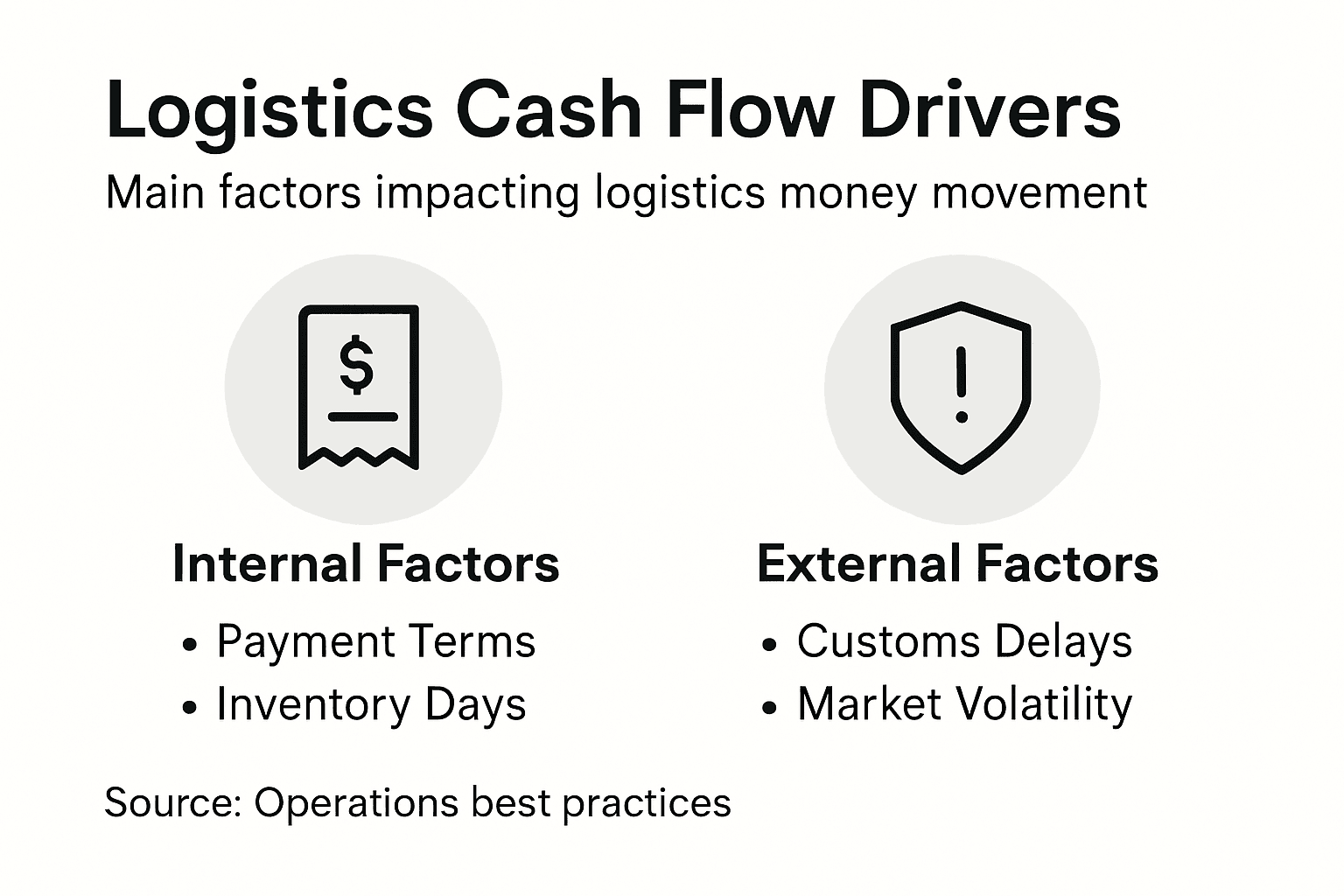
Your cash flow doesn’t exist in a vacuum. Multiple external and internal forces constantly push and pull on your available capital, and as an import/export logistics manager, you’re exposed to more of these pressures than most businesses. Understanding what actually drives your cash flow health—and which drivers you can control—separates companies that survive market turbulence from those that get caught flat-footed.
Start with the operational factors you directly influence. Payment terms you negotiate with customers and suppliers create the foundation of your cash cycle. If you allow net 60 terms to clients while your freight forwarders demand net 15 payment, you’re financing their operations with your cash. Similarly, inventory holding periods matter significantly in logistics. A shipment sitting in a warehouse waiting for customs clearance or final delivery ties up capital that could cover other operational costs. Your operational efficiency also plays a major role. Delays in cargo handling, documentation errors that trigger re-inspections, or inefficient routing all extend the time money stays locked in transit rather than flowing into your accounts.

Beyond your direct control, external factors create substantial cash flow turbulence. Infrastructure quality, customs efficiency, and shipment timeliness directly affect how quickly goods move and how many costs you’ll absorb along the way. A port bottleneck in Los Angeles doesn’t just delay deliveries; it forces you to cover additional demurrage fees, storage costs, and potentially expedited trucking to meet customer commitments. Geopolitical disruptions and trade route shifts have become increasingly unpredictable. Conflicts affecting major shipping lanes, tariff changes, or new trade restrictions can instantly change your cost structure and customer demand patterns. Currency fluctuations also impact cash flow when you’re billing in U.S. dollars but paying suppliers in euros or Chinese yuan.
Market volatility compounds these pressures. Emerging logistics trends including e-commerce expansion, technology adoption, and sustainability requirements are reshaping operational costs. Your customers increasingly demand greener logistics options, which often cost more. Technology investments in AI-driven logistics solutions or real-time tracking systems require upfront capital before they generate savings. Pandemic-related supply chain disruptions taught many mid-sized companies that relying on single suppliers or routes creates cash flow fragility when disruptions occur.
To quickly reference major internal and external cash flow drivers, see the table below:
| Driver Type | Key Example | How It Impacts Cash Flow |
|---|---|---|
| Internal | Payment terms negotiation | Delays or accelerates collections |
| External | Port congestion or bottleneck | Raises costs and slows payments |
| Internal | Inventory holding period | Ties up capital unnecessarily |
| External | Currency fluctuations | Alters cost structure unexpectedly |
Pro tip: Map your top three cash flow pressure points by calculating how many days your cash is tied up in each stage of a typical shipment—from payment to freight forwarder through customer invoice collection—then prioritize negotiating better terms on whichever stage holds the most capital longest.
Streamlining Invoicing and Payment Terms
Invoicing and payment terms sit at the heart of your cash flow problem. Get these wrong, and you’re essentially giving away interest-free loans to your customers while your suppliers demand faster payment. The gap between when you pay for services and when customers pay you is where cash flow deteriorates fastest. Streamlining this process means tightening the mechanics of how invoices get issued, tracked, and ultimately paid.
Start by standardizing your invoice format and delivery process. Vague invoices or missing details create friction—customers dispute charges, accounting departments hold payments for clarification, and your cash sits in limbo while everyone figures out what was actually shipped. Clear invoicing instructions including required formats and detailed descriptions reduce payment delays and reconciliation headaches. Your invoices should include specific shipment details, costs broken down by service line (ocean freight, customs brokerage, warehouse fees), invoice numbers that reference shipment tracking information, and crystal-clear payment instructions. When a customer opens your invoice and understands exactly what they’re paying for and where to send the money, payment follows faster.
Next, be intentional about payment terms you offer and request. If you’re currently offering net 45 to all customers indiscriminately, you’re likely creating cash flow problems for yourself. Your largest, most creditworthy customers might qualify for net 45, but smaller freight forwarders or new trading partners should start at net 15 or net 20. Similarly, negotiate harder with your suppliers. If you’re accepting net 30 from everyone, you’re leaving money on the table. Many carriers and customs brokers will offer net 15 discounts if you ask. Even a 10-day difference across multiple shipments each month compounds into significant working capital savings. Consider using electronic invoicing and settlement systems that automate invoice generation, track payment status in real time, and flag overdue invoices immediately rather than discovering the problem weeks later during month-end reconciliation.
Implement early payment incentives selectively. Offering a 2 percent discount for payment within 10 days sounds expensive until you calculate that it annualizes to roughly 36 percent returns on your cash. For high-volume customers paying thousands monthly, that 2 percent discount recovers itself through accelerated cash flow. Create tiered payment options: standard net terms, early payment discounts, and potentially slightly extended terms for multi-year contract customers willing to pay upfront deposits. A deposit of 20 to 25 percent when a shipment is booked provides immediate working capital while the shipment is in transit.
Pro tip: Audit your current customer payment behavior by listing each major client, their average invoice size, and actual days-to-payment over the past six months, then prioritize renegotiating terms with the slowest payers or proposing early payment incentives for your fastest payers to create momentum.
Leveraging Technology for Faster Collections
Paper invoices, manual follow-ups, and disconnected accounting systems are cash flow killers. Every manual step introduces delay, creates opportunities for errors, and forces your team to spend time chasing payments instead of managing operations. Technology changes this equation dramatically. The right tools compress your collection cycle from 45 days to 30 days or better, and that acceleration multiplies across dozens of shipments monthly.
Start with visibility. Real-time supply chain visibility and track-and-trace capabilities support timely invoicing and accelerate collections. Traditional approaches wait until a shipment physically arrives before issuing an invoice. Modern logistics platforms generate invoices automatically as shipments move through key milestones—when cargo clears customs, when it arrives at the distribution center, or when the final delivery occurs. Your customer receives an invoice within hours of triggering an invoiceable event rather than days later. Paired with automated payment reminders triggered by due-date logic, this transforms collections from reactive scrambling into proactive pipeline management. Customers receive the invoice when the service is fresh in their mind, payment terms start running immediately, and you know exactly when money should arrive.
Next, implement integrated financial systems that connect your logistics operations directly to accounting. Digital workflows and electronic documents integrated with financial systems reduce errors and delays in payment processing. When your shipping platform, customs broker system, and accounting software talk to each other, reconciliation becomes automatic. An invoice gets paid, the payment posts to your account, and the system matches it to the original invoice without human intervention. Compare this to manual reconciliation where someone manually crosses invoice numbers against bank deposits, discovering days later that a payment arrived under a slightly different reference code. These gaps are where cash flow gets stuck.
Consider implementing automated collections workflows with your major customers. Many enterprise platforms allow customers to pay through integrated portals that accept multiple payment methods (ACH, wire transfer, credit card) and provide real-time confirmation. Some logistics software now includes electronic invoicing standards that integrate directly with customer accounts payable systems, meaning your invoice arrives pre-populated in their payment queue rather than buried in an email inbox. The friction disappears. For smaller customers or those resistant to new platforms, automated email reminders sent 7 days before and 3 days after the due date cost nothing and typically increase on-time payment rates by 15 to 20 percent.
Pro tip: Start by mapping your current collection touchpoints—from invoice generation through final payment posting—then identify which three steps create the most delay or error, and prioritize finding technology to automate those specific bottlenecks rather than adopting a platform for every possible feature.
Avoiding Common Cash Flow Management Mistakes
Most cash flow crises don’t appear suddenly. They build gradually from repeated mistakes that seem minor in isolation but compound into serious problems. Understanding these pitfalls lets you avoid them before they damage your operation. The difference between companies that maintain healthy cash flow and those that struggle often comes down to discipline in a few key areas.
The first major mistake is setting a cash forecast and then forgetting about it. You build a projection in January based on expected shipment volumes and payment patterns, then never update it. Meanwhile, actual business diverges from your forecast. Customers pay slower than expected. A major freight rate spike hits the market. A geopolitical disruption forces route changes. Your outdated forecast becomes useless, and you’re flying blind. Effective cash management requires proactive variance analysis and reforecasting assumptions based on market and operational trends. You need to compare actual cash flow against your forecast monthly, understand why variances occurred, and most importantly, determine whether those deviations represent one-time events or persistent changes. If a customer suddenly pays net 60 instead of net 30, you need to know immediately and adjust your projection forward. This prevents the surprise cash shortage that catches you unprepared.
Another common trap is compartmentalizing cash management. Your accounts receivable team worries about collecting invoices. Your accounts payable team manages supplier payments. Your operations manager controls inventory and warehousing costs. Nobody coordinates. You end up with situations where you’re aggressively collecting from customers while paying suppliers too early, or conversely, stretching payables while letting receivables age unnecessarily. Successful cash management involves maintaining adequate liquidity by integrating collections, disbursements, banking, short-term borrowing, and investment planning comprehensively. Your cash management strategy must address all these areas together. If you reduce payment terms with customers from net 45 to net 30, you should simultaneously negotiate extended terms with suppliers. If you’re struggling with liquidity, you need to coordinate payment timing with your bank to optimize when checks clear versus when deposits post.
A third mistake is ignoring your operating cash cycle. You know what profit your company generates, but you don’t track how many days elapse between paying cash for a shipment and receiving payment from the customer. That gap is your true vulnerability. A customer paying after 60 days while you pay suppliers after 15 days creates a 45-day cash drain on every active shipment. Add seasonal surges in volume, and suddenly you need significant working capital reserves or credit lines. Many logistics managers never calculate this metric and therefore never understand their true cash requirements.
Pro tip: Create a simple monthly cash flow variance report comparing your forecast to actuals, listing the top three reasons for any deviations and your planned adjustments for next month’s forecast, then review it with finance and operations leadership every month without fail.
Take Control of Your Cash Flow Challenges with Expert Logistics Solutions
Improving cash flow in logistics requires mastering operating cash cycles, streamlining invoicing, and managing payment terms effectively. If you struggle with delayed customer payments or unexpected fees that strain your cash reserves, you are not alone. Worldwide Express delivers tailored international shipping solutions designed to reduce those timing gaps between supplier payments and client collections. By leveraging our expertise in customs brokerage, freight forwarding, and supply chain management, you gain not only operational efficiency but also improved visibility and control over your cash position.
Discover how partnering with Worldwide Express can help you optimize your cash flow today. Visit our international shipping solutions to explore customized plans that address your critical pain points and accelerate invoice settlements. Act now to secure a logistics partner who understands your unique cash flow pressures and offers proven strategies to keep your business financially healthy every step of the way.
Frequently Asked Questions
How can I streamline invoicing to improve cash flow in logistics?
Standardizing your invoice format and delivery process can significantly reduce payment delays. Including specific shipment details, clear payment instructions, and automated reminders can enhance clarity and expedite collections.
What key factors should I consider to manage cash flow effectively in logistics?
Internal factors like payment terms and inventory holding periods are crucial. Additionally, external factors such as infrastructure quality and market volatility can significantly impact cash flow.
How can technology help in accelerating cash flow in logistics?
Implementing real-time supply chain visibility and integrated financial systems can automate invoicing and payment processes, significantly reducing delays and errors, which leads to faster cash collections.
What are common mistakes to avoid in cash flow management?
Common mistakes include failing to update cash forecasts based on actual performance, compartmentalizing cash management among teams, and not tracking the operating cash cycle, which can lead to unforeseen cash shortages.
Recommended
- Growing Your Business Online: Strategies for Logistics – Worldwide Express, Inc.
- Business Networking Strategies for Logistics Managers – Worldwide Express, Inc.
- Understanding Sustainability in Logistics: Key Insights – Worldwide Express, Inc.
- How to Optimize Logistics for Efficient Global Shipping – Worldwide Express, Inc.
- Rol van logistiek bij e-commerce: Succesfactoren en valkuilen