Moving goods across borders often means facing a maze of customs forms and unpredictable fees, especially for American import/export businesses. For logistics managers juggling international shipments, understanding the ATA Carnet system is essential. This document allows duty-free and tax-free temporary import and export for up to one year, accepted in about 80 countries. Learn how using a carnet can simplify your customs process, cut costs, and provide peace of mind throughout your company’s global operations.
Table of Contents
- Defining Carnet: Purpose And Core Concepts
- Key Carnet Types And Their Uses
- How A Carnet Works In International Trade
- Legal Requirements And Compliance For U.S. Companies
- Costs, Common Pitfalls, And Alternatives
Key Takeaways
| Point | Details |
|---|---|
| Carnet Overview | A carnet is an international customs document that simplifies the temporary movement of goods across borders, reducing administrative burdens. |
| Types of Carnets | Key carnet types include ATA and TECRO/AIT, catering to different international trade needs and regions. |
| Operational Mechanism | The carnet system acts as a passport for goods, enabling duty-free movement for up to one year while tracking admissions and exits. |
| Compliance and Costs | Businesses must adhere to strict compliance regulations, with associated costs including processing fees and security deposits. |
Defining Carnet: Purpose and Core Concepts
A carnet represents an international customs document that allows businesses to temporarily move goods across international borders with minimal administrative complexity. These specialized documents serve as critical tools for companies engaged in global trade, enabling smooth transportation of commercial samples, professional equipment, and exhibition materials without incurring substantial customs duties.
The ATA Carnet system, administered by the International Chamber of Commerce, provides a standardized mechanism for temporary import and export of goods. Its primary purpose is to simplify customs procedures while offering robust financial guarantees to national customs authorities.
Key characteristics of carnets include:
- Duty-free and tax-free temporary import/export privileges
- Valid for up to one year across multiple international borders
- Accepted in approximately 80 countries worldwide
- Eliminates the need for separate customs documentation at each border crossing
The carnet operates through a unique international guarantee system where national chambers of commerce and industry associations collaborate to provide financial assurances. World Customs Organization guidelines ensure standardized implementation across participating nations, creating a predictable framework for temporary goods movement.
Pro tip: Before international travel with commercial goods, always confirm the specific carnet requirements for your destination countries to prevent potential customs complications.
Key Carnet Types and Their Uses
Navigating international trade requires understanding the diverse carnet types available to businesses. These specialized documents serve different purposes, enabling companies to transport goods across borders with minimal bureaucratic friction. From commercial exhibitions to professional equipment transportation, each carnet type addresses specific international trade needs.
The most prominent carnet types include ATA and TECRO/AIT Carnets, which facilitate temporary goods movement with unique characteristics:
ATA Carnet:
- Covers commercial samples
- Supports professional equipment transportation
- Valid across approximately 80 countries
- Eliminates customs duties and taxes for temporary imports
TECRO/AIT Carnet:
- Exclusively used between the United States and Taiwan
- Specifically designed for commercial samples
- Covers professional equipment transfers
- Streamlines customs processes between these specific regions
Additionally, the TIR Carnet represents another critical document in international logistics, primarily focusing on goods transit across multiple countries under customs seal. Unlike ATA Carnets that emphasize temporary admission, TIR Carnets specialize in facilitating efficient international road transport operations.

Each carnet type serves a distinct purpose, providing businesses with flexible mechanisms to navigate complex international trade regulations. Understanding these variations allows companies to select the most appropriate documentation for their specific cross-border transportation requirements.
Here’s a quick comparison of major carnet types and their applications:
| Carnet Type | Regions Accepted | Primary Uses | Unique Feature |
|---|---|---|---|
| ATA Carnet | About 80 countries | Samples, equipment, shows | Broadest international acceptance |
| TECRO/AIT Carnet | U.S. and Taiwan only | Samples, equipment | Streamlined U.S.-Taiwan process |
| TIR Carnet | Europe, Asia, Middle East | Goods in transit | Customs-sealed road transport |
Pro tip: Always verify the specific carnet requirements for your intended destination countries to ensure seamless goods transportation and avoid potential customs complications.
How a Carnet Works in International Trade
The carnet system functions as a sophisticated passport for international goods movement, providing businesses with a streamlined mechanism for temporary cross-border transportation. Customs documentation processes involve a carefully orchestrated sequence of steps that minimize administrative burdens while ensuring regulatory compliance.
The core operational mechanism of a carnet involves several critical stages:
- An authorized representative completes and signs the carnet document
- Customs officials validate the document using specific counterfoils and vouchers
- The carnet tracks temporary admission and exit of goods
- Duty-free and tax-free movement is authorized for up to one year
- Multiple international trips are permitted under a single document
Modern carnets are evolving with technological advancements. Digital transformation initiatives are introducing QR codes and digital tracking mechanisms, enabling real-time management of goods movement. These innovations aim to enhance transparency, reduce processing times, and provide more precise tracking capabilities for international logistics professionals.
The carnet operates as a comprehensive financial guarantee, ensuring that imported goods will be re-exported and protecting customs authorities from potential revenue losses.
The international guarantee system underpinning carnets involves national associations approved by customs authorities. This collaborative framework creates a robust mechanism that allows businesses to transport professional equipment, commercial samples, and exhibition materials across borders with minimal friction.
Pro tip: Always verify your carnet’s complete documentation and validate its acceptance in all intended destination countries before initiating international shipments.
Legal Requirements and Compliance for U.S. Companies
Navigating the complex landscape of carnet regulations requires a comprehensive understanding of federal guidelines and international trade compliance. U.S. regulations governing carnets are meticulously detailed in Title 19 of the Code of Federal Regulations, establishing clear parameters for businesses engaged in international shipping.
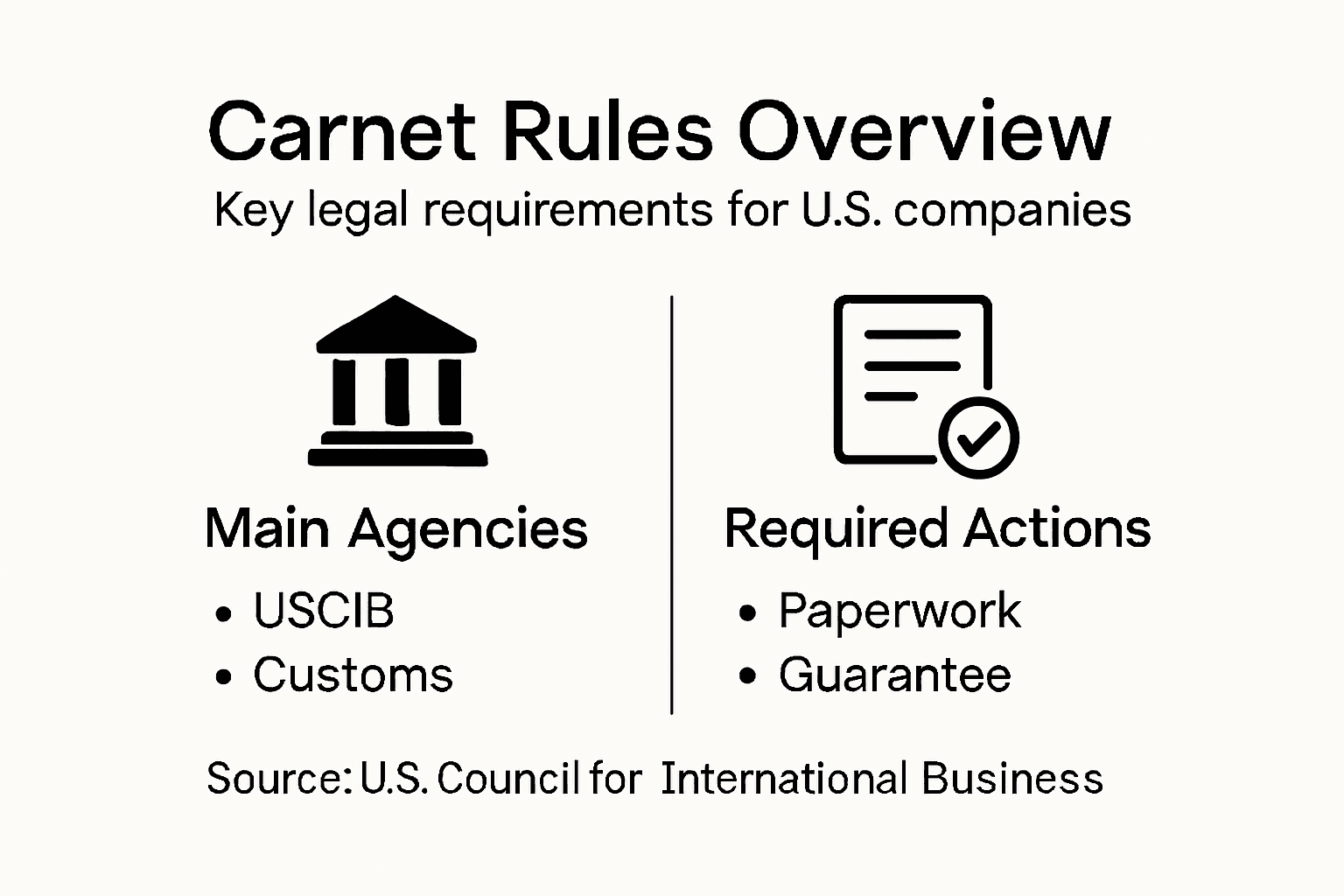
Key compliance requirements for U.S. companies include:
- Obtaining proper authorization from the U.S. Council for International Business
- Submitting complete and accurate carnet documentation
- Paying required security deposits and processing fees
- Securing additional destination-specific permits
- Adhering to strict goods classification guidelines
- Maintaining precise records of temporary imports and exports
The application process involves several critical steps managed by authorized entities. Companies must demonstrate that their goods fall within specific categories, such as commercial samples or professional equipment. Failure to comply can result in significant financial penalties and potential legal complications.
Carnet compliance is not just a bureaucratic requirement, but a fundamental aspect of maintaining smooth international trade operations.
The U.S. Council for International Business (USCIB) plays a pivotal role in managing carnet issuance and guarantees. Their oversight ensures that businesses meet all necessary regulatory standards, providing a structured framework for temporary international goods movement.
Pro tip: Consult with a customs compliance specialist before your first international shipment to ensure complete understanding of all carnet requirements and potential documentation nuances.
Costs, Common Pitfalls, and Alternatives
Companies engaged in international trade must carefully evaluate the financial and procedural implications of using carnets. Carnet costs and alternatives involve a complex calculation of processing fees, security deposits, and potential long-term savings for businesses shipping goods internationally.
Financial considerations for carnets typically include:
- Processing fees ranging from $235 to $475
- Security deposits equal to 40% of goods’ total value
- Refundable deposits upon correct carnet usage
- Potential cost savings compared to traditional import methods
- Elimination of upfront duty payments
Common pitfalls that businesses must navigate include:
- Improper documentation
- Failure to re-export goods within carnet validity period
- Using carnets for non-qualifying merchandise
- Missing strict one-year re-exportation deadline
- Incomplete customs declarations
Carnets represent a strategic financial tool that can significantly reduce administrative complexity and upfront costs for international shipments.
Temporary import alternatives such as temporary import bonds exist, but often involve more complex paperwork and higher overall costs. Professional equipment and commercial sample transporters frequently prefer carnets due to their streamlined international acceptance and reduced administrative burden.
Below is a reference table outlining carnet costs, pitfalls, and alternatives:
| Category | Carnet Approach | Alternative Methods | Considerations |
|---|---|---|---|
| Upfront Cost | $235-$475 fees, deposits | Often higher fees | Carnets may be more cost-effective |
| Processing Time | Fast border crossings | More paperwork | Carnets reduce delays |
| Risk Factors | Penalties for misuse | More complex compliance | Strict deadlines apply |
| Administrative Load | Streamlined documentation | Extensive forms, extra permits | Carnets minimize paperwork |
Pro tip: Always calculate the total landed cost, including potential penalties, when comparing carnet options against alternative temporary import methods.
Simplify Your International Shipping with Expert Carnet Support
Understanding how a carnet works and navigating its legal requirements can feel overwhelming. Dealing with strict documentation rules, submission deadlines, and customs compliance across multiple countries creates real challenges for businesses. Mistakes in carnet handling risk costly delays, financial penalties, and disrupted supply chains. If you want to avoid these stress points and enjoy duty-free, tax-free temporary imports that power your global trade, expert logistics guidance is essential.
Worldwide Express specializes in clearing these complexities with tailored international shipping solutions designed for businesses just like yours. Our team offers comprehensive assistance in customs brokerage, freight forwarding, and carnet compliance to ensure your shipments move smoothly across borders without surprises. We combine deep industry knowledge with advanced tracking and documentation tools to give you reliability and peace of mind.
Take control of your temporary import and export logistics today by partnering with Worldwide Express. Explore how our customized freight forwarding strategies and carnet expertise can save you time and money. Visit Worldwide Express to get started or request a quote. Let us handle the details so you can focus on growing your international business confidently.
Frequently Asked Questions
What is a carnet and how does it benefit international shipping?
A carnet is an international customs document that simplifies the temporary movement of goods across borders, allowing businesses to avoid customs duties and taxes. It benefits shipping by streamlining documentation requirements and reducing administrative burdens.
What are the different types of carnets available for shipping?
The most common carnet types include ATA Carnets, which cover commercial samples and professional equipment, and TECRO/AIT Carnets, specifically for use between the U.S. and Taiwan. TIR Carnets are also available for goods in transit under customs seal.
How does a business apply for a carnet for their products?
A business must complete and sign the carnet document, ensuring proper authorization from relevant authorities. They need to submit accurate documentation, pay any required fees, and comply with specific goods classification guidelines.
What are the common pitfalls associated with using carnets for shipping?
Common pitfalls include improper documentation, failing to re-export goods within the carnet’s validity period, using carnets for non-qualifying merchandise, and incomplete customs declarations, all of which can lead to penalties and complications.
Recommended
- Understanding What is a Shipping Manifest – Worldwide Express, Inc.
- Understanding Letter of Credit Shipping for International Trade – Worldwide Express, Inc.
- Understanding Bill of Lading Types in Trade Transactions – Worldwide Express, Inc.
- 7 Key Types of Bill of Lading Explained for Exporters – Worldwide Express, Inc.
- What is cruise port fee and why it matters for travelers