Missed deadlines at major ports can quickly turn a smooth shipment into a costly headache for American import and export companies. Understanding demurrage fees is vital for logistics professionals who want to control expenses and prevent operational delays. This guide breaks down the core meaning of demurrage, clears up common misconceptions, and explains the financial impact, providing practical insights to keep your international shipping on track.
Table of Contents
- Core Definition And Common Misconceptions
- Types Of Demurrage Fees In Logistics
- How Demurrage Works In Freight Operations
- Legal Rules And Free Time Provisions
- Financial Impact And Risk Management
- Avoiding Demurrage: Best Practices
Key Takeaways
| Point | Details |
|---|---|
| Understanding Demurrage | Demurrage compensates shipowners for delays in cargo loading/unloading, incurring costs when laytime exceeds agreements. |
| Differentiating Terms | Demurrage specifically impacts vessel time, while detention refers to containers held outside port limits. |
| Financial Risks | Accumulating demurrage fees can significantly affect shipping budgets; proactive measures help mitigate these risks. |
| Best Practices for Prevention | Strategic planning, clear contracts, and advanced tracking systems are crucial for minimizing demurrage-related issues. |
Core Definition and Common Misconceptions
In international shipping, demurrage represents a critical financial mechanism that compensates shipowners when cargo loading or unloading exceeds contractually agreed timelines. Comprehensive maritime law analysis defines demurrage as a pre-agreed daily liquidated damage payment triggered when charterers surpass allocated laytime.
Key characteristics of demurrage include:
- Compensation for vessel time lost during loading/unloading
- Pre-determined daily rate specified in charter agreements
- Absolute liability mechanism requiring payment regardless of delay causes
- Contractual penalty for operational inefficiencies
Many logistics professionals misunderstand demurrage, often confusing it with related maritime terms. Vessel chartering terminology clarifies critical distinctions, particularly between demurrage and detention. While demurrage specifically applies to vessel time, detention refers to container equipment held outside port boundaries.
Here’s a quick comparison of demurrage versus detention in maritime logistics:
| Criteria | Demurrage | Detention |
|---|---|---|
| What is affected | Vessel time | Container equipment |
| Trigger condition | Exceeding laytime at port | Container held outside port |
| Responsible party | Charterer or cargo owner | Consignee or shipper |
| Typical context | Bulk shipping operations | Containerized cargo flows |
The financial implications of demurrage can be substantial. Charterers may face significant additional costs when operational delays extend beyond contractually permitted timeframes. These expenses can quickly accumulate, transforming what seems like a minor delay into a major financial burden for import/export companies.

Pro tip: Implement robust scheduling and cargo management protocols to minimize potential demurrage charges and maintain operational efficiency.
Types of Demurrage Fees in Logistics
Demurrage fees represent complex financial penalties in international shipping that vary significantly based on multiple operational factors. Public health supply chain research reveals these charges are strategically designed to incentivize rapid cargo movement and equipment turnaround.
Key types of demurrage fees include:
- Container size-based demurrage rates
- Time-elapsed incremental charges
- Cargo-specific demurrage calculations
- Port-specific penalty structures
- Specialized equipment demurrage fees
Port authority guidelines distinguish between critical demurrage categories that impact logistics operations. Container demurrage specifically applies when shipped containers remain at ports beyond agreed free time, with escalating rates designed to motivate swift processing and prevent port congestion.
The financial implications of these fees can be substantial. Different demurrage structures emerge depending on geographic region, shipping contract specifics, and individual port regulations. Logistics managers must carefully track free time windows and understand nuanced fee calculations to minimize unexpected financial penalties.
Summary of major regional and contract variables affecting demurrage fee structures:
| Factor | Example Impact on Fee Structure | Practical Effect |
|---|---|---|
| Port regulations | Different free time allowances | Cost varies by location |
| Container size | Higher rates for larger units | Budget impacts for big shipments |
| Cargo type | Special fees for hazardous goods | Added complexity for compliance |
| Contract terms | Negotiable penalty clauses | Opportunities for risk reduction |
Pro tip: Develop a comprehensive tracking system that monitors container free time across different ports to proactively prevent demurrage fee accumulation.
How Demurrage Works in Freight Operations
Freight operations rely on precise timing and coordination, with demurrage serving as a critical mechanism to ensure efficient cargo movement. Port authority research demonstrates how these charges incentivize rapid container processing and minimize port congestion.
Key operational mechanisms of demurrage include:
- Tracking container free time windows
- Calculating incremental daily charges
- Monitoring port-specific time restrictions
- Assessing cargo type and container specifications
- Documenting precise arrival and departure timestamps
Supply chain management insights reveal the complex dynamics of demurrage calculation. When containers exceed allocated free time at terminals, daily fees begin accumulating, creating a financial pressure mechanism designed to accelerate cargo movement and maintain supply chain efficiency.
The financial complexity of demurrage requires meticulous tracking and strategic planning. Logistics managers must develop sophisticated systems that monitor container movement, anticipate potential delays, and calculate potential fee structures across different ports and shipping contracts. Understanding these nuanced mechanisms can significantly reduce unexpected financial burdens.
Pro tip: Implement real-time tracking technologies and develop comprehensive contingency plans to proactively manage potential demurrage scenarios.
Legal Rules and Free Time Provisions
The legal framework surrounding demurrage is complex and tightly regulated by federal maritime authorities. Federal Maritime Commission regulations have established comprehensive guidelines to ensure transparency and fairness in billing practices and charge calculations.
Key legal provisions for demurrage include:
- Mandatory detailed invoice requirements
- Clear guidelines for billing eligible parties
- Specific timelines for charge issuance
- Established dispute resolution procedures
- Standardized free time calculation methods
Code of Federal Regulations guidelines outline precise rules governing demurrage and detention practices. These regulations define critical aspects such as when free time begins, how charges accrue, and the specific responsibilities of ocean carriers and terminal operators in managing container movement.
The regulatory environment creates a structured approach to demurrage, balancing the interests of shipping companies, port operators, and cargo owners. By establishing clear rules, these legal provisions aim to promote efficient cargo processing while protecting stakeholders from arbitrary or excessive charges. Logistics managers must understand these nuanced regulations to effectively navigate potential financial implications.
Pro tip: Consult legal counsel specializing in maritime regulations to develop a comprehensive understanding of demurrage provisions specific to your shipping operations.
Financial Impact and Risk Management
Demurrage charges represent a significant financial risk for logistics operations, with potential to dramatically impact shipping budgets. Public health supply chain research reveals systematic approaches can measurably reduce these unexpected expenses through strategic planning and infrastructure optimization.
Key financial risk management strategies include:
- Implementing real-time tracking systems
- Developing precise scheduling protocols
- Negotiating flexible free time provisions
- Creating contingency funds for potential charges
- Establishing cross-departmental communication channels
- Conducting regular logistical performance audits
The financial complexity of demurrage demands a multifaceted approach. Logistics managers must anticipate potential delays by understanding various factors that contribute to extended container retention, such as customs processing, transportation bottlenecks, and documentation challenges. Proactive risk mitigation involves developing comprehensive strategies that address potential friction points in the supply chain.
Companies can significantly minimize financial exposure by investing in advanced tracking technologies, improving customs coordination, and developing robust communication protocols with shipping partners. The goal is not just to reduce demurrage fees, but to create a more efficient and predictable logistics ecosystem that reduces overall operational friction.
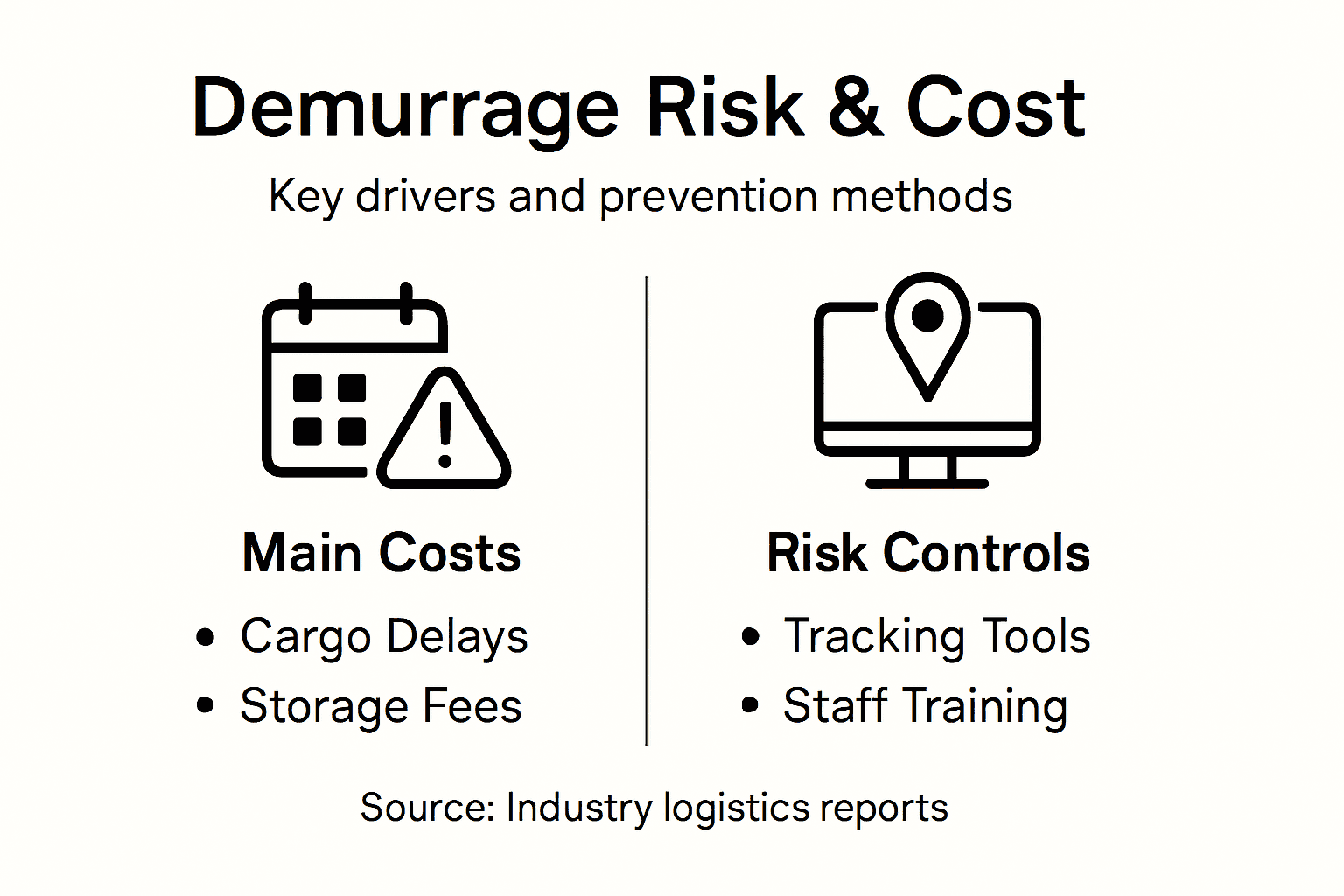
Pro tip: Develop a detailed demurrage tracking dashboard that provides real-time alerts and calculates potential financial risks before they become substantial expenses.
Avoiding Demurrage: Best Practices
Strategic planning is essential for minimizing demurrage risks in international shipping operations. Industry recommendations emphasize proactive approaches that address potential logistical bottlenecks before they escalate into costly delays.
Key best practices for avoiding demurrage include:
- Negotiating clear contract terms with explicit free time provisions
- Implementing advanced tracking and predictive logistics technologies
- Developing robust communication protocols with shipping partners
- Creating flexible contingency plans for potential disruptions
- Conducting regular performance audits of shipping processes
- Maintaining comprehensive documentation for quick dispute resolution
Successful demurrage prevention requires a holistic approach that integrates technological solutions with strategic operational planning. Logistics managers must anticipate potential challenges by developing sophisticated tracking mechanisms, understanding port-specific regulations, and maintaining exceptional communication with all stakeholders involved in the shipping process.
Companies can significantly reduce demurrage risks by investing in real-time monitoring systems, training personnel in efficient logistics management, and establishing proactive communication channels that enable rapid problem resolution. The goal is to transform reactive logistics management into a predictive, efficient operational model.
Pro tip: Develop a comprehensive digital dashboard that provides real-time alerts on potential demurrage risks and allows immediate intervention.
Take Control of Demurrage Costs with Expert Logistics Support
Demurrage charges can quickly become a major financial burden when cargo exceeds free time limits during shipping operations. The challenges of managing precise timings, port-specific rules, and complex contractual terms can leave businesses vulnerable to unexpected fees and operational delays. Understanding key concepts like demurrage and free time is essential, but partnering with a skilled logistics provider can make all the difference.
At Worldwide Express, we specialize in comprehensive international shipping solutions designed to help you navigate these complexities. Our expertise in customs brokerage, global tracking, and tailored supply chain management ensures your cargo moves swiftly and efficiently. We help minimize demurrage risk by providing advanced scheduling, real-time monitoring, and compliance support to keep your shipments on time and your costs predictable.
Don’t let demurrage charges drain your budget. Explore how our customized logistics services can safeguard your shipments from costly delays. Visit Worldwide Express today to get started and take proactive control over your freight operations.
Frequently Asked Questions
What is demurrage in shipping?
Demurrage is a financial mechanism in international shipping that compensates shipowners when the loading or unloading of cargo exceeds the agreed timelines, resulting in additional charges for the charterers.
How are demurrage fees calculated?
Demurrage fees are typically calculated based on a pre-determined daily rate specified in charter agreements, which begins accruing once the allotted laytime at port is exceeded.
What is the difference between demurrage and detention?
Demurrage refers to charges related to the vessel’s time spent waiting at the port, while detention applies to fees incurred when container equipment is held outside of port boundaries beyond the agreed time period.
How can I avoid incurring demurrage charges?
To avoid demurrage charges, implement robust scheduling and cargo management protocols, negotiate clear contract terms, and utilize tracking technology to monitor container free time and address potential delays swiftly.
Recommended
- What Is Drayage and Why It Matters in U.S. Shipping – Worldwide Express, Inc.
- Supply Chain Risk Management: Safeguarding Global Trade – Worldwide Express, Inc.
- 7 Proven Ways to Lower International Container Shipping Rates – Worldwide Express, Inc.
- How to Reduce Shipping Costs: Effective Strategies for 2025 – Worldwide Express, Inc.
- Surcharges for additional services | Parcel International
- Wat is shipping management? Uitleg en begrip hiervan – Send with Parcel International