Shipping a container across the Atlantic may seem routine, but what happens if the cargo description on your Bill of Lading contains a single error? For American logistics managers, the Bill of Lading is a critical legal instrument that determines everything from ownership to liability. Misunderstandings and documentation mistakes can lead to costly disputes and regulatory penalties. This guide uncovers the true function of Bills of Lading, explores common misconceptions, and shows how accuracy protects your business during every international shipment.
Table of Contents
- Bill of Lading Explained and Common Misconceptions
- Types of Bills of Lading in International Trade
- Essential Elements and How They Function
- Legal Significance and Compliance for U.S. Shippers
- Risks, Liabilities, and Common Documentation Errors
Key Takeaways
| Point | Details |
|---|---|
| Bill of Lading Significance | A Bill of Lading serves as a receipt, contract, and legal document, necessitating precision in documentation to mitigate risks. |
| Types and Their Uses | Different types of Bills of Lading serve specific functions, impacting ownership transfer and shipping efficiency. |
| Accuracy in Documentation | Errors in weight, classification, or cargo details can lead to costly disputes and legal challenges. |
| Legal Obligations for Compliance | U.S. shippers must adhere to federal guidelines to avoid penalties and ensure liability clarity in transactions. |
Bill of Lading Explained and Common Misconceptions
A Bill of Lading (BOL) represents far more than a simple shipping document. Critical legal instrument in transportation for global trade, it serves multiple essential functions that can significantly impact commercial transactions.
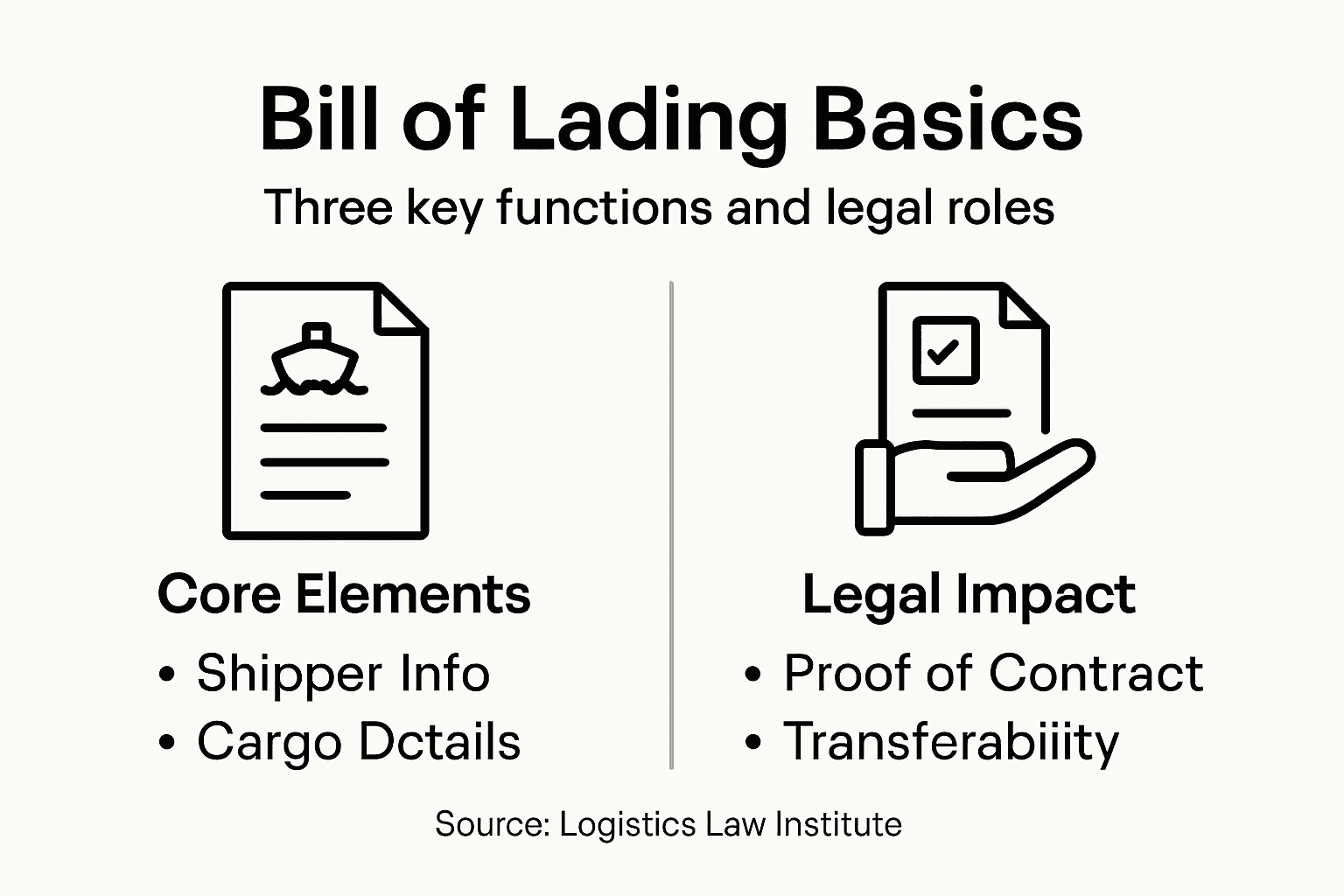
At its core, a Bill of Lading performs three primary roles:
- Receipt for Goods: Confirms the carrier has received specific merchandise
- Contract of Carriage: Outlines precise shipping terms and conditions
- Document of Title: Potentially represents legal ownership of transported goods
Many logistics professionals and shippers misunderstand the BOL’s complexity. Transportation law defines it as a negotiable or non-negotiable instrument with substantial legal implications. These documents create binding contractual obligations that can determine liability, transfer ownership, and establish critical shipping parameters.
Common misconceptions about Bills of Lading often lead to significant operational challenges:
- Treating the BOL as merely an address label
- Underestimating the importance of precise cargo descriptions
- Overlooking potential liability risks from inaccurate documentation
- Assuming all BOLs have identical legal standing
Accuracy is paramount. Errors in weight, classification, or shipment details can trigger costly disputes, potentially exposing carriers and shippers to substantial financial and legal risks.
Pro tip: Always have multiple professionals review your Bill of Lading before finalizing to minimize potential documentation errors.
Types of Bills of Lading in International Trade
In international shipping, Bills of Lading represent diverse legal instruments designed to meet complex commercial needs. Several key types exist that serve unique functions in global trade transactions, each carrying distinct legal implications and operational characteristics.
The primary categories of Bills of Lading include:
- Negotiable Bill of Lading: Allows transfer of goods ownership through endorsement
- Non-Negotiable (Straight) Bill of Lading: Specifies a named consignee with no transfer rights
- Order Bill of Lading: Can be transferred by endorsement to another party
- Bearer Bill of Lading: Transfers to whoever physically possesses the document
- Sea Waybill: Evidences contract and receipt without being a title document
Different Bill of Lading types serve specific commercial scenarios. The Negotiable Bill enables complex financial transactions by allowing ownership transfer, while Straight Bills provide direct, non-transferable delivery instructions. Order Bills offer flexibility for businesses needing to redirect shipments during transit.
Understanding these variations is crucial for logistics professionals. Each Bill of Lading type carries unique legal weight, determines ownership transfer mechanisms, and impacts shipping and financing strategies. Selecting the appropriate type can minimize risks, streamline transactions, and provide critical legal protections.
Here’s a comparison of the main types of Bills of Lading and their business impacts:
| Bill of Lading Type | Transferability | Use Case | Key Business Impact |
|---|---|---|---|
| Negotiable Bill | Transferable by endorsement | Complex international shipments | Enables financing & resale |
| Non-Negotiable (Straight) | No transfer rights | Direct delivery to named consignee | Simple, secure delivery |
| Order Bill | Transferable to another party | Redirection during transit | Flexibility in routing |
| Bearer Bill | Transfers to holder | Physical possession transactions | Fast trade, minimal checks |
| Sea Waybill | Non-title, no transfer allowed | Routine, low-risk shipments | Streamlined digital process |
Pro tip: Consult with a logistics expert to determine the most appropriate Bill of Lading type for your specific international trade transaction.
Essential Elements and How They Function
A comprehensive Bill of Lading requires precise documentation that serves multiple critical functions in international shipping. Essential elements define the entire transaction by establishing legal and operational frameworks for cargo transportation.
The key elements of a Bill of Lading typically include:
- Shipper Information: Complete contact details and legal name
- Consignee Details: Recipient’s full identification and contact information
- Carrier Information: Shipping company’s legal name and contact details
- Cargo Description: Detailed specifications of goods being transported
- Shipment Specifications:
- Exact weight and measurements
- Commodity classification
- Packaging type
- Quantity of items
- Origin and Destination Points: Precise shipping route details
Critical documentation components function as more than simple shipping records. They serve three fundamental purposes: receipt of goods, contract of carriage, and potential document of title. Each element plays a strategic role in establishing legal accountability, determining liability, and facilitating smooth international trade transactions.

Accurate completion of these elements is not just bureaucratic procedure—it’s a critical risk management strategy. Errors or omissions can trigger significant legal complications, potentially resulting in delayed shipments, financial penalties, or complete cargo seizure. Logistics professionals must treat each line of the Bill of Lading as a legally binding commitment.
Pro tip: Cross-verify every detail on your Bill of Lading with original shipping documents to ensure 100% accuracy before final submission.
Legal Significance and Compliance for U.S. Shippers
Bills of Lading represent critical legal documents in U.S. transportation law, carrying substantial implications for shipping professionals. Federal regulations mandate specific compliance requirements that govern interstate motor carriage and international trade transactions.
Key legal compliance aspects for U.S. shippers include:
- Regulatory Framework:
- Federal Motor Carrier Safety Administration (FMCSA) guidelines
- Pomerene Act provisions
- Interstate commerce regulations
- Documentation Requirements:
- Comprehensive shipment details
- Accurate carrier and shipper information
- Precise freight descriptions
- Legal Obligations:
- Establishing clear contractual terms
- Defining carrier and shipper responsibilities
- Determining potential liability scenarios
U.S. legal standards emphasize the Bill of Lading’s multifaceted role as a receipt, contract of carriage, and potential document of title. This legal instrument binds carriers and shippers to specific terms, creating a framework for resolving potential disputes and clarifying operational responsibilities.
Noncompliance can trigger significant consequences, including financial penalties, shipment delays, and potential legal actions. U.S. shippers must treat the Bill of Lading as more than a routine document—it’s a legally binding instrument that requires meticulous attention to detail and comprehensive understanding of federal transportation regulations.
Pro tip: Consult with a transportation law specialist annually to ensure your Bill of Lading practices remain fully compliant with the latest federal regulations.
Risks, Liabilities, and Common Documentation Errors
Bills of Lading involve complex legal landscapes where documentation precision can mean the difference between smooth transactions and costly disputes. Common documentation errors create significant operational risks that can derail shipping processes and expose businesses to financial vulnerabilities.
Typical documentation errors include:
- Commodity Description Mistakes:
- Incomplete freight details
- Inaccurate product classifications
- Missing specific cargo characteristics
- Weight and Measurement Errors:
- Incorrect shipment dimensions
- Miscalculated total weight
- Improper freight class determination
- Accessorial Charge Omissions:
- Forgotten special service fees
- Unrecorded delivery conditions
- Missing handling requirements
Regulatory frameworks mandate strict liability standards that can trigger substantial consequences for documentation inaccuracies. Potential risks range from shipping delays and billing disputes to potential legal claims and regulatory audits.
Mitigating these risks requires systematic documentation review and robust internal verification processes. Logistics professionals must treat each Bill of Lading as a critical legal instrument, recognizing that even minor errors can result in significant financial and operational repercussions.
The table below summarizes major documentation errors and related business risks:
| Error Type | Typical Cause | Business Impact |
|---|---|---|
| Inaccurate Description | Vague or missing details | Misrouted cargo, disputes |
| Weight Mistakes | Manual entry errors | Billing issues, penalties |
| Omitted Charges | Neglected service notes | Lost revenue, surprise fees |
| Wrong Classification | Misunderstood cargo class | Regulatory fines, delays |
Pro tip: Implement a mandatory two-person review process for all Bill of Lading documentation to minimize human error and reduce potential liability exposure.
Master Your Bill of Lading Challenges with Worldwide Express
Navigating the complexities of a Bill of Lading requires precision and expert handling to avoid costly legal risks and shipping delays. This article highlights key pain points such as accurate cargo descriptions, legal compliance, and choosing the right Bill of Lading type. If you want to protect your business from documentation errors and improve your international shipping efficiency, tackling these issues with expert support is essential.
Discover tailored logistics solutions at Worldwide Express, Inc. that specialize in freight forwarding, customs brokerage, and compliance to ensure your Bill of Lading is flawless. Visit our Uncategorized – Worldwide Express, Inc. page to explore how we bring reliability and legal assurance to your shipments. Don’t wait for issues to arise—partner with a trusted logistics provider who can streamline your international trade operations from start to finish. Take the next step for seamless global shipping today.
Frequently Asked Questions
What are the key elements of a Bill of Lading?
The key elements of a Bill of Lading typically include shipper information, consignee details, carrier information, cargo description, shipment specifications (e.g., weight, dimensions), and origin and destination points.
Why is accuracy important in a Bill of Lading?
Accuracy is crucial because errors in weight, cargo description, or shipment details can lead to costly disputes, delayed shipments, financial penalties, or even legal complications.
What are the legal implications of a Bill of Lading?
A Bill of Lading serves as a legal contract between the carrier and shipper, establishing terms of transport, detailing ownership transfer, and determining liability in case of disputes. Noncompliance can lead to significant legal and financial consequences.
How can I ensure my Bill of Lading is compliant with regulations?
To ensure compliance, consult with a transportation law specialist, regularly review documentation practices, and verify that all elements meet federal regulations and requirements.
Recommended
- Understanding Bill of Lading Types in Trade Transactions – Worldwide Express, Inc.
- 7 Key Types of Bill of Lading Explained for Exporters – Worldwide Express, Inc.
- How to Read a Bill of Lading: A Step-by-Step Guide – Worldwide Express, Inc.
- Understanding What is Through Bill of Lading – Worldwide Express, Inc.