Every small or mid-sized American importer knows shipping disruptions can create costly setbacks across their supply chain. Understanding the real impact of a freight broker agent means recognizing how these professionals connect shippers and carriers, handle regulatory compliance under Federal Motor Carrier Safety Administration rules, and manage vital financial transactions. This introduction brings clarity to agent responsibilities, helping logistics managers confidently achieve smoother and more reliable global shipping operations.
Table of Contents
- Core Duties Of Freight Broker Agents
- Types Of Freight Broker Agents Explained
- How Agents Facilitate International Shipping
- Legal Requirements And Licensing Process
- Key Risks, Fees, And Compliance Issues
Key Takeaways
| Point | Details |
|---|---|
| Core Responsibilities | Freight broker agents identify carriers, manage finances, ensure regulatory compliance, negotiate rates, and maintain communication between shippers and carriers. |
| Types of Agents | Various types of freight broker agents exist, including Independent Sales Agents, Licensed Broker Agents, and Commission-Based Agents, each with unique roles and responsibilities. |
| International Shipping | Agents facilitate international shipping by managing documentation, coordinating carriers, and ensuring compliance with international trade regulations. |
| Legal and Compliance Issues | Freight broker agents face risks related to financial liability, regulatory compliance, and operational integrity that require proactive management and adherence to legal standards. |
Core Duties of Freight Broker Agents
Freight broker agents serve as critical intermediaries in the complex world of transportation logistics, connecting shippers with carriers and managing the intricate financial and operational details of freight movement. These professionals play a pivotal role in ensuring smooth, efficient shipping processes for U.S. importers by facilitating critical shipment connections.
The core responsibilities of freight broker agents encompass several key strategic functions:
- Carrier Identification: Locating and securing appropriate transportation carriers for specific freight requirements
- Financial Management: Handling invoicing, payments, and credit extensions between shippers and carriers
- Regulatory Compliance: Ensuring adherence to Federal Motor Carrier Safety Administration (FMCSA) regulations
- Rate Negotiation: Establishing competitive pricing and managing transportation costs
- Communication Management: Maintaining continuous communication between shippers and carriers throughout the shipping process
Beyond these fundamental duties, freight broker agents often work on commission, bringing in new customers and cultivating long-term business relationships. They leverage their industry expertise to negotiate optimal shipping arrangements that balance cost-effectiveness with reliable transportation solutions. Relationship building becomes a critical skill, as successful agents must develop robust networks of carriers and shippers.
These professionals operate with remarkable complexity, simultaneously managing financial transactions, legal requirements, and logistical challenges. By navigating carrier safety regulations, they protect both shipper and carrier interests while ensuring cargo moves efficiently across national transportation networks.
Pro tip: Successful freight broker agents invest heavily in building strong carrier relationships and maintaining impeccable communication skills to differentiate themselves in a competitive logistics marketplace.
Types of Freight Broker Agents Explained
In the dynamic world of transportation logistics, freight broker agents play diverse roles that are critical to efficient shipping operations. These professionals can be categorized into distinct types based on their operational structure, licensing, and business relationships. Independent freight agents operate with notable variations across different organizational models.
The primary categories of freight broker agents include:
- Independent Sales Agents: Work under an established freight broker’s license
- Earn commissions by bringing in new customers
- Do not require personal broker licensing
- Focus primarily on sales and client relationship management
- Licensed Broker Agents: Operate with full brokerage licensing
- Can establish and manage their own brokerage agencies
- Hold broader legal and financial responsibilities
- Manage comprehensive logistics operations
- Commission-Based Agents: Compensation structured around successful shipment connections
- Paid based on volume and frequency of shipments secured
- Work closely with carriers and shippers
- Incentivized to build strong transportation networks
Each type of freight broker agent brings unique capabilities to the logistics ecosystem. Operational responsibilities vary significantly between independent sales representatives and fully licensed brokers, with the latter assuming more comprehensive management and compliance duties.
Here is a comparison of the main types of freight broker agents and their unique responsibilities:
| Agent Type | Licensing Required | Primary Responsibility | Business Impact |
|---|---|---|---|
| Independent Sales | No personal license | Client acquisition & sales | Grows shipper relationships |
| Licensed Broker | Full broker license | End-to-end logistics | Handles complex regulations |
| Commission-Based | Varies by employer | Securing shipments | Maximizes shipment volume |
The complexity of these roles requires agents to develop sophisticated skills in negotiation, communication, and relationship management. Successful agents must navigate intricate networks of carriers, understand complex shipping regulations, and consistently deliver value to both shippers and transportation providers.
Pro tip: Aspiring freight broker agents should focus on developing a robust professional network and understanding the nuanced differences between agent types to maximize their career potential.
How Agents Facilitate International Shipping
International shipping represents a complex logistical challenge that requires expert navigation through regulatory landscapes and operational intricacies. Freight broker agents serve as critical intermediaries, coordinating intricate international shipping processes that enable smooth cross-border commerce for U.S. importers.
The key mechanisms through which freight broker agents facilitate international shipping include:
- Documentation Management
- Preparing and verifying export/import paperwork
- Ensuring compliance with international trade regulations
- Managing customs declaration forms
- Carrier Coordination
- Negotiating optimal shipping rates
- Selecting appropriate transportation methods
- Tracking shipment progress across multiple transport modes
- Regulatory Compliance
- Monitoring changing international trade laws
- Verifying carrier licensing and insurance
- Managing risk mitigation strategies
Regulatory Oversight plays a crucial role in these operations. Federal Maritime Commission regulations establish stringent standards that freight broker agents must consistently meet, ensuring that international shipping processes remain transparent, secure, and legally compliant.

Beyond administrative functions, these agents act as strategic partners for importers, translating complex global shipping requirements into streamlined, cost-effective solutions. Their expertise transforms potential logistical challenges into seamless transportation experiences, bridging communication gaps between shippers, carriers, and regulatory bodies.
Pro tip: Develop comprehensive documentation tracking systems and maintain updated knowledge of international shipping regulations to minimize potential shipping complications.
Legal Requirements and Licensing Process
Navigating the complex legal landscape of freight brokerage requires meticulous attention to regulatory requirements and comprehensive licensing procedures. Freight broker agents must undergo rigorous registration processes that ensure their credibility and operational competence in the transportation industry.
The key legal requirements for freight broker agents include:
- Federal Registration
- Submit application through Unified Registration System
- Obtain broker authority from FMCSA
- Pay mandatory application fees
- Insurance and Financial Requirements
- Provide proof of insurance coverage
- Establish surety bond or trust fund agreement
- Demonstrate financial stability and risk management
- Documentation Compliance
- Complete Form BOC-3 designating process agent
- Maintain accurate shipping and financial records
- Adhere to ongoing regulatory reporting standards
Licensing Procedures represent a critical step in establishing legitimacy. Customs broker licensing involves comprehensive examinations that assess an agent’s knowledge of import/export regulations, ensuring only qualified professionals enter the field.
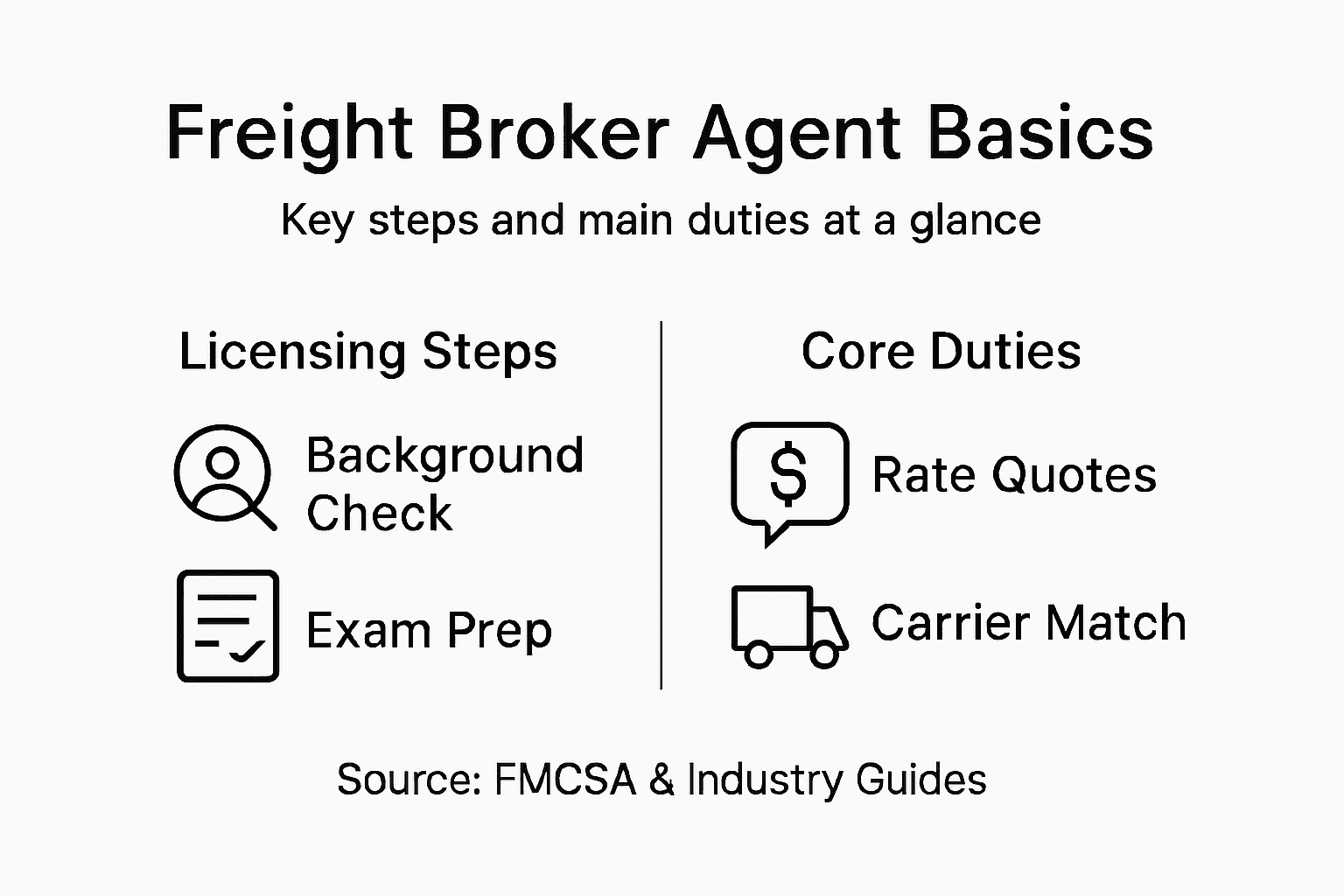
The entire licensing process typically requires significant preparation, including background checks, comprehensive examinations, and continuous professional development. Agents must demonstrate not just technical knowledge, but also a commitment to ethical practices and regulatory compliance.
Pro tip: Invest in professional preparation courses and maintain meticulous documentation to streamline your freight broker agent licensing journey.
Key Risks, Fees, and Compliance Issues
Freight broker agents navigate a complex landscape of financial and legal risks that demand meticulous attention and proactive management. Strict regulatory requirements govern broker operations, creating a challenging environment where compliance is not just recommended, but mandatory.
The primary risks and compliance challenges include:
- Financial Liability Risks
- Potential for carrier payment defaults
- Mandatory $75,000 surety bond requirement
- Financial responsibility for transaction accuracy
- Regulatory Compliance Risks
- Penalties for non-compliance with FMCSA regulations
- Strict recordkeeping mandates
- Potential license revocation for serious violations
- Operational Integrity Risks
- Ensuring carrier operating authority verification
- Avoiding fraudulent misrepresentation
- Maintaining transparent transaction records
Transaction Transparency represents a critical component of broker operations. Federal regulations mandate honest and fair transactional practices, requiring brokers to provide complete contract information, avoid misleading statements, and maintain rigorous documentation standards.
The financial implications of non-compliance can be severe, ranging from monetary penalties to complete operational shutdown. Successful freight broker agents must develop robust internal systems that anticipate regulatory requirements and proactively manage potential risks before they become critical issues.
The table below highlights major risks and fees faced by freight broker agents in day-to-day operations:
| Issue Category | Main Challenge | Typical Costs/Impact | Prevention Strategy |
|---|---|---|---|
| Financial Liability | Carrier payment default | Loss of funds, bond risk | Financial screening of carriers |
| Regulatory Penalty | Non-compliance fines | Penalties, license loss | Routine compliance audits |
| Operational Integrity | Fraudulent representation | Legal action, reputation harm | Strict transaction documentation |
Pro tip: Invest in comprehensive compliance management software and conduct regular internal audits to stay ahead of potential regulatory challenges.
Simplify Your Freight Brokerage Challenges with Trusted Global Solutions
Freight broker agents face numerous challenges as they bridge importers and carriers managing complex compliance, regulatory requirements, and international shipping logistics. With the constant need for clear communication, reliable carrier coordination, and regulatory adherence, shippers require a partner who can bring expertise and efficiency to every step of the process. If you are seeking to overcome these pain points and ensure seamless cross-border operations, exploring comprehensive logistics services is essential.
Discover how Worldwide Express, Inc. specializes in delivering tailored customs brokerage, import/export freight forwarding, and end-to-end supply chain management solutions designed for U.S. importers. By leveraging proven expertise with shipment tracking, cargo insurance, and global compliance, you can protect your shipments and streamline your international trade processes. Learn more about our range of services through our Uncategorized – Worldwide Express, Inc. page and take the first step toward worry-free freight broker collaboration. Start optimizing your shipping operations today by visiting Worldwide Express, Inc. and gaining immediate access to professional logistics support.
Frequently Asked Questions
What are the primary responsibilities of a freight broker agent?
Freight broker agents primarily handle carrier identification, financial management, regulatory compliance, rate negotiation, and communication management between shippers and carriers.
How do freight broker agents facilitate international shipping?
Freight broker agents facilitate international shipping by managing documentation, coordinating carriers, and ensuring regulatory compliance for import and export processes.
What legal requirements must freight broker agents comply with?
Freight broker agents must comply with federal registration, insurance requirements, and maintain accurate documentation to ensure legal operation within the freight brokerage industry.
What are the main risks faced by freight broker agents?
Freight broker agents face financial liability risks, regulatory compliance risks, and operational integrity risks that require diligent management and proactive strategies.
Recommended
- Customs Broker Explained: Ensuring Smooth U.S. Imports – Worldwide Express, Inc.
- Understanding Customs Broker vs Freight Forwarder – Worldwide Express, Inc.
- Understanding the Role of a Customs Import Broker – Worldwide Express, Inc.
- Broker vs Freight Forwarder: Key Differences Explained – Worldwide Express, Inc.
- Wat is customs clearance? Begrijp het proces en belang – Send with Parcel International