Rush deadlines and tight margins can turn ISF shipping into a source of stress for American importers. Missing or inaccurate information leads to costly U.S. Customs holds, threatening your ability to deliver cargo on time. By focusing on gathering the required ISF data elements and using the Automated Commercial Environment portal, you can reduce exam risks, maintain compliance, and keep cargo clearance moving smoothly from the foreign port to American shores.
Table of Contents
- Step 1: Gather Required ISF Shipping Information
- Step 2: Submit Accurate ISF Data to Customs
- Step 3: Monitor Filing Status and Address Issues
- Step 4: Confirm Compliance and Document Clearance
Quick Summary
| Essential Insight | Clear Explanation |
|---|---|
| 1. Gather Required Documents | Collect all necessary documents, including invoices and bills of lading, to prevent shipping delays. |
| 2. Submit ISF Data Accurately | Ensure ISF data is accurate and submitted via an approved system at least 24 hours before loading. |
| 3. Monitor ISF Status Promptly | Check the filing status in the ACE portal within 24 hours to address any issues immediately. |
| 4. Confirm Full Compliance | Verify all regulatory requirements are fulfilled before clearance to avoid holds or penalties. |
| 5. Maintain Documentation for 5 Years | Keep copies of all documents and communications for five years for compliance and audit purposes. |
Step 1: Gather Required ISF Shipping Information
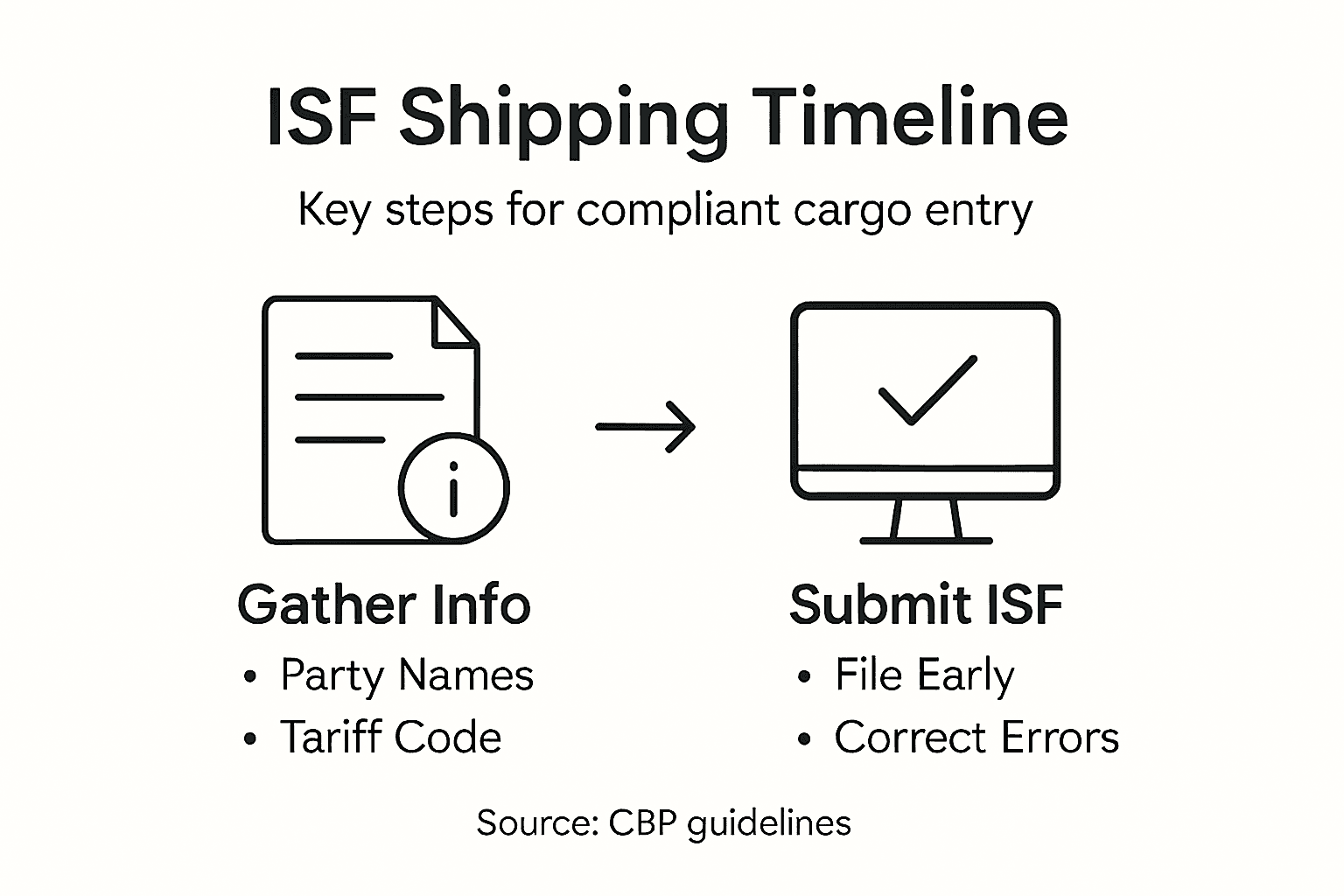
Before you can file your Importer Security Filing, you need to collect all the necessary data elements. The U.S. Customs and Border Protection (CBP) has specific requirements for what information must be submitted, and accuracy here prevents delays and costly holds on your shipment.
Start by assembling the foundational documents you’ll need:
- Bill of lading or air waybill details
- Commercial invoices for all items
- Packing lists showing container contents
- Power of attorney forms authorizing your broker
- Importer of record and consignee information
You’ll need to identify several key parties involved in your shipment. The seller (manufacturer or exporter) and buyer (your company) must be clearly documented. Next, confirm your importer of record number and the consignee details for where cargo arrives in the United States.

For each product line, gather the Harmonized Tariff Schedule (HTSUS) number, the country of origin, and details about your manufacturer or supplier. This information helps CBP classify goods and assess duties correctly.
Here’s a summary of key parties and their roles in ISF shipping:
| Role | Responsibility | Impact on ISF Compliance |
|---|---|---|
| Seller/Manufacturer | Provides product and commercial details | Accurate data prevents holds |
| Importer of Record | Files ISF, ensures all information is complete | Central to compliance, liable for errors |
| Consignee | Receives goods in the U.S.; contact for issues | Missing info can delay release |
| Customs Broker | Prepares and files ISF, validates documentation | Errors here risk penalties |
| Consolidator | Combines shipments, provides location data | Required for consolidated cargo |
You must submit required ISF data elements in English through a CBP-approved electronic system no later than 24 hours before cargo is loaded at the foreign port.
If your shipment involves consolidation at a foreign facility, identify the consolidator’s name and location. For containerized cargo, note the container stuffing location where goods are packed into shipping containers.
Collect all customs forms your broker requires, including U.S. Customs Form 3299 and any required certificates of origin. Having these documents organized and accurate before filing saves time and prevents rejection of your filing.
Pro tip: Create a master checklist for each shipment and keep copies of all supporting documents for at least five years; this speeds up future filings and protects you during audits.
Step 2: Submit Accurate ISF Data to Customs
Now that you’ve gathered your documents, it’s time to submit your ISF data through a CBP-approved electronic system. Accuracy and timing are everything here—one mistake can trigger exam holds or delay your cargo clearance by days.
Your submission must include 10 specific data elements that CBP requires. Double-check that each field matches your source documents exactly:
- Importer of record number
- Consignee numbers and details
- Seller and buyer information
- Manufacturer or supplier data
- Commodity HTSUS codes
- Country of origin
- Container stuffing location
- Consolidator details (if applicable)
- Bill of lading reference
- Ship-to party information
Work with your customs broker or freight forwarder to ensure the filing is submitted correctly. They’ll verify that your data aligns with your commercial documents and bill of lading before transmission. This cross-check prevents mismatches that CBP flags during verification.
Filing accurate ISF data electronically and within deadlines ensures your cargo moves smoothly through U.S. Customs and avoids examination delays.
Your ISF must be filed no later than 24 hours before your vessel loads cargo at the foreign port. Missing this window means your shipment cannot sail. Once submitted, your broker should confirm the filing was accepted by CBP and provide you with a confirmation number.
If you discover an error after submission, correct it immediately. CBP appreciates prompt corrections and considers them part of maintaining compliance. Waiting days to fix mistakes signals negligence and invites closer scrutiny of future shipments.
Pro tip: Request a written confirmation from your broker showing the exact submission time and date; this protects you if CBP questions whether you met the 24-hour deadline.
Step 3: Monitor Filing Status and Address Issues
After submitting your ISF, you need to monitor its status and respond quickly to any CBP requests. Delays in addressing issues can result in exam holds, penalties, or cargo being held at the port, so staying on top of this step is critical for timely cargo entry.
Log into the Automated Commercial Environment (ACE) portal to track your ISF submission status. This CBP system shows whether your filing was accepted, rejected, or flagged for further review. Check ACE within 24 hours of submission to confirm receipt.
Monitor your portal for these key status indicators:
- Accepted filings with confirmation numbers
- Rejected filings requiring resubmission
- Requests for additional documentation
- Exam holds or compliance alerts
- Release authorizations
The ACE Secure Data Portal lets you respond directly to CBP requests for missing information or clarification. If CBP flags an error in your commodity codes, country of origin, or consignee details, you can update and resubmit corrections electronically. This direct communication prevents back-and-forth delays.
The table below outlines common ISF status outcomes and the recommended next steps:
| Status on ACE Portal | What It Means | Action Required |
|---|---|---|
| Accepted | Filing complete, no issues detected | Monitor for further CBP updates |
| Rejected | Errors or missing information present | Correct and resubmit promptly |
| Request for Docs | CBP needs more documents or clarification | Upload and submit without delay |
| Exam Hold | Shipment flagged for inspection | Coordinate docs and respond quickly |
| Released | Cargo cleared for entry/delivery | Archive confirmation for records |
Address CBP requests within 48 hours whenever possible to keep your shipment moving and demonstrate your commitment to compliance.
Set up email alerts in ACE so you’re notified immediately when CBP sends messages about your shipment. Don’t rely on memory or casual checking. Your broker can help configure alerts if you’re unfamiliar with the portal.
If you receive an exam notice, work with your broker to prepare documentation quickly. Exams are routine and often cleared within one business day if you respond promptly with the requested papers. Dragging your feet signals evasion and invites stricter scrutiny.
Pro tip: Assign one team member to check ACE daily during the pre-clearance period and maintain a log of all CBP communications; this creates accountability and prevents missed deadlines that could derail your shipment.
Step 4: Confirm Compliance and Document Clearance
Once CBP approves your ISF and your cargo arrives at the U.S. port, you need to confirm full compliance and finalize cargo clearance. This step ensures your shipment is released without holds and that all regulatory obligations are satisfied.
Verify that all required regulatory requirements have been met before entry. Check your ACE portal for final clearance notifications from CBP. You should see a release authorization that confirms duties have been assessed and your cargo is cleared for delivery.
Your final compliance checklist includes:
- Confirmation of ISF acceptance with no rejections
- All CBP examination requests answered completely
- Duty payments processed and confirmed
- Release notification received from CBP
- Documentation archive complete and organized
- Power of attorney and bonds current and valid
Work with your customs broker to reconcile your commercial documents against CBP’s final entry records. Any discrepancies between your invoices, bills of lading, and CBP data must be resolved before release. Small errors that slipped through earlier stages can still trigger holds at this final checkpoint.
Proper filing of ISF data and timely responses throughout the process ensure your goods are released without delays, seizures, or additional penalties.
Maintain complete documentation for at least five years after clearance. Keep copies of your ISF submission confirmation, all CBP correspondence, commercial invoices, bills of lading, and power of attorney forms. This documentation proves compliance if audited.
Request a formal cargo release confirmation from your broker once CBP sends the final authorization. Don’t assume anything based on email or verbal communication. Written confirmation protects you legally and gives you proof that you complied with all requirements.
Pro tip: Create a clearance checklist spreadsheet with dates for each milestone (ISF submission, CBP requests, payment, release); this becomes your compliance proof and helps you identify bottlenecks for future shipments.
Simplify ISF Shipping Compliance With Trusted Logistics Expertise
Ensuring timely and compliant cargo entry is vital to avoid costly delays and penalties when filing your Importer Security Filing. Challenges like gathering accurate data, submitting your ISF on time, and quickly responding to CBP requests demand a reliable logistics partner who understands these critical processes inside and out. Whether it is managing key parties like importers of record, sellers, or consolidators, or navigating the ACE portal for filing status, precision and speed matter.
Take control of your international shipments today by partnering with Worldwide Express, Inc. Our customs brokerage specialists and freight forwarding experts streamline your compliance with expert document handling, timely ISF submissions, and proactive monitoring in the Uncategorized – Worldwide Express, Inc. category. Do not risk holds or penalties from the U S Customs and Border Protection when you can leverage our global network and tailored logistics solutions. Visit Worldwide Express now to request a freight quote and start shipping with confidence.
Frequently Asked Questions
What documents are required for ISF shipping?
To ensure compliance with ISF shipping, you need key documents like the bill of lading, commercial invoices, packing lists, and power of attorney forms. Collect these items in advance to streamline your submission process and avoid delays.
How do I submit my ISF data accurately?
Submit your ISF data through a CBP-approved electronic system, ensuring all 10 required data elements match your source documents precisely. Double-check your information and aim to file at least 24 hours before cargo loading to prevent issues.
What should I do if my ISF filing is rejected?
If your ISF filing is rejected, correct the errors as quickly as possible and resubmit your data according to CBP guidelines. Prompt resubmission helps avoid delays in cargo clearance and demonstrates your commitment to compliance.
How can I monitor the status of my ISF submission?
Log into the Automated Commercial Environment (ACE) portal within 24 hours of submission to check your ISF status. Look for updates on acceptance, rejections, or any requests from CBP to address issues swiftly.
What actions can I take if my cargo is held for inspection by CBP?
If your cargo is flagged for an exam hold, work closely with your customs broker to gather and prepare the necessary documentation quickly. Respond quickly to CBP requests to reduce inspection delays and facilitate the release of your cargo.
How long should I keep my ISF and customs clearance documents?
Maintain all documentation related to ISF submissions and customs clearance for at least five years. Keeping these records organized will help you demonstrate compliance during audits and streamline future shipments.
Recommended
- What Is ISF and Its Role in U.S. Import Compliance – Worldwide Express, Inc.
- How to Complete the ISF 10 2 Form PDF for Compliance – Worldwide Express, Inc.
- Complete isf 10 2 form for compliant U.S. imports – Worldwide Express, Inc.
- 7 Essential Importer Security Filing Tips for Success – Worldwide Express, Inc.
- Real-Time Shipment Tracking Systems: Transforming Modern Logistics | Singleclic