Managing import operations can feel overwhelming when every shipment is subject to United States regulations and ever-changing customs rules. For logistics managers at mid-sized manufacturing firms, securing a customs broker license is more than a credential—it is the federal requirement that allows you to confidently oversee compliance, filing, and cargo clearance. This guide breaks down what the license permits you to do, the steps to obtain it, and how it positions you as the trusted authority between your company and United States Customs and Border Protection.
Table of Contents
- Customs Broker License Essentials Explained
- Different Ways to Use a Broker License
- Roles and Daily Activities of a Licensed Broker
- Regulations, Compliance, and Renewal Obligations
- Risks, Liabilities, and Common Mistakes to Avoid
Key Takeaways
| Point | Details |
|---|---|
| Customs Broker License is Essential | A customs broker license is mandatory to legally represent importers and exporters before U.S. Customs and Border Protection. It ensures compliance with trade regulations. |
| Responsibilities of a Broker | Licensed brokers must accurately file entry documents, calculate duties, and maintain compliance with federal requirements to avoid liabilities. |
| Examination and Continuing Education | Obtaining a customs broker license requires passing a comprehensive exam and completing 36 continuing education credits every three years to maintain it. |
| Potential Risks and Liabilities | Brokers face significant risks, including penalties for poor documentation or misclassification, underscoring the importance of thorough record-keeping and compliance. |
Customs Broker License Essentials Explained
A customs broker license is your credential to legally represent importers and exporters before U.S. Customs and Border Protection (CBP). This license opens doors to a specialized career where you help businesses navigate complex trade regulations and move cargo across borders efficiently.
The license itself isn’t optional for this work—it’s a federal requirement. CBP licenses brokers through a rigorous examination and vetting process to ensure only qualified professionals handle import and export compliance.
What the License Actually Qualifies You to Do
Your license gives you authority to perform several critical functions for your clients:
- File entry documents and declarations with CBP on behalf of importers and exporters
- Handle customs duty calculations, tariff classification, and valuation questions
- Arrange for cargo release and payment of applicable fees and taxes
- Represent clients in routine customs matters and compliance discussions
- Maintain and submit required documentation for international shipments
With a customs broker license, you become the trusted intermediary between your clients and federal customs authorities—managing documentation, compliance, and timely cargo clearance.
For mid-sized manufacturing firms, this means you can streamline their import operations significantly. Instead of your company wrestling with CBP requirements independently, a licensed broker handles the details while you focus on production and supply chain strategy.
Understanding Your Responsibilities
The license comes with accountability. Customs brokers must meet federal requirements including maintaining client records, preserving documentation, and ensuring accuracy in all filings.
You’re responsible for:
- Verifying that imported goods are properly classified and valued
- Ensuring all entry documents are complete and accurate before submission
- Communicating any compliance issues to clients immediately
- Keeping current on changing tariff codes and trade regulations
- Maintaining professional standards and ethical conduct in all transactions
Misclassification, undervaluation, or incomplete filings create legal exposure for both you and your clients. The CBP takes broker conduct seriously, and violations can result in license suspension or revocation.
The Examination and Licensing Process
Before you can obtain this license, you must pass a comprehensive examination administered by CBP. The exam tests your knowledge of import/export procedures, tariff classification, entry procedures, and applicable laws.
The process typically involves:
- Meeting CBP eligibility requirements (citizenship, age, and background check)
- Studying CBP regulations, tariff schedules, and entry procedures
- Passing the written licensing examination
- Submitting a completed application with supporting documentation
- Receiving your license after CBP approval
The examination is thorough because CBP trusts licensed brokers to handle thousands of import transactions correctly. Getting licensed takes preparation, but it’s the credential that separates you from unlicensed freight forwarders or shipping agents.
Why This Matters for Your Career
The license positions you as an expert in your field. Employers and clients recognize it as proof you understand customs law and can execute complex transactions. For logistics managers at manufacturing firms, it validates your expertise in managing international supply chains.
Clients trust licensed brokers because the license is backed by federal oversight. Without it, you’re limited to administrative support roles rather than direct client representation.
Pro tip: Start your licensing study 3-4 months before your exam date, focusing on recent tariff changes and entry procedures relevant to your industry—CBP frequently updates regulations, and staying current makes the difference between passing confidently and struggling with outdated material.
Different Ways to Use a Broker License
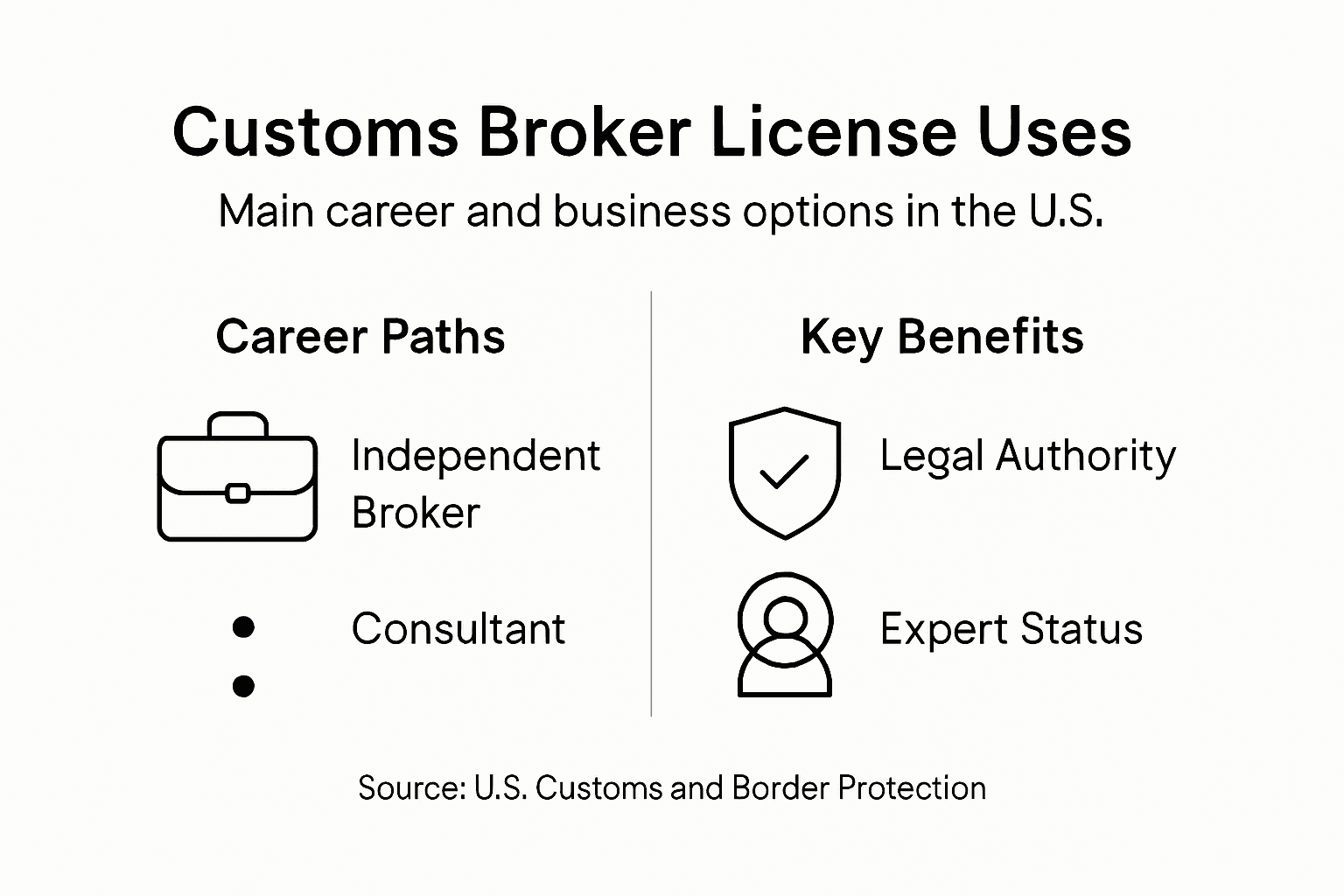
Your customs broker license isn’t one-size-fits-all. It opens multiple career and business paths depending on your goals, market, and risk tolerance. Some brokers work independently; others join established firms or launch their own operations.
The key is understanding which path aligns with your logistics expertise and business vision. For logistics managers at manufacturing companies, this flexibility means you can shape your career without being locked into a single role.
Working as an Independent Broker
The simplest path is operating as a sole proprietor. You represent importers and exporters directly, handling their customs documentation and compliance in exchange for fees. You keep all profits and maintain full control over client relationships and pricing.
This model works best when you have:
- An established network of importers or exporters who trust you
- Time to manage your own administrative and business operations
- Comfort with irregular income until your client base stabilizes
- Capital to cover initial licensing, compliance, and technology costs
Operating independently gives you flexibility and higher margins, but you shoulder all business risks and overhead alone.
Many brokers start this way, building a small portfolio of loyal clients before expanding. You’re essentially a one-person operation handling entry documentation, duty calculations, and client communication.
Joining an Established Brokerage Firm
Alternatively, you can work as a broker employed by a larger customs brokerage or freight forwarding company. This approach provides stability, established client relationships, and shared operational costs.
Employment as a licensed broker means:
- Regular salary or commission structure instead of variable client fees
- Access to existing infrastructure, technology, and support staff
- Opportunity to learn from experienced brokers and build expertise
- Built-in client base rather than starting from zero
Companies like Worldwide Express employ licensed brokers because the license validates their team’s ability to represent clients before CBP. You become part of a larger logistics operation handling trade compliance across multiple shipments and industries.
For manufacturing logistics managers, this path often makes sense early in your career. You gain hands-on experience with diverse importers and industries before considering independent operations.
Starting Your Own Brokerage Business
If you have entrepreneurial ambitions, licensed customs brokers may work as partnerships or corporate associations to offer brokerage services nationwide. This requires more capital, business planning, and operational complexity than independent work.
Launching a brokerage firm involves:
- Securing startup capital for technology, office space, and compliance infrastructure
- Building relationships with importers and exporters who need customs services
- Hiring and training additional licensed brokers as you scale
- Maintaining strict compliance records and audit procedures
- Managing client expectations and service quality across multiple transactions
This path demands business acumen beyond customs knowledge. You’re running a service company, not just handling documents.
Offering Compliance Consulting
Your license also positions you to consult directly with companies on import/export procedures and tariff strategies. Rather than processing individual shipments, you advise clients on trade compliance, cost optimization, and regulatory changes.
Consulting works well when you understand the tactical side of customs but prefer strategic client conversations over transaction processing. Mid-sized manufacturers often hire consultants to audit their existing import processes and identify cost savings.
Pro tip: Build relationships with your early clients first before deciding your business model—their feedback about what they actually need often reveals the most profitable and sustainable path forward.
Here’s a comparison of common career paths available to licensed customs brokers:
| Career Path | Work Structure | Client Acquisition | Income Stability |
|---|---|---|---|
| Independent Broker | Self-managed | Build client base | Fluctuates with clients |
| Employed by Brokerage Firm | Team-based | Provided by company | Stable salary or commission |
| Brokerage Owner | Team management | Acquire and retain clients | Variable, scalable with growth |
| Compliance Consultant | Project-based | Industry networking | Project-dependent |
Roles and Daily Activities of a Licensed Broker
A customs broker’s day isn’t spent sitting behind a desk waiting for paperwork. It’s active, deadline-driven work involving constant communication with clients, CBP officials, and logistics partners. Your responsibilities shift based on shipment volume, client needs, and regulatory changes.

Understanding what brokers actually do helps you assess whether this career fits your skills and work style. For logistics managers considering this path, it’s useful to know the real rhythm of the job.
Documentation and Entry Processing
Your core responsibility is preparing and submitting entry documentation to CBP. This includes commercial invoices, bills of lading, packing lists, and official CBP forms for each shipment.
Documentation work involves:
- Reviewing shipper information for accuracy and completeness
- Classifying goods using the Harmonized Tariff Schedule
- Calculating duties and taxes based on merchandise value and origin
- Preparing CBP Form 3461 (entry/immediate delivery) or other required forms
- Submitting documents electronically before cargo arrives at the port
Even a single missing field or incorrect classification delays shipment release. Precision matters. You’re balancing speed (manufacturers need their materials fast) with accuracy (CBP penalties for errors are expensive).
Client Communication and Problem-Solving
Expect frequent conversations with importers about shipment status, duty costs, and compliance issues. Clients call when they need answers: “Why is my shipment held?” or “What tariff code applies to this product?”
You translate CBP requirements into language clients understand. When CBP requests additional documentation or information, you’re the bridge between the agency and your client.
Licensed brokers spend significant time communicating—explaining duties, resolving classification disputes, and managing client expectations when delays occur.
This requires patience and clear communication skills. You’re solving real business problems for manufacturers who depend on timely imports.
Maintaining Accurate Records
Regulation requires brokers to maintain accurate transaction records for every shipment they process. These records document shipment details, duties paid, client information, and any communications with CBP.
Record-keeping responsibilities include:
- Filing invoices, bills of lading, and packing lists for each entry
- Documenting all client communications about specific shipments
- Maintaining evidence of duty payments and CBP filings
- Retaining records for the required retention period
- Providing records to CBP upon request during audits
Sloppy record-keeping creates serious liability. If CBP audits your work and you can’t produce documentation, you face penalties and potential license suspension.
Monitoring Shipments and Handling Issues
Your job doesn’t end when you submit entry documentation. You monitor shipment status, watch for CBP examination notices, and handle unexpected problems.
Monitoring involves:
- Tracking shipments through customs clearance
- Responding to CBP examination requests for additional information
- Arranging payment of duties and fees to release cargo
- Notifying clients of status changes and delays
- Resolving issues that arise during clearance
If CBP opens a container for inspection and finds discrepancies, you investigate and explain the difference to the agency. If duties are miscalculated, you adjust the payment. This problem-solving is constant.
Staying Current on Regulations
Tariff codes change. Trade agreements shift. CBP issues new guidance regularly. Part of your daily responsibility is staying informed about regulatory changes that affect your clients’ shipments.
You can’t afford to file an entry using outdated tariff information or miss a new duty requirement. Regulatory awareness is ongoing learning, not a one-time certification.
Pro tip: Set up automated alerts for CBP announcements and tariff changes relevant to your clients’ industries—catching a regulatory update before filing a shipment prevents costly reclassification and duty disputes down the road.
Regulations, Compliance, and Renewal Obligations
Your customs broker license isn’t a one-time credential you earn and forget. CBP requires active compliance and ongoing education to keep your license current. Failing to meet these obligations can result in license suspension or revocation.
Think of it like a driver’s license—you don’t just pass the test once and ignore the rules forever. You must follow traffic laws and renew periodically.
Continuing Education Requirements
Brokers must complete 36 continuing education credits every three years to maintain their licenses. This isn’t busywork—it’s a federal mandate designed to keep brokers current on changing customs laws and procedures.
The education covers:
- Changes to tariff classifications and trade regulations
- Updates to CBP procedures and modernization initiatives
- Import/export compliance requirements
- New trade agreements and duty changes
- Professional ethics and best practices
Licensed brokers must complete minimum continuing education through approved providers, and you must document which courses you completed and when. CBP tracks your compliance through triennial status reports.
You’ll need to prove your education credits when CBP requests them during audits or renewal. Keep course completion certificates and maintain detailed records for three years after reporting.
The Triennial Renewal Process
Every three years, you submit a triennial status report to CBP confirming you’ve met continuing education requirements. This report includes documentation of your 36 completed credits and any other compliance information CBP requires.
The renewal process involves:
- Completing 36 education credits from approved sources
- Documenting course titles, dates, and credit hours
- Preparing your triennial status report with supporting evidence
- Submitting the report to CBP within the required timeframe
- Maintaining records for three years following submission
Miss the deadline or fall short on credits, and your license goes inactive. You’ll need to retest and reapply—a far more expensive option than simply staying current.
Maintaining Compliance Standards
Beyond education, CBP expects brokers to maintain operational compliance across multiple areas. This means following all federal requirements for record-keeping, client communications, and fee handling.
Compliance expectations include:
- Accurate documentation for all transactions processed
- Timely payment of duties and fees collected from clients
- Honest representation to CBP regarding shipment details
- Prompt notification to CBP of any violations or issues
- Professional conduct in all client interactions
Compliance is how CBP protects revenue and maintains integrity in the customs brokerage system—and it directly impacts your ability to keep your license.
A single major violation—like knowingly filing false documentation or mishandling client funds—can trigger license revocation. CBP audits brokers regularly, and they take violations seriously.
Modernization and Regulatory Changes
CBP continuously updates broker regulations through the Customs Broker Modernization initiative. These changes affect licensing requirements, operational processes, and compliance protocols. You must stay informed about regulatory updates and adjust your practices accordingly.
New regulations might change how you file entries, handle client information, or report to CBP. Staying aware of these changes is part of your continuing education responsibility.
For manufacturing logistics managers, this means your compliance obligations evolve. What was acceptable practice three years ago might violate current regulations today.
Pro tip: Subscribe to CBP’s official Broker Notification System and join industry groups like the National Customs Brokers and Forwarders Association—both sources alert you to regulatory changes before they create compliance problems for your clients.
Risks, Liabilities, and Common Mistakes to Avoid
Your customs broker license carries real legal and financial liability. One mistake—whether careless or intentional—can cost you your license, trigger CBP penalties, or expose you to client lawsuits. Understanding these risks helps you avoid the pitfalls that end careers.
For logistics managers considering this path, liability is the reality you must accept before pursuing a license. It’s not theoretical; it’s tangible.
Documentation and Record-Keeping Failures
The single most common mistake brokers make is poor documentation. You file an entry, process the shipment, and move on—but years later, CBP audits you and discovers incomplete or inaccurate records.
Documentation mistakes include:
- Missing or incomplete commercial invoices
- Undocumented client communications about shipment details
- Incorrect tariff classifications without supporting evidence
- Missing evidence of duty payment or CBP communications
- Records destroyed before the required retention period
Brokers must maintain proper recordkeeping and supervision of all transactions to protect against audit findings and penalties. If you can’t produce documentation during an audit, CBP assumes violations occurred.
This isn’t a minor compliance issue—poor record-keeping is grounds for license suspension or revocation.
Misclassifying Goods
Tariff classification determines duty rates. Classify a product incorrectly and the importer pays the wrong duty amount. CBP discovers the error later and assesses penalties against both you and your client.
Common classification mistakes:
- Applying outdated tariff codes without checking recent changes
- Misinterpreting product composition or intended use
- Failing to research country of origin requirements
- Overlooking special tariff programs or exemptions
- Guessing at classifications without documentation
Even honest mistakes create liability. The importer’s broker is responsible for accuracy, and clients often look to you to cover penalty costs.
Inadequate Supervision and Client Vetting
You’re responsible for knowing your clients and refusing to process shipments you suspect are illegal or undisclosed. If a client asks you to file false information or you suspect contraband, you have a duty to decline the work.
Liability arises when you:
- Process shipments without verifying client legitimacy
- Ignore red flags suggesting illegal goods or fraud
- Allow clients to use your license without proper oversight
- File entries knowing information is false or incomplete
Your license is your liability shield—but only if you use it responsibly by supervising clients and refusing improper work.
If CBP discovers you processed contraband or fraudulent entries, you’re liable even if the client initiated the violation. Ignorance doesn’t protect you.
Failure to Report Violations
When you discover a violation—a client admits undervaluation, a shipment contains undeclared items, or you filed inaccurate information—you must notify CBP promptly. Covering it up creates far worse liability than disclosing it.
Brokers who discover violations but fail to report them face:
- License revocation
- Criminal liability in severe cases
- Civil penalties from CBP
- Client lawsuits for handling the situation poorly
The right move is always disclosure. Contact CBP, document your actions, and notify the client immediately.
Operational and Compliance Gaps
Beyond documentation and classification, operational mistakes create liability. Missing audit deadlines, failing to pay duties on time, or losing client confidentiality all carry consequences.
Common operational mistakes:
- Missing triennial renewal deadlines
- Failing to complete continuing education
- Mishandling client funds or duties collected
- Breaching data security for client information
- Ignoring CBP notification requirements
Each mistake compounds liability exposure. A single violation might cost you a warning; multiple violations trigger license suspension.
Pro tip: Implement a quarterly compliance checklist covering recordkeeping, client files, duty payment verification, and CBP notification status—catching mistakes before they mature into audit findings is far cheaper than defending violations after the fact.
This table outlines the main types of risks customs brokers face and their real-world consequences:
| Risk Type | Example Scenario | Potential Consequences |
|---|---|---|
| Poor Documentation | Missing records during audit | Fines, license suspension |
| Tariff Misclassification | Using outdated tariff codes | Client penalties, legal claims |
| Inadequate Supervision | Failing to vet client shipments | Liability for illegal goods |
| Missing Education Credits | Insufficient ongoing learning | License inactivation, re-test |
| Operational Oversights | Late renewal or missed duties | CBP penalties, client loss |
Maximize Your Customs Broker License with Expert Support from Worldwide Express
Navigating the complex world of customs brokerage requires precision, up-to-date knowledge, and reliable partners who understand the challenges you face daily. Whether you are managing tariff classifications, ensuring compliance across shipments, or maintaining crucial documentation, the risks and responsibilities are significant. Worldwide Express specializes in delivering comprehensive customs brokerage and international shipping solutions that align perfectly with your goals to streamline import/export operations while minimizing liability.
Ready to elevate your customs brokerage capabilities and ensure flawless compliance? Discover how Worldwide Express can support your licensed customs broker activities with trusted expertise, global reach, and tailored logistics services. Visit our customs brokerage solutions page to learn more and start securing smooth cargo clearance today.
Frequently Asked Questions
What are the key responsibilities of a customs broker?
Your key responsibilities include preparing and filing entry documentation, verifying goods classification and valuation, handling duty calculations, arranging cargo release, and representing clients in customs matters.
How do I obtain a customs broker license?
To obtain a customs broker license, you must meet eligibility requirements, study regulations and procedures, pass a comprehensive written examination, submit a completed application with supporting documentation, and receive approval from CBP.
Can I work independently or do I need to join a brokerage firm with a customs broker license?
You can choose to work independently as a sole proprietor, join an established brokerage firm, or even start your own brokerage business, depending on your career goals and expertise in the field.
What ongoing education requirements must licensed customs brokers fulfill?
Licensed customs brokers must complete 36 continuing education credits every three years to maintain their licenses, ensuring they stay updated on changes in customs laws and practices.
Recommended
- Customs Broker Explained: Ensuring Smooth U.S. Imports – Worldwide Express, Inc.
- 7 Steps to Advance Your Knowledge of Custom Broker Jobs – Worldwide Express, Inc.
- Understanding Customs Broker Near Me: What You Need to Know – Worldwide Express, Inc.
- Understanding the Role of a Customs Import Broker – Worldwide Express, Inc.