You’ve probably heard that customs forms are just for travelers declaring purchases abroad. That’s a costly misconception. Commercial shipments require entirely different US customs forms, and confusing them can halt your cargo at the port, rack up fines, and damage client relationships. Understanding which forms apply to your business shipments and how to complete them correctly transforms customs clearance from a compliance headache into a streamlined competitive advantage.
Table of Contents
- Types And Purposes Of Key US Customs Forms
- Accessing And Correctly Filling US Customs Form PDFs
- Common Misconceptions And Mistakes In US Customs Forms
- Compliance Impacts And Practical Tips To Avoid Delays
- Best Practices For Electronic Submission Of Customs Forms PDFs
- Enhance Your Customs Compliance With Expert Freight Services
- Frequently Asked Questions About US Customs Form PDFs
Key Takeaways
| Point | Details |
|---|---|
| Form Selection | Commercial shipments require CBP 3461 and 7501 forms, not traveler declaration 6059B. |
| Accuracy Impact | Proper form completion reduces clearance delays by up to 40% according to trade studies. |
| Electronic Filing | ACE system processing is 30% faster than paper submissions. |
| HS Code Risks | HS code errors cause 20% of cargo holds at US ports. |
| Compliance Updates | Official CBP PDFs are updated semi-annually; always use the latest version. |
Types and Purposes of Key US Customs Forms
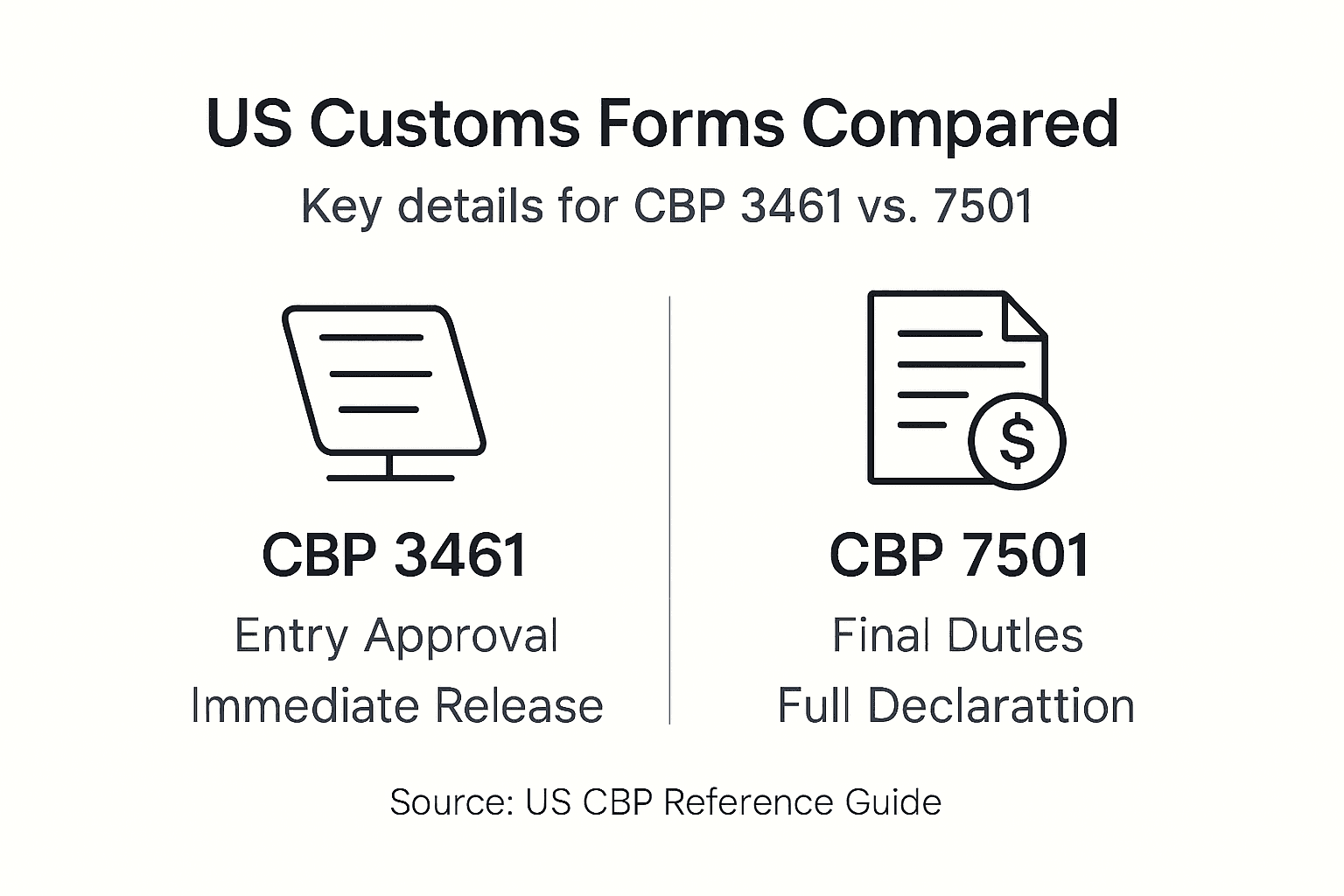
Understanding the distinct roles of US customs forms is the foundation for smooth international shipping. CBP Form 3461 authorizes entry and immediate delivery of cargo, allowing you to move goods quickly while completing final paperwork. CBP Form 7501 serves as the detailed entry summary where you declare valuation, tariff classifications, and duty calculations. Understanding CBP Forms clarifies that these forms serve complementary but distinct legal purposes in the entry process.
The traveler form CBP 6059B applies exclusively to individuals declaring personal goods. Using it for commercial shipments is a compliance violation that triggers immediate rejection. Each form captures specific data fields required by law, and substituting one for another creates legal exposure for your business.
To help you select the right form, here’s a comparison of the primary customs forms:
| Form Number | Primary Purpose | When to Use |
|---|---|---|
| CBP 3461 | Entry/Immediate Delivery | Time-sensitive cargo needing quick release |
| CBP 7501 | Entry Summary | Final duty payment and detailed classification |
| CBP 6059B | Traveler Declaration | Individual passengers only, not commercial |
| CBP 5106 | Importer ID Input | One-time registration for new importers |
Form 3461 requires the shipment description, consignee information, entry type code, and estimated duties. Form 7501 demands more granular data including precise HS codes, country of origin, manufacturer details, entered value broken down by tariff line, and calculated duties. You’ll also need the importer of record number, bond information, and entry filer code.
Your Customs Power of Attorney Form Guide becomes essential when authorizing customs brokers to file these forms on your behalf. The power of attorney designation must be current and properly executed to avoid processing delays.
Accessing and Correctly Filling US Customs Form PDFs
Locating official form PDFs starts at the CBP website’s forms library. Navigate to cbp.gov/newsroom/publications and select the forms section. Download only from official government sources or authorized broker portals. Third-party sites may host outdated versions that CBP will reject.
Here’s your step-by-step process for accurate form completion:
- Verify you have the latest form version by checking the revision date in the footer against CBP’s current publication list.
- Start with the importer of record information, entering the exact legal business name and IRS/EIN number as registered with CBP.
- Classify your goods using the correct 10-digit HS code from the Harmonized Tariff Schedule, cross-checking multiple sources if uncertain.
- Calculate entered value using the transaction value method, including all costs up to the US port of entry.
- Complete origin and manufacturer fields with specific factory locations, not just country names.
- Apply for applicable duty reductions through free trade agreements, special programs, or duty drawback when relevant.
- Double-check math on duty calculations before submission to avoid assessment discrepancies.
As noted in How to Use CBP Power of Attorney for Customs Clearance, many importers designate licensed brokers through power of attorney arrangements, which shifts form filing responsibility while maintaining importer liability for accuracy.
Pro tip: Create an internal validation checklist that maps each required field to its data source document. Running every form through this checklist before submission catches errors when they’re still easy to fix.
CBP updates forms at least annually, sometimes more frequently when regulations change. Set a recurring calendar reminder to check for new versions quarterly. The form revision date appears at the bottom of each PDF. Using an outdated version, even if the changes seem minor, can result in rejection and resubmission delays.
For guidance on related authorization documents, review the CBP Power of Attorney Usage Guide to understand how broker relationships streamline the filing process while maintaining your compliance responsibilities.
Common Misconceptions and Mistakes in US Customs Forms
The traveler form mistake tops the list of costly errors. CBP 6059B is strictly for individual passengers declaring personal items. Commercial entities attempting to use this form for business shipments face immediate rejection, cargo holds, and potential fines. This form lacks the data fields required for commercial entry and cannot legally establish import record status.
Many logistics managers believe that older form versions remain acceptable if the core information hasn’t changed. CBP explicitly requires current versions to ensure compatibility with processing systems and updated regulatory requirements. A form that’s even one revision behind gets flagged and returned, adding days to clearance time.
HS code inaccuracies create significant operational problems. According to HS Code Errors Causing Cargo Holds at US Ports:
“HS code errors cause 20% of cargo holds at US ports, with misclassification leading to incorrect duty assessments, trade agreement eligibility disputes, and delayed release requiring physical examination.”
These classification mistakes happen when importers rush through tariff research or rely on outdated product descriptions. Each digit in the 10-digit code matters. Getting the first six digits right but missing the last four still results in wrong duty rates and compliance exposure.
Another widespread belief is that paper submission equals electronic filing in processing speed and accuracy. Paper forms take longer to enter into systems, lack real-time validation, and carry higher error rates from manual data entry. Electronic submission through ACE catches formatting issues instantly and integrates directly with CBP databases.
Pro tip: Schedule quarterly training sessions for your compliance team covering common form errors and recent regulation updates. Real examples from your own shipment history make the training relevant and memorable.
Confusing one-time registration forms like CBP 5106 with recurring shipment forms also causes problems. New importers must complete initial registration separately from individual entry filings. For additional guidance on avoiding compliance pitfalls, the Customs Brokerage Myths Article addresses misconceptions that lead to these expensive mistakes. The HS Code Error Impact Report provides detailed analysis of how classification mistakes ripple through supply chains.
Compliance Impacts and Practical Tips to Avoid Delays
Form accuracy directly impacts your bottom line through faster clearance, reduced storage fees, and fewer compliance interventions. Impact of Documentation Accuracy on Customs Clearance demonstrates that accurate customs forms reduce clearance delays by approximately 40%, translating to significant cost savings on port fees and inventory carrying costs.

When CBP flags a form for errors, your cargo enters examination status. This triggers physical inspection, additional documentation requests, and detention charges that accumulate daily. A single misclassified tariff line can result in duty underpayment penalties ranging from interest charges to formal enforcement actions.
Implement these compliance best practices to maintain smooth operations:
- Establish a form review process where a second team member validates high-value or complex entries before submission.
- Maintain a current library of HS codes for your regular product lines, updating them when tariff schedules change each January.
- Transition to electronic filing through ACE to gain real-time validation and faster processing.
- Document your classification methodology for each product to demonstrate reasonable care during audits.
- Conduct quarterly internal audits of recent entries to identify patterns in errors or areas needing additional training.
- Build relationships with industry experts and customs attorneys for guidance on ambiguous classifications.
The financial impact extends beyond immediate delays. Repeated form errors signal compliance weakness to CBP, potentially triggering more frequent examinations of future shipments. This elevated scrutiny status can persist for years, slowing every entry until you demonstrate sustained accuracy improvement.
Regular staff training pays dividends in error reduction. Your team should understand not just how to fill forms but why each field matters for duty assessment and trade agreement eligibility. When staff grasp the compliance implications, they take more care with data entry and flag questionable information for review.
For comprehensive strategies on managing compliance scrutiny, explore the Customs Audit Handling Tips resource, which walks through preparation and response procedures when CBP initiates formal reviews.
Best Practices for Electronic Submission of Customs Forms PDFs
The Automated Commercial Environment (ACE) represents the modern standard for customs form submission. This CBP-managed system processes electronic filings faster, validates data in real time, and maintains complete digital records accessible for audits and dispute resolution. Filing Customs Forms Electronically Through ACE confirms that ACE electronic filing improves processing speed by up to 30% compared to paper submissions.
ACE offers several advantages that paper filing cannot match:
- Immediate error checking flags missing or invalid data before submission, allowing corrections without resubmission penalties.
- Direct integration with CBP databases auto-populates registered importer information and validates bond coverage.
- Real-time status updates show exactly where your entry stands in the review process.
- Secure storage of filing history simplifies record retention requirements and audit responses.
- Reduced data entry errors through system validations and dropdown menus for standardized fields.
Enrolling in ACE requires establishing an account through CBP’s portal, submitting your company identification documents, and designating authorized users. Licensed customs brokers can file on your behalf using their ACE credentials combined with your power of attorney authorization, as detailed in the Customs Power of Attorney Guide.
The basic electronic submission process flows like this: log into your ACE portal, select the appropriate form type, complete required fields using dropdown selections and validated inputs, attach supporting documentation as PDFs, review the pre-submission summary, then transmit to CBP. The system generates an immediate confirmation number and typically returns preliminary acceptance or rejection within hours.
Combining ACE filing with proper power of attorney documentation creates the most efficient clearance workflow. Your designated broker handles technical filing requirements while you maintain oversight through portal access and status notifications. This division of labor lets you focus on strategic decisions while compliance specialists manage procedural details.
For comprehensive guidance on related import documentation, the ISF 10-2 Form Completion Guide explains ocean shipment advance filing requirements that work in parallel with entry forms. Additional technical details about the ACE system appear at Electronically Filing Through ACE, including video tutorials and technical specifications.
Enhance Your Customs Compliance with Expert Freight Services
Navigating customs forms correctly demands specialized knowledge that evolves with regulatory changes. Worldwide Express brings decades of freight forwarding and customs brokerage experience to help import/export businesses maintain compliance while optimizing clearance speed. Our team handles form preparation, ACE filing, and regulatory monitoring so you can focus on core business operations.
We manage the technical complexity of customs documentation while keeping you informed through every step. From initial classification research to final duty payment, our customs professionals ensure accuracy that protects your business from penalties and delays. Compare service options through our Best Freight Forwarding Services analysis, explore our comprehensive US Customs Brokerage Services, or learn selection criteria in our guide on Choosing the Right Freight Forwarder for your specific shipping needs.
Frequently Asked Questions About US Customs Form PDFs
Can I use older versions of US customs form PDFs?
No, CBP requires the current form version for all submissions. Outdated forms get rejected even if changes seem minor, because system compatibility and regulatory updates necessitate the latest revision. Check the form footer date against CBP’s current publication list before every submission to avoid unnecessary delays.
What is the difference between CBP 3461 and CBP 7501 forms?
Form 3461 authorizes immediate release of time-sensitive cargo before final entry paperwork is complete, while Form 7501 provides the detailed entry summary with final duty calculations and classifications. Most commercial shipments use 3461 for quick release followed by 7501 within 10 days for final settlement. They serve complementary functions in the two-step entry process.
How does electronic filing via ACE improve customs processing?
ACE validates data instantly before submission, eliminating the formatting and calculation errors common in paper filing. The system processes electronic entries 30% faster by integrating directly with CBP databases, auto-populating verified information, and flagging issues in real time. You also gain immediate status visibility and secure digital record storage for audit purposes.
Are traveler customs declarations required for commercial shipments?
Absolutely not. CBP Form 6059B is exclusively for individual passengers declaring personal items. Commercial entities must use Forms 3461 and 7501 for business shipments, as the traveler form lacks required commercial data fields and cannot establish legal import record status. Using the wrong form results in immediate rejection and cargo holds.
What are the top tips to avoid fines related to customs form errors?
Verify HS codes using multiple authoritative sources before classification, implement a second-person review for all entries, transition to ACE electronic filing for real-time validation, maintain current product classification documentation to demonstrate reasonable care, and conduct quarterly internal audits to catch systematic errors before CBP does. Documentation of your classification methodology provides strong defense during audits and reduces penalty exposure when honest mistakes occur.
Recommended
- Complete Guide to Customs Power of Attorney Form PDF – Worldwide Express, Inc.
- Power of Attorney for Customs Clearance: Streamline US Imports – Worldwide Express, Inc.
- Complete Guide to Using Customs Power of Attorney PDF – Worldwide Express, Inc.
- How to Complete a Customs POA Form for U.S. Imports – Worldwide Express, Inc.