This is a working glossary of freight shipping terms, built for anyone who needs a clear definition fast and a sense of how that term shows up on a bill of lading, a rate sheet, or a shipment tender. We ground every definition in authoritative sources like the Federal Highway Administration and FMCSA, plus what we see daily moving freight for importers and exporters. Scroll to the section that matches your question, whether that is documents, pricing, or shipment type.
TL;DR:
- Small shipments are best handled using less-than-truckload shipping, which shares trailer space among multiple shippers and is cost-effective up to a certain pallet count.
- Ocean freight options include full-container load for large volumes and less-than-container load when volume does not justify a full box, with TEU measuring capacity.
- Accurate documentation, especially the bill of lading and proof of delivery, is critical for claims, with discrepancies often causing disputes over damages or missing freight.
- Correct freight classification based on density and handling reduces reweighs, rebilling, and billing disputes, emphasizing the importance of proper NMFC classification.
- Incoterms set responsibility for costs and risks during international shipments, with common terms like FOB and CIF defining the transfer points and obligations between buyer and seller.
Table of Contents
- Freight basics: shipment types and transport modes
- The documents that prove what actually happened
- What drives your freight bill: class, line haul, and accessorials
- Container terms you need before booking ocean freight
- Who does what: carriers, forwarders, brokers, and insurers
- Delays, penalties, and the metrics behind your rate
- Putting these definitions to work: practical checks that prevent disputes
- Incoterms and who pays for what in international trade
- Compliance terms you will see on every international shipment
- How tracking and visibility technology talks about your shipment
- Who pays and when: freight payment terms explained
- Why getting the terminology right actually matters
- How we help put these terms into practice
- FAQ
- Sources
Freight basics: shipment types and transport modes
Most freight moves under one of a handful of labels, and picking the right one changes your cost and your timeline. Less-than-truckload (LTL) shipping combines multiple shippers’ freight on one trailer, which works well for small loads that do not fill a trailer on their own. Full-truckload (FTL or TL) dedicates an entire trailer to one shipper’s freight, and it tends to make financial sense once a shipment reaches a moderate pallet count or weight threshold that approaches typical density-based premium start points for LTL carriers.
Full container load (FCL) and less-than-container load (LCL) apply the same logic to ocean freight. FCL books an entire container for one shipper, which keeps your cost-per-unit low on larger volumes and avoids the handling that comes with sharing space. LCL consolidates several shippers’ cargo into a shared container, a good option when your volume does not justify a full box, since paying for unused container space rarely makes sense for a small shipment.
Intermodal freight moves across more than one transport mode, often rail and truck, using the same container the entire way so cargo is never physically handled between modes. Drayage is the short truck move that gets a container between a port or rail yard and a nearby warehouse. Last mile refers to the final leg of delivery, typically from a local terminal to the recipient’s door, and a lane simply describes the origin-destination pairing a shipment travels, such as Los Angeles to Dallas.
Picture a small e-commerce company shipping six pallets of furniture from a Georgia warehouse to a regional distributor. At that pallet count, LTL likely beats paying for a full trailer, but if the order grows to a dozen pallets, the math flips toward FTL.
- LTL suits small, palletized freight sharing trailer space with other shippers.
- FTL/TL suits larger loads where a dedicated trailer costs less per pound than LTL rates.
- FCL suits high-volume ocean freight that fills or nearly fills a container.
- LCL suits smaller ocean shipments where splitting container costs beats paying for empty space.
For a closer look at the breakeven math, our FTL versus LTL guide walks through the pallet and weight thresholds in more detail.
The documents that prove what actually happened
Every shipment generates paperwork, and the accuracy of that paperwork determines whether a claim gets paid or denied. The bill of lading (BOL) serves three legal functions at once: it is a contract of carriage between shipper and carrier, a receipt confirming the carrier took possession of the freight, and, in some forms, a document of title that controls who can claim the goods. Electronic versions, known as eBOLs, and electronic proof of delivery (ePOD) now handle much of this digitally, but the legal weight of the information has not changed.
Proof of delivery (POD) is the signed confirmation that freight arrived in the condition described, and it becomes the primary evidence in a loss or damage claim, a process detailed in What Is a Bill of Lading Driver? Roles and Duties. According to FMCSA’s glossary, the bill of lading and its related documentation play a central role in how claims and valuation disputes are resolved, which is why discrepancies between the BOL and the POD tend to decide who pays for damaged or missing freight.
A few other documents round out a standard shipment file:
- The commercial invoice lists the transaction value, buyer, seller, and goods description, and customs authorities use it to assess duties.
- The packing list itemizes exactly what is in each package or pallet, separate from the invoice’s financial detail.
- The manifest is the carrier’s summary of everything on a given conveyance, used for customs and cargo control.
- The tariff is the carrier’s published rate and rules document that governs charges, including accessorials, for shipments under its service.
Consider a typical error: a BOL lists “20 cartons, 1,200 pounds,” but only 18 cartons arrive damaged in transit. If the original piece count was logged incorrectly at pickup, the carrier can dispute liability for the missing two, and the claim stalls while both sides try to reconstruct what was actually loaded. Our bill of lading legalities guide walks through the specific fields worth double-checking before freight leaves the dock.
Pro Tip: Photograph your freight and count pieces out loud with the driver before signing the BOL, since a signature confirms the count as accurate even if no one actually verified it.
What drives your freight bill: class, line haul, and accessorials
Freight charges rarely come down to a single number. Freight class, part of the National Motor Freight Classification (NMFC) system, groups commodities into one of several classes based on four factors: density, stowability, handling, and liability. Denser, easier-to-handle freight with low damage risk gets a lower class and a cheaper rate, while bulky, fragile, or high-value freight gets classed higher. Misclassifying a shipment, whether by accident or to save money, is one of the most common reasons a freight bill gets reweighed and rebilled after the fact, according to industry glossary guidance on NMFC factors.
Freight class misdeclaration is flagged as a leading cause of post-delivery billing disputes, according to industry glossary sources, which makes accurate class determination worth the extra five minutes at booking.
Line haul is the base transportation charge for moving freight from origin to destination, calculated per mile for truckload freight or per hundredweight for LTL. On top of line haul, carriers add accessorial charges for anything outside standard dock-to-dock service:
- Liftgate service covers mechanical unloading when a dock is unavailable.
- Inside delivery covers moving freight past the first available door.
- Detention charges apply when a truck waits beyond the carrier’s free time at pickup or delivery.
- Layover charges apply when a driver has to stop overnight due to delays outside their control.
- Storage-in-transit (SIT) covers short-term warehousing when freight cannot move directly to its final destination.
Fuel surcharges adjust the line haul rate based on current diesel prices and are recalculated frequently, often weekly, which is why the same lane can quote differently from one week to the next. For a deeper walkthrough of how classification affects your bottom line, see our freight classifications guide.
Container terms you need before booking ocean freight
Ocean freight carries its own vocabulary, most of it built around the standard shipping container. The two most common sizes are 20-foot and 40-foot containers, and capacity is measured in twenty-foot equivalent units (TEU), a standard unit that lets carriers and ports compare vessel and terminal capacity across different container mixes.
Drayage, as noted earlier, is the trucking move between a port or rail ramp and a nearby facility, and it typically comes with its own line-item charge separate from ocean freight. Containers also travel on chassis, the wheeled frame that lets a truck haul them over the road, and most ocean contracts require the container and chassis to be returned to a designated yard within a set number of free days before per-diem charges kick in.
Transloading means moving cargo from one container or trailer into another, often shifting ocean freight from a 40-foot international container into a 53-foot domestic trailer for the inland leg, since domestic equipment holds more freight per load than standard ocean containers. Roll-on/roll-off (RO/RO) service applies to wheeled cargo, like vehicles or heavy equipment, that drives directly onto a vessel rather than being loaded in a container.
- 20-foot and 40-foot containers are the standard ocean freight sizes; TEU measures capacity in 20-foot equivalents.
- Drayage moves containers short distances between ports, rail yards, and warehouses.
- Transloading shifts cargo between equipment types, commonly from ocean containers to 53-foot domestic trailers.
- RO/RO handles wheeled cargo that rolls directly onto and off a vessel.
Who does what: carriers, forwarders, brokers, and insurers
Freight moves through a chain of parties, and knowing which one holds liability at each stage avoids a lot of confusion when something goes wrong. For-hire carriers transport freight for the general public for a fee, while contract carriers operate under a dedicated agreement with a specific shipper, and the distinction matters for liability and regulatory obligations.
A freight forwarder arranges transportation on a shipper’s behalf, often consolidating multiple shipments and coordinating across modes, and can assume liability for the cargo depending on how the engagement is structured. A broker, by contrast, arranges transportation between a shipper and a carrier but does not take possession of the freight or typically assume cargo liability itself. A third-party logistics provider (3PL) is a broader term covering any outside company handling logistics functions, from warehousing to transportation management, on a shipper’s behalf.
A customs broker is licensed to clear goods through customs on an importer’s behalf, filing the necessary documentation and calculating duties owed, and is required whenever formal entry procedures apply to an import. Cargo insurance is a separate purchase from standard carrier liability, since carrier liability is often capped well below a shipment’s actual value, which leaves a meaningful gap for high-value freight.
- For-hire carriers serve the general public; contract carriers serve a specific shipper under agreement.
- Freight forwarders can assume cargo liability; brokers generally do not.
- 3PLs cover a broad range of outsourced logistics functions beyond transportation alone.
- Customs brokers handle formal import entry and duty calculation.
Pro Tip: Ask any forwarder or broker directly whether they assume liability for your freight in writing, since the answer changes who you file a claim against if something goes missing.
Delays, penalties, and the metrics behind your rate
A handful of terms describe timing and the penalties tied to it. Estimated time of arrival (ETA) and transit time describe how long a shipment is expected to take, while lead time covers the planning window needed before pickup, and both shift depending on the lane and mode you choose.
- Detention charges apply when a truck sits beyond free time at a shipper or receiver’s dock, and the party causing the delay is usually billed.
- Demurrage applies specifically to containers held at a port terminal beyond their free days, separate from per-diem charges for the chassis itself.
- Layover charges cover a driver forced to stop overnight due to delays outside their control, distinct from detention at a single stop.
Ton-mile, a measure of one ton of freight moved one mile, shows up in rate-setting and network reporting as a way to compare efficiency and cost across different freight volumes and distances.
Putting these definitions to work: practical checks that prevent disputes
Knowing a definition only helps if you apply it before freight moves. Before tendering a shipment, verify the BOL’s piece count, weight, dimensions, and freight class against what is actually on the dock, since any mismatch becomes the carrier’s leverage in a dispute. When choosing between LTL and FTL, or LCL and FCL, run the math on cost per pallet or per cubic meter rather than defaulting to habit.
When a carrier disputes your declared freight class, request the NMFC item number and supporting density calculation in writing, and keep your own measurements and photos as a counter-record. Cargo insurance decisions hinge on one distinction: full value coverage reimburses based on the goods’ actual worth, while released value coverage, often built into carrier liability, caps reimbursement at a fraction of that, regardless of what the freight was actually worth.
- Verify BOL piece count, weight, and class before signing or releasing freight.
- Compare cost-per-unit across LTL, FTL, LCL, and FCL before booking.
- Request written NMFC documentation when a class dispute arises.
- Choose full value coverage for high-value freight where released value would leave a meaningful gap.
Pro Tip: Keep a standing file of your typical commodities’ NMFC classifications so you can catch a reclassification attempt the moment a rate confirmation comes back different from your quote.
Incoterms and who pays for what in international trade
Incoterms are a set of 11 internationally recognized rules published by the International Chamber of Commerce that define exactly where cost, risk, and responsibility transfer between buyer and seller during a shipment, according to Trade. They cover questions like who arranges export clearance, who pays for main carriage, and at what point risk of loss shifts from seller to buyer, but they do not address payment terms or ownership transfer, a common point of confusion.
Terms like FOB (Free On Board) and EXW (Ex Works) sit at opposite ends of the responsibility spectrum: under EXW, the buyer handles nearly everything from the seller’s dock onward, while under FOB, the seller delivers the goods onto the vessel before responsibility shifts. CIF (Cost, Insurance, and Freight) requires the seller to arrange and pay for insurance and freight to the destination port, though risk still transfers earlier than the final delivery point in most versions of the term.
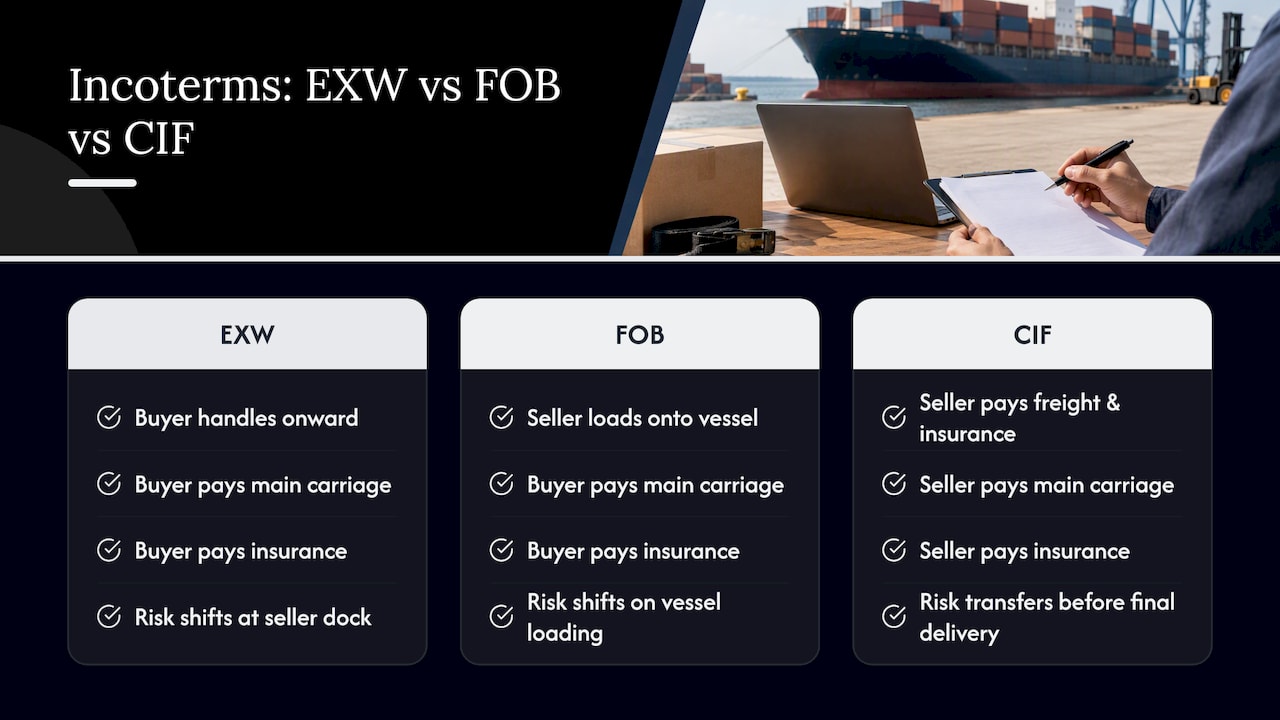
Because Incoterms govern cost and risk allocation rather than the underlying sales agreement, they work alongside a contract of sale rather than replacing it. Getting the Incoterm wrong on a purchase order can leave a buyer unexpectedly on the hook for ocean freight, insurance, or destination customs clearance they assumed the seller was covering, which makes confirming the term in writing before goods ship worth the extra step.
Compliance terms you will see on every international shipment
Customs clearance is the formal process of getting goods legally admitted into a country, involving document review, duty assessment, and sometimes physical inspection before cargo releases to the importer. An import license or export license is government authorization required for specific regulated goods, and requirements vary significantly by product category and destination country, so confirming licensing needs before shipping avoids delays at the border.
A Harmonized System (HS) code is a standardized numerical classification assigned to traded goods, used worldwide to determine duty rates and track trade statistics, and getting the code wrong can trigger incorrect duty assessments or customs holds. Related to HS codes, a certificate of origin documents where goods were manufactured, which matters for preferential duty treatment under trade agreements.
For FDA-regulated products, additional documentation and prior notice requirements apply before goods can clear at a U.S. port, a process distinct from standard customs entry. Shippers moving regulated commodities, food, cosmetics, or medical devices among them, should confirm those requirements well before freight departs rather than discovering them at the border.
Accurate classification and licensing paperwork protect against the two most common compliance failures: incorrect duty payment and shipment holds pending additional documentation. Both cost time and money that proper upfront documentation avoids entirely.
How tracking and visibility technology talks about your shipment
Electronic Data Interchange (EDI) is the standardized digital format carriers, shippers, and customs systems use to exchange shipment data automatically, replacing manual paperwork with structured electronic messages that update in near real time. GPS tracking uses satellite positioning to report a vehicle or container’s location throughout transit, giving shippers visibility into where freight actually is versus where it was scheduled to be.
A transponder, often used interchangeably with tracking hardware in ocean and rail freight, transmits identifying and positional data that terminals and carriers use to monitor equipment movement. Milestone tracking refers to the practice of logging specific checkpoints, like “departed origin facility” or “arrived at port,” rather than continuous location data, which is common in less technologically integrated parts of the supply chain.
Application programming interfaces (APIs) increasingly connect shipper systems directly to carrier and forwarder platforms, pulling tracking updates automatically rather than requiring manual status checks. For shippers managing multiple carriers, this kind of integration matters more as shipment volume grows, since manually checking status across several providers does not scale.
Visibility terminology matters less for the technology itself and more for what it tells you to expect: a shipment tracked only by milestone updates will show less granular detail than one with continuous GPS reporting, and setting expectations accordingly avoids unnecessary follow-up calls to a carrier that simply has not reached the next checkpoint yet.
Who pays and when: freight payment terms explained
Prepaid and collect describe who pays the carrier directly. Under prepaid terms, the shipper pays freight charges before or at pickup, while under collect terms, the receiver pays upon delivery, and the choice is typically set by whichever party controls the shipping arrangement under the governing Incoterm or purchase agreement.
Demurrage, covered earlier in the context of container terminals, is fundamentally a billing term: it charges for a resource, port space, held beyond its allotted free time, and failing to track free time windows is one of the more avoidable costs in international shipping. Detention operates on the same logic for equipment held at a shipper or receiver’s facility rather than at a port.
Freight bill audit refers to the practice of reviewing carrier invoices against the original rate quote and accessorial charges actually incurred, catching billing errors before payment rather than after. Net terms describe the payment window a carrier or forwarder extends, commonly 30 days, within which an invoice must be paid without penalty.
Understanding who pays, and when, prevents the kind of billing surprises that strain a shipper-carrier relationship over what often amounts to a documentation gap rather than a genuine dispute over service.
Why getting the terminology right actually matters
The cost of a misunderstood freight term rarely shows up where you would expect it. It shows up three weeks later, when a claim gets denied because the BOL described “machinery parts” instead of the specific commodity that determines liability coverage, or when a shipment gets reclassified mid-transit because the original class filed with the carrier did not match the freight’s actual density.
Most disputes we see trace back to a handful of avoidable gaps: a vague commodity description, an unconfirmed Incoterm, or a declared value that was never actually verified against the goods. None of those require specialized knowledge to fix, just the discipline to use the correct term, consistently, from quote to delivery.
— Ian
How we help put these terms into practice
Knowing the vocabulary is the first step; applying it correctly across customs paperwork, ocean bookings, and carrier contracts is where most shippers want support. Our International Logistics Services cover the services referenced throughout this glossary, from licensed U.S. customs brokerage to cargo insurance that closes the gap left by standard carrier liability.
- Customs brokerage for accurate HS code classification and formal entry filing.
- Ocean transportation, including FCL and LCL booking, matched to your actual volume.
- Cargo insurance covering full value when released value liability would not.
Request a freight quote to see how these services apply to your next shipment.
FAQ
What are common freight terms?
Common freight terms include bill of lading, proof of delivery, freight class, line haul, accessorial charges, and Incoterms, each defined in detail in the FHWA freight glossary. These terms describe the documents, pricing structure, and risk allocation involved in moving freight from origin to destination.
What is LCL and FCL in shipping terms?
FCL (full container load) means one shipper books an entire ocean container, while LCL (less-than-container load) means multiple shippers share space in one container. FCL tends to suit larger, higher-volume shipments, while LCL suits smaller shipments where splitting container costs is more economical than booking a full box.
What are the 11 Incoterms in shipping?
Incoterms are 11 rules published by the International Chamber of Commerce that define buyer and seller responsibility for cost, risk, and tasks during international shipment, as outlined in trade.gov’s Incoterms guide. They include terms like EXW, FOB, and CIF, each assigning a different point where risk and cost transfer from seller to buyer.
What is the vocabulary of freight?
Freight vocabulary spans shipment types (LTL, FTL, FCL, LCL), legal documents (bill of lading, proof of delivery, commercial invoice), pricing terms (freight class, line haul, accessorials), and compliance terms (customs clearance, HS codes), all defined with authoritative detail in the FMCSA glossary. Together, these terms describe how freight is classified, priced, documented, and moved across modes.